Homepage Site Search
Copyrighted Material—All Rights Reserved

Geography Index
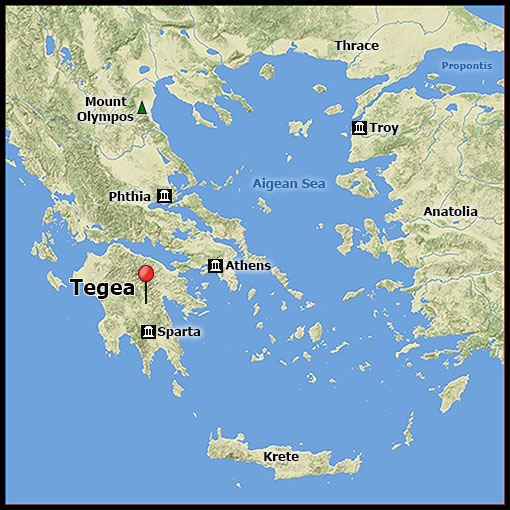
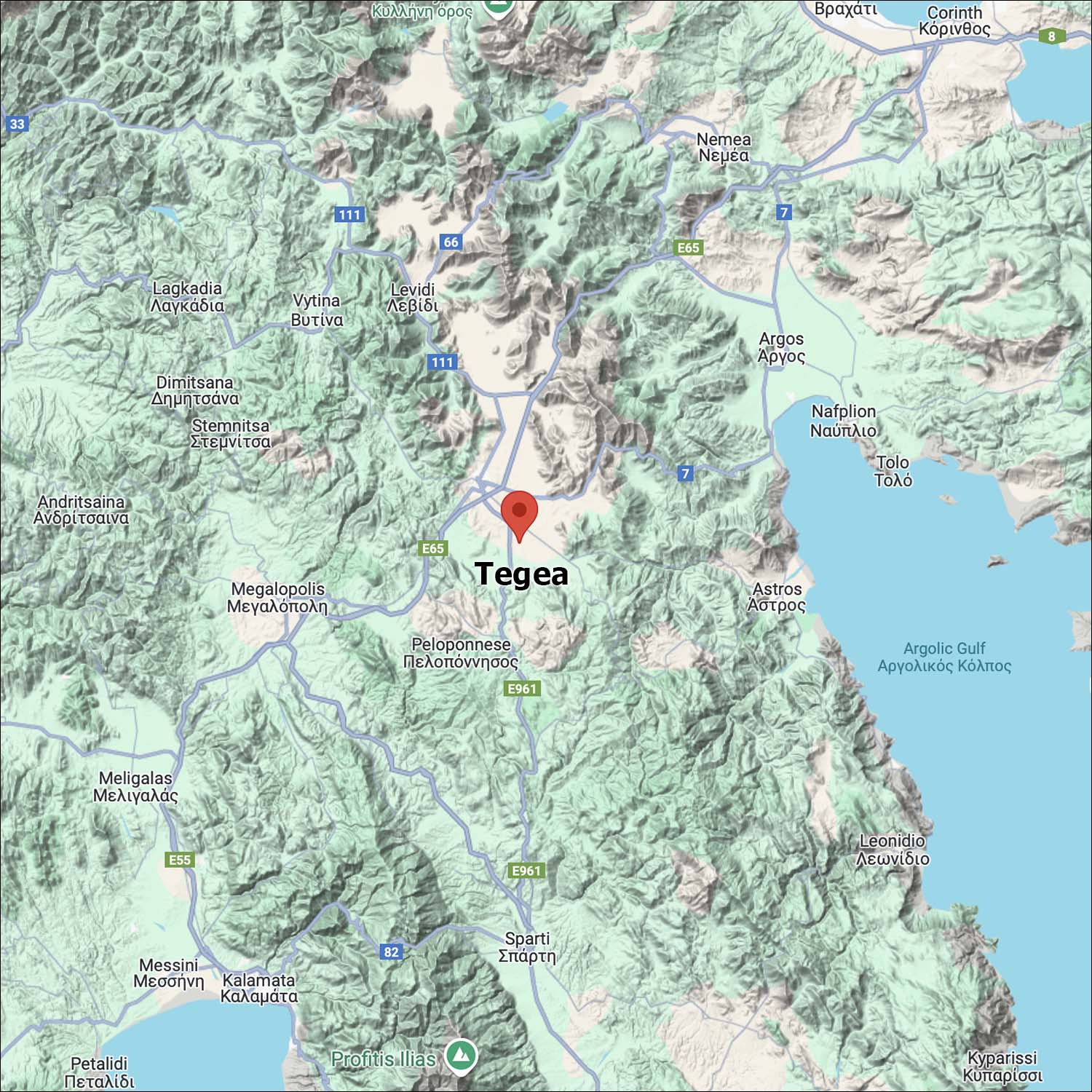
A city in Arkadia (Arcadia).
The history of Tegea essentially began with King Aleus, son of Apheidas. Aleus built a sanctuary and temple to the goddess Athene (Athena) Alea and made Tegea the capital of his kingdom. He had three sons, Amphidamas, Kepheos (Cepheus), and Lykurgos (Lycurgus) and one daughter, Auge.
Amphidamas, Kepheos, and Lykurgos' son Ankaios (Ancaeus) were selected to accompany Ieson (Jason) on the Quest for the Golden Fleece. Aleus did not want his grandson Ankaios to go on the Quest and to prevent him from joining the Argonauts, Aleus hid Ankaios' armor. Undaunted, Ankaios dressed himself in the hide of a bear from nearby Mount Mainalos (Maenalus) and, armed with a double-edged ax, joined the Argonauts.
The Quest for the Golden Fleece occurred circa 1300 BCE, approximately two generations before the Trojan War. The Golden Fleece was from a flying ram created by the god Helios and Nephele, a woman molded from clouds by the god Zeus. Possession of the Fleece imparted divine approval to the bearer. King Pelias of Iolkos (Iolcus) challenged his nephew Ieson (Jason) to retrieve the Golden Fleece from Kolchis (Colchis) at the eastern edge of Pontus (the Black Sea).
Ieson accepted the challenge and with the assistance of the goddesses Athene (Athena) and Hera, assembled a magnificent crew of heroes and built the Argo—the finest ship to ever sail the ancient seas. The crewmembers of the Argo were called Argonauts—Argo Seamen. Ankaios was a muscular man and earned a seat across from Herakles (Heracles) because they were the most powerful rowers on the Argo.
Returning safely from the Quest for the Golden Fleece, Ankaios participated in the Kalydonian (Calydonian) Hunt. One generation before the Trojan War (circa 1270 BCE), King Oineus of Kalydon (Calydon) offended the goddess Artemis and the resulting punishment became the backdrop for one of the most important events in the ancient world—the Kalydonian (Calydonian) Hunt. After reaping an excellent crop of grain, Oineus offered sacrifices to all the Immortals except Artemis. As punishment for the oversight, Artemis sent a savage boar to ravage Kalydon ... it became known as the Kalydonian Boar. The hunt for the boar was led by Oineus' son Meleagros (Meleager). There were several fatalities during the hunt, including Ankaios, and several more in the aftermath, including Meleagros.
Aleus' daughter Auge secretly became the consort of Herakles. When Aleus discovered Auge was pregnant, he banished her. By one means or another, Auge became the wife of Teuthras, lord of Kaikos (Caicus) in Asia Minor.
After Aleus died, his eldest son Lykurgos assumed the throne of Tegea. Lykurgos proved his worthiness by defeating Areithous, known as the mace-man. In battle, Areithous was considered to be unbeatable because he wore armor given to him by Ares, god of war. Lykurgos lured Areithous into a narrow passage where swinging his mace was impractical. Lykurgos killed Areithous and took his armor. Lykurgos had no surviving sons so when he died he gave Areithous' armor to his attendant, Ereuthalion. Nestor of Pylos (Pylus) fought and killed Ereuthalion. Nestor said Ereuthalion was the largest man he had ever fought. While relating the story of his fight with Ereuthalion, Nestor neglected to say what became of Areithous' armor.
Circa 1240 BCE, the Achaian (Achaean) Greeks attacked the city of Troy in Asia Minor on the northeastern coast of the Aigean (Aegean) Sea. The Trojans and their allies were also Greeks. The war lasted ten years and resulted in the utter destruction of Troy and the death or enslavement of the entire Trojan population—men women and children. The story of the Trojan War was recorded in the poems, The Iliad and The Odyssey, by the poet Homer.
During the Trojan War, Agapenor mustered Achaian (Achaean) soldiers from sites throughout Arkadia including—Tegea, Enispe, Mantinea (Mantineia), Orchomenos, Parrhasia, Pheneos, Rhipe, Stratie (Stratia), Stymphalos (Stymphalus), and the slopes of Mount Kyllene (Cyllene).
The daughters of Leda and King Tyndareus of Sparta were cursed by Aphrodite, goddess of love. Helen deserted her Spartan husband Menelaos (Menelaus) and became Helen of Troy. Klytemnestra (Clytemnestra) murdered her husband Agamemnon after his victorious return from Troy. Timandra married Echemus of Tegea and eventually deserted him.
Latitude North, Longitude East
37.4553, 22.4206
| References: Homer, Iliad book 2, line 607 Strabo, Geography book 8.8.2 Apollonius of Rhodes, Argonautica book 1, lines 161–171; book 1, Line 398 Pausanias, Description of Greece Phocis, Ozolian Locri; Arcadia Herodotos, The Histories book 1.67–68 Hesiod, Catalogue of Women 19 |