Homepage Site Search
Copyrighted Material—All Rights Reserved

Geography Index
The primary city of Lakedaimon (Lacedaemon).
During the Trojan War, Menelaos (Menelaus), co-commander of the Achaian (Achaean) army, mustered soldiers from the Lakedaimon cities of Sparta, Amyklai (Amyclae), Augeiai (Augeiae), Bryseiai (Bryseiae), Helos, Laas, Messe, Oitylos (Oetylus), and Pharis. Lakedaimon is an acceptable name for the city of Sparta and the surrounding territory.
The god Zeus taunted his sister-wife Hera by saying he would allow the Achaians to destroy Troy if she would allow him to obliterate one of her favorite Achaian cities. She readily agreed, including Sparta as a potential site for Zeus' revenge.
Latitude North, Longitude East
37.0818, 22.4246
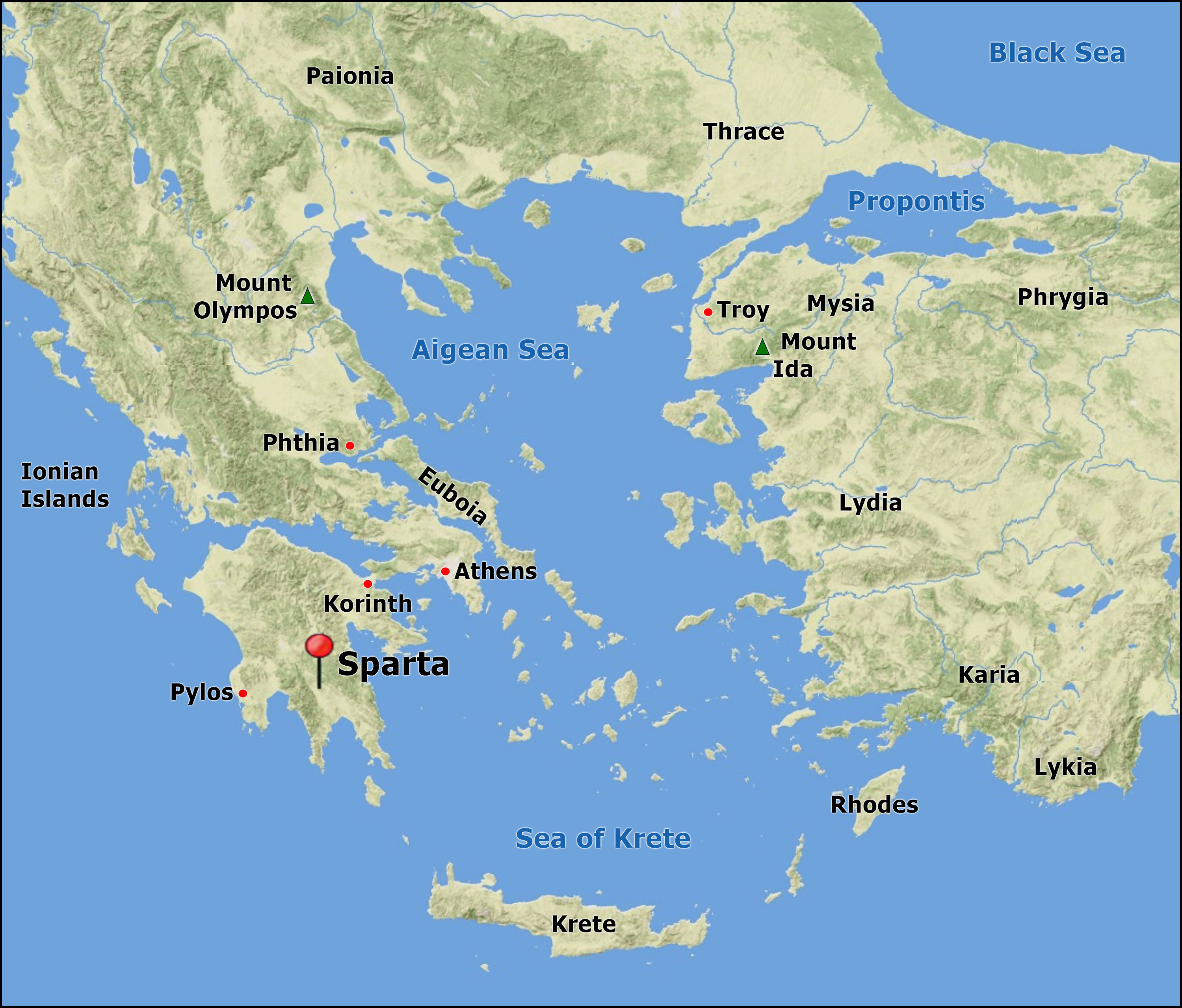
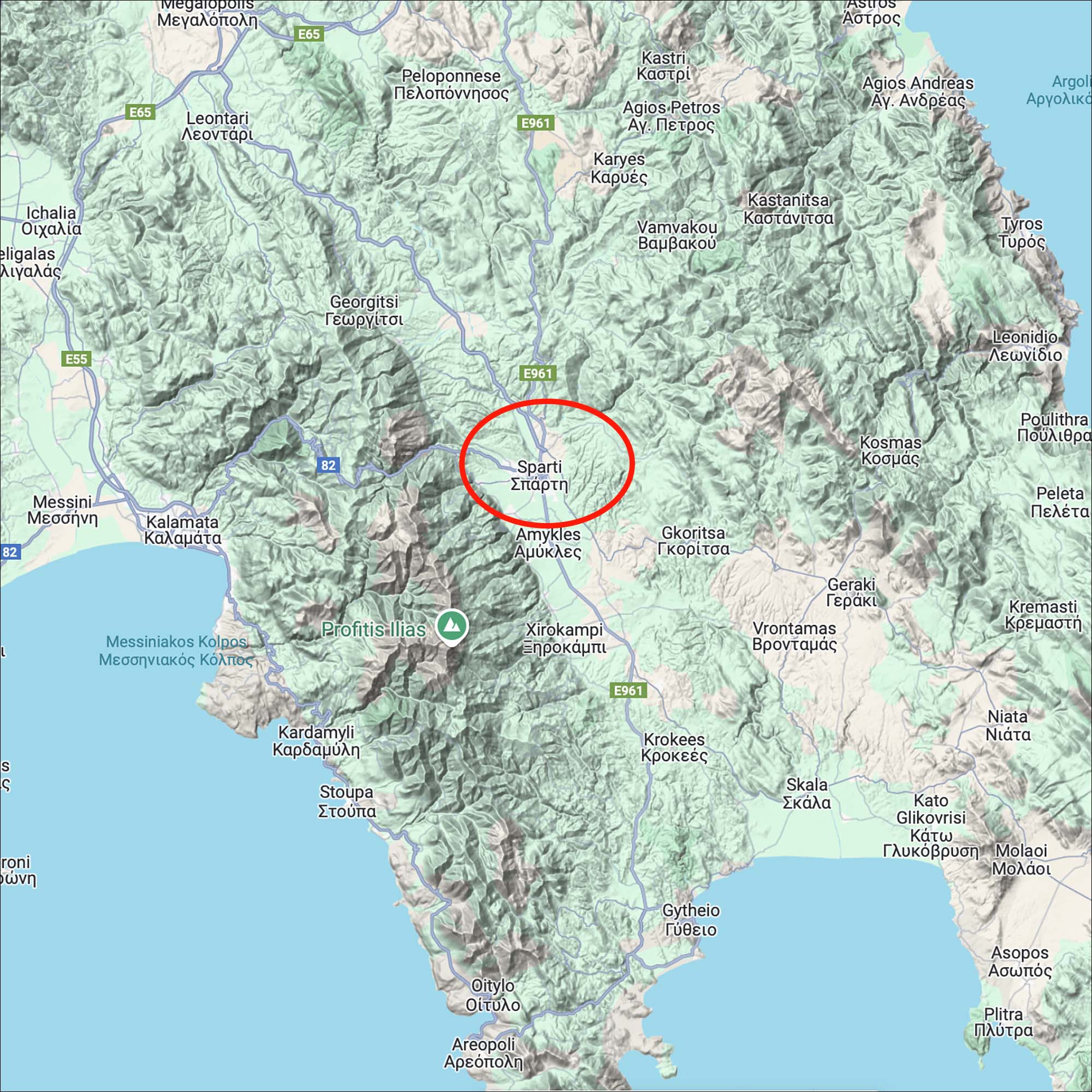
The foundations of Sparta and the culture typified by the Spartan ideals (frugality and simplicity), are considered to be prehistorical and therefore mythological. The Spartans did not enter the historical record until their subjugation of the town Aigys (Aegys) in northern Lakonia (Loconia) circa 750–740 BCE. However, we know Sparta was a vital and very real place at the time of the Trojan War, circa 1250 BCE.
According to the annals of prehistory, the territory surrounding Sparta was originally ruled by an aboriginal king named Lelex, his subjects were called Leleges. Eurotas, the son (or grandson) of Lelex, and a Naiad Nymph named Kleocharia (Cleocharia), transformed the swampy landscape into a habitable area by digging a trench and draining away the stagnant water to the sea. The waterway thus formed was named after Eurotas, which consequently means Fair-Flowing.
Having no son, Eurotas left his kingdom to Lakedaemon (Lacedaemon), a son of the god Zeus and a woman named Taygete. Lakedaemon married Eurotas' daughter Sparta and named the territory after himself and the primary city after his wife. He named the nearby mountain after his mother Taygete, Mount Taygetos.
When Lakedaemon died, the throne was passed down through his descendants—Amyklas (Amyclas), Aigalus, Kynortas (Cynortas) and then to Oebalus. The succession became muddled at that point.
After taking the city of Pylos (Pylus) Herakles (Heracles) turned his attention to Sparta. Herakles had a grudge against Spartan King Hippokoon (Hippocoon) for two reasons: 1) Hippokoon sided with King Neleus when Herakles attacked Pylos. Herakles brother Iphikles (Iphicles) was killed in the battle for Pylos. 2) Hippokoon's sons murdered a friend of Herakles named Oeonus, son of Likymnios (Licymnius). Oeonus angered Hippokoon's sons when he threw a stone at their fierce dog. This wasn't just any dog, it was a hound of the Molossian breed, which was used by the Greeks as a guard dog and by the Romans as a war dog. Hippokoon's sons beat Oeonus to death.
Hippokoon's claim to the throne of Sparta was questionable. According to the traveler/historian Pausanias, King Oebalus of Sparta had three sons—Hippokoon, Tyndareus, and Ikarios (Icarius). Tyndareus and Ikarios were born to Oebalus' legal wife, Gorgophone, a daughter of Perseus. Hippokoon was the eldest but was not considered to be a legitimate heir to the kingship. Regardless, Hippokoon usurped the throne and exiled Tyndareus and Ikarios.
Herakles killed Hippokoon and his numerous sons and installed Tyndareus as king of Sparta on the condition that Tyndareus keep the kingdom safe for Herakles' descendants.
Tyndareus' children were of the generation of the Trojan War. Menelaos (Menelaus) married Tyndareus' de facto daughter Helen and became king of Sparta and the Lakedaemon territory, also called Lakonia (Laconia). Menelaos was co-commander of the Achaian (Achaean) army that went to Troy to retrieve Helen after she had been kidnapped by Trojan Prince Alexandros (Paris).
Although not considered to be a historical figure, a remarkable man named Lycurgus devised a social and governmental framework that regulated all aspects of Spartan life. His edicts were observed well into historical times. Lycurgus went to the Oracle at Delphi to consult the priestess for divine guidance. The god Apollon, speaking through his priestess, gave his approval to Lycurgus' new laws and the Spartans willingly incorporated Lycurgus' mandates into their daily lives.
Some of the more innovative laws were:
1) All currency was iron ... no gold or silver was allowed. This deterred grifters and opportunists because iron coins were essentially worthless.
2) No laws were written down. If a law was too complicated to understand or remember, it was a bad law.
3) Everyone ate at the communal table and shared the same simple food. There was no luxury or opulence.
4) Spartan kings led their armies into battle. They were literally at the front of the battle lines.
For a complete accounting of Lycurgus' innovations, I suggest Plutarch's Lives, Lycurgus.
The historical records include many examples of Spartan bravery and resolve. The fight against the Persian army at Thermopylae is perhaps most memorable. Several hundred Spartans and their allies fought to the death against an overwhelming number of Persians. The result of the battle was a foregone conclusion, but the Spartans would not retreat or surrender.
| References: Homer, Iliad book 2, line 582; book 4, line 52 Homer, Odyssey book 1, lines 93, 285; book 2, lines 214, 327, 359; book 4, line 10; book 11, line 460; book 13, line 412 Apollodorus, The Library III, 3, 4, 5 Pausanias, Description of Greece book 3 (Laconia) 1.1, 4; 12.3; 15.2, 3, 4, 5, 6, 7 Pausanias, Description of Greece book 4 (Messenia) 1.1 Diodorus of Sicily, Library of History book 4.5; 4.7 |