Homepage Site Search
Copyrighted Material—All Rights Reserved

Geography Index
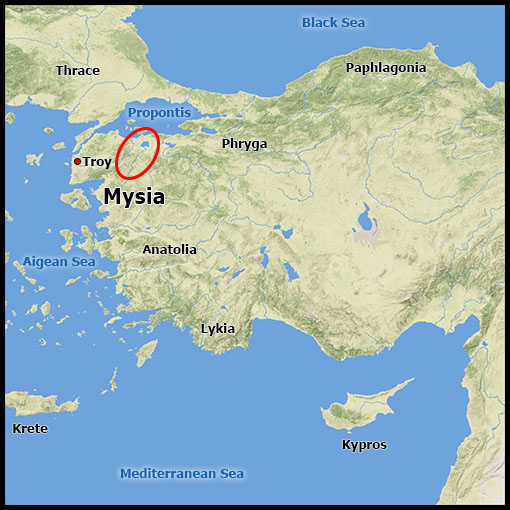
A geographic region in northern Anatolia.1
The boundaries and populations of Mysia varied over the centuries. At the time of the Trojan War (circa 1240 BCE) the Aisepos River defined the eastern border with the Propontis on the north, Lydia on the south and Phrygia on the west. Some historians considered Mysia the be a part of the Troad2 but Homer listed the Mysian soldiers as allies and not as Trojans.
The kidnapping of Helen, daughter of Spartan King Tyndareus, by Trojan Prince Alexandros (Paris) prompted the Achaian Greeks to attack Troy. It's interesting to note that it took 10 years for the Greek fleet to arrive at Troy. Mysia played an important part in the delayed attack.
It took four years for Helen's husband Menelaos and his brother Agamemnon to gather an army to attack Troy. They knew Troy was somewhere in northern Anatolia but did not know the city's exact location. They sailed between the island of Lesbos and the Troad and landed in Mysia. After a brief battle with the Mysians, the Greeks realized their mistake and sailed home to reconsider their options.
Six years elapsed before they found a guide to show them the location of Troy. The army was reassembled and the Trojan War officially began 10 years after Helen had been abducted.
Khromis and Ennomos commanded an undisclosed number of Trojan allies from Mysia. Hyrtios, son of Gyrtios, fought as part of the Mysian contingent, and was killed by Telamonian Aias.
1. Anatolia—corresponding essentially to modern-day Turkey.
2. Troad—the region surrounding Troy from the Aigean Sea to Mysia.
| Homer, Iliad Mysians: book 2, line 858 book 10, line 430 book 13, line 5 book 14, line 512 book 24, line 278 |