Homepage Site Search
Copyrighted Material—All Rights Reserved

Geography Index
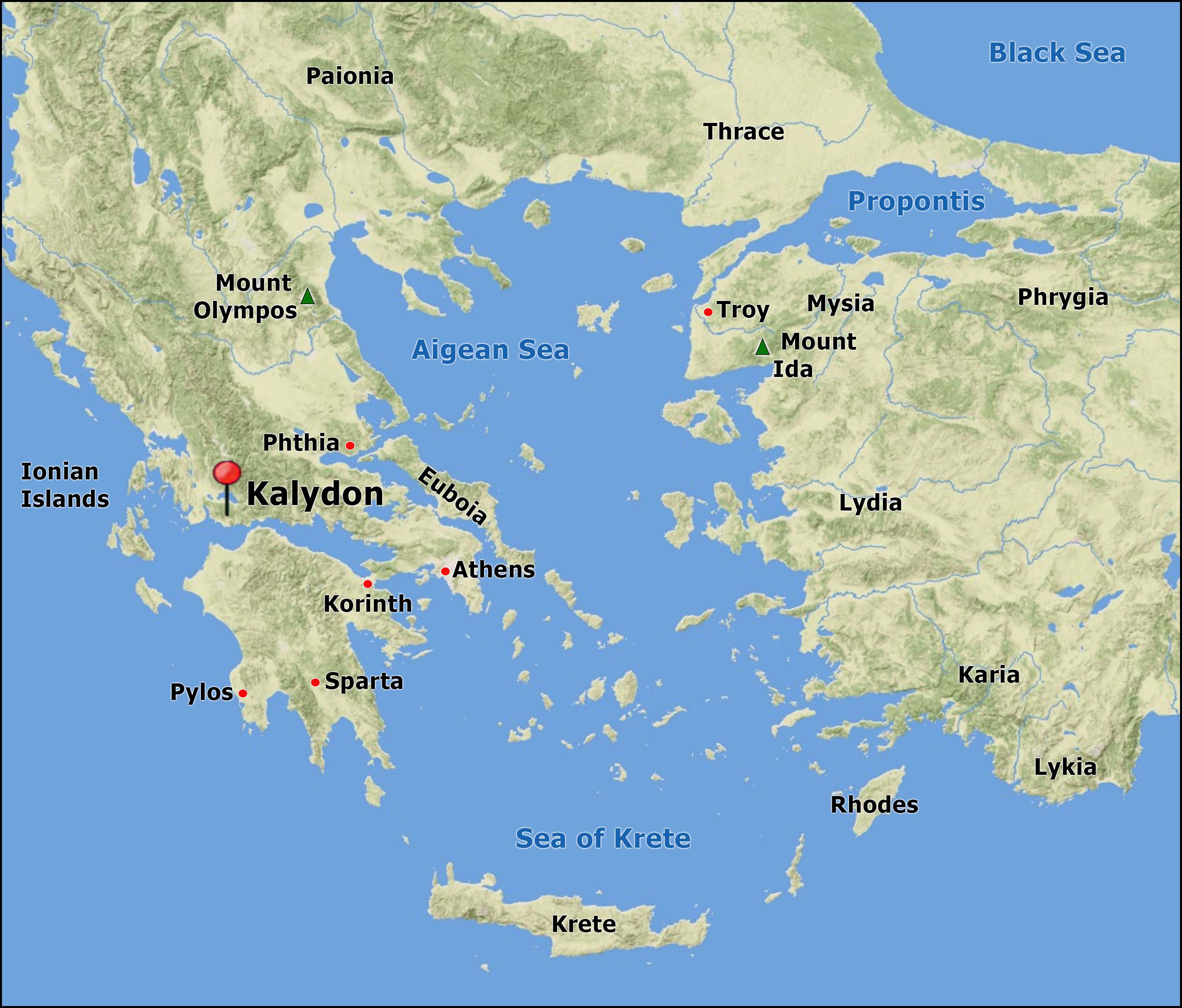
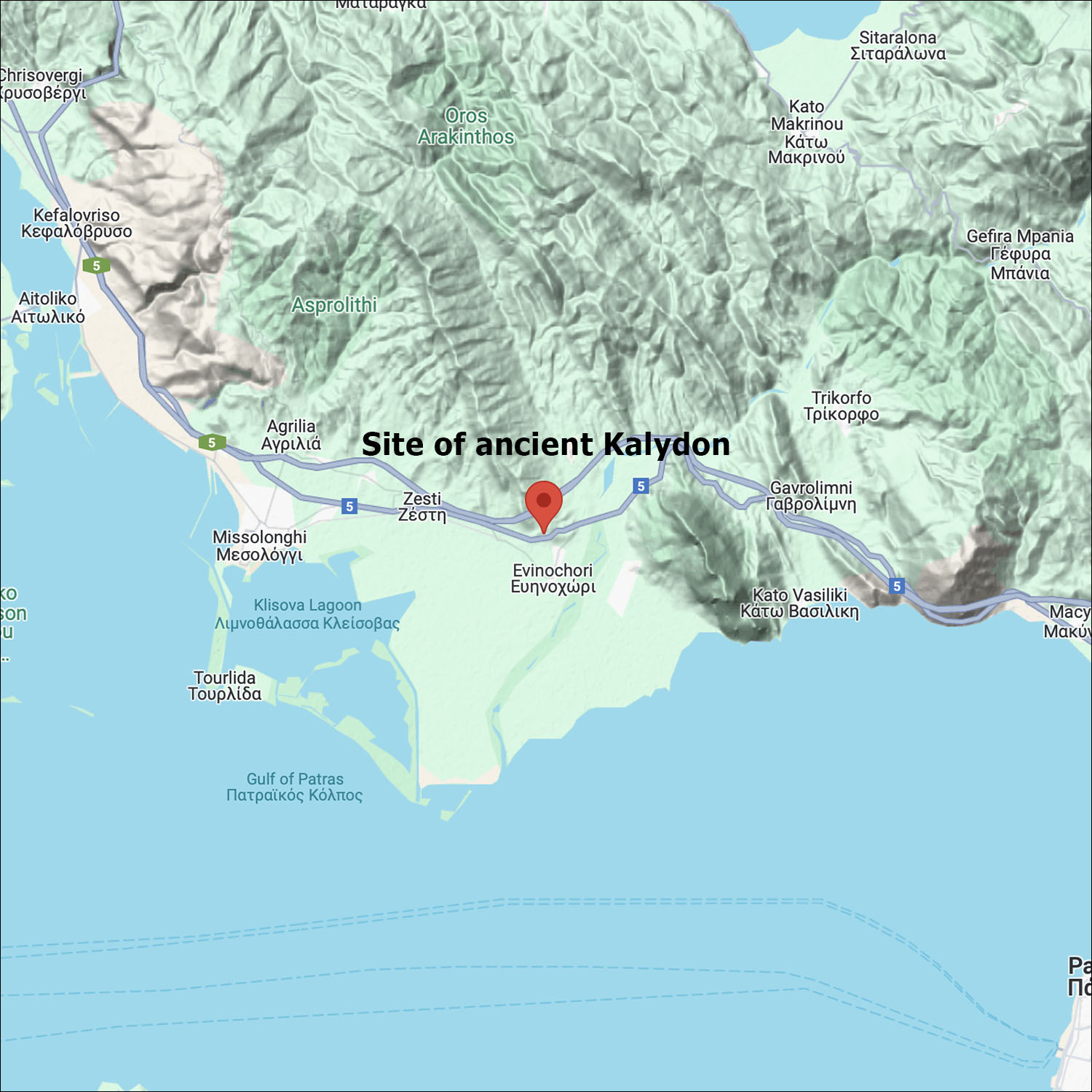
A city in Aitolia (Aetolia).
Kalydon was named after one of the sons of the eponymous founder of Aitolia, Aitolos (Aetolus). Kalydon's mother was Pronoe and his brother was Pleuron.
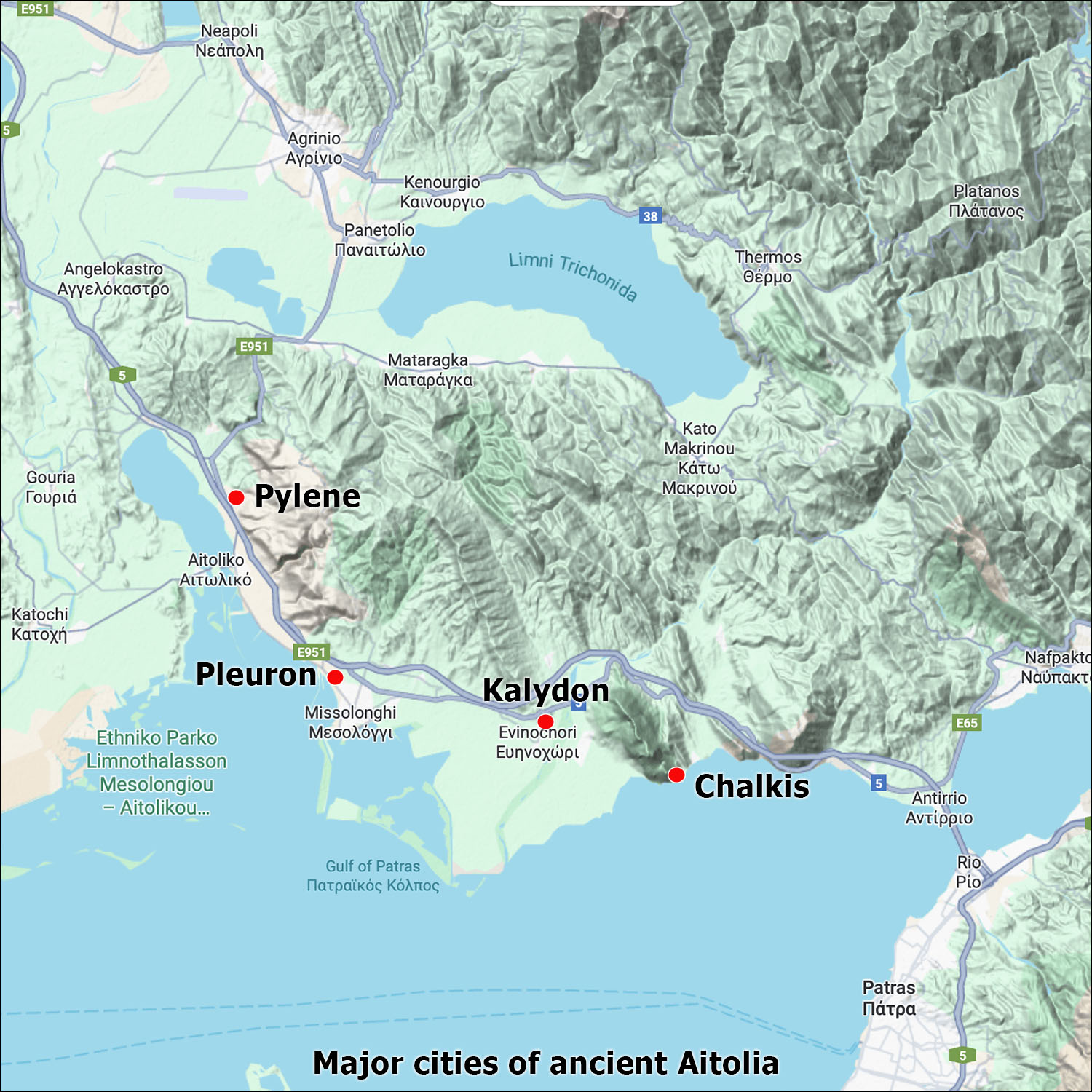
During the Trojan War, Thoas, son of Andraimon, commanded the Achaian (Achaean) soldiers from rocky Kalydon, Chalkis (Chalcis), Pleuron, Olenos, and Pylene.
The Achaian commander Diomedes traced his heritage back to a man named Portheus, who lived in Kalydon and Pleuron. The three sons of Portheus were—Oineus (Oeneus), Agrios, and Melas. Diomedes was the son of Tydeus, son of Oineus. Tydeus was forced to flee Aitolia because he murdered one or perhaps several people. He settled in Argos on the Peloponnesian Peninsula and passed his prosperous kingdom down to his son, Diomedes.
King Oineus of Kalydon was a colorful and memorable man. He married Althaia (Althaea), who was descended from Aitolos, the eponymous founder of Aitolia. Oineus killed their son Toxeus for nebulous reasons; Toxeus apparently "crossed the line" in some sort of symbolic or ethical way justifying his murder. The god Dionysos (Dionysus) gave Oineus the vine plant (wine) and mated with Oineus' wife Althaia to become the father of a daughter named, Deianira.
Two generations before the Trojan War, Oineus angered the goddess Artemis by neglecting her sacrifices and not offering her the first fruits of the harvest. Artemis sent a wild boar to terrorize the countryside and destroy Kalydon's orchards. This was no ordinary boar, it was of extraordinary size and strength. The rampaging boar prevented the Kalydonians from tending their fields and herds.
King Oineus assembled a group of outstanding men and one woman to hunt and kill the boar. He placed his son Meleagros (Meleager) in charge of the hunt. The expedition came to be known as the Kalydonian (Calydonian) Hunt.
| Participants of the Kalydonian Hunt according to Apollodorus: |
|---|
| Dryas, son of Ares, from Kalydon | Idas and Lynkeus (Lynceus), sons of Aphareus, from Messene |
| Kastor (Castor) and Polydeukes (Pollux), sons of Zeus and Leda, from Lakedaimon (Lacedaemon) | Theseus, son of Aegeus, from Athens |
| Admetos (Admetus), son of Pheres, from Pherai (Pherae) | Ankaios (Ancaeus) and Kepheus (Cepheus), sons of Lykurgos (Lycurgus), from Arkadia (Arcadia) |
| Ieson (Jason), son of Aeson, from Iolkos (Iolcus) | Iphikles (Iphicles), son of Amphitryon, from Thebes |
| Peirithoos (Pirithous), son of Ixion, from Larissa | Peleus, son of Aiakos (Aeacus), from Phthia |
| Telamon, son of Aiakos (Aeacus), from Salamis | Eurytion, son of Aktor (Actor), from Phthia |
| Atalanta, daughter of Schoeneus, from Arkadia (Arcadia) | Amphiaraus, son of Oikles (Oicles), from Argos |
| Iphiklos (Iphiclus), son of Thestius, from Kalydon | Euippos (Evippus), son of Thestius, from Kalydon |
| Plexippos (Plexippus), son of Thestius, from Kalydon | Eurypylos (Eurypylus), son of Thestius, from Kalydon |
Oineus entertained the hunters for nine days but when it came time to begin the hunt, Meleagros' uncles, brothers of his mother, did not want Atalanta to participate because she was a woman. Dismissing their objections, Meleagros compelled them to join the hunt. The adventure was not without incident; the boar killed two of the hunters and another man was killed by a mis-thrown javelin. Atalanta and one of Meleagros' uncles wounded the boar but Meleagros delivered the fatal blow. To the utter chagrin of his uncles, Meleagros awarded the boarhide to Atalanta. A confrontation ensued and in one way or another, Meleagros killed his uncles.
One version of the story has it that Meleagros killed his uncles as a direct result of their objections to award the boarhide to Atalanta. Another possibility is that the uncles returned to the area around Pleuron where their father, Thestius, ruled a tribe known as the Kuretes (Curetes). Rousing the Kuretes against the Kalydonians, the uncles were killed by Meleagros in the subsequent war. Regardless, Meleagros' mother Althaia employed a curse that had been placed on Meleagros by the Fates seven days after he was born. The Fates decreed that when the log in the fireplace was consumed, Meleagros would die. Althaia took the log from the fireplace and kept it hidden so Meleagros could have a long and happy life. Learning of the deaths of her brothers, Althaia placed the log back in the fireplace and Meleagros died. When the Trojan War started, Meleagros was already dead.
Latitude North, Longitude East
38.3729, 21.5331
| References: Homer, Iliad book 2, line 640 book 9, lines 530, 531, 577 book 13, line 217 book 14, line 116 Apollodorus, The Library 1.8 Strabo, Geography book 10.2.5 |