Homepage Site Search
Copyrighted Material—All Rights Reserved

Geography Index
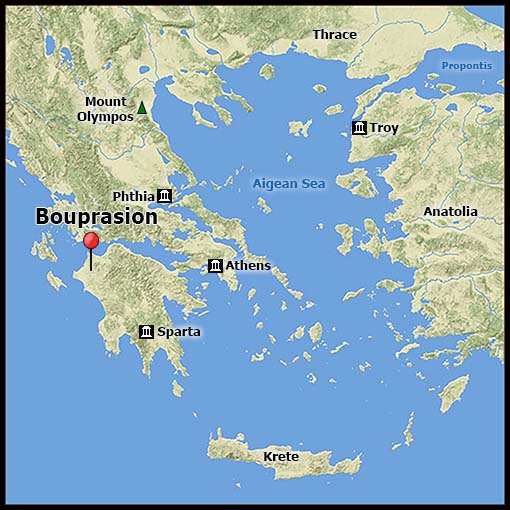
A city or territory in Elis.
When Homer spoke of Bouprasiun he was probably indicating a territory and the primary settlement of that territory. Homer differentiates between Elis and Bouprasiun but combines the two when describing the military commanders mustering troops for the Trojan War.
At the time of the geographer Strabo (first century BCE, Bouprasiun was no longer in existence. He speculated that the location of ancient Bouprasiun could be surmised using Elian landmarks like the road leading from the city of Elis to Dyme. Strabo suggested that just as the archaic name Epeians was replaced by Eleans, Bouprasiun came to be synonymous with Elis.
During the Trojan War, a total of forty ships from Bouprasion and Elis sailed to Troy. The Elean Achaians (Achaeans) were divided into four groups, each with a different commander.
As a young man, Nestor of Pylos attended the burial of King Amaryngkeus at Bouprasion. Nestor competed in the funeral games held in honor of Amaryngkeus and, with the exception of the chariot race, won every event.
Approximate Geographic Center
Latitude North, Longitude East
38.0195, 21.5182
| References: Homer, Iliad book 2, line 615 book 11, lines 756 and 760 book 23, line 631 Strabo, Geography book 8.3.8–10 book 8.3.29 book 8.3.32 book 8.7.5 |