Homepage Site Search
Copyrighted Material—All Rights Reserved

Geography Index
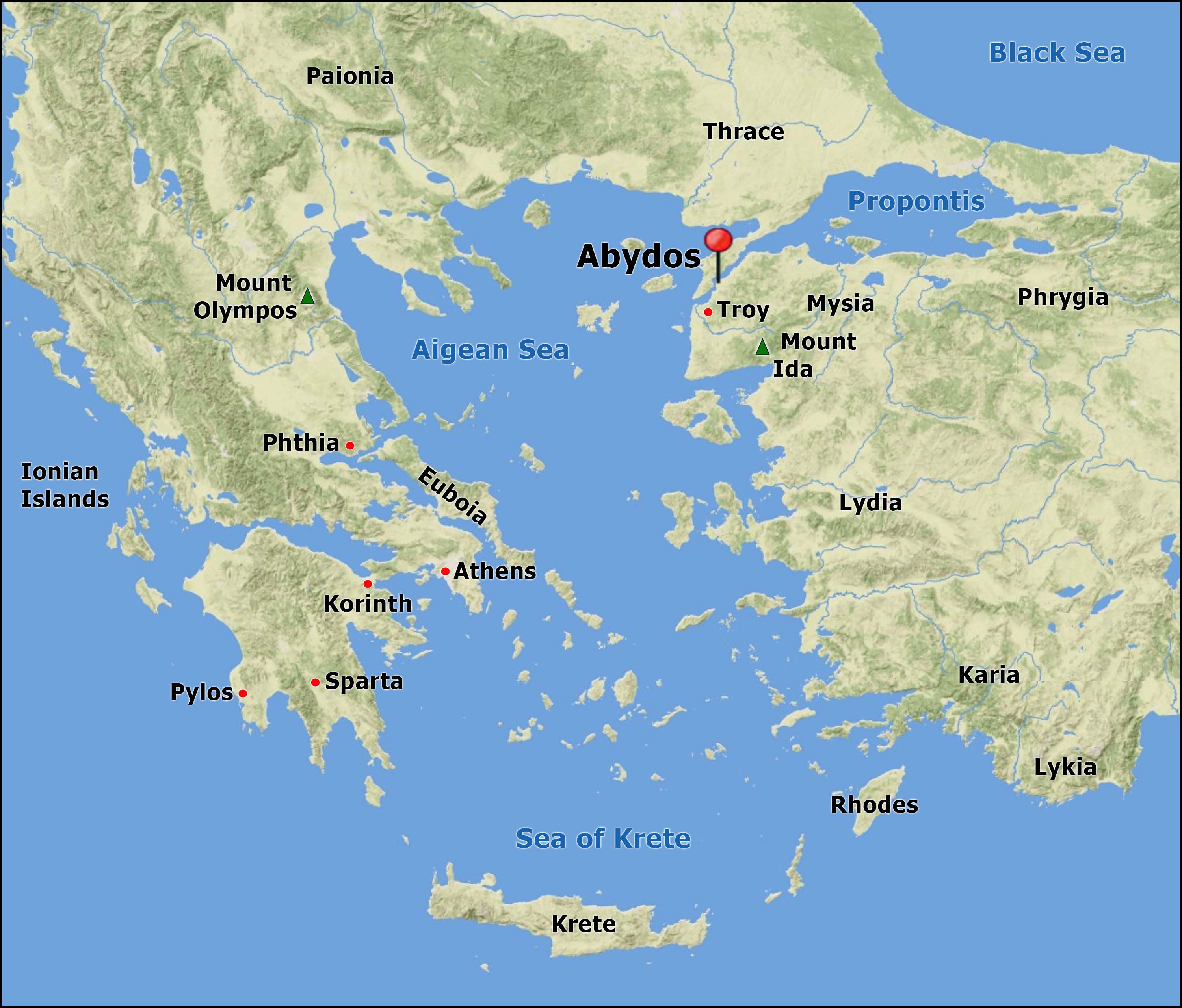
A city on the Asian side of the Hellespont.1
During the Trojan War, Asios (Asius) commanded an undisclosed number of Trojan soldiers from Abydos, Arisbe, Perkote (Percote), Sestos (Sestus), and the vicinity of the Selleeis (Selleïs) and Praktion (Practius) Rivers. Trojan King Priam's kingdom included the territories of the Hellespont. Inhabitants of Abydos were considered to be Trojans.
Demokoon (Democoon), a bastard son of King Priam, traveled from his home in Abydos to fight in the war at the request of his father.
Abydos was the home of a young man named Leander who was in love with a priestess of Aphrodite named Hero. Leander would regularly swim the channel at night in order to meet with Hero at the temple of Aphrodite on the shore just south of Sestos. Hero would use a lamp to guide Leander to the temple. One night he lost his way and drowned. This tale from antiquity inspired many young adventurers to swim the strait to duplicate Leander's feat. Perhaps the most famous crossing was made by Lord Byron on May 3rd, 1810 CE. The grueling 4 mile (6.4 km) swim took one hour and ten minute to swim from shore to shore.
There is a point of land jutting into the Hellespont from the European side of the waterway called Cape Sestias. It was at this spot, in 480 BCE, that Persian King Xerxes built a pontoon bridge by lashing ships together and crossing the Hellespont from Abydos to Cape Sestias.
Before he arrived at Abydos, Xerxes instructed the townspeople to construct a platform of stones on a hill so that he could stand atop it and survey the massive army and navy he had assembled for the invasion of Greece.
The other Greek cities of the Hellespont were required to supply soldiers and ships for Xerxes' invasion forces but the people of Abydos were ordered to stay at home and protect the pontoon bridge from attack. The bridge was not harmed by any enemy of the Great King but, when Xerxes retreated back to Abydos after his invasion of Greece had failed, the waves and wind had made the pontoon bridge unstable and unusable. Xerxes and his army crossed from Sestos to Abydos via ship.
When the people of Abydos and Sestos learned that the Greeks who had not allied themselves with the Persians were approaching the Hellespont, they dismantled the pontoon bridge and stored the gear at Sestos. When the Greeks arrived, they focused their attention on punishing the traitor-Greeks on the European side of the Hellespont and left Abydos alone.
Because of its strategic location, Abydos played a major role in the long and brutal Peloponnesian War (431–404 BCE). Many sea battles were fought in the narrow channel between Abydos and Sestos.
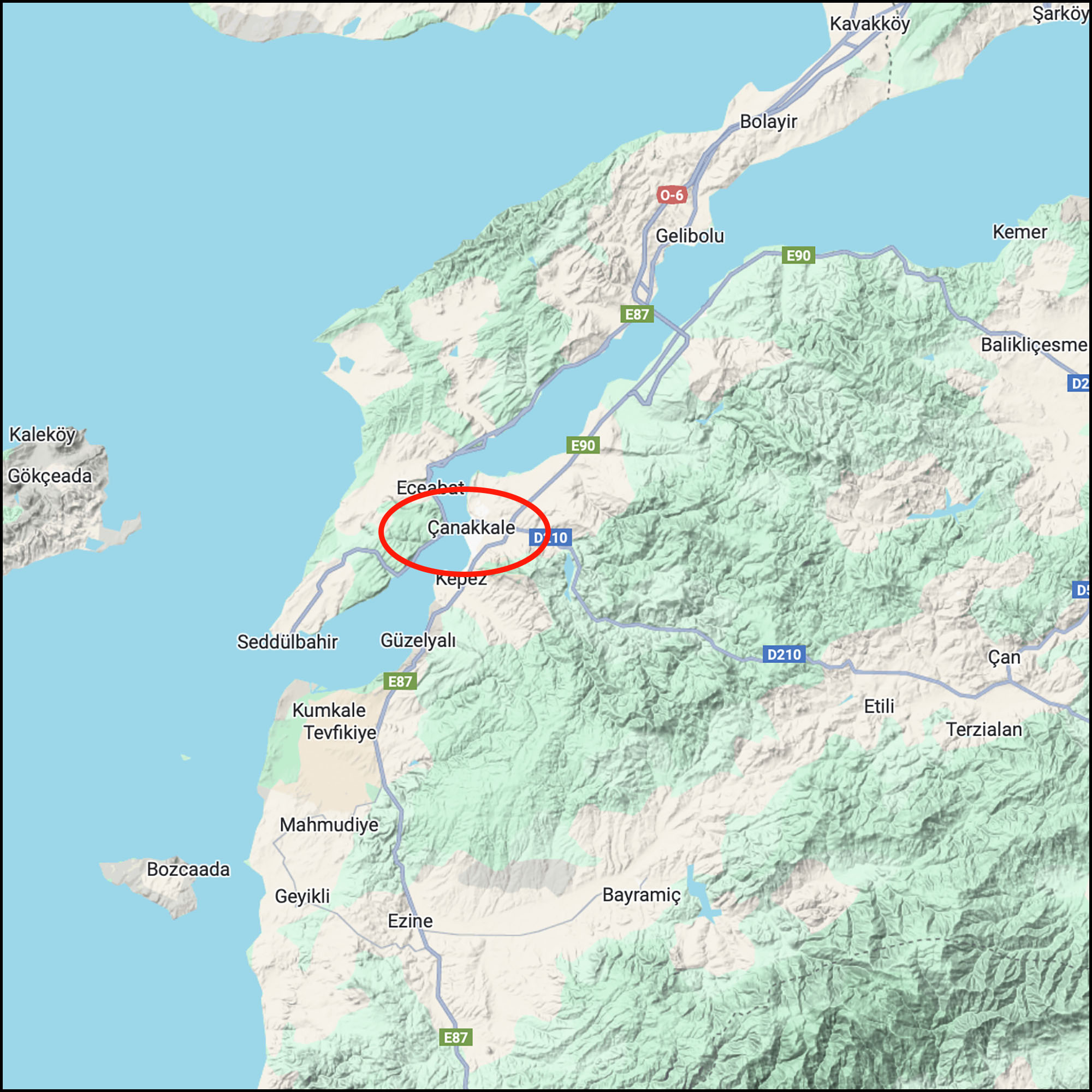
Abydos is now known as Canakkale, Turkey.
1. (Helle's Sea)—now associated with the Dardanelles, the narrow body of water separating Europe and Asia. The Hellespont of antiquity was undoubtably much larger and probably included the Propontis and a large portion of the northern Aigean (Aegean) Sea.
Latitude North, Longitude East
40.1942, 26.4113
| References: Homer, Iliad book 2, line 836 book 4, line 500 book 17, line 584 Herodotus, Histories book 5, chapter 117 book 7, chapters 33–37, 44–45, 95, 147 book 8, chapter 117 book 9, chapter 114 |