Homepage Site Search
Copyrighted Material—All Rights Reserved

Geography Index
A Greek city on the coast of Thrace, east of the river Nestos (Nestus).
The city was named after Abderus, a son of Hermes (the messenger god). The eighth labor of Herakles (Heracles) required him to go to Thrace and capture the mares of a cruel and vicious man named Diomedes. The mares ate human flesh and were an abomination. Herakles slew Diomedes and entrusted the horses to Abderus for safe keeping. The horses got away from Abderus and he was killed in his attempt to recapture them. Herakles erected a tomb for Abderus, which became the hallmark of a new city founded nearby, Abdera.
Abdera was first settled by a man named Timesias of Klazomenae (Clazomenae) in the mid-seventh century BCE; this attempt at colonization was not successful and Timesias and his followers were driven from Thrace by the native inhabitants.
As a result of the Persian invasion of Greece in 480 BCE, the Great King's general, Harpagus, assaulted the land of the Teians who lived in Ionia; the Teians fled to Thrace and re-established Abdera as a Greek city; of all the Ionians who were besieged by the Persians, the Teians were the only ones to flee the Great King's wrath; the other Ionians were reduced to slavery.
The city prospered and by 545 BCE had a protective wall, holy sanctuaries and a well equipped harbor; the city continued to grow and prosper until the Romans conquered the area; from that time on, the city declined into obscurity and finally became nothing more than a cemetery.
Abdera was the birthplace of the philosopher Demokritus (Democritus) and the sophist Protagoras; ironically, the inhabitants of the city were mocked for their inferior minds.
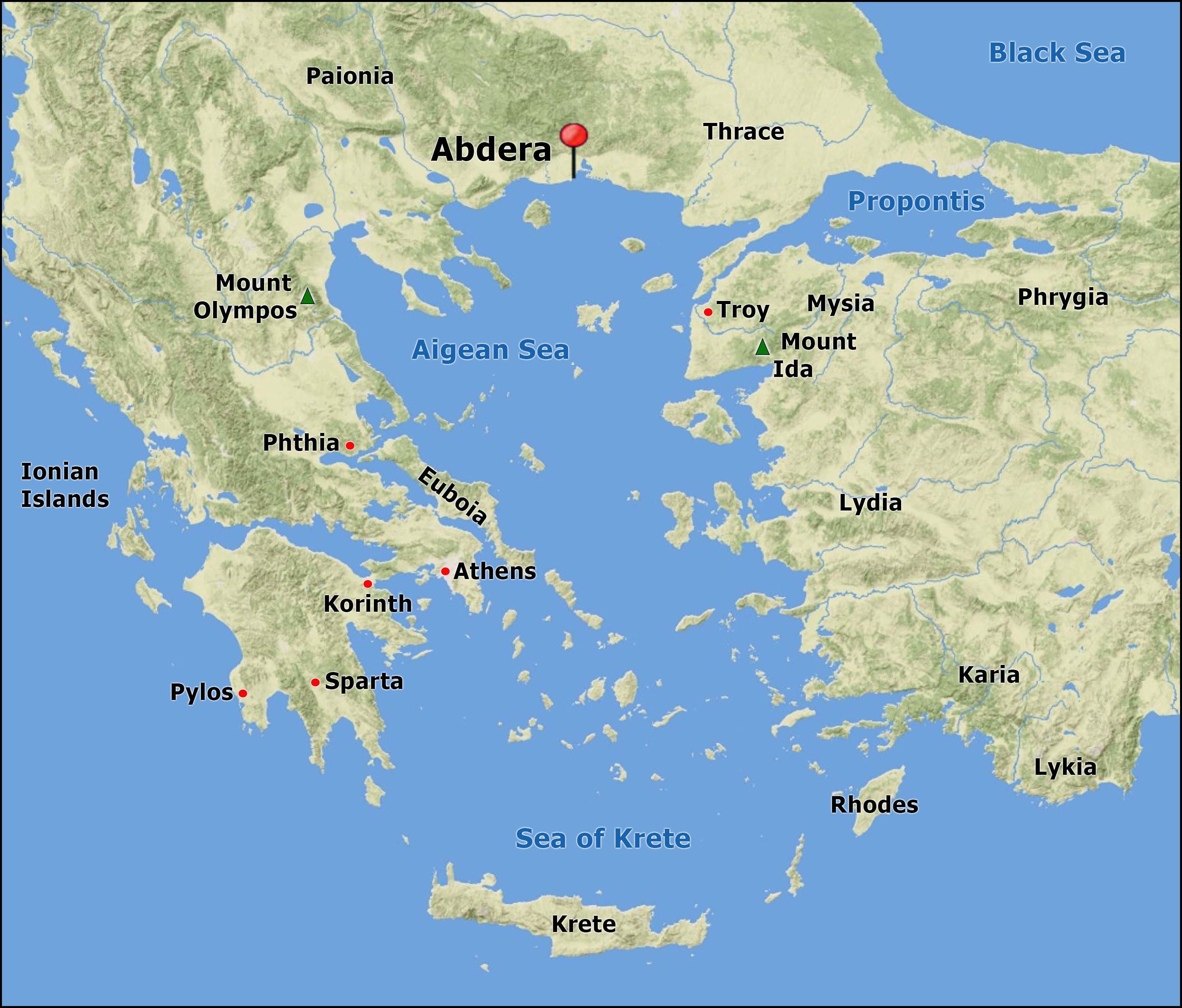

| References: Apollodorus, The Library II book 8 |