
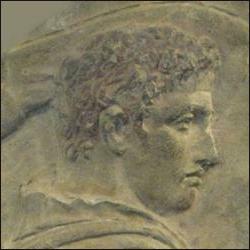
The life and exploits of Theseus are eclipsed only by those of Herakles. Whereas Herakles was the son of Zeus and thus semi-divine, Theseus was the son of mere mortals and yet managed to accomplish some truly amazing feats of physical strength as well as implementing innovative social reforms that transformed Athens and Attica into an enviable center of Greek culture.
As a man, Theseus was easy to admire ... he was a fearless adventurer, a dutiful son, a champion of the people and an innovative social reformer. As for his faults ... he was a notorious womanizer and guilty of kidnapping a young girl.
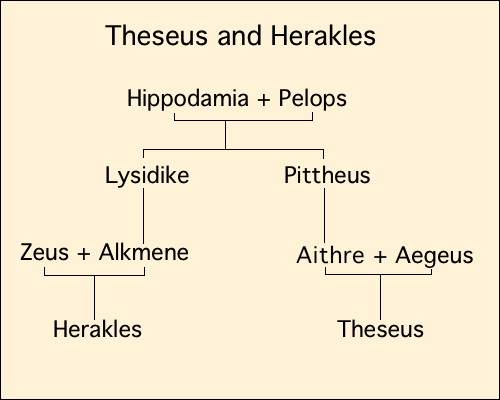
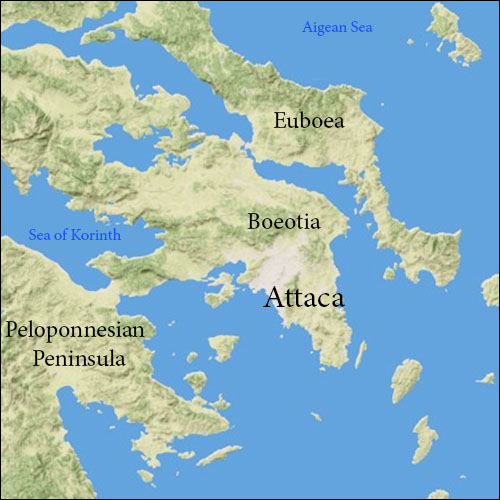
The noble and scandalous character of Theseus was shaped by the times in which he lived as well as the noble blood that coursed through his veins. King Aigeus of Athens was traveling on the Peloponnesian Peninsula and came to a small city named Troezen. The king had previously received an oracle from Delphi commanding him not to cavort with any woman until he returned to Athens but he thought the meaning of the oracle was ambiguous ... he told King Pittheus of Troezen about the oracle and asked what it might mean. Pittheus preyed on Aigeus's skepticism and convinced him to ignore the obvious message and share the bed of a local woman. It wasn't until later that Aigeus found out that "the local woman" was Princess Aithre, King Pittheus's daughter.
Aigeus suspected that he had impregnated Aithre and hoped their child would be a son ... he hid a sword and a pair of sandals under a large stone and told Aithre where they were concealed. His intention was that if their child was a son, Aithre was to show him where the tokens were hidden when he came to manhood ... if he could move the stone and remove the sword and sandals, Aithre was to send him to Athens ... she was also instructed to be as secretive as possible about her son's true identity. Aigeus had no heir and his brother Pallas had fifty eager sons who wanted to become the next king of Athens ... if they knew that Aigeus had a son, he would be in danger.
King Pittheus was also in on the secret ... when the boy was born, Pittheus let it be known that Poseidon (lord of the sea) was the father ... this was believable to the people of Troezen because Poseidon was their patron god. The boy was named Theseus, which was a play on the word Θέσις, referring to the items that were "placed" for the boy to find. King Pittheus and a man named Konnidas became the tutors of Theseus ... Konnidas was such a positive influence on young Theseus, he was honored in Athens for hundreds of years after Theseus's death.
It was the custom for boys approaching manhood to go to the temple of Apollon at Delphi and sheer off their hair as an offering to the god. When Theseus went to Delphi, he obeyed the spirit of the custom but only cut off the fore part of his hair ... this was such a unique and somewhat radical departure from the accepted custom that the place where it happened was called the Theseia and the hairstyle was called Theseis.
Long before Theseus was born, Aigeus returned to Athens and focused his attention on the day-to-day turmoil that had become his life ... his brother Pallas was a constant threat to his sovereignty ... to make his political situation even more tenuous, he had married the renowned sorceress Medeia after she murdered her children and fled, or had been chased from, Korinth. Aigeus apparently gave little thought to the happenings in Troezen.
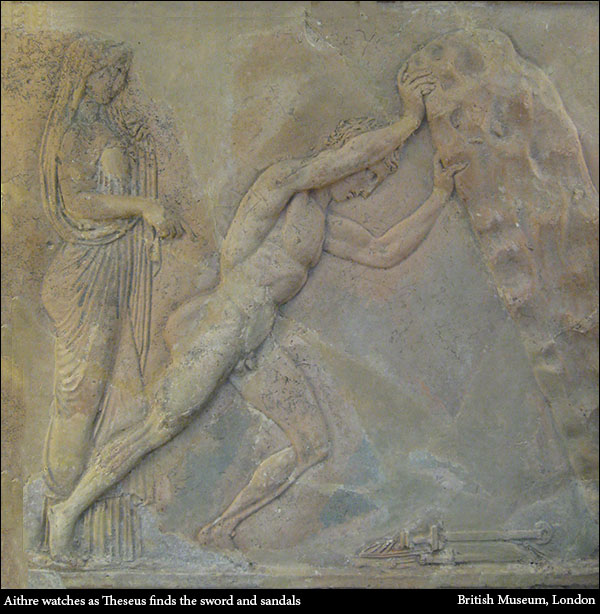
Theseus grew to manhood and his mother showed him where the sword and sandals were hidden ... such items were referred to as gnorismata, i.e., the token by which a lost child is identified. Theseus lifted the stone and removed the sword and sandals. He was told the identity of his father and he immediately started making plans to travel to Athens and claim his royal birthright.
Theseus's grandfather Pittheus urged him to go to the nearby seacoast and sail to Athens ... it would be a fast and safe way to travel ... he explained in detail about the robbers and brigands who infested the roads. Theseus was determined to take the overland route because he wanted to follow in the tradition of his cousin Herakles by confronting and eliminating villains as he traveled. It had been almost a generation since Herakles had wandered the countryside and it was time for a new hero to march forth and become a champion of the people.
Honor was preeminent in Theseus's mind ... he believed it would be dishonorable to his father's name to arrive at Athens with a sword that was unstained with blood and sandals that had not walked on the roads of Greece ... he swore to treat all men justly, but he would not hesitate to punish those who offered him violence. With such a philosophy and determination, Theseus set out for Athens.
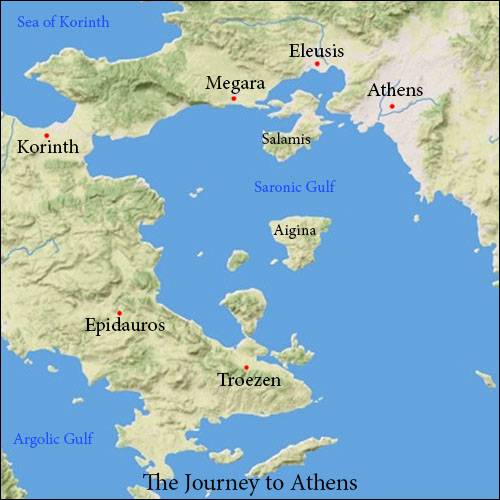

Traveling north from Troezen, Theseus came to Epidauros. The city of Epidauros was the cult-center for the divine healer Asklepios but it was also the home of a violent man named Periphetes ... known as the Club-Bearer.
Periphetes was a son of the god Hephaistos and contrary to the nature of his hardworking and productive father, Periphetes would attack and kill travelers with his bronze club. Theseus fought and killed Periphetes ... he kept Periphetes's club and carried it as a symbol of his invincibility ... it became a "trademark" just as the lion-skin became the symbol of Herakles after he killed the Nemean Lion ... people knew that the man with the bronze club was Theseus, the man who had mastered Periphetes.
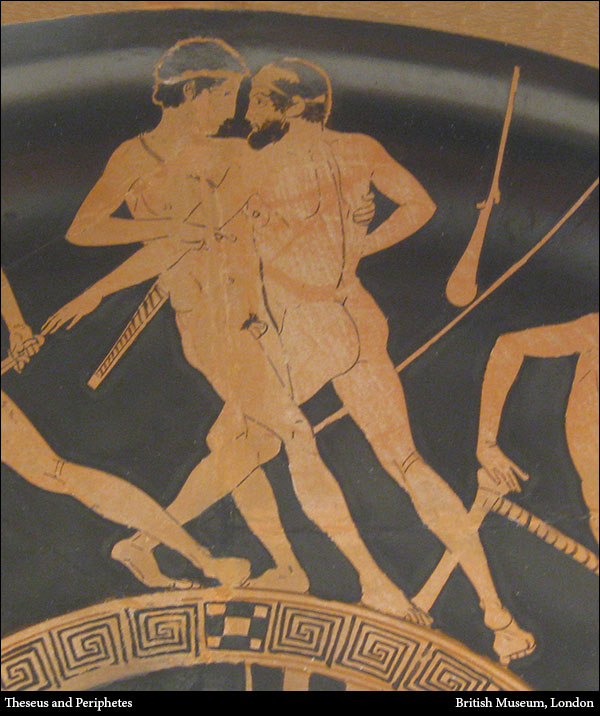
Theseus lived such a long time ago it should be no wonder that the details of his life have been lost or obscured ... his encounter with Phaia is an example of this confusion.
The town or district called Kromyon was the site of Theseus's second adventure after leaving Troezen. Located somewhere in Korinthian territory, Kromyon was the home of a scoundrel named Phaia, who owned a fierce sow also named Phaia ... sometimes referred to as the Krommyonian Sow or Crommyonian Sow.
Phaia was no ordinary sow ... she was the offspring of Ekhidna and Typhaon ... her parents were notorious serpent-creatures and there is every reason to assume that Phaia was like her parents in disposition and ferocity.
Although Phaia was potentially dangerous and conceivably a menace to travelers, it appears that Theseus killed the beast for sport rather than necessity ... he wanted to show that a brave man should occasionally risk his life in battle with "nobler beasts."
Another version of the killing of Phaia says she was not a "sow" in the literal sense ... she was a human female robber ... not just a thief, she was "a woman of murderous and unbridled spirit" ... she was called Sow because of her manners and lifestyle ... for those reasons, Theseus killed her.
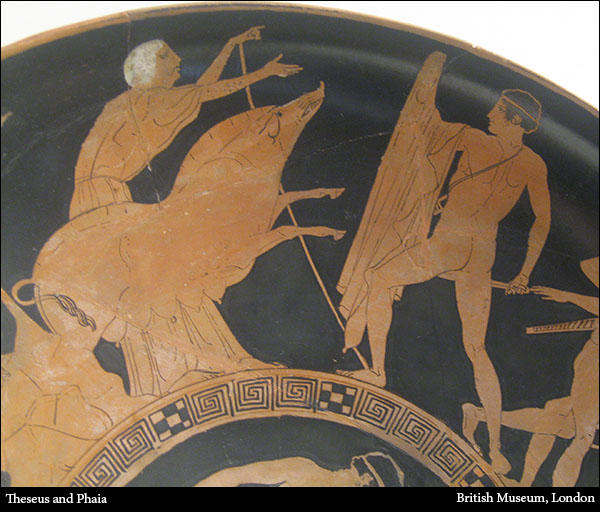
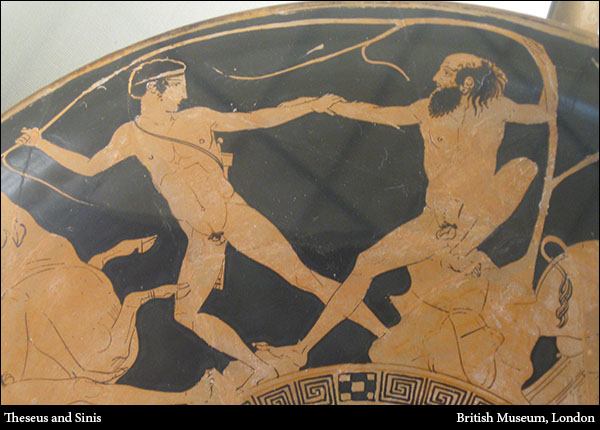
At the Isthmus of Korinth, Theseus met man named Sinis who was widely known as a brigand and brute. Some said Sinis was related to Theseus because Sinis was the son of Kanethos and Heniokhe, who was the daughter of Pittheus ... others said it was not Sinis who was the son of Kanethos and Heniokhe but rather another brute named Skiron.
Sinis was called the Pine-Bender because he would bend pine trees, tie travelers to the trees and then either hurl them to their deaths or rip them to shreds. The description of the way in which Sinis did these horrible things indicated that there was some sort of apparatus involved ... in other words, Sinis did not simply bend wild pine trees to do his dirty work, he apparently had a device that required a certain amount of skill to operate.
The details of the confrontation are lost to us but Theseus apparently killed Sinis with his own device, proving that "valor is superior to all device and practice." The story of Sinis did not end there ... Sinis had a beautiful and stately daughter named Perigune ... she saw Theseus kill her father and took flight. Theseus searched and found her hiding in a place abounding with shrubs, rushes, and wild asparagus ... in her childish simplicity, she prayed for the plants to protect her ... she promised to never trample or burn them if they would help her.
Theseus captured young Perigune and convinced her that he would not harm her ... she and Theseus became lovers and had a son named Melanippos. Theseus eventually entrusted Perigune to the care of Deioneus, the son of Eurytos. Melanippos had a son named Ioxus who helped found a colony in Karia in Asia Minor ... a group of men and women called the Ioxids honored Perigune's pledge to the reeds and wild asparagus by never burning them.
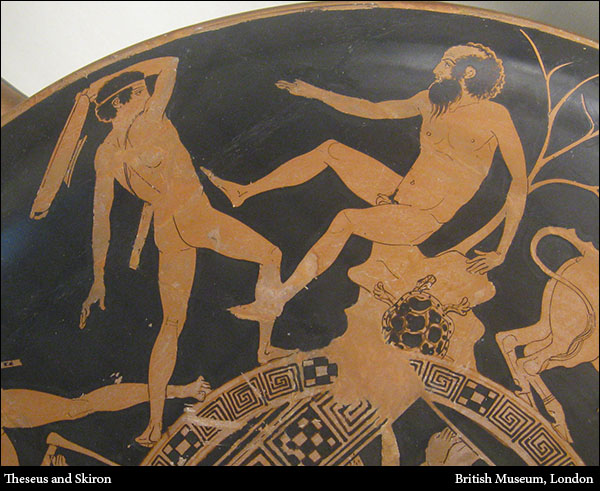
Between Korinth and Megara are a series of rocky outcroppings that are famous for several reasons. The "evil" stepmother of Phrixus and Helle was redeemed when she jumped into the sea and was transformed into the goddess Leukothea ... you might recall that Phrixus and Helle rode on the flying ram with the Golden Fleece to flee the machinations of Ino. Repenting her despicable behavior, Ino jumped into the sea at a place called the Molurian Rock ... it was considered to be a sacred place for that reason. Not far from the Molurian Rock was the haunt of a man named Skiron.
Skiron would waylay travelers, rob them and then force them to wash his feet ... after his prisoners were thoroughly humiliated, he would push them from the cliff to the rocky shore below ... if the fall did not kill the unfortunate victims, a flesh-eating sea-tortoise waiting on the rocks would seize them, making their deaths all the more painful. When Theseus arrived, Skiron thought he had another vagabond who could be robbed and killed ... Theseus turned the tables on Skiron and tossed him into the sea where he was attacked and killed by the sea-tortoise.
Writers from the nearby city of Magara later challenged that version of events ... they believed that Skiron was a relative of Theseus, being the son of Kanethos and Heniokhe, who was the daughter of Pittheus. They concluded that Skiron was from a good family and reasoned that nobility begets nobility. Their attempts to salvage the reputation of their fellow Magarian were noted but generally unsuccessful.
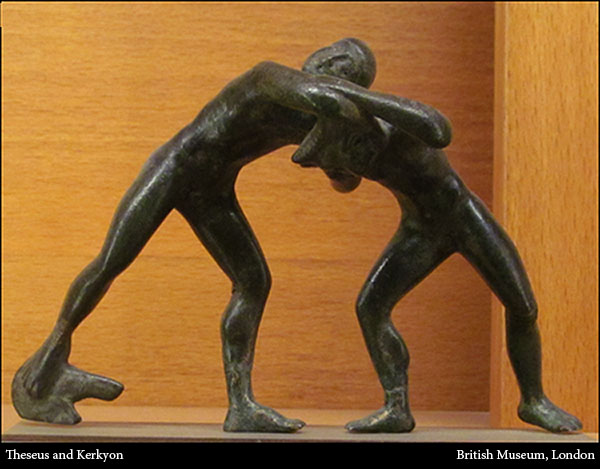
Theseus encountered Kerkyon the Arkadian at Eleusis, the sacred city of Demeter and Persephone. To prove the validity of his reputation as a formidable wrestler, Kerkyon challenged Theseus to a match. No one had ever survived a wrestling match with Kerkyon because of his imposing physical strength but Theseus willingly agreed to fight. He wrestled Kerkyon to the ground and then proceeded to beat him to death.
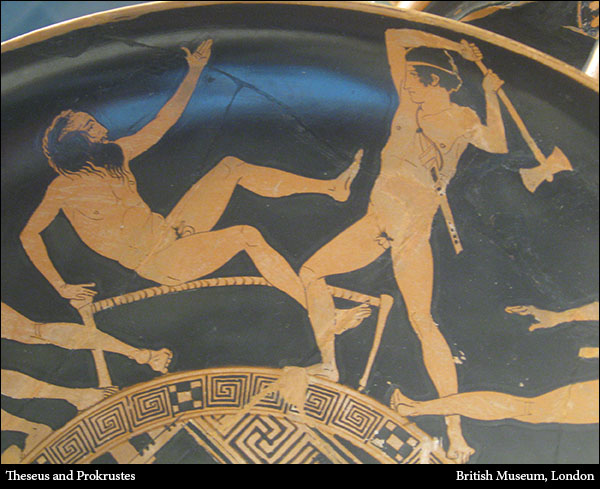
Continuing his journey Athens, Theseus confronted a villain with the surname Prokrustes. The historian Plutarch said his name was Damastes but the traveler-historian Pausanias gave his name as Polypemon ... both agree that his surname was Prokrustes, usually transliterated to mean, The Stretcher as it might apply to a blacksmith hammering and thus stretching metal.
Prokrustes lived near Eleusis and would feign gentility in order to entice travelers to stay with him. Prokrustes offered his guests his bed and then bound them to it ... if they were too tall for the bed, he would hack them down to size ... if they were too short, he would stretch them to fit ... regardless, the results were always lethal.
When Prokrustes tried to force Theseus into the bed, the results were not what Prokrustes expected ... Theseus made Prokrustes lie in his own bed ... even though it was his bed, Prokrustes had to be "fitted" ... the process was fatal.
Crossing the Kephisos River, Theseus went to the ancient altar of Zeus Meilikhius (Gracious). The Phytalidae (descendants of Phytalus) greeted him as he crossed the river ... when he asked to be cleansed and purified for killing the brigands and thieves he had been forced to fight on his journey from Troezen, the Phytalidae performed the customary rites and made the appropriate sacrifices ... afterwards, they welcomed him into their home for a feast ... it was the first kindness Theseus received since he left Troezen.
The traveler-historian Pausanias mentions two rivers named Kephisos in his Description of Greece but one of the references seems to contradict a reference to the Kephisos River in the Iliad by Homer. (book 2.522)
The Kephisos River mentioned by Homer runs near the city of Thebes and would have been a dramatic detour from Theseus's road to Athens. Pausanias places the river in Attica (book 1.37.4) near the altar of Zeus Meilikhius. Pausanias then mentions another Kephisos River near Eleius ... a violent river where Theseus fought Prokrustes. It would seem fitting that Theseus would cross this Kephisos River on his way to Athens. Perhaps he crossed both.
Aigeus was still king of Athens when Theseus arrived but their reunion was like Theseus's journey from Troezen ... grim and dangerous. Tradition states that Theseus arrived at Athens on the eighth day of the month of Kronios, later called Hekatombaeon ... this would be approximately the end of June by our calendar.
Athens was in complete disorder when Theseus entered the city ... public affairs were riddled with confusion and dissension ... King Aigeus's was getting old and was increasingly fearful of the way the city was dividing into factions ... his brother Pallas and Pallas's ambitious sons were at the point of starting a civil war.
Aigeus's sorceress wife Medeia only added to the chaos. She used Aigeus's confusion and his ignorance of Theseus's arrival to initiate a scheme to kill Theseus. She told Aigeus that a stranger-guest was coming to dinner and she was going to poison him ... Aigeus apparently agreed to the plan. As chance would have it, just as Medeia was passing Theseus the poisoned wine, he drew his sword to slice some meat ... he did it in a conspicuous way so Aigeus could get a good look at his sword. Aigeus recognized the sword instantly ... he knocked the cup of poison to the floor and embraced his son.
With the sons of Pallas clamoring for Aigeus to be removed from the kingship, the arrival of Theseus meant that even if Aigeus resigned or died, Theseus would become king and they (the sons of Pallas) would still be politically powerless. Civil war was unavoidable. Pallas divided his sons into two bands ... he led one group openly against the city ... the remainder of his sons hid so as to ambush the supporters of Aigeus. A herald named Leos deserted Pallas's sons and informed Theseus of the group laying in ambush ... Theseus was able to take them by surprise and kill them all ... Pallas's surviving sons dispersed and gave up their ambitions to depose Aigeus.
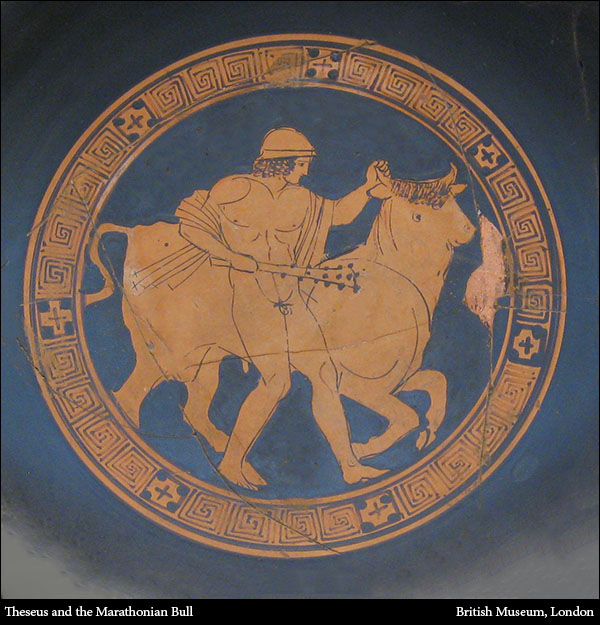
Theseus was intent on winning the favor of the Athenians ... he wanted to do something important but he also wanted to do something flashy ... something that would draw crowds and generate public acclaim. A bull had been menacing northern Attica near Marathon ... Theseus decided to capture the beast and take it back to Athens as a trophy.
Theseus made the short journey to Marathon but before he began hunting the bull, he was the guest of an elderly woman named Hekale. She promised to make a sacrifice to Zeus if Theseus returned safely from the bull-hunt. Theseus marched out to find and capture the bull, which has become known as the Marathonian Bull. We are not told exactly how Theseus was able to subdue the animal but he seems to have captured the bull without injury to himself. When he returned to the home of Hekale, he found that she had died. Theseus initiated a festival in her honor ... the Hekalesia, dedicated to Zeus Hekalus.
Theseus returned to Athens with the Marathonian Bull and drove the beast through the streets ... the bull was sacrificed to Delphinian Apollon.
The exploits of Theseus on the island of Krete have been questioned and disputed but there are several elements of the story that have remained constant:
1) King Minos of Krete exacted a tribute from the Athenians because his son Androgeos had been killed in Athens;
2) Theseus ended the tribute to Minos by killing the Minotaur; and
3) When Theseus left Krete, Princess Ariadne was with him.
The first Panathenaea in Athens was a spectacular event celebrating the goddess Athene. King Minos's son Androgeos won all the prizes in the athletic competitions. King Aigeus sanctioned a vengeful and petty act ... he had Androgeos killed without giving thought to the possible consequences.
Since the Minoan Empire was very strong at that time, Minos waged war on Athens to avenge the death of his son. Minos was not the only one offended by the murder of Androgeos ... the Immortals punished the Athenians too. The Athenians not only had to fight the war with Krete, the Immortals inflicted them with a drought ... the war, coupled with the shortage of food and water, made Athens a desperate city.
Peace and prosperity were finally restored with the promise that Athens would send seven young men and seven young women every nine years to King Minos as a tribute. A condition of the agreement was that the Athenians should furnish the ship carrying no warlike weapons, and that the youths should sail to Krete accompanied by King Minos.
As to what happened to the Athenian youths when they arrived at King Minos's palace at Knossos is a disputed issue.
The rationalists insist the young people were placed in a prison called the Labyrinth and then given out as slaves to disserving Kretans ... their jailer was a man named Taurus ... his name means "bull" and he worked for Minos ... he was thus the Minotaur, i.e. Minos's bull.
The traditional explanation is that the Athenian youths were placed in a maze designed by the master craftsman Daidalos ... the maze was called the Labyrinth ... the Labyrinth was the den of the half-man, half-bull Minotaur ... the Minotaur killed the youths.
In recalling the life of Theseus, Plutarch quotes Simonides regarding the way in which traditional accounts are rationalized by later authors who he says are 'waging war with antiquity.' Writers and historians of the Hellenistic and Classical periods did not appreciate the fact that the Labyrinth, the Minotaur, other supernatural creatures and divine wonders of the ancient world were real things ... they couldn't understand that those things were not fictional or imaginary.
When it came time for the third Athenian tribute, Theseus was chosen to be one of the sacrificial youths. We can't be sure if King Minos specifically chose Theseus because he was Aigeus's son or if the Athenian people demanded that Aigeus's son be included or if Theseus volunteered to go. Regardless, Theseus became one of the sacrificial Athenian youths. The other young men and women were either chosen by drawing lots or personally selected by King Minos.
After making the proper sacrifices to Apollon at the Delphinium, the preparations for the voyage to Krete were nearly complete. An oracle from Delphi advised Theseus to let Aphrodite be his guide ... although he did not understand the subtlety of the oracle when it was given, it would make perfect sense to Theseus after he arrived on Krete. The sacrificial youths boarded their ship on the sixth day of the month Munykhion ... roughly the last week of March by our calendar.
The ship that carried the fourteen youths was normally fitted with black sails to symbolize the hopelessness of their situation. Before leaving Athens, Theseus made arrangements with the ships' captain to hoist special sails on the return voyage to signify whether he was dead or alive ... black sails meant he was dead ... white (or perhaps red sails, emblazoned with the flower of the holm-oak) meant he was returning safely.
On the voyage from Athens to Krete, King Minos began bragging about his divine heritage ... as a son of Zeus he had every reason to be proud ... he took a ring from his finger and threw it overboard. Theseus jumped into the sea and, with the assistance of Poseidon's wife Amphitrite, retrieved the ring.
The name Minotaur literally means Minos's Bull.
When King Minos asked Poseidon (lord of the sea) for a sacrificial animal, Poseidon sent him a perfect bull. Minos was so taken by the beauty of the bull he refused to sacrifice it as he had intended. Poseidon punished Minos by causing his wife Pasiphae to have a child that was half-bull and half-man ... the Minotaur.
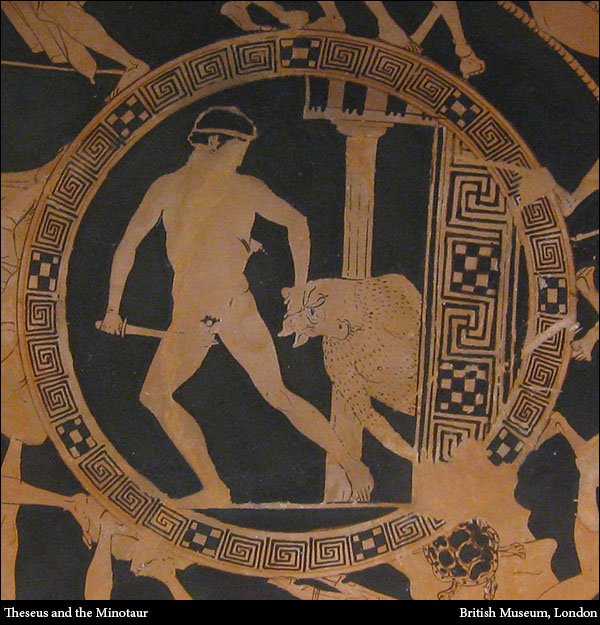
The master craftsman Daidalos was a slave of King Minos. Daidalos had no peers in the field of design and construction ... statues, buildings and devices became works of art in his gifted hands. Daidalos was instructed to build an elaborate maze to house the Minotaur ... the maze was called the Labyrinth. Each time the Athenian sacrificial youths arrived, they were placed in the Labyrinth where the Minotaur would hunt them down and kill them.
King Minos's daughter Ariadne played a significant role in Theseus's ordeal on Krete. She became infatuated with the dashing young Theseus and pledged to help him escape the Labyrinth. She gave Theseus a spool of thread to be unraveled as he wandered through the maze-like passageways of the Labyrinth ... assuming he could kill the Minotaur, he would then be able to follow the thread to find the exit.
The plan worked ... Theseus killed the Minotaur. The actual fight with the Minotaur was not described in the ancient literature so we will just have to assume that Theseus prevailed and the sacrificial Athenian youths were freed unharmed.
Perhaps the story of the Minotaur is inaccurate or downright false ... certain ancient authors thought so. The writer Philokhorus is mentioned by Plutarch and supposedly said the Kretans refuted the story of the Minotaur ... they claimed the events attributed to the Minotaur actually involved a Kretan general named Taurus.
Despite the fact that he was a high-ranking general in King Minos's military and given the honors appropriate a winner of the athletic games, Taurus made inappropriate romantic advances towards Queen Pasiphae. When Theseus arrived at Knossos, another round of games was scheduled ... everyone assumed that Taurus would be the overall winner. Theseus asked to be included in the games ... Minos was more than agreeable to that arrangement because he wanted someone to defeat and humiliate Taurus. Theseus won the wrestling match and Taurus was suitably humbled ... Minos was so pleased, he freed the Athenian hostages.
In this sense, Theseus defeated the "bull-man" (Taurus) and freed the Athenian captives from the Labyrinth (prison).
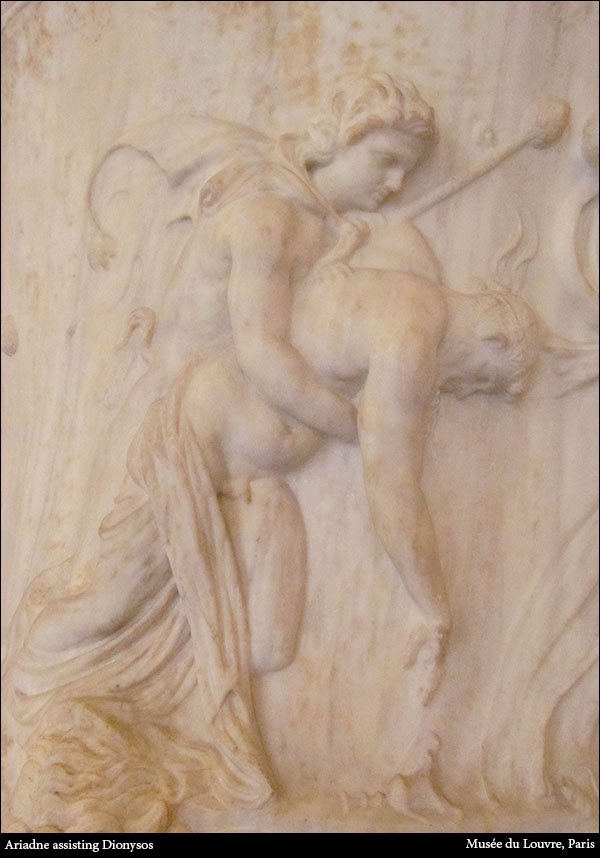
Theseus and Ariadne became lovers but their relationship was very brief.
According to the Odyssey by Homer, Odysseus encountered the 'shade' of Ariadne when he evoked the spirits of the Underworld. Ariadne's 'shade' told Odysseus that Theseus was taking her to Athens after he escaped the Labyrinth but abandoned her on the island of Dia. She encountered the god Dionysos, a son of Zeus, but he "bore witness against her," and the goddess Artemis killed her.
That is the oldest mention of Ariadne but, according to Plutarch, the stories relating to Theseus, Ariadne, and the Labyrinth were not as clear-cut as we might imagine. The idea that Ariadne was in love with Theseus is a common thread that winds through all the stories but her ultimate fate is by no means clear ... she either:
1) Was abandoned on the island of Dia and killed by Artemis;
2) Inherited the throne of Krete and made a pact of truce with Athens after the deaths of her father Minos and her brother Deukalion;
3) She committed suicide after Theseus abandoned her;
4) She was taken to the island of Naxos where she married a priest of Dionysos named Oenarus after Theseus abandoned her for a woman named Aigle;
5) Theseus put the pregnant Ariadne ashore on the island of Kypros and was not able to return before she died in childbirth;
6) After Dionysos made Ariadne his wife, Zeus made her immortal and un-ageing; or
7) There were two women named Ariadne stranded on the island of Naxos ... one was married to Dionysos and her passing was celebrated with gaiety ... the other Ariadne was abandoned by Theseus and her passing was commemorated with sorrow and lamentation.
King Aigeus waited impatiently for Theseus to return from Krete. He watched the sea hoping to see the white sails (or perhaps red sails, emblazoned with the flower of the holm-oak) indicating Theseus's safe return.
Theseus was triumphant ... he defeated the Minotaur and thus ended the feud between Athens and King Minos. His return voyage to Athens was joyous and jubilant ... the high spirits on the ship clouded Theseus's otherwise clear thinking ... he forgot to take down the black sails.
Aigeus was keenly watching the sea for any sign of Theseus's ship and when it finally came into view, he saw that the sails were black. Thinking Theseus was dead, Aigeus threw himself from a seaside cliff and was dashed to death on the rocks below.
Oblivious to what his father had done, Theseus came ashore and began pouring libations of thanks for his safe return ... it was after the ceremonies that he learned of his father's death. It was a time of mixed feelings for the citizens of Athens because Theseus had freed them from their blood-tribute to King Minos but they had also lost their king. Several festivals and traditions were started to commemorate the death of Aigeus and the safe return of Theseus. The ship that carried Theseus to and from Krete was preserved for over a thousand years.
Theseus was a "man of the people" ... when he traveled from Troezen to Athens he had purposefully taken the more arduous overland route so he could rid the highways of robbers and brigands ... his willingness to fight the Minotaur for the sake of the young Athenian hostages and their families ... he did those things because they were genuine expressions of his character and not "theater" designed to enhance his public image.
When he became king, his first political endeavor was to unite Attica into a "city-state" governed by a coordinated and cooperative government. He traveled from town to town promoting this novel idea. Many people were enthusiastic and readily agreed to support Theseus's cause ... others were not in favor of surrendering their sovereignty but were realistic enough to see that Theseus was going to unite Attica whether they liked it or not ... they decided to cooperate rather than risk a military confrontation. We can safely assume that Theseus would not have used force to make anyone join his cause because one of the main reasons he wanted to unite the townships was to quell the perpetual hostilities and counterproductive squabbling that seemed to permeate Attica throughout its history.
After the unification was unanimously approved, a common town-hall and a council-chamber were built in Athens ... Theseus relinquished his royal powers but in accordance with the poetic suggestion of an oracle from Delphi, his influence submerged but did not sink. He instituted the Metoekia, or Festival of Settlement, on the sixteenth day of the month Hekatombaion ... approximately the first of August by our calendar.
A bold but necessary restructuring required the division of the citizens into three strata—noblemen, husbandmen, and handicraftsmen. The noblemen exemplified dignity, the husbandmen embodied usefulness, and the handicraftsmen represented the common citizen because they were most numerous. He also coined money stamped with the effigy of an ox, which gave rise to terms like 'ten oxen' and 'a hundred oxen' when discussing the value of commercial items. The use of the ox-symbol was thought to represent either the Marathonian Bull, General Taurus or to emphasize the importance of agriculture to the future of Attica.
When the city of Megara was firmly incorporated into Attica, Theseus placed boundary markers at the Isthmus of Korinth. Athletic games were initiated in honor of Poseidon but may have also been an attempt by Theseus to get absolution for the murder of Skiron, the rogue who would push travelers off the cliffs near Megara. As mentioned before, some ancient writers believed Skiron was related to Theseus because he was the son of Kanethos and Heniokhe, who was the daughter of Pittheus who was in turn the grandfather of Theseus.
Since Theseus and Herakles were cousins, there were many blatant attempts by Classical writers to link the two men on various adventures. Herakles was clearly of the generation before Theseus and in all probability, Herakles died and ascended to Mount Olympos while Theseus was still quite young. One instance where Theseus and Herakles are repeatedly said to have worked together was in a war against the Amazons.
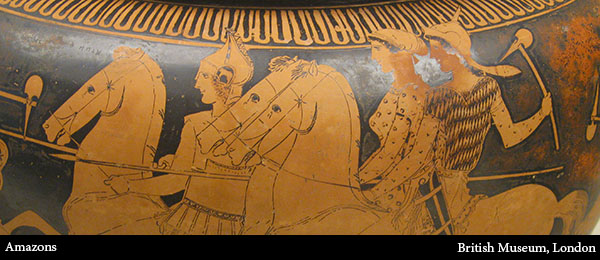
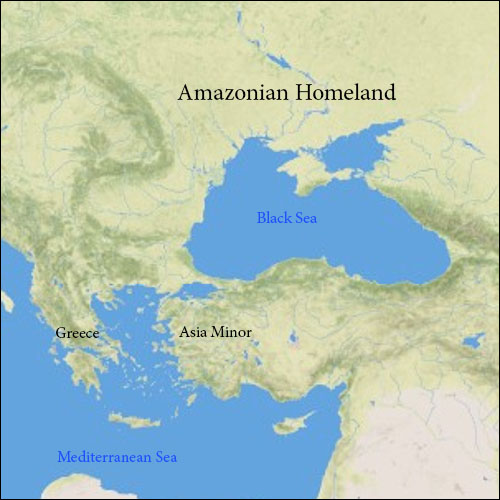
The Amazons were a society of female warriors reputed to be the daughters of Ares, god of war, and the Nymph, Harmonia. They lived at the fringe of the civilized world beyond the shores of the Black Sea in the land of Skythia. The Amazons shunned contact with the Greeks but were forced into several confrontations with the likes of Herakles, Ieson (Jason), Bellerophontes, the Greeks at Troy, and Theseus. In all of their encounters, the Amazons were defeated. Of course, the records of the Greeks interacting with the Amazons were kept by the Greeks ... they may have exaggerated their victories over the warlike Amazons.
After unifying Attica, Theseus went on his first foreign military campaign ... he sailed to the Black Sea and then marched northward to the Amazon homeland in the area where the Borysthenes (Dnieper) River flows into the sea. The purpose of the campaign is not clear but the resulting war became the stuff of legends. Theseus captured Queen Antiope and took her back to Athens as his consort.
Theseus and Antiope had a son named Hippolytus ... no real time frame is given for how long Antiope stayed with Theseus but we get the impression that after several years the Amazons came to Athens to retrieve their kidnapped queen. The Amazons attacked Athens and when Antiope fought against her sisters, an Amazon named Molpadia shot her with an arrow ... Theseus then killed Molpadia.
The war with the Amazons must have been a glorious event ... the artistic representations of the war were a very popular theme throughout the ancient Greek world ... not only were the Greeks shown as valiant fighters but the Amazons were given honorable treatment as formidable warriors.
The death of Antiope in the war with the Amazons prompted Theseus to look for a new wife ... he didn't have to wait long before a suitable woman came to his attention.
The death of King Minos elevated his son Deukalion to the throne of Krete and the Minoan Empire. He arranged for his sister Phaedra to marry Theseus. Phaedra and Theseus had two sons, Akamas and Demophon. Theseus took measures to insure that there would be no dispute over who would follow him on the throne of Athens because he did not want Hippolytus to be subject to Phaedra's children ... he sent Hippolytus to Troezen to be raised by his grandfather Pittheus with the intention that Hippolytus would eventually become the king of Troezen.
It's unclear as to how Phaedra first met Hippolytus ... one version of events says she met him while he was in Athens for a celebration. Phaedra was so captivated by his youthful beauty that she supposedly had a temple of Aphrodite (goddess of love) built beside the Acropolis of Athens that looked towards Troezen. Another account says they met when she and Theseus were visiting Troezen ... regardless, all agree that Phaedra tried to seduce Hippolytus and he rejected her.
Phaedra told Theseus that Hippolytus tried to forcibly have his way with her. Theseus did not believe her and sent for Hippolytus ... he wanted to hear Hippolytus's side of the story. Fearing what Hippolytus would say, Phaedra hanged herself. When Hippolytus heard the lies Phaedra had told about him, he became so distracted he lost control of his chariot, became tangled in the reins and was dragged to his death.
In the years following Phaedra's suicide, Theseus became involved in some very interesting and damnable situations.
King Oedipous of Thebes had been disgraced, blinded and exiled ... he was an unwitting player in a tragedy that spanned three generations and Theseus was there to witness the final moments of Oedipous's life.
Oedipous had been the unwanted child of King Laius and Queen Iokasta of Thebes ... an oracle informed Laius that his son would kill him and take his throne ... thinking he could thwart the will of the Immortals, Laius abandoned his son (Oedipous) in the wilderness and thought all would be well. The infant was rescued, adopted, and raised to adulthood in Korinth ... he too received an oracle ... the oracle said he would kill his father. Not knowing he was adopted, Oedipous fled Korinth and by the design of the Immortals met Laius on the road ... the two men fought and Laius was killed. Oedipous also met and killed the Sphinx that had been terrorizing the people of Thebes.
When Oedipous entered the city of Thebes, he was greeted with enthusiasm because he had killed the dreaded Sphinx ... when the citizens found out that Laius was dead, they offered Oedipous the throne ... he married the queen (his mother) and had four children. When he learned the truth of his situation, Oedipous blinded himself and went into a self-imposed exile. His miserable vagabond life was one of continual rejection and sadness.
Oedipous's travels finally led him to Attica ... Theseus learned that Oedipous was nearby and went to see the bedraggled ex-king. It seems that Theseus was the only person in Greece who was willing to give comfort to the old man as he stood at death's door. Theseus was the last man on earth to see Oedipous alive.
Peirithoos was the legendary king of the Lapiths in Thessaly near Mount Pelion.
Peirithoos was familiar with the exploits of Theseus and felt compelled to test him to see if his reputation was deserved. Peirithoos stole some of Theseus's cattle from the plain of Marathon and then waited for Theseus to come after him ... Peirithoos did not try to escape but rather stood his ground and faced the hero. The two men were impressed with each other and instead of fighting, Peirithoos extended his hand in friendship and swore he would accept any punishment Theseus deemed appropriate. Theseus opted for forgiveness instead of punishment and the two men sealed their friendship with an oath.
The lives of Theseus and Peirithoos became intertwined ... they shared some exciting adventures but they also indulged in some rather despicable escapades.
Centaurs were an intelligent race of beings having the head, trunk and arms of a man but with the body of a horse. The Centaurs lived peacefully with the Greek inhabitants around Mount Pelion in Thessaly until they abused the hospitality of Peirithoos.
Peirithoos invited Theseus to a wedding feast and for one reason or another, the Centaurs at the wedding became unruly ... Peirithoos and Theseus took up their weapons and led the Lapiths in an all-out war against the Centaurs.
There are at least two versions of how the Centaurs disrupted the wedding feast:
1) The wedding was for Peirithoos and Hippodamia ... the neighboring Centaurs raided the festivities and tried to kidnap Hippodamia; or
2) The Centaurs were invited guests to the wedding of Peirithoos's daughter, Deidamia. The Centaurs became intoxicated and began to harass the Lapith women
Regardless of the motivation, Peirithoos, Theseus, and the Lapith men began to fight with the Centaurs and a bitter war ensued. The Lapiths eventually drove the Centaurs from the area around Mount Pelion.
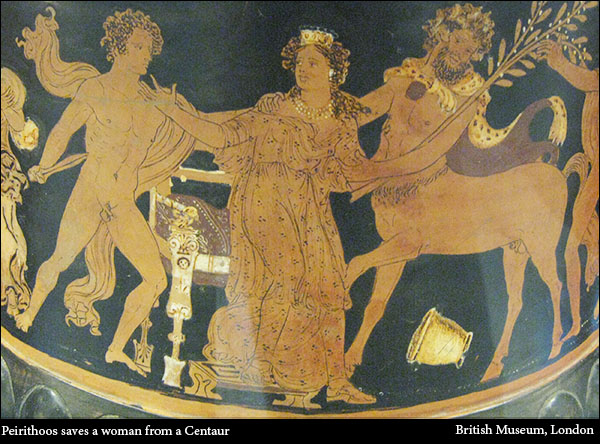
No matter what sort of man Theseus had been before he met Peirithoos, he did some rather despicable things after they became companions.
Theseus was fifty years old when he entered the darkest chapter of his life ... he and Peirithoos decided to kidnap Helen of Sparta ... this was long before she became known as Helen of Troy. It would seem that this one deplorable act was the beginning of Theseus's downfall and the cause of Peirithoos's premature death.
While visiting the city of Sparta, the two men saw Helen dancing in the temple of the goddess Artemis Orthia. They were captivated by her youthful beauty and took the girl against her will. Helen was young and beautiful but she was too young to marry ... she was the daughter of Zeus and the ward of King Tyndareus of Sparta ... any one of those facts should have been enough to make Theseus and Peirithoos abandon their heinous and foolish plan but they couldn't resist ... they took the girl and fled.
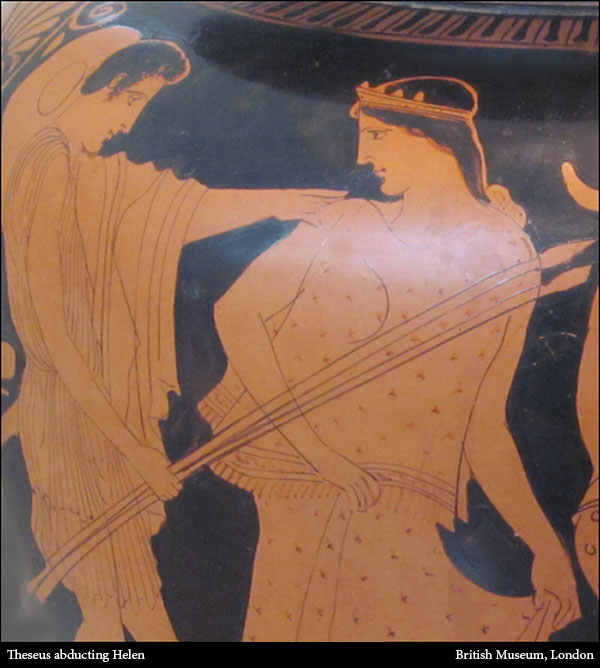
They traveled west from Sparta ... when they got as far as Tegea they decided to draw lots to see who would "marry" Helen ... the winner was obliged to help the loser find a wife. Theseus won the draw and took Helen to the town of Aphidna ... he placed his mother Aithre and a friend named Aphidnus as guardians while he and Peirithoos blundered on to their next fiasco.
There was an eccentric Molossian king with a strange obsession with Hades, lord of the dead. His name was Aidoneus, a pseudonym for Hades; his wife was named Persephone, the name of Hades wife; they named their daughter Kore which is a pseudonym for the goddess Persephone; to complete the association, the family dog was named after the hound of Hades, Kerberos.
Theseus had Helen as his captive wife, now it was his turn to help Peirithoos "get" a wife. Peirithoos decided that he wanted Aidoneus's daughter, Kore. They went to Epirus and immediately got into trouble.
When Aidoneus realized Theseus and Peirithoos were trying to kidnap Kore, he set Kerberos loose on them ... the hound killed Peirithoos and Theseus was taken prisoner ... his execution was inevitable but delayed.
Again we are told that Herakles and Theseus shared adventures ... supposedly, while Herakles was a guest of Aidoneus, the king told him of his encounter with Theseus and Peirithoos. Herakles thought it best to not to complain about the cruel death of Peirithoos and focus his attention on freeing Theseus ... he asked Aidoneus to release Theseus as a favor to him ... the king finally agreed.
While Theseus was being held prisoner by King Aidoneus and Helen was still hidden at Aphidna, Helen's brothers Kastor and Polydeukes were scouring Attica trying to find either Theseus or Helen.
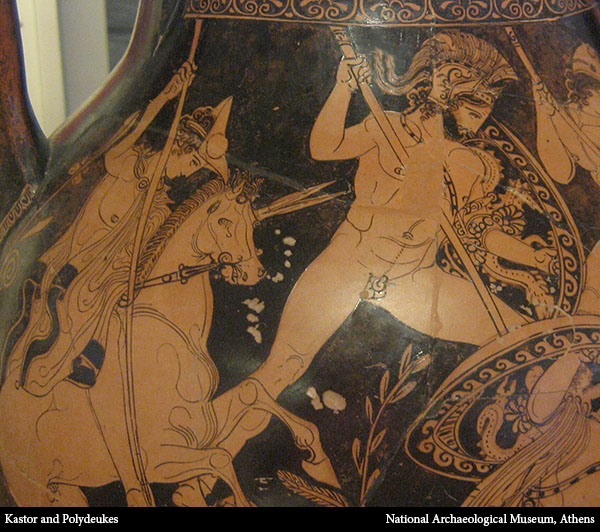
With the absence of Theseus and the reports of his scandalous behavior, the people of Athens were very receptive to dissident rhetoric. A man named Menestheus, "the first of men," began to speak against Theseus and the way he had unethically unified Attica ... other citizens took up the banner and voiced their discontent with the way in which their rights and property had been unjustly coopted. To compound the situation, Kastor, Polydeukes and the Spartan army were at the gates of Athens threatening to raze the city unless Helen was surrendered to them.
Akademus, for whom the Academy of Athens was named, had somehow learned where Helen was being held ... he told Kastor and Polydeukes how to find their sister and thereby earned the unwavering gratitude of the Spartan people. Kastor and Polydeukes stormed Aphidna and rescued Helen. Theseus's mother Aithre was taken back to Sparta where she lived in servitude as one of Helen's handmaids.
The Athenians were fearful that the Spartans would still take revenge on them even though Helen had been found ... on the advice of Menestheus, they graciously invited Kastor and Polydeukes into the city and offered them every courtesy ... Athens was spared, Menestheus had saved the city.
Theseus returned to an Athens that was completely different from the city he had once ruled. The people who had been his rivals were now enemies ... hatred had become contempt. He tried to placate certain factions by renaming his eponymous precincts after Herakles but the effect was negligible. The government had become corrupt and people were no longer willing to perform their civic duties.
Theseus tried to force cooperation but he was "overpowered by demagogues and factions" ... he finally accepted the hopelessness of his situation and sent his children to a man named Elephenor on the island of Euboia. After stopping at Gargettus to curse the Athenians, Theseus went to the island of Skyros to reclaim his ancestral estates.
He petitioned King Lykomedes of Skyros for the privilege of living on the island ... his request was rendered moot when he died an untimely death.
There is the strong possibility that King Lykomedes killed Theseus. The assumption is that he was either afraid of Theseus because he was such a powerful man or he killed Theseus as a favor to Menestheus. On the pretense of showing Theseus his ancestral estates, Lykomedes lured Theseus to a high cliff and pushed him over the side.
A less popular version of events postulates that Theseus lost his footing while on a precarious cliff and fell to his death.
Little account of Theseus's death was made in Athens ... Menestheus assumed Theseus's role as king ... Theseus's children accompanied their guardian Elephenor to fight in the Trojan War.
A thousand years later, when the Persians invaded Greece in 490 BCE, an apparition that looked to be Theseus was seen leading the victorious Athenian charge at the battle of Marathon ... belief was so strong that Theseus had returned to Athens at the time of its greatest peril, he was formally given the honors of a demigod.
Circa 475 BCE, the Pythian priestess of Delphi told the Athenians to find the bones of Theseus and return them to Athens. This seemed like an impossible request because the savage Dolopians had control of Skyros. In 480 BCE Kimon took the island for the Athenians and discovered the grave of Theseus.
Kimon was anxious to find Theseus's grave ... he saw an eagle "pecking" and tearing up the ground on what seemed to be a mound. Kimon dug into the mound and found a coffin with the remains of a large man flanked by a bronze spear and sword. Kimon returned the bones and relics to Athens where they were received as if Theseus himself had entered the city ... splendid processions and sacrifices proceeded the burial of Theseus at the gymnasium of Ptolemy. His tomb became a sanctuary for runaway slaves, men of low estate, the poor, and the needy ... Theseus had been the protector of such men during his life and there was every reason to believe his spirit would offer the same protection.
The Iliad
The Odyssey
Catalogues of Women and Eoiae
Catalogue of Women
Shield of Herakles
Kypria
Little Iliad
Returns
The Histories by Herodotos
The Argonautika by Apollonius of Rhodes
History of the Peloponnesian War by Thucydides
Description of Greece by Pausanias
Library of History by Diodorus of Sicily