
| The Sisters of Styx |
| Bibliography |
| Previous Page |
| Homepage |
| Site Search |
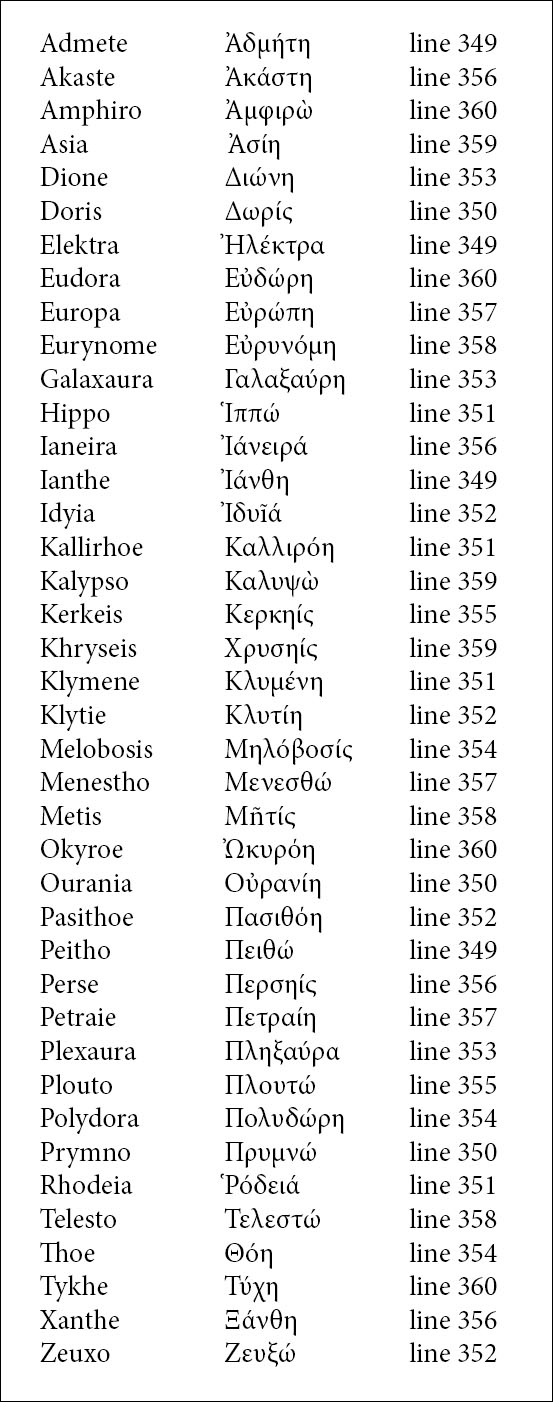
Styx is one of the daughters of Okeanos (Ocean) and Tethys, which means she is an Okeanid. She and her sisters are only a small portion of the thousands of daughters of Okeanos and Tethys but they were the first born and are called a Holy Company ... Styx is the oldest and most eminent of her sisters.
The god Zeus and his brothers and sisters fought to gain control of all creation, their primary rivals were the haughty Titan gods. The war with the Titans was a long and bitter struggle but after ten years, Zeus and his supporters finally won. During the war, Zeus promised that any Immortal who fought on his side would retain their power and position and those without power or position would be rewarded justly. Styx, with her children, were the first to stand with Zeus ... for that reason, Styx was preeminent amongst the Immortals. A tenth part of the waters of Okeanos were allotted to Styx.
Pallas, a son of the Titans Krios and Eurybia, mated with Styx and they had four children—Zelos (Rivalry), Nike (Victory), Bia (Force), and Kratos (Strength). Styx's children are forever honored by Zeus and make their homes wherever Zeus resides.
Although she is called the Oath River, Styx is actually an Okeanid. The Okeanids and the Rivers are of the same parents but the Okeanids are said to be a Race Apart or a Holy Company. Zeus gave the Okeanids, Apollon, and the Rivers the special obligation of having the young in their keeping. Styx is also called The Hateful because she is the body of water in the Underworld over which the souls of the dead are ferried by Kharon and by which the Immortals swear their most solemn oaths.
Styx resides near the halls of Hades and Persephone, the lord and queen of the dead. Styx lives apart from the other Immortals in a glorious house with a stone roof supported by silver columns. The messenger goddess Iris is the only Immortal to enter Styx's home. When a dispute erupts on Mount Olympos, Zeus sends wind-footed Iris to Styx for a pitcher of water. Any Immortal who pours the waters of Styx, and swears an oath, is solemnly bound to tell only the truth. The punishment for breaking such an oath is one year without ambrosia, nectar or AIR! If that's not enough, for nine additional years, the oath-breaker is not allowed to attend the festivals or share the company of the other Immortals.
According to the historian Herodotos, Styx came to the surface of the earth in the town of Nonakris, which is in Arkadia near the town of Pheneus. Styx manifested herself as a small stream trickling from a rock into a pool and surrounded by a dry wall.
The Iliad
The Odyssey
Theogony
Hymn to Demeter II
Hymn to Delian Apollon III
Hymn to Hermes IV
The Argonautika by Apollonius of Rhodes
The Histories by Herodotos
Description of Greece by Pausanias