
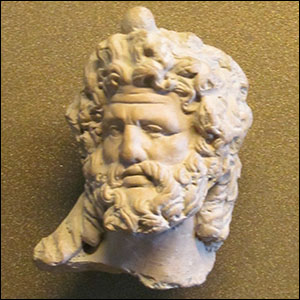
Poseidon had two brothers—Zeus and Hades—and three sisters—Hera, Demeter, and Histia. All six were children of the Titans, Kronos and Rhea.
The Titans were the children of Ouranos (Heaven) and Ge (Earth). Realizing the depravity of his children, Ouranos devised the name Titan to mean Stretcher or Strainer because he saw his offspring stretching and straining the limits of propriety, thereby guaranteeing an ignoble fate.
Kronos was perhaps the worst of all the Titans. He was told by Ge that one of his children would depose him ... to prevent that from happening, Kronos swallowed each of his children as they were born and foolishly thought he had evaded Ge's prophecy. Poseidon was swallowed with the other four children of Rhea and Kronos but when the sixth child was born Rhea had had enough of Kronos's indulgences. Rhea substituted a stone for the newborn infant and Kronos swallowed it down without hesitation. The newest child became known as Zeus and was secretly reared on the island of Krete. When Zeus became old and powerful enough, he attacked Kronos with such violence, the swallowed children were vomited up ... Poseidon was thus born again.
The children of Rhea and Kronos were destined to rule heaven and earth but it was not a simple matter to dethrone Kronos and assume control. The brothers of Kronos came to his assistance and the battles that ensued came to be known as the War of the Titans.
An interesting story was told about two otherwise unknown Titans who refused to fight with their brethren against the children of Rhea and Kronos ... their names were Xanthos and Balios. Xanthos fought beside Poseidon and Balios fought beside Zeus. They wanted to hid their identity from the other Titans so they asked to be transformed into horses. After the Titans were defeated, Xanthos and Balios, still in the guise of horses, were given to King Peleus who in turn gave them to his son Achilles so they could pull Achilles's chariot in the Trojan War.
When the dust cleared and the War of the Titans was over, the Titans were banished to the Underworld ... Poseidon and his brothers and sisters took up residence on Mount Olympos and became known as The Olympians. Zeus was given the title, Father of Gods and Men ... all Immortals answer to him or suffer his wrath.
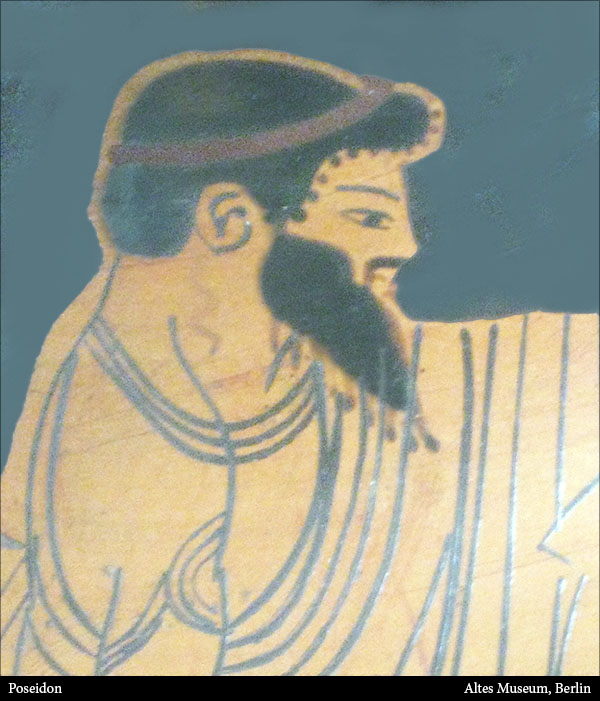
Zeus was the ultimate authority but he decided to share his power with his brothers, Poseidon and Hades. The three gods drew lots for the division of all creation. Zeus won the sky, Hades became the lord of the dead in the mists and darkness of the Underworld. Poseidon won dominion of the sea but he also made it his mission to give voice to the earth ... for that reason, he is commonly called the Earth-Shaker ... he pounds and shakes the earth and sea to demonstrate his pleasure and wrath. He populated the sea with creatures of his own design and answers to no one ... except Zeus.
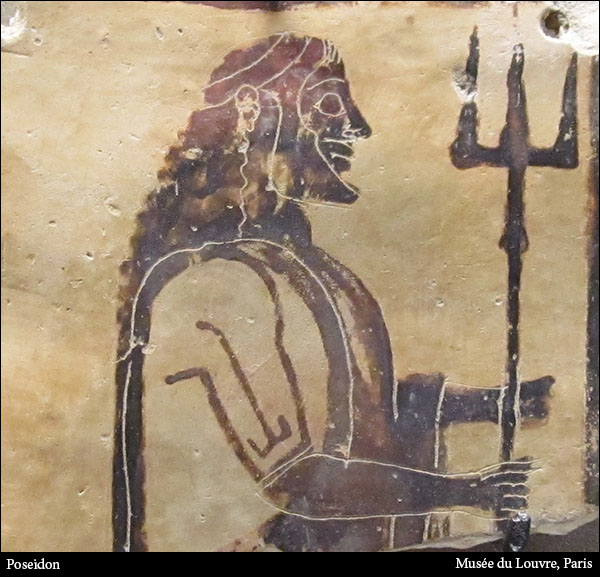
Poseidon rides the waves in his chariot and carries his distinctive trident, which he uses to smite the earth and sea. The Telkhines are the nine dog-headed sea creatures who, as great artisans, crafted the trident of Poseidon as well as the sickle of Zeus.
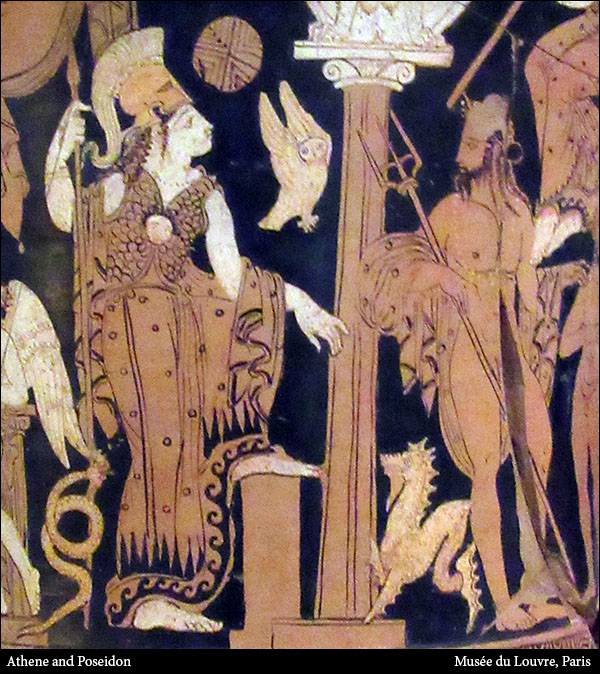
Although Poseidon is intimately linked to the sea, his most honored creation is the horse. The horse came into existence when Poseidon was vying with the goddess Athene for the adoration of the human race. A competition was proposed to see which of the two Immortals could devise the most cunning gift for the mortals of the earth. Poseidon crafted the horse and Athene brought forth an olive tree. The olive tree was such a wonderful creation that Athene won the competition and the city of Athens was named her. The olive was used as food, oil and the wood from the larger trees was used for building ships. Poseidon's gift of the horse was by no means unappreciated ... the horse literally changed the shape of the ancient Greek world.
There is a story about Poseidon and the lost continent of Atlantis that deserves our consideration. This story is not from one of the early Greek authors such as Homer or Hesiod but comes much later, circa 345 BCE. The story of Poseidon and his role in establishing Atlantis was told by Plato at the end of his career in two Dialogues—Timaeus and Kritias.
I choose not to disregard these Dialogues simply because of they are of a much later date than most of the literature on which the vast majority of the Greek mythical histories are based. I choose to believe Plato in a very literal sense and dispense with the second-guessing and what-he-really-meant arguments. Plato's geographical view of the world was limited but not myopic ... his time reckoning was not precise but we should not be too hasty in correcting his facts and figures simply because they do not agree with our modern preconceptions.
According to Plato, the continent of Atlantis was destroyed circa 9000 BCE after a long and prosperous reign. Atlantis was founded at the dawn of time when Zeus, Hades, and Poseidon divided the domains of the earth between them. Poseidon became lord of the sea and consequently assumed control of the island-continent, which became known as Atlantis.
Poseidon encountered a woman named Kleito from an Earth-Born race native to the continent and took her as his consort. Poseidon began to terraform the land where Kleito's parents lived until it became a round island surrounded concentric rings of water and land ... two rings of land and three of water. Poseidon then made two springs flow on the center island, one of hot and one of cold water. The water from the springs was used to irrigate the land and provide water for domestic use including elaborate baths for people and animals. Over time, the surrounding fertile plain began to grow with abundant produce of every kind.
After Poseidon and Kleito had five sets of male twins, Poseidon divided the island-continent into ten separate domains for his sons to administer as kings. Each son assumed absolute power in his own region and could punish or execute his subjects at will. After the institutions of Atlantis were firmly established, Poseidon left his sons and their descendants to their own devices.
Although each king was the master of his own domain, the distribution of power and the relations between the kings were governed by a set of injunctions Poseidon had dictated. The injunctions were engraved on an oreikhalkos pillar and placed in his temple, which was built on the center island where Kleito's original home had been. Inside the temple stood a golden statue of Poseidon driving a chariot drawn by six winged horses and surrounded by one hundred Nereids riding dolphins. The outside of the temple was covered in silver, with golden figures on the pediment. Inside, the roof was flecked with silver, gold, and oreikhalkos ... the walls, pillars, and floor were covered with oreikhalkos. The temple was surrounded with statues of the ten original kings as well as statues of succeeding kings and private persons.
Oreikhalkos was said to be metal more precious than gold or silver and found in abundance in Atlantis. Oreikhalkos is also rendered as "orichalcum" and loosely translated as "mountain copper." Samples of what is believed to be oreikhalkos have been found in the form of ingots in an ancient shipwreck off the coast of Sicily ... the composition of the ingots was 75–80% copper, 15–20% zinc, with traces of lead, iron and nickel.
As generation followed generation, the temple of Poseidon was expanded and enlarged by each succeeding group of kings, each trying to surpass their predecessors with lavish additions to the original structure. The result of this long-term uncoordinated building program was a temple that was described as having a "barbaric" appearance.
Atlantis flourished for many generations but the divine blood of Poseidon became more and more diluted until finally the kings began to act in ways that were not in accordance with the noble character of the first kings. When the latter-day kings of Atlantis tried to invade the eastern Mediterranean area, they were soundly defeated by the Athenians ... at that remote time, Athens had the strongest military and most advanced culture in the Mediterranean. Soon after the humiliating military defeat of the Atlantians and the stunning military victory of the Athenians, a deluge struck the entire region with such force that the Atlantians were completely destroyed and the Athenians were scattered into small impoverished groups.
The destruction of Atlantis and ancient Athens took place circa 9000 BCE. Atlantis sank beneath the waves in a single day and night, never to be seen again. Plato ended Kritias in mid-sentence so we are not told the details of the destruction of Atlantis ... at the end of Kritias, Zeus is addressing a gathering of the Immortals to discuss the fate of Atlantis but as to what was said or done, we do not know. We are also not told whether Poseidon as lord of the sea, was a party to the watery destruction of the civilization he created.
The island of Rhodes was first populated by a race of sea creatures known as the Telkhines ... the Telkhines were very mysterious and described in a variety of ways but generally thought of as dog-headed sea creatures. The Telkhines were children of Thalassa (an aspect of the sea) and thus possessed many different talents that were appreciated by Immortals and mortals alike. The Telkhines crafted the sickle of Zeus and the trident of Poseidon. The Telkhines were said to be wizards who could summon clouds, rain, hail, and snow at their will. The Magi of Persia were said to have developed similar magical skills. The Telkhines were also said to have the ability to change their shapes, and not inclined to teach their arts to others.
The Telkhines were living on Rhodes when the children of Kronos and Rhea were quite young and were still on the island when Poseidon and Zeus reached maturity. Rhea gave the infant Poseidon to the Telkhines and a daughter of Okeanos (Ocean) named Kapheira to be nurtured ... it seems appropriate that Poseidon would be nurtured by sea-beings because he eventually became lord of the sea.
Zeus and Poseidon took consorts on Rhodes ... the sons of Zeus were honored and enjoyed long lives but the sons of Poseidon were doomed by their own insolent behavior. Poseidon was attracted to a sister of the Telkhines named Halia ... she and Poseidon had six male children and one daughter named Rhodos.
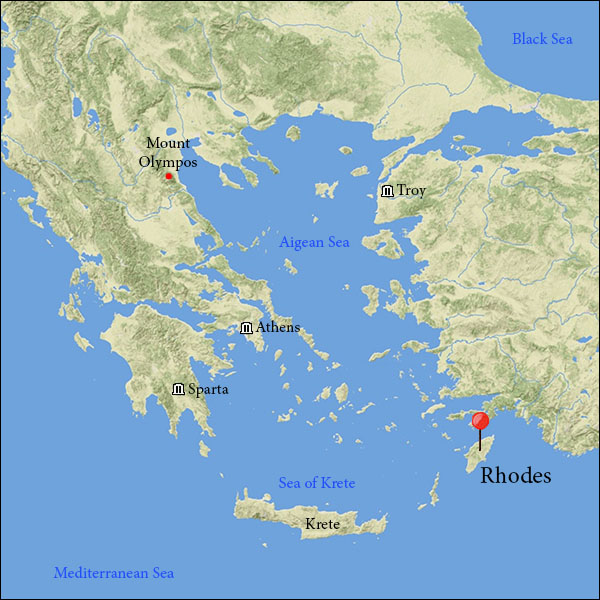

The sons of Poseidon and Halia were arrogant men who came to an evil end when they offended Aphrodite (goddess of love). Aphrodite drove the young men mad and they assaulted their mother. When Poseidon learned of their horrendous behavior, he buried them on Rhodes where they became known as the "Eastern Demons." Halia was so shamed by her son's wanton actions, she threw herself in the sea ... afterwards, she became known as Leukothea and was given Immortal honors by the islanders.
Soon after those events, the Telkhines perceived that the island was going to suffer a cataclysmic flood ... they fled, never to return. At that time, the island was populated by Nymphs of various types and people who were "sprung from the earth" ... many of the inhabitants perished in the flood but the survivors retreated to the highlands with Zeus's sons as their semi-divine leaders.
The island was devastated by the flood but Helios (Sun) dried the land and made it habitable again. Helios took Poseidon's daughter Rhodos as his consort and named the island Rhodes after her. Rhodos and Helios were the parents of eight children, seven sons and one daughter ... the daughter died while still a maiden but the sons, despite infighting and fratricide, went on to become the island's rulers.
The sons of Helios and Rhodos surpassed all other men in their knowledge of astrology and seamanship. They also introduced the division of the day into hours ... the Egyptians learned art and science from the sons of Helios and Rhodos and not visa versa as is commonly believed. The reason the sons of Helios and Rhodos are not credited with their pioneering achievements is because another devastating flood, which might be properly called a deluge, killed a majority of the human race and destroyed all historical records on Rhodes ... the only knowledge of the past that was preserved was in the form of myths and legends.
Poseidon and Demeter are brother and sister ... the relationship between the two was not really elaborated upon in ancient texts such as the Iliad, the Odyssey, and Theogony but there is however a later story about Poseidon and Demeter that resolves the mystery of the identity of a goddess who is only referred to as Mistress.
When Demeter's daughter Persephone was kidnapped by Hades (lord of the dead), Demeter did not know what had become of her only daughter. While Demeter was desperately searching for Persephone, Poseidon began to pursue Demeter. She managed to evade Poseidon until she came to Arkadia where she, in a moment of exasperation, transformed herself into a horse. Poseidon changed into a stallion and mated with her. Demeter was furious with her brother and thus earned the surname Fury ... as her temper cooled, she bathed in the Ladon River and assumed the surname Bather. The Arkadians built a temple for Demeter and furnished it with statues of Demeter as Fury and Bather.
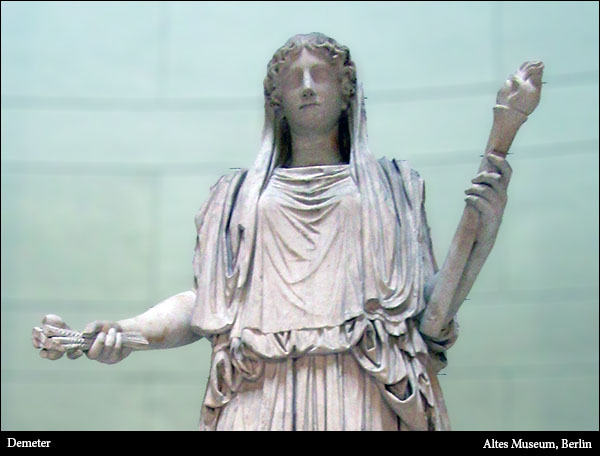
Demeter and Poseidon had a daughter who is only referred to as "Mistress" and a son named Arion The rites of Demeter as practiced in Arkadia were kept secret from non-initiates, thus the true name of the divine daughter of Demeter and Poseidon was never made public.
Arion became famous as the steed of King Adrestos (Adrastus) of Sikyon. After the infamous King Oedipous fled the city of Thebes, a bitter rivalry began between Oedipous's sons, Eteokles and Polyneikes. Adrastus rode Arion in the first attack on Thebes and was the only commander to survive the attack. When the second attempt was made to capture Thebes, Adrastus again rode Arion but this time the assault was successful ... the city was captured but Adrastus's son Aigialeus was the only commander killed ... astride Arion, Adrastus returned home and died of grief.
Arion was also the name of the chariot horse of Herakles when he fought a son of Ares named Kyknos ... it is unclear whether Herakles's Arion was the original son of Demeter and Poseidon.
Because of the transformation into a horse by Poseidon in his desire for Demeter, the Arkadians were the first to give Poseidon the surname Horse.
King Minos of Krete was a very devout man who failed only once to give Poseidon his due respect ... that one oversight became the reason for the creation of the Minotaur and the construction of the famous Labyrinth at King Minos's palace at Knossos. This happened one generation before the Trojan War and involved the Athenian hero, Theseus.
It was traditional for King Minos to sacrifice a bull annually to Poseidon but one year the bull that was to be sacrificed was of extraordinary beauty and vigor ... King Minos decided to keep the bull and sacrifice another less perfect bull instead. Poseidon recognized the betrayal and began a series of events that would result in King Minos's humiliation and repentance. With the contrivance of Poseidon, King Minos's wife Pasiphae became pregnant and gave birth to a hideous creature with the body of a human male and the head of a bull ... the creature became known as the Minotaur—Minos's Bull.
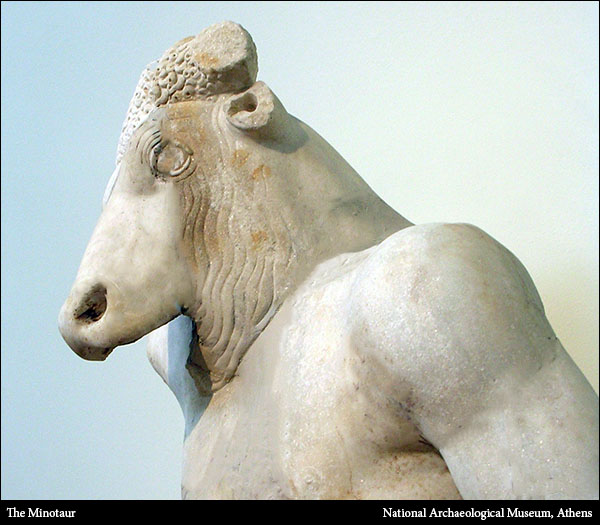
At approximately the same time, another tragedy befell King Minos ... his son Androgeos was killed in Athens when he competed in the first Panathenaea games ... Androgeos's death was no accident. Androgeos was an outstanding athlete and won all the competitions ... King Aigeus of Athens was outraged and had the boy killed. King Minos waged war on Athenians and forced them into submission. He instructed the master builder Daidalos to construct a labyrinth at Knossos and placed the Minotaur inside the maze of passageways ... he then demanded that the Athenians send seven young men and seven young women every nine years to Krete to be placed in the labyrinth and killed by the Minotaur.
The barbaric tradition continued until King Aigeus's son Theseus entered the labyrinth and killed the Minotaur.
Poseidon was said to have taken King Minos's daughter Euryale as his consort and sired the great hunter, Orion.
The Trojan War began circa 1250 BCE and was fought by mortals, demigods, and the Immortals. Poseidon was often in the midst of the fighting and clearly on the side of the Achaian Greeks against the Trojans. The Trojan War was an attempt by Zeus to rid the world of the demigods, i.e. the sons of the Immortals and mortal women. The war was staged and choreographed by the Immortals and the outcome was never in doubt by those watching from Mount Olympos.
The pretext for the war was the kidnapping of Helen of Argos. She was the wife of Spartan King Menelaos, and had been enchanted by Aphrodite (goddess of love) to flee her home and become the wife of Prince Alexandros (Paris) of Troy. The stage was set, the participants were in place, and ten years of bloody fighting followed.
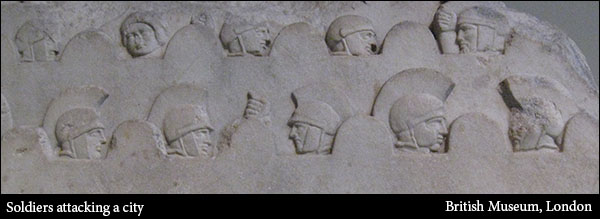
Prior to the Trojan War, Zeus commanded Poseidon and Apollon to serve King Laomedon of Troy for one year. Poseidon built the walls of Troy and Apollon tended Laomedon's herds. When their servitude was over, Laomedon refused to pay for their services and threatened to sell them into slavery. Apollon seemed more inclined to forgive the insult but Poseidon would not forgive or forget. When the final battle for Troy was fought, Poseidon fought fiercely on the side of the Achaians and helped topple the walls he had built.
In the tenth year of the war, Zeus still limited the roles the Immortals could play in the actual fighting. Certain rules had to be obeyed and Poseidon willingly did the bidding of Zeus to prolong the war. In a limited way, Poseidon would go among the Achaians in the guise of moral men and urge them to fight or strike soldiers with his staff to magically make them forget their fears and plunge into the Trojan defenses.
At one point during the fiercest fighting, Poseidon left his horses in an underwater cave between the islands of Tenedos and Imbros before he went ashore at the Achaian camp. He took the guise of the seer Kalkhas and approached Aias, son of Oileus, and Aias, son of Telamon ... both men were courageous and bold but Poseidon wanted to make sure they were at their best ... he touched them with his staff and filled them with power and valor. The two men charged into the Trojan defenses with determination. Satisfied with his deed, Poseidon flew off to Mount Olympos like a hawk.
As the Trojans became bolder and more aggressive, Poseidon felt as if he had to be more assertive to protect the Achaians. With the assistance of Zeus's sister-wife Hera, Poseidon devised a way to participate in the fighting without Zeus's knowledge. Hera met Zeus on Mount Ida where he was watching the war ... using a charm provided by Aphrodite and slumber induced by Hypnos (Sleep), Hera seduced Zeus. While Zeus was still in the thralls of love and lulled by sleep, Poseidon raged into the Trojan defenses and was nearly successful in destroying the Trojans but he became the victim of his own lust for blood ... the bellowing and earth-shaking clamor which arose from the battlefield awakened Zeus ... realizing the deception, Zeus summoned his faithful messenger Iris to go to Poseidon and command him to withdraw. Hearing Iris's message, Poseidon launched into a tirade. Iris listened patiently and asked if Poseidon wanted her to take his hostile words back to Zeus. She reminded Poseidon that the Erinyes (the Furies) always side with the elder brother, which in this case was Zeus. Poseidon understood the futility of his anger and praised Iris for being a messenger who knows what is proper.
Finally, Zeus called the Immortals together and told them the end of the war was at hand and the gods and goddesses could enter the fighting on any side they chose. Poseidon rushed to the side of the Achaians ... when he landed on the battlefield, the earth quaked with such force that Hades (lord of the dead) was afraid his halls would crack open. The final and most brutal phase of the war had begun but there were still rules that had to be obeyed. For example, when Achilles (the best warrior in the Achaian army) was poised to kill Aphrodite's son Aineias, Poseidon put a mist over Achilles's eyes and threw Aineias safely to the edge of the battlefield. The reason for this seemingly contradictory behavior was simply that Aineias was not destined to die in the war and Poseidon's long-range perspective superseded his personal hatred of the Trojans.
Achilles was without doubt the most brutal and dangerous man in the Achaian army. When he donned his god-made armor and charged into the Trojan defenses Poseidon and Athene met him on the battlefield and assured him that he would drive the Trojans back to their walls.
Poseidon and Apollon had one more score to settle before the war was over. Apollon had been fighting for the Trojans and now he and Poseidon were preparing to fight one another. Poseidon told Apollon that since he was the younger of the two, he should strike the first blow. Apollon wanted to back away from the fight and tried to reason with his uncle Poseidon ... Apollon could not understand why two Immortals should fight for the sake of mere mortals. The two gods did not fight but Apollon's sister Artemis scolded him for not wanting to fight because he had once bragged that he could match Poseidon in strength.
Despite the fierce fighting and the deaths of Achilles and Trojan Prince Hektor, the war was at a stalemate. The Achaians came up with a plan that was so brilliant it still has a place in our modern lexicon—the Trojan Horse. A man named Epeios, with the inspiration of the goddess Athene, designed and built a hollow Wooden Horse in which they could hide some of their best warriors. The Achaian army retreated to a nearby island so the Trojans would think the war was over and the attackers had finally given up their siege and gone home. The horse was then left in front of the gates of Troy with the assumption that the Trojans would take it into the city as a trophy.
Some of the Trojans thought the Wooden Horse was a symbol of peace and a tribute to the goddess Athene ... others thought the Wooden Horse was a trick and should be burned where it stood. The Trojan seer Laokoon tried to warn King Priam that the Wooden Horse was a trick and not a peace offering but Poseidon sent one of his giant ketos (sea-serpents) to kill Laokoon and one (or both) of his sons. King Priam assumed Laokoon was killed because he was giving false prophecy and ordered the Wooden Horse to be brought inside the walls of the city.
After the victory celebration was over and night had fallen, the Achaians emerged from the Wooden Horse and the war was over ... the Trojans were caught completely off-guard and were overwhelmed. The Trojan men were killed and the women and children were taken as slaves. Poseidon retreated to Mount Olympos but was soon stirred to wrath by two of the Achaian survivors of the Trojan War—Aias and Odysseus.
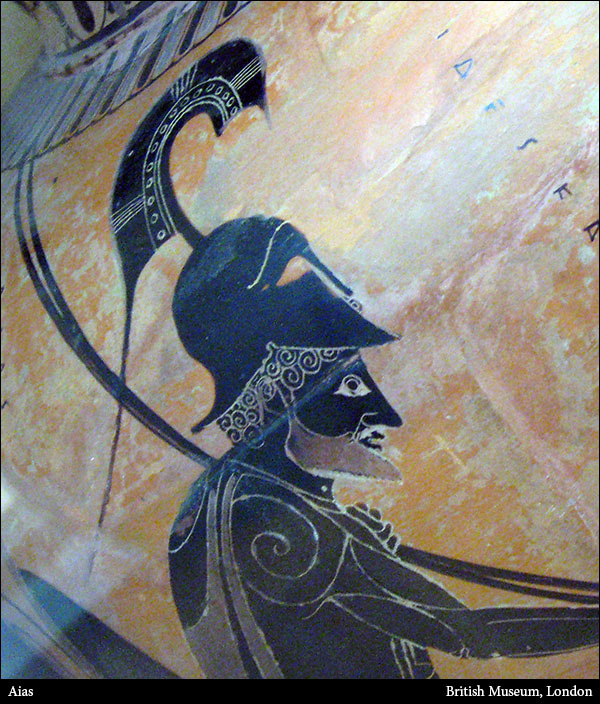
Telamonian Aias was the largest and, second only to Achilles, the fiercest fighter for the Achaians in the Trojan War ... he survived the war but was killed on the voyage home for insulting Poseidon.
While on the open sea, Poseidon drove Aias and his ships against the rocks of Gyrae in the Aigean Sea (their exact location is unknown to us). Poseidon did not intend to kill Aias when he dashed the ships against the rocks and to ensure that no injury would come to Aias, Poseidon prevented the goddess Athene from harming the hero. Not understanding the importance of what had befallen him, Aias began to rave madly and declared that he survived the Trojan War and the great gulf of the sea in spite of the Immortals and not because of their protection. He continued to rant and rave until Poseidon had heard enough ... Poseidon drove his trident against the rocks of the Gyrae and splintered off a piece that landed in the water next to Aias ... the surging water sucked Aias down to the depths of the sea where he drowned.
Odysseus was the king of the island Ithaka and played an important part in the Trojan War. Odysseus was not a large man but he was very strong and to add to his formidable fighting abilities, he was a brilliant negotiator and strategist. All these attributes served him well during the Trojan War but on the voyage home his bravado and cleverness could not prevent the deaths of all his comrades and the loss of all his ships.
Troy was in ruins and the plunder had been distributed amongst the Achaians. Odysseus did not anticipate any problems on his voyage home, but his expectations were soon dashed when his twelve ships were blown off course and he was forced ashore on the island of the Cyclopes.
Exploring the island, Odysseus and twelve of his men inadvertently entered the cave of the largest of all the Cyclopes, his name was Polyphemos—the son of Poseidon and the Nymph, Thoosa. Polyphemos, like all Cyclopes, was a "wheel-eyed" giant with one eye in the center of his forehead.
Regarding Odysseus as an intruder and not a guest, Polyphemos scorned the idea of offering gifts of hospitality. With no hesitation, he proceeded to eat several men before Odysseus rallied the survivors for a counterattack. Using potent wine, clever words and a sharpened log, Odysseus and his men blinded Polyphemos.
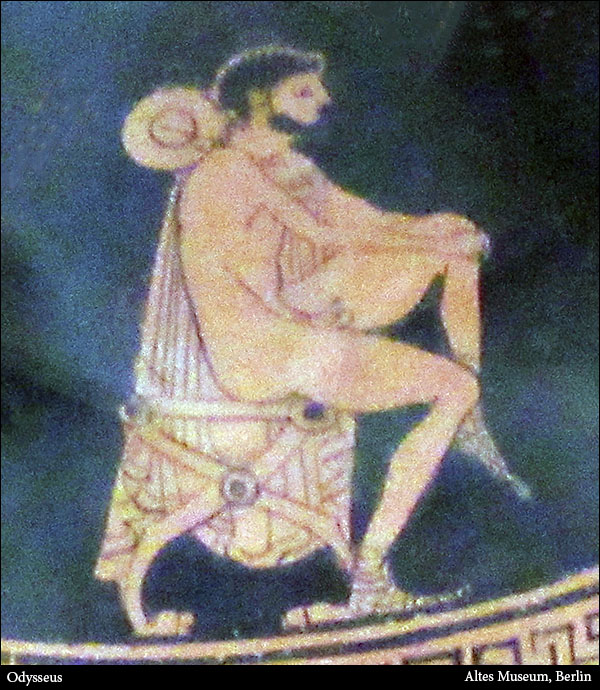
The sailors stole Polyphemos's flocks and made a hasty retreat. When the ships were a little distance from the shore, Odysseus could not contain his pride and anger, he called out to Polyphemos and said that the wrath of the gods had been justly administered and that good men had been the instrument of divine retribution. The sailors tried to restrain Odysseus, but his proud heart would not be silent. He shouted to Polyphemos that he was Odysseus, the sacker of cities from the island of Ithaka, and that he should have killed the evil Cyclops instead of just blinding him.
Polyphemos raised his arms to heaven and called upon his father to bring down vengeance on Odysseus, kill all his men, bring turmoil to his household and delay his homecoming for many years. Poseidon heard his son's plea and made it all come to pass.
Poseidon's revenge was tempered by Zeus who forbade Poseidon from killing Odysseus. For ten long years, Poseidon caused Odysseus constant misery, but he did not kill the haggard wanderer, he just kept driving him away from his home and happiness.
After all of Odysseus's comrades had been killed and all of his ships lost, Poseidon found his desperate prey on a raft drifting on the sea. The wind rose at Poseidon's command and with his trident, he staggered the sea and let loose the storm blasts against Odysseus ... the tiny raft shattered. As Odysseus clung to the remnants of the raft, the sea goddess Leukothea came to Odysseus and gave him her veil as protection against drowning but Odysseus was afraid that this was just another one of Poseidon's tricks and refused the goddesses' help ... when the raft was ready to sink in the turbulent sea, Odysseus took the goddesses' veil and began the three-day swim to the island of the Phaiakians. There were two mortal women who became sea-goddesses and called Leukothea—Poseidon's mistress on Rhodes and the stepmother of Phrixus and Helle, who rode the ram with the Golden Fleece. It's unclear as to which Leukothea saved Odysseus.
King Nausithoos, the original leader of the Phaiakians, was descended from Poseidon. When Odysseus arrived on their island, the Phaiakians had no knowledge of Poseidon's grudge against Odysseus. True to their benevolent nature, the Phaiakians treated Odysseus as an honored guest ... they bestowed many gifts on him and launched a ship to take him to his home on the island of Ithaka.
When the Phaiakians returned to their island, Poseidon punished them by turning their ship to stone and left it in the harbor as a permanent reminder of his displeasure. Satisfied that enough punishment had befallen Odysseus, Poseidon turned away from the long-suffering hero and made his way to his palace.
Agenor was the son of Poseidon and the Nymph, Libya. Agenor was king of the city of Tyre and the father of Europa, Kadmos, and Phineus.
Agenor lived two generations before the Trojan War, circa 1310 BCE. All three of his children played important roles in laying the foundations of the Greek culture. Europa was kidnapped by Zeus and taken to the island of Krete where her son Minos became the founder of a remarkable civilization. Kadmos went searching for Europa but, at the advice of the priestess of Apollon at Delphi, abandoned his search and founded the city of Thebes. Phineus was the blind seer who gave assistance to Ieson (Jason) and the Argonauts in their Quest for the Golden Fleece.
Alebion (perhaps his name was spelled Ialebion) was a son of Poseidon and the brother of Derkynus. After Herakles completed his Tenth Labor (Taking the Cattle of Geryon) he encountered the two brothers ... they obviously didn't realize who they were dealing with when they tried to forcibly take Geryon's cattle from Herakles ... their ignorance cost them their lives.
Leis, the daughter of Orus, and Poseidon had a son named Althepus. Orus was said to be the first man born in the area that became known as Troezen on the Peloponnesian Peninsula ... at that time, the country was called Oraea. When Althepus inherited the land from Orus, it was renamed Althepia. The traveler-historian Pausanias doubted the story because to him the name Orus was un-Greek and probably Egyptian.
Amphimarus was a son of Poseidon ... the poet Linus is thought to be the son of Amphimarus and the Muse, Ourania. Amphimarus won a reputation for music greater than that of any contemporary or predecessor ... Apollon killed him for being his rival in singing.
Amykos was the son of Poseidon and the Nymph, Melie. King Amykos of the Bebrykians was the cruel and arrogant man who demanded that travelers face him a boxing match. When the Argonauts arrived, he made his challenge not realizing the caliber of men he was facing. Polydeukes, a son Zeus, accepted the challenge and beat Amykos to death.
The Argonauts Ankaios and his brother Erginos were both sons of Poseidon and the Nymph, Astypalaia. Ankaios became the helmsman of their ship, the Argo, after the original helmsman, Tiphys, was killed.
Anthas and Hyperes were the sons of Poseidon and Alkyone, daughter of Atlas. The country of Althepia (later called Troezen) was passed down to Hyperes and Anthas ... they founded their own cities and named them Anthea and Hyperea.
Arion is the immoral son of Poseidon and Demeter (goddess of the harvest) ... he has the form of a horse ... he was ridden by King Adrestos (Adrastus) of Sikyon in two sieges on the city of Thebes—the Seven Against Thebes and the Epigoni.
Poseidon wanted to mate with his sister Demeter but she avoided him as best she could. When she hid in a herd of horses, she assumed the shape of a horse ... Poseidon was not fooled ... he too transformed into a horse and mated with her ... Arion was one offspring of that union.
The other child born to Poseidon and Demeter became a powerful and highly protected goddess known simply as "Mistress."
Asopos was the son of Poseidon and Kelusa ... in very ancient times, King Aras ruled Arantia northwest of the city of Korinth. During the rule of King Aras, Asopos discovered the waters of a river ... the city and land of Arantia have long since disappeared but the river still bears Asopos's name.
Aspledon was the son of Poseidon and the Nymph, Mideia. Its ironic that Aspledon, even though he was a son of the lord of the sea, gave his name to a city that had to be abandoned because of a water shortage.
The Libyans believed that the goddess Athene was the daughter of Poseidon and Lake Tritonis. The traveler-historian Pausanias thought the story had some credence because a statue he saw of Athene had blue eyes like Poseidon.
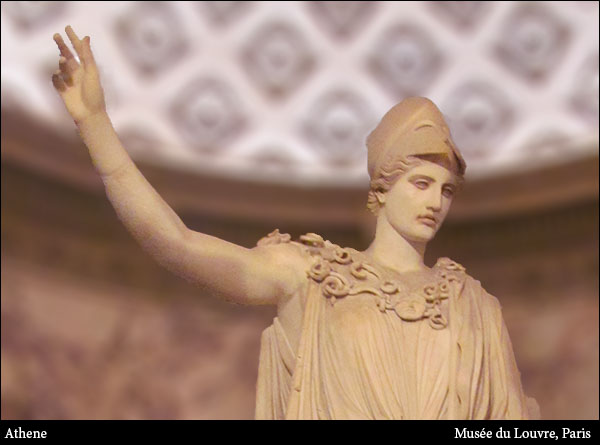
As a son of Poseidon, Atlas was the first king of the continent of Atlantis. Poseidon mated with a woman named Kleito who was the daughter of "Earth Born" parents. Poseidon terraformed a continent beyond the Pillars of Herakles and installed his sons as kings ... Atlas was the eldest son and the primary king of Atlantis. Atlas also gave his name to the Atlantic Ocean.
Bellerophontes was the son of Poseidon and Eurynome, the daughter of Nisus. Bellerophontes was blessed by the Immortals with beauty and manly stature. Anteia, queen of Ephyre, developed an unrequited affection for Bellerophontes. She did not accept his rejection well. Anteia lied and told her husband, King Proetus, that Bellerophontes had tried to force himself on her. Proetus was furious but too scrupulous to kill Bellerophontes. Proetus asked Bellerophontes to deliver a message to the ruler of Lykia, in southern Asia Minor. The message said simply, Kill This Messenger.
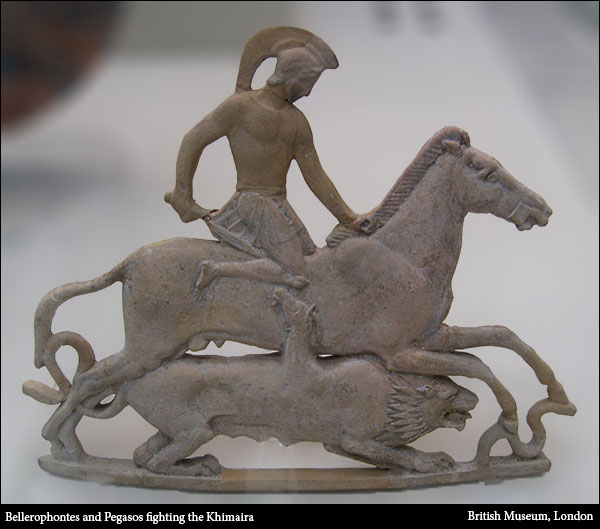
For nine days, the lord of Lykia entertained Bellerophontes without reading King Proetus's message but on the tenth day he finally read the message and devised a clever plan for killing Bellerophontes without having to resort to out-and-out murder. He sent Bellerophontes to kill a fire breathing she-beast called the Khimaira.
Bellerophontes had protection from his father and the goddess, Athene. To assure his success, Athene bridled the flying horse named Pegasos, which had been created from the blood of the severed head of the Gorgon, Medusa. Poseidon presented the immortal horse to Bellerophontes and, riding on the back of Pegasos, Bellerophontes killed the Khimaira.
Impressed by Bellerophontes's victorious return, the lord of Lykia sent him to fight a fierce tribe called the Solymoi. After disposing of the Solymoi, Bellerophontes was tasked with fighting the warrior women known as the Amazons. Bellerophontes's victories were so impressive the lord of Lykia offered him his daughter in marriage. Bellerophontes eventually lost the favor of the Immortals and spent his last days as a wanderer.
The Egyptians said the city of Babylon was colonized by Belus who was a son of Poseidon and the Nymph Libya.
Butes was a son of Poseidon. Butes's son Polykaon married Euaekhime who was the daughter of Hyllos, the son of Herakles.
On the Acropolis of Athens there was a building called the Erekhtheum ... inside the building were altars to Poseidon, Hephaistos, and Butes. On the walls were paintings representing members of the clan Butadae. Inside the building was a cistern filled with seawater that was remarkable for the noise of waves it produced when a south wind blew.
Byzas was a son of Poseidon and Keroessa, the daughter of the Heifer-Maiden Io. Byzas was acknowledged and celebrated in a festival as the founder of Byzantium.
Derkynus was a son of Poseidon and the brother of Alebion (perhaps his name was spelled Ialebion). After Herakles completed his Tenth Labor (Taking the Cattle of Geryon) he encountered the two brothers ... they obviously didn't realize who they were dealing with when they tried to forcibly take Geryon's cattle from Herakles ... their ignorance cost them their lives.
Kyzikos is a peninsula that juts into the Propontis (Sea of Marmara) from the Phrygian mainland north of the Aisepos River. Although not really an island, the peninsula of Kyzikos is often called Bear Island, Mount of Bears as well as Bear Mountain. A six-handed race called the Earthborn dwelled on Bear Island ... they were the aboriginal descendants of Poseidon. The Earthborn had two arms attached to their shoulders and four additional arms protruding from their sides.
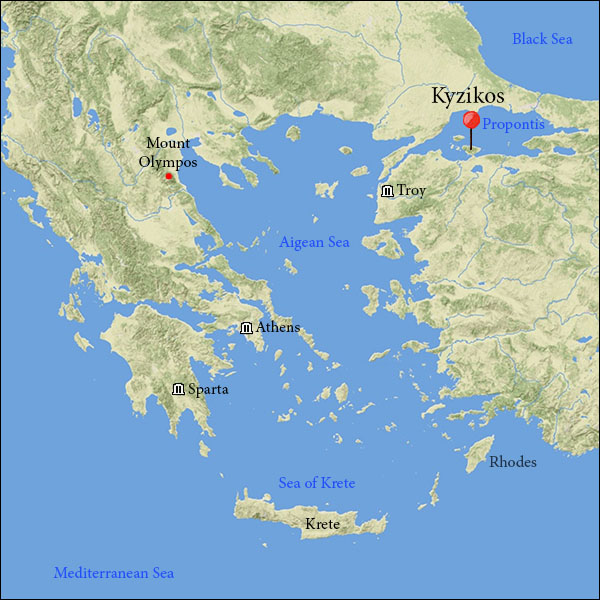
The Doliones also lived on Bear Island and were ruled by King Kyzikos. There had been a longstanding animosity between the Doliones and the Earthborn sons of Poseidon. The King Kyzikos entertained Ieson (Jason) and the Argonauts when they came ashore on Bear Island but as the Argonauts sailed on to resume their journey, they became disorientated. The Argonauts inadvertently sailed back to Bear Island, arriving after sunset. Not recognizing the Argonauts in the darkness, the Doliones attacked what they thought to be a contingent of the Earthborn warriors. During the confusion of the night-fight, Ieson killed King Kyzikos.
The traveler-historian Pausanias related a story he personally did not believe concerning how the district of Elis got its name. Originally the northwestern corner of the Peloponnesian Peninsula was named after Aetolus, the son of Endymion. After the death of Aetolus the kingdom fell to his nephew Eleius, the son of Eurykyda, daughter of Endymion ... many believed that Eleius was the son of Poseidon and gave the inhabitants their present name of Eleans in place of Epeians.
Ephialtes and his brother Otos were the monstrous sons of Iphimedeia and Poseidon. Iphimedeia was married to a man named Aloeus but she was seduced by Poseidon and the magnificently terrible brothers were the result of that union. Although they were incredibly large, Ephialtes and Otos were really quite beautiful ... second only to the mighty hunter Orion, Otos and Ephialtes were the most handsome demigods to ever exist. The two brothers were by far the tallest men ever to reside on the earth ... when they were nine years old, they were nine cubits across and nine fathoms tall ... the units of measurement (yards, cubits and fathoms) varies with each translator but the number nine is used consistently.
In the Iliad by Homer, we are given an amazing story demonstrating the physical prowess and audacity of Otos and Ephialtes. After a confrontation with the gigantic brothers, Ares (god of war) was bound in chains and imprisoned in a cauldron. Ares remained in that humiliating and helpless situation for thirteen months until he was finally freed when Eeriboia, the stepmother of Otos and Ephialtes, told the god Hermes of Ares's plight.
Before the two brothers reached adulthood, they brought about their own doom by daring to try and reach the heavens. The two rebellious boys tried unsuccessfully to pile Mount Ossa on top of Mount Olympos and then put Mount Pelion on top of that. Their intentions were so outrageous that Zeus commanded Apollon to kill Otos and Ephialtes with a rain of arrows.
The Argonauts Erginos and his brother Ankaios were both sons of Poseidon and Astypalaia.
Erginos was the father of the legendary architects, Trophonius and Agamedes, who were credited with building the temple of Apollon at Delphi.
According to the traveler-historian Pausanias, Eumolpus was the son of Poseidon and Khione, the daughter of Boreas (North Wind) and Oreithyia. Homer says nothing about the descendants of Eumolpus, but describes him as being "manly."
Euphemos was the son of Poseidon and Europe, daughter of Tityos. Euphemos was chosen as an Argonaut in the Quest for the Golden Fleece because of his ability to skim across the sea only getting his toes wet.
Eurypylos was the son of Poseidon and Mestra, the daughter of Erysikhthon. Poseidon gave Mestra the ability to change shapes into whatever form she wished.
Mestra's father Erysikhthon angered the goddess Demeter when he cut down one of her sacred groves. As punishment for his sacrilege, Demeter inflicted Erysikhthon with an insatiable hunger ... no matter how much he ate, he was always at the point of starvation. In order to satisfy his unquenchable appetite, Erysikhthon would sell Mestra and use the money to buy food; after being sold or promised in marriage for a dowry, Mestra would transform into an animal and return to her father so they could repeat the deception over and over again.
The goddess Athene put an end to Erysikhthon's schemes and Poseidon transported Mestra to the island of Kos where she gave birth to Eurypylos.
Eurytos and his brother Kteatos were sons of Poseidon and Molione. Molione was married to Aktor and he raised Poseidon's sons as if they were his own. Eurytos and Kteatos each had four feet and two heads.
Halirrhothius was a son of Poseidon but he incurred the wrath of Ares (god of war) when the lusty young man attacked the virgin daughter of Ares at the Kalos Spring near the Acropolis in Athens. For killing Halirrhothius, Ares was the first to be put on trial for murder but was acquitted because his offence was considered justified.
Hippothoon was the son of Poseidon and Alope, daughter of Kerkyon.
Kerkyon tried his best to protect Alope from Poseidon but she became pregnant anyway ... when she gave birth to Hippothoon, Kerkyon put Alope to death.
Hyperes and Anthas were the sons of Poseidon and Alkyone, daughter of Atlas. The country of Althepia (later called Troezen) was passed down to Hyperes and Anthas ... they founded their own cities and named them Hyperea and Anthea.
Kenkhrias and Lekhes were the sons of Poseidon and Peirene (she was either the daughter of Acheloios or Oebalus). The harbors of the city of Korinth were named after Kenkhrias and Lekhes.
According to the Athenian author Khoerilus, Kerkyon was the brother of Triptolemus ... their mother was the daughter of Amphiktyon ... the father of Triptolemus was Rarus but Kerkyon's father was Poseidon.
Kharybdis was the most formidable whirlpool in the sea ... as the daughter of Poseidon and Ge (Earth), she inhabited the waters in the Strait of Messina between Italy and Sicily. Kharybdis would alternately suck down and spews forth the waters of the strait and posed a constant danger to all sea traffic. Across the strait from Kharybdis was the six-headed beast, Skylla. When ships sail past, they will be menaced by either Skylla or Kharybdis ... both were deadly and both were insatiable.
The only historical references we have of encounters with Kharybdis and Skylla are from the voyages of Ieson (Jason) and the Argonauts and Odysseus. Circa 1260 BCE, a generation before the Trojan War, Ieson and the Argonauts were required to sail between Kharybdis and Skylla but with the assistance of the goddess Hera they were able to sail through the dangerous strait without loss of life. Circa 1240 BCE, after the Trojan War, Odysseus had to make the difficult decision as to whether to sail by Kharybdis or Skylla. His fear of Kharybdis was justified because Skylla might snatch six or a dozen men from the decks of the ships whereas Kharybdis could drown the whole fleet. Odysseus only lost six men to Skylla.
When Poseidon mated with the Gorgon Medusa, he was not turned to stone ... he must have avoided her gaze.
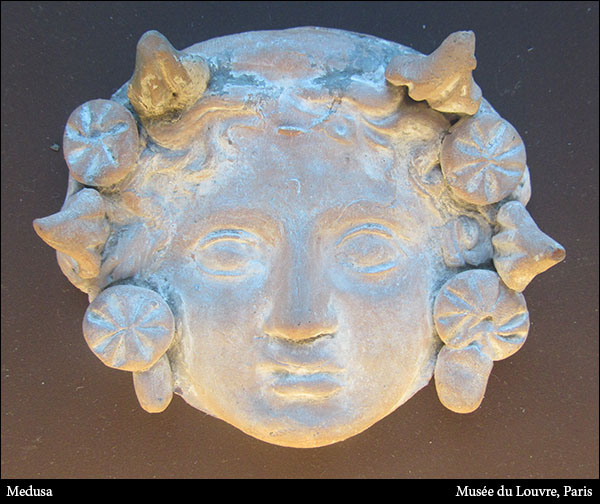
There were three Gorgons—Medusa, Sthenno and Euryale. Of the three, only Medusa was mortal. The gaze of the Gorgons could turn any creature, mortal or immortal, to stone. The gruesome death and blood of Medusa engendered a variety of creatures. We might consider those creatures the children of Medusa and Poseidon. Khrysaor was one of the creatures to be born from Medusa's blood.
There is no actual physical description of Khrysaor but he is usually assumed to be monstrous because his children were the three-headed Geryon and the snake-like monster, Ekhidna. Khrysaor's his name was derived from his golden sword, (Khyseos means Golden and Aor means Sword).
Khryses was the son of Poseidon by Khrysogeneia, daughter of Almus. Khryses was vital to the future of the Greeks because he was the father of Minyas, the eponymous founder of the Minyans from which Achilles and a majority of the Argonauts descended.
Krinakos was the son of Poseidon and Alkyone.
Kromos was a son of Poseidon. The city of Kromyon in the Korinthian territory was named after Kromos.
Kteatos and his brother Eurytos were sons of Poseidon and Molione. Molione was married to Aktor and he raised Poseidon's sons as if they were his own. Kteatos and Eurytos each had four feet and two heads.
Kyknos was a son of Poseidon and had the dubious distinction of being the first man to be killed by Achilles at the siege of Troy, which means that Kyknos died circa 1250 BCE.
Kymopoleia was the daughter of Poseidon and the wife of Briareos.
Briareos was one of the most terrible creatures ever spawned by Ge (Earth) and Ouranos (Heaven), he had fifty heads and fifty arms sprouting from his massive shoulders.
Lamia was the daughter of Poseidon who became the consort of Zeus. With Zeus as the father, Lamia was the mother of Herophile, the first woman to chant oracles. Herophile would stand on a rock at Delphi and chant the will of Zeus ... the Libyans later gave her the surname Sibyl.
Lekhes and Kenkhrias were the sons of Poseidon and Peirene (she was either the daughter of Acheloios or Oebalus). The harbors of the city of Korinth were named after Lekhes and Kenkhrias.
Lelex was a son of Poseidon and Libya, daughter of Epphus ... Lelex came to the city of Nisaea from Egypt and was made king. His son Myles (Mill-Man) was the first human being to invent a mill and grind corn.
Makhaon and Podaleirios were physicians who became famous at the siege of Troy ... Makhaon treated wounds and Podaleirios treated illnesses. It is generally accepted that they were the sons Asklepios, Apollon's son, but it was also recorded that they were in fact the sons of Poseidon.
Megareus was a son of Poseidon from "holy Onkhestos." According to the Boeotians, Megareus led a contingent of Boeotian soldiers to support King Nisus of Nisa in his war against King Minos of Krete. Megareus was killed in the fighting and buried where he fell. The city of Nisa was renamed to honor Megareus and thus called Megara.
Minyas was the founder of the Minyan culture of Orkhomenos in Boeotia and Iolkos circa 2000 BCE. He was the son of Poseidon and Euryanassa, daughter of Phylakos and Hyperphas.
Minyas was the father of Klymene and the great-grandfather of Ieson (Jason), who led the Argonauts in their Quest for the Golden Fleece. The Argonauts called themselves Minyans because, in one way or another, most of them were descended from Minyas.
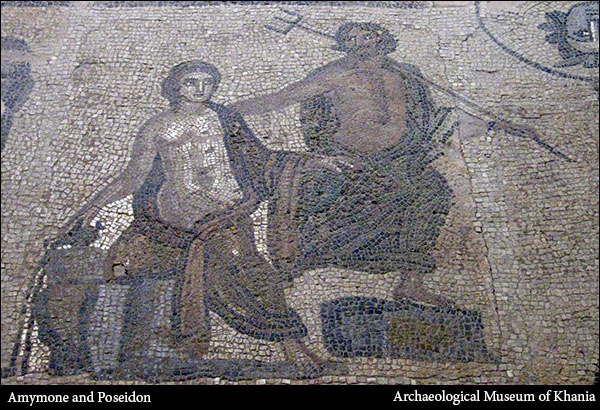
Nauplios was a son of Poseidon and Amymone, daughter of Danaus ... he exceeded all mortals in seamanship. Nauplios was the ancestor of an Argonaut who was also named Nauplios.
King Nausithoos was the original leader of the Phaiakians ... he was descended from Poseidon and Giants. Nausithoos had two male children, Alkinoos and Rhexenor. Rhexenor was married and Alkinoos was not ... Apollon killed Rhexenor with a shower of painless arrows and Alkinoos married Rhexenor's daughter, Arete.
The Phaiakians lived on the secluded island of Skheria. The location of Skheria was known only to the Immortals but was accidentally discovered by Odysseus and Ieson, leader of the Argonauts.
Neleus and Pelias were the sons of Poseidon and Tyro, daughter of King Salmoneus of Elis. Using a bit of skullduggery, but legitimate nonetheless, Neleus became king of the port city of Pylos on the western Peloponnesian Peninsula. Using dubious and immoral tactics, Pelias became king of the city of Iolkos. Neleus ruled Pylos two generations before the Trojan War, i.e. circa 1310 BCE.
Tyro eventually married a mortal man named Kretheus ... they had a son named Aeson who became the half-brother of Neleus and Pelias.
The legendary hero Herakles asked King Neleus to be absolved of the crime of murder ... Herakles had killed a man named Iphitos ... Neleus refused. In a fit of rage, Herakles killed eleven of Neleus's twelve sons. Neleus's only surviving son was Nestor ... he became king of Pylos after Neleus's death. Nestor lived a life of adventure and honor and will always be remembered as the aged and wise Achaian commander at the siege of Troy.
Oeoklos was the son of Poseidon and Askra. Oeoklos had the distinction of being the co-founder of a city named after his mother ... the other two founders of the city of Askra were also sons of Poseidon, the giants Otos and Ephialtes.
Onkhestos was the son of Poseidon and eponymous founder of the city of Onkhestos, which was located near Thebes, Boeotia. The city was praised by the poet Homer when he called it "holy Onkhestos, the bright grove of Poseidon."
There were several accounts as to how Orion was conceived but the poet Hesiod said he was the son of Poseidon and Euryale, a daughter of King Minos of the island of Krete. Orion was a Giant ... also known as The Hunter.
Poseidon gave Orion the ability to walk on water as if it were land. He went to the island of Khios and, in a state of drunkenness, ravaged a woman named Merope. Her father blinded Orion forcing him to flee to the island of Lemnos. The god Hephaistos took pity on the blind hunter and gave him a servant named Kedalion to act as his guide. Orion carried Kedalion on his shoulders to point out the roads and help him find his way around the world.
Orion and Kedalion were traveling in the east, presumably Asia Minor, when Helios (Sun) saw the pitiful blind hunter and healed him. Unrepentant, Orion resumed his prideful and indulgent life. When he ventured to the island of Krete he hunted with the goddesses Artemis and Leto. His zeal for hunting made him boast that he would kill every wild animal on the earth. Outraged by his boasting, Ge (Earth) sent a giant scorpion to kill Orion and, after his death, Artemis and Leto persuaded Zeus to place Orion in the heavens as a constellation.
Otos and his brother Ephialtes were the monstrous sons of Iphimedeia and Poseidon. Iphimedeia was married to a man named Aloeus but she was seduced by Poseidon and the magnificently terrible brothers were the result of that union. Although they were incredibly large, Ephialtes and Otos were really quite beautiful ... second only to the mighty hunter Orion, Otos and Ephialtes were the most handsome demigods to ever exist. The two brothers were by far the tallest men ever to reside on the earth ... when they were nine years old, they were nine cubits across and nine fathoms tall ... the units of measurement (yards, cubits and fathoms) varies with each translator but the number nine is used consistently.
In the Iliad by Homer, we are given an amazing story demonstrating the physical prowess and audacity of Otos and Ephialtes. After a confrontation with the gigantic brothers, Ares (god of war) was bound in chains and imprisoned in a cauldron. Ares remained in that humiliating and helpless situation for thirteen months until he was finally freed when Eeriboia, the stepmother of Otos and Ephialtes, told the god Hermes of Ares's plight.
Before the two brothers reached adulthood, they brought about their own doom by daring to try and reach the heavens. The two rebellious boys tried unsuccessfully to pile Mount Ossa on top of Mount Olympos and then put Mount Pelion on top of that. Their intentions were so outrageous that Zeus commanded Apollon to kill Otos and Ephialtes with a rain of arrows.
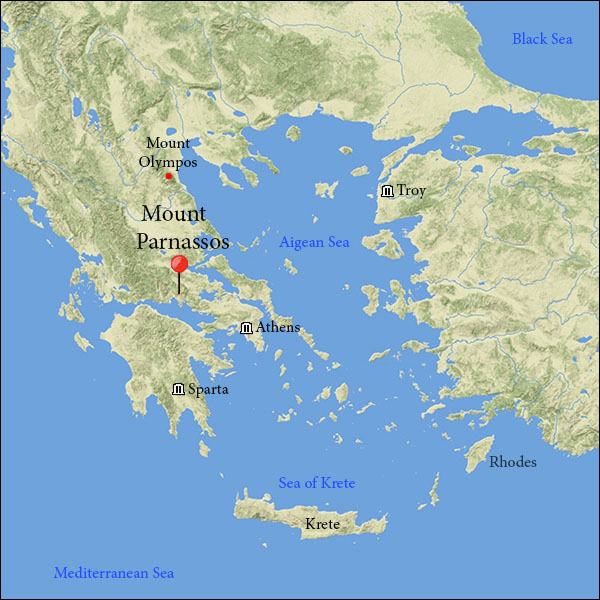
Parnassos was the son of Poseidon and a Nymph named Kleodora who lived on the mountain that would bear the name of her son Parnassos. He was raised by a mortal man named Kleopompos. Parnassos gave his name to the mountain and also the surrounding Parnassian Glen ... he discovered the art of augury—fortelling the future from the flight and cries of birds.
When Poseidon mated with the Gorgon Medusa, he was not turned to stone ... he must have avoided her gaze.
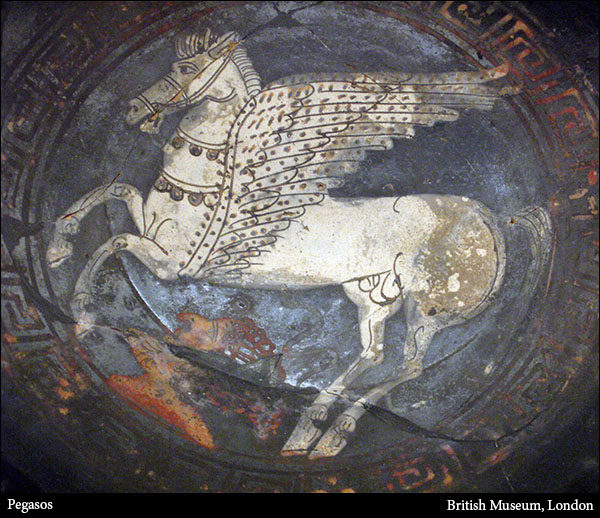
There were three Gorgons—Medusa, Sthenno and Euryale. Of the three, only Medusa was mortal. The gaze of the Gorgons could turn any creature, mortal or immortal, to stone. The gruesome death and blood of Medusa engendered a variety of creatures. We might consider those creatures the children of Medusa and Poseidon. Pegasos was one of the more benevolent creatures to be born from Medusa's blood.
Pegasos opened the spring of Hippokrene on Mount Helikon with a stroke of his hoof. Pegasos is most famous because he and carried Bellerophontes in his battle with the fire breathing she-beast with three heads, the Khimaira. Since Pegasos was born "near the springs of Ocean" (springs = pegas), his name became Pegasos ... he resides on Mount Olympos and carries the thunder and lightning for Zeus.
Pelias was the son of Poseidon and Tyro, daughter of King Salmoneus of Elis ... Pelias was also the brother of King Neleus of Pylos.
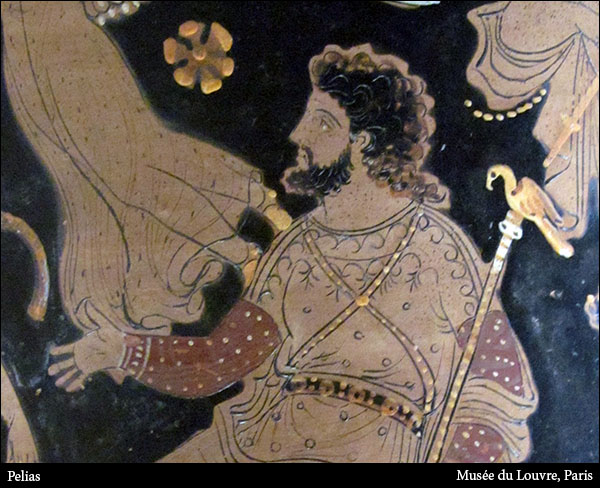
Pelias was said to have been a hard and cruel man ... he assumed the throne of Iolkos because he was of semidivine birth and relegated his stepbrothers to lives of submission ... his stepbrothers Amythaon and Aeson thought Aeson's son Ieson (Jason) should be the next king of Iolkos.
Pelias told Ieson he could become the next king if he would go to the distant land of Kolkhis and retrieve the Golden Fleece, which had been created by Helios (Sun) and left at Kolkhis. Ieson agreed to go to Kolkhis and bring back the Golden Fleece but he did not realize Pelias was trying to send him to his death.
The Quest for the Golden Fleece became a glorious victory for Ieson but when he returned to Iolkos with his sorceress wife Princess Medeia, he discovered that his father Aeson was dead. Whether it was true or not, Ieson believed that Pelias was responsible for his Aeson's death. Ieson was determined to kill Pelias but he did not have enough men to force his way into the city. Medeia was a clever and deadly woman. She contrived a plan which would allow Ieson to kill Pelias and take the city without a fight ... she entered the city in the guise of an old hag and pretended to be a messenger of the goddess Artemis.
Medeia convinced the people of Iolkos of her divine mission with a series of magic tricks and gradually won the trust of Pelias's daughters. She told the gullible girls she could restore Pelias's youthful vigor with one of her potions. Using simple slight-of-hand magic, Medeia demonstrated the process on an old ram ... the beast was chopped to pieces and then put in a caldron with her secret concoction ... a young animal emerged from the caldron and Pelias's daughters were convinced Medeia had supernatural powers. Medeia then drank a harmless liquid and cleverly removed the hag disguise to further delude the girls; when they saw the youthful Medeia, they unwittingly agreed to cut their father into pieces and thus have his youth restored. Medeia drugged Pelias and his daughters hacked him to pieces.
Pelias died soon after the Quest for the Golden Fleece was completed which would have been circa 1285 BCE.
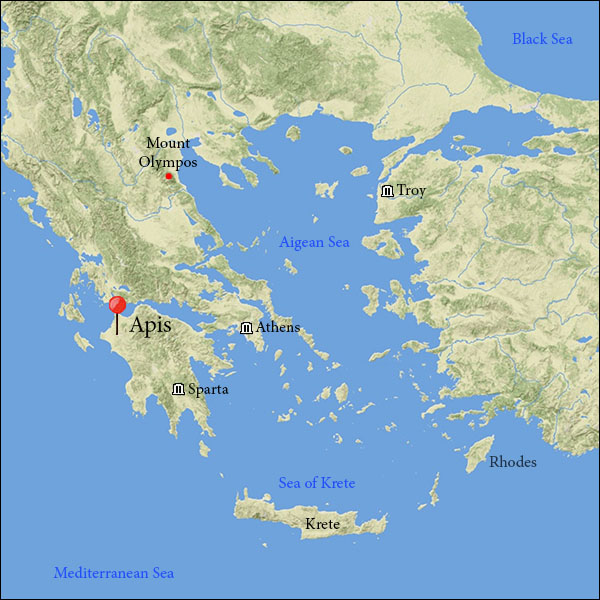
Peratus was the son of Poseidon by a woman named Kalkhinia, the only child of Leukippus. After his birth, Peratus was raised by Leukippus and eventually inherited Leukippus's kingdom of Apis, which later became known as Olympia on the Peloponnesian Peninsula.
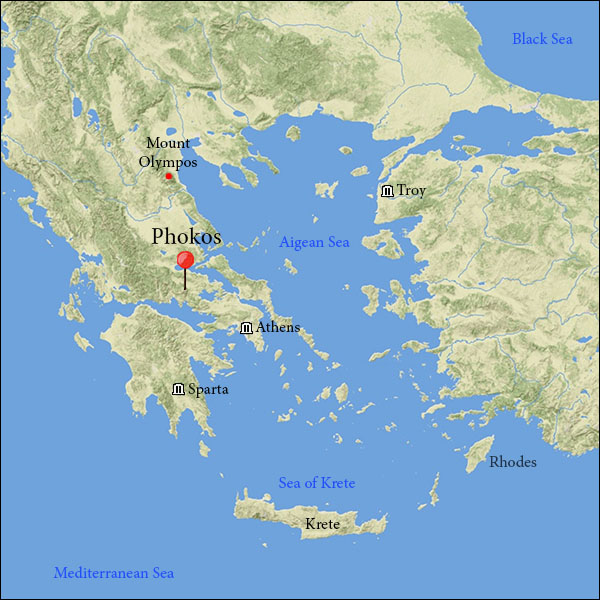
Phokos was thought to be the son of Poseidon with Ornytion as the "stepfather" ... Phokos was raised by Ornytion and eventually became the eponymous founder of Phokis, which lies north of the Gulf of Korinth.
Podaleirios and Makhaon were physicians who became famous at the siege of Troy ... Podaleirios treated illnesses and Makhaon treated wounds. It is generally accepted that they were the sons Asklepios, Apollon's son, but it was also recorded that they were in fact the sons of Poseidon.
Polyphemos was the Cyclops son of Poseidon and the sea Nymph Thoosa. The Cyclopes were a peculiar race of beings with one eye in the center of their foreheads. Polyphemos lived with other Cyclopes on an island in an undisclosed location.
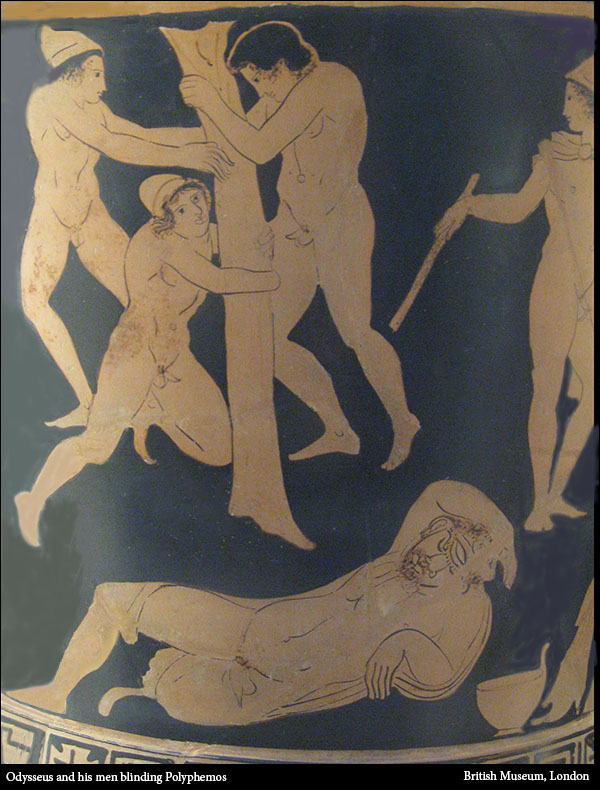
King Odysseus of Ithaka left the ruined city of Troy with his plunder and surviving men circa 1240 BCE. His voyage home was abruptly interrupted when he blundered onto the island of the Cyclopes and had a tragic encounter with Polyphemos. Before their encounter, Polyphemos had been given a prophecy warning him about a stranger named Odysseus.
Exploring the island for supplies and expecting hospitality from the inhabitants, Odysseus and twelve of his men became trapped in Polyphemos's cave. Polyphemos offered no hospitality ... the beastly Cyclops began to eat Odysseus's men. Odysseus told Polyphemos that his name was Nobody and cleverly tricked the Cyclops into drinking some potent wine. While Polyphemos slept in a drunken stupor, Odysseus blinded him with a searing tree trunk and escaped the cave.
As Odysseus and his men were fleeing the island, Odysseus shouted insults at Polyphemos and revealed his true name. Polyphemos realized the prophecy had come true and called to his father Poseidon for justice. Poseidon's fury caused the deaths of all of Odysseus's men as well as a ten-year ordeal before Odysseus was allowed to return to his home and family.
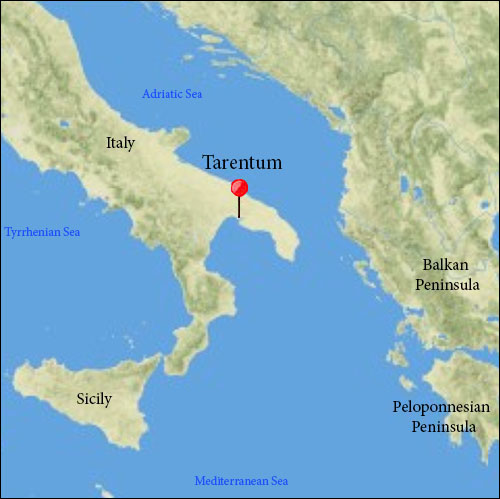
Taras was the eponymous founder of the prosperous costal city of Tarentum. He was the son of Poseidon and a Nymph of that country.
Triton was a son of Poseidon and the Nereid, Amphitrite ... he had the head and body of a man and the tail of a fish ... he used a conch shell as his trumpet.
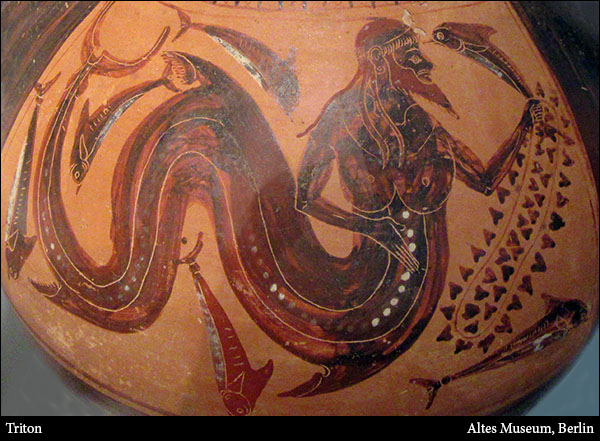
After retrieving the Golden Fleece, Ieson (Jason) and the Argonauts were stranded in Libya (northern Africa) on the shores of the Tritonian Lake—Triton's Lake. The Argonauts could not find their way to the sea and were in desperate need of divine assistance. They set out a tripod Ieson had been given at the temple of Apollon at Delphi as an offering, hoping an Immortal would see their plight and come to their assistance. Triton accepted their gift and rose from the depths in the guise of a young man.
The tripod indicated they had Apollon's blessing and their ship was clear evidence they had Athene and Hera's protection, but they were stranded in Triton's domain and needed his help. Triton humbly apologized that the barren land around his lake afforded no appropriate gifts, so he offered them a clod of earth. He then showed them the course they should take to reach the sea. The clod of earth would later prove to be the "seed" for the island of Thera.
Although they were not children of Poseidon, Homer and Hesiod were thought to be his direct descendants and therefore infused with his divine blood. The poem The Contest of Homer and Hesiod gives a glimpse of their linage and might be represented as follows:
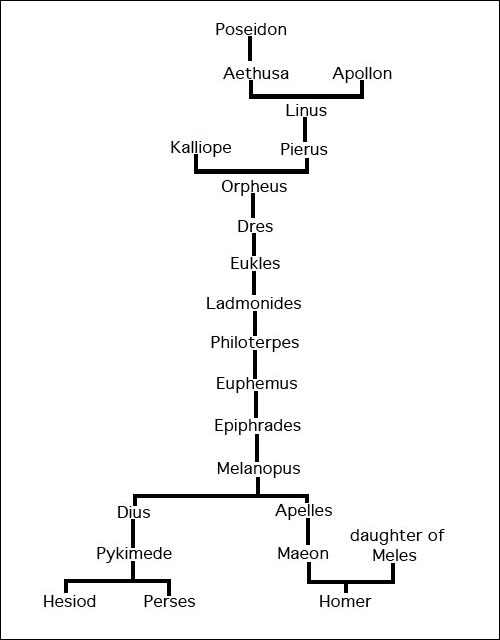
There is a brief mention in the Iliad by Homer of an incident involving Poseidon, Hera, and Athene ... they put Zeus in shackles!
The relations between Hera and Zeus were always contentious but her aggression was usually tempered with caution. Athene was a devoted daughter to Zeus but sometimes she became involved in the intrigues of Hera and incurred Zeus's displeasure. Of the Olympians, Poseidon was second only to Zeus in power and nobility ... his submissiveness to Zeus was a matter of respect ... not fear.
We are told that Zeus was in shackles when the Nereid Thetis found him ... she was powerless against Poseidon, Hera, and Athene so she summoned Briareos to Mount Olympos ... Briareos did not have to use his incredible strength against the rebel Immortals ... he simply sat beside Zeus and the conflict was over. We are not told exactly how the shackles were removed but we might assume that Briareos easily ripped them off. Briareos was one of the first sons of Ge (Earth) and Ouranos (Heaven) ... he had fifty heads and fifty arms ... he was more than a match for the individual or combined might of Poseidon, Hera, and Athene.
Arethusa, daughter of Hyperes, had an affair with Poseidon and incurred the wrath of the goddess Hera. As to why Hera was enraged with this situation is not made clear but it appears that Arethusa was transformed into a fountain simply because she became the consort of Poseidon.
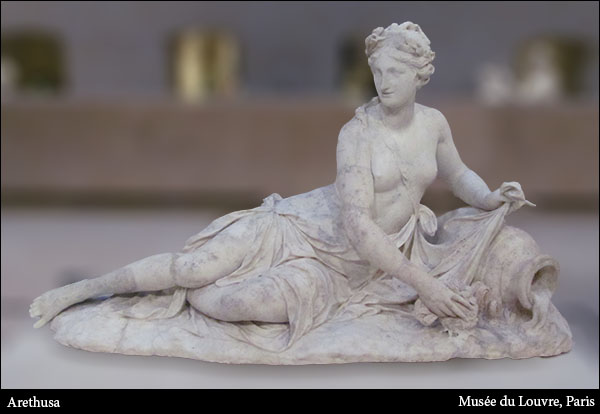
The Catalogue of Women gives an interesting account of Poseidon's lovers ... the list includes: Amymone, Iphimedeia, Lapethea, Methone, Alkyone, Kelaeno, Kalyke, Mekionike, Laodike, Tyro, Polyboea, and the mortal Gorgon (Medusa).
Poseidon became infatuated with a mortal woman who happened to be the daughter of the king of the Lapiths ... her name was Kaenis. The young woman was reluctant to become the consort of a god so in order to win her affection, Poseidon agreed to give her anything she desired ... her wish was to be turned into an man ... her wish was granted and she was thereafter called Kaeneos.
Periklymenos was the eldest son of Neleus and Khloris ... Neleus was a son of Poseidon, therefore Periklymenos was Poseidon's grandson. Poseidon gave Periklymenos boundless strength and the ability to assume any shape he desired. Periklymenos could transform into an eagle, an ant, a swarm of bees, a snake or any other form.
Periklymenos sailed with Ieson (Jason) and the Argonauts but his individual exploits are not mentioned in the Argonautika by Apollonius of Rhodes. Another Argonaut named Iphitos played an important role in the eventual death of Periklymenos at the hands of Herakles.
After the voyage of the Argonauts, Herakles threw Iphitos from the walls of the city of Tiryns. When Herakles asked Neleus for absolution for the murder of Iphitos, Neleus refused ... in a rage, Herakles killed Periklymenos and ten of his brothers.
During the fight with Periklymenos, the goddess Athene warned Herakles about Periklymenos's shape-shifting abilities. When Periklymenos assumed the shape of a bird and perched on the yoke-boss of Herakles's chariot, Herakles killed Periklymenos with an arrow.
Poseidon endowed several mortals with the ability to be shape-shifters ... they could assume the guise of a variety of people or animals ... a woman named Mestra was given that facility but she chose to use it in a very questionable way.
Mestra was the daughter of a cursed man named Erysikhthon ... he had violated a sacred grove of Demeter (goddess of the harvest) and she cursed him with unquenchable hunger. To support his voracious appetite, he would either sell Mestra or collect a marriage dowry and then she would shape-shift and desert her owner or husband. When she was reunited with her father, they would repeat the deception over and over again.
The goddess Athene finally put an end to their schemes ... Poseidon transported Mestra to the island of Kos where she gave birth to Poseidon's son, Eurypylos.
Poseidon was surnamed Prosklystios (Flooder) by the people of Argos on the Peloponnesian Peninsula for what might seem to be obvious reasons but is actually quite convoluted.
There was an important debate as to which of the Immortals had dominion over Argos. The people reasoned that since the goddess Hera was often called Hera of Argos, she should be honored above all other deities ... Hera did not agree. She induced Poseidon to flood the lowlands to show his dominance and her displeasure. The people understood exactly what was expected of them ... they built a temple for Poseidon Prosklystios at the spot where the tide ebbed.
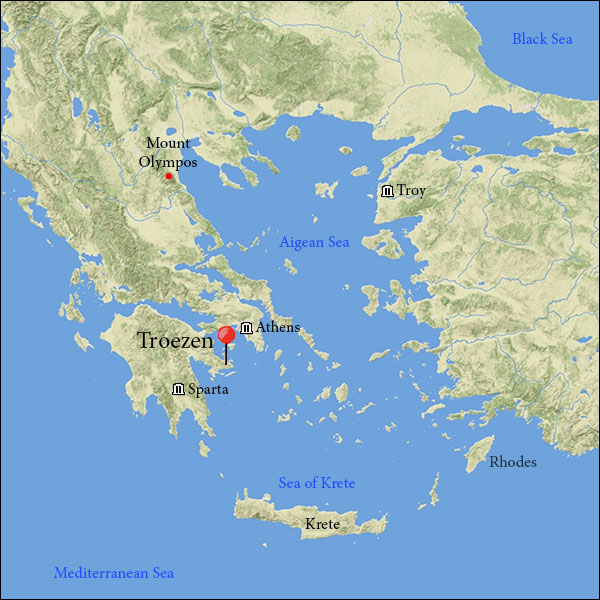
Near the city of Troezen on the southern Peloponnesian Peninsula is a sanctuary of Poseidon Phytalmios (Nurturer). The sanctuary was established to appease Poseidon for inundating the farmland and making it barren. The reason Poseidon was wroth with the people of Troezen is not stated but after the sanctuary was set aside for Poseidon as the Nurturer, the punishment ceased.
Aithre was the mother of the Athenian hero Theseus ... she became pregnant as the consort of King Aigeus of Athens and raised Theseus at Troezen until he was old enough to join his father and claim his royal inheritance.
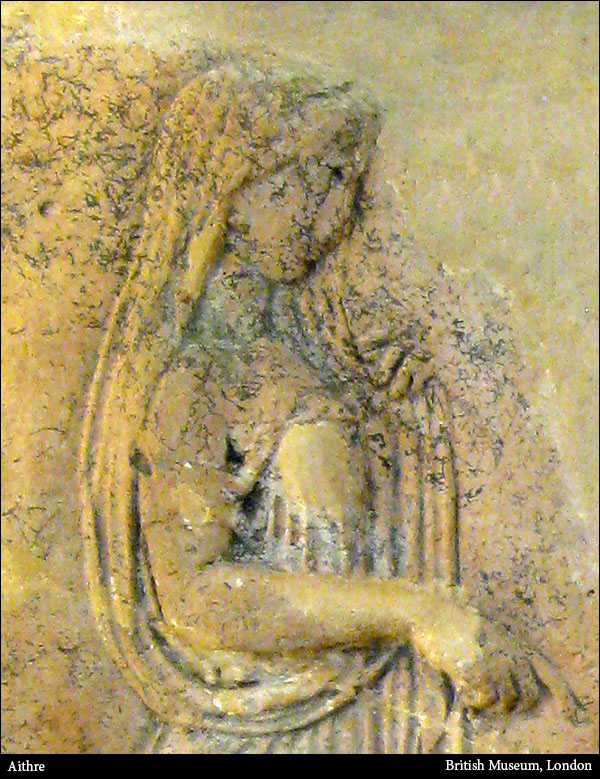
No precise time frame is given for the following incident but it's assumed to have happened sometime after the birth of Theseus. One of the islands near the mainland was named Sphaeria to honor the hero Sphaerus who was buried on the island ... Sphaerus had been the charioteer of Pelops. Aithre had a dream inspired by the goddess Athene ... the goddess instructed Aithre to cross over the shallow waters to the island ... Poseidon was waiting for Aithre when she arrived on the island and had relations with her. To commemorate the occurrence, Aithre had a temple built and dedicated it to Athene Apaturia (Deceiver). It became the custom for Troezenian maidens to dedicate their girdles to Athene Apaturia before they married.
The oracle of Apollon at Kalaurea implied that before Apollon established his shrine at Delphi, the site was sacred to Poseidon.
Also the poet Musaeus, son of Antiophemus, said that before Apollon came to Delphi, the oracle belonged to Ge (Earth) and Poseidon. Ge gave her oracles herself, but Poseidon used a man named Pyrkon as his medium in giving responses.
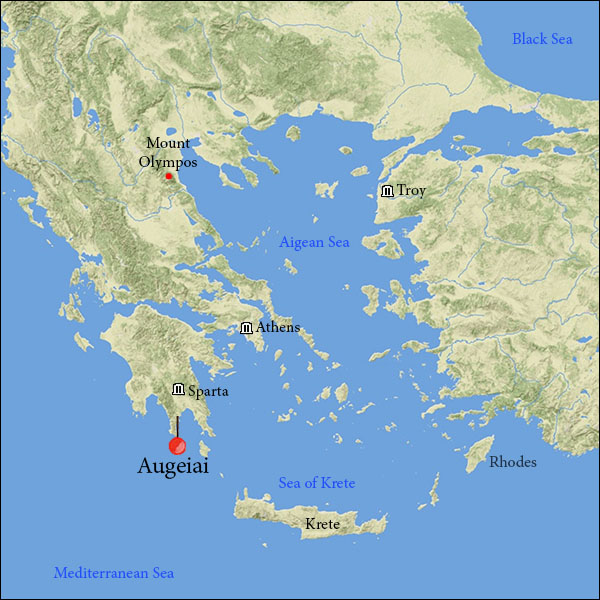
In Lakonia near the city of Augeiai was a body of water called Poseidon's Lake ... there was a temple with a statue of Poseidon next to the lake. No fish were taken from the lake because after fishing in the lake, fishermen transformed into a fish called "the fisher." The city is now called Gytheio.
Circa 464 BCE the Spartans incurred the wrath of Poseidon by violating the sanctity of supplicants. Several criminals were found guilty of serious crimes and condemned to death. When the opportunity arose, the condemned men escaped and fled to the town of Taenarum ... they presented themselves as supplicants and expected to be protected under common law ... the Spartan Ephors were more interested in justice than formalities ... they seized the men and put them to death. Poseidon "razed all their city to the ground."
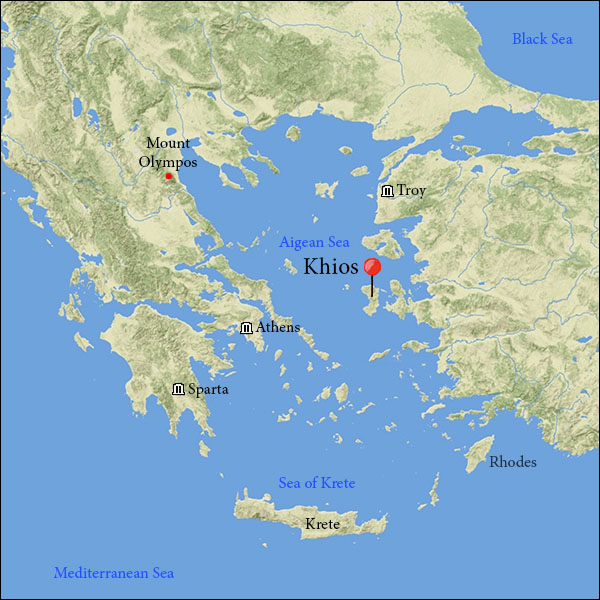
The island of Khios got its name from Poseidon's encounter with a Nymph. The island we call Khios was uninhabited by mortals when Poseidon first visited the island ... he met and had relations with an unnamed Nymph of the island ... when she went into labor, snow began to fall. Poseidon named the island Khios because the Greek word for snow is χῑονί, which roughly transliterates into English as Khios.
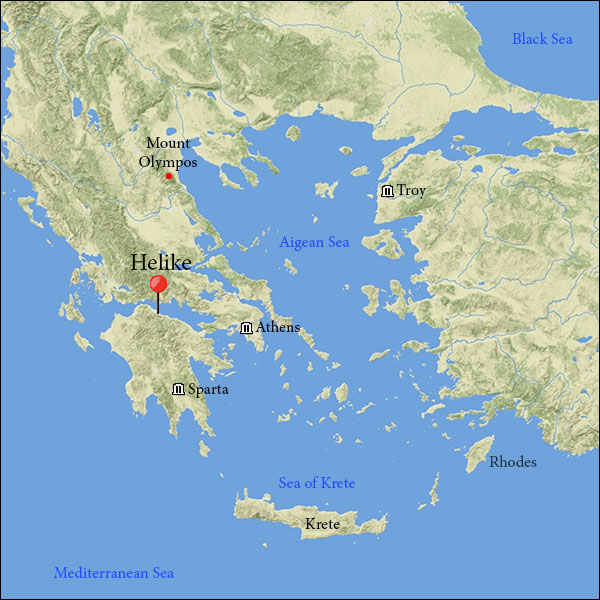
Helike was located on the northern coast of the Peloponnesian Peninsula, west of the city of Korinth. The wrath of Poseidon was never more severe than when he obliterated Helike and its inhabitants.
The reason Poseidon vented his wrath on Helike is not entirely clear but it revolved around a confrontation with some Ionians who wanted to build a replica of the altar of Poseidon at Helike. The Helikians either killed the Ionian supplicants (according to Pausanias) or scattered the Ionian's sacred possessions and took their representatives captive (according to Diodorus of Sicily). Regardless, the punishment from Poseidon was immediate and extreme.
The disaster began with an earthquake ... the entire city was swallowed. A short time later, the sea flooded the area Helike had once occupied and covered the land to the tops of the trees. The combination of earthquake and tidal wave swallowed up Helike and every person in it.
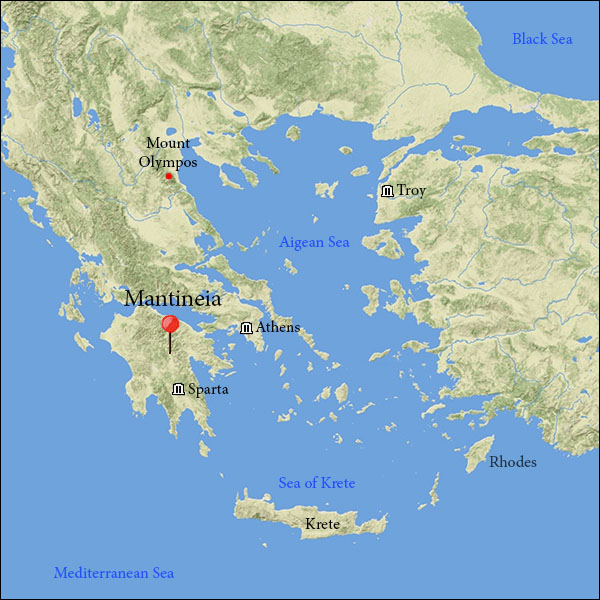
Aipytos was a hero from Arkadia but his fame and bravery could not protect him when he defied Poseidon. Aipytos dared to enter the sanctuary of Poseidon at Mantineia where mortals were forbidden to pass.
At the foot of Mount Alesium near Mantineia was an ancient sanctuary of Horse Poseidon. The Roman Emperor Hadrian sanctioned improvements to the ancient structure and to preserve the sanctity of the site, assigned overseers to watch the workmen so no one would look into the old sanctuary. Hadrian was also careful that none of the oaken ruins of the old sanctuary were removed.
After the new sanctuary was finished, no barrier or gate was placed at the entrance because it was common knowledge that entry was forbidden to mortals ... a simple thread was stretched across the entry ... some people thought the thread had some sort of "power" that would discourage righteous people from entering the sanctuary.
Aipytos did not jump over or slip under the thread, he cut it and violated the scared ground ... a wave sent by Poseidon dashed into his eyes and blinded him ... soon afterwards, he died.
In Arkadia horses were sacrificed to Poseidon for his gift of fresh water rising in the salty sea. The Inakhos River goes underground and then reemerges in the sea as fresh water by what in Argolis is called Genethlium. It was the custom to adorn horses with bridles and drown them in the fresh water of the Dine (Whirlpool) as a tribute to Poseidon.
Poseidon was one of the six children of the Titans, Kronos and Rhea. Afraid his children would usurp his authority, Kronos swallowed Rhea's babies as soon as they were born. The accepted version of the birth of Poseidon and his siblings has Poseidon's brother Zeus attacking Kronos and freeing the swallowed children. There is another account of Poseidon's birth that deserves our attention.
Circa 160 CE the Arkadians told the traveler-historian Pausanias the following story: Rhea was in Arkadia near a place called the Dancing Floor of Maera when she gave birth to Poseidon. She hid the infant Poseidon among a flock of sheep by a spring called Lamb (Αρνη) ... Rhea told Kronos she had given birth to a horse and gave him a foal to swallow instead of the child ... this is reminiscent of the trick Rhea used when she substituted a stone wrapped in swaddling clothes for the infant Zeus ... he swallowed the stone without perceiving the deception.
Not far from the sanctuary of Horse Poseidon near Mantineia was a war trophy commemorating the victory of the Mantineans over the Lakedaemonians. King Agis of Lakedaemon was confidant and perhaps a little careless ... the Mantineans were confidant too but their bravado came from a prophecy of victory delivered by an Elean seer named Thrasybulus.
When the battle was engaged, the Mantineans feigned a retreat, luring the Lakedaemonians into a trap. The Mantineans surrounded the Lakedaemonians and soundly defeated them. The Mantineans were adamant that Poseidon entered the battle on their behalf ... a victory trophy was erected in honor of Poseidon's assistance.
The Korkyraeans had an unusual encounter with Poseidon that involved their inability to catch fish. They noticed that every day a bull would lead the cows to the shore and then bellow towards the water ... at that moment, the fishermen would see countless fish, but their nets would always come up empty. An envoy was sent to Delphi hoping that Apollon's oracle could explain the strange phenomena. The Pythia (priestess of Apollon) told them to sacrifice a bull to Poseidon. The sacrifice was made, and they were able to catch fish ... in gratitude, the fishermen dedicated a portion of their catch to Apollon at Delphi and to Zeus at Olympia.
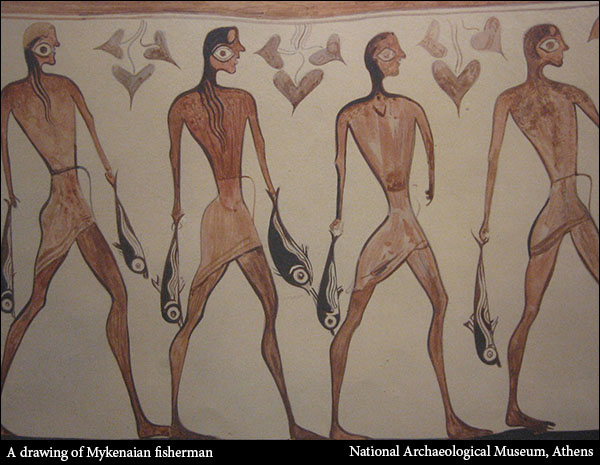
Some of the Libyans (north Africans) worshiped Poseidon as the god of the harvest ... the Greeks of course gave that honor to the goddess Demeter. These Libyans were called the Ikhthyophagi (Fish-Eaters) and as is evident by their name, harvested fish from the sea and thus the lord of the sea was their benefactor.
Returning from the land of the Amazons after completing his Ninth Labor, Herakles stopped at Troy just in time to save the king's daughter from one of Poseidon's ketos—sea monsters. King Laomedon (who was descended from Zeus) had failed to give proper tribute to Poseidon. As his punishment, Laomedon's daughter Hesione was to be sacrificed to one of Poseidon's beastly minions. There is a wonderful proto-Korinthian krater (shown below) from circa 560 BCE with Herakles shooting arrows at the giant skull-faced monster while Hesione stands face-to-face with the foul creature bravely throwing rocks.
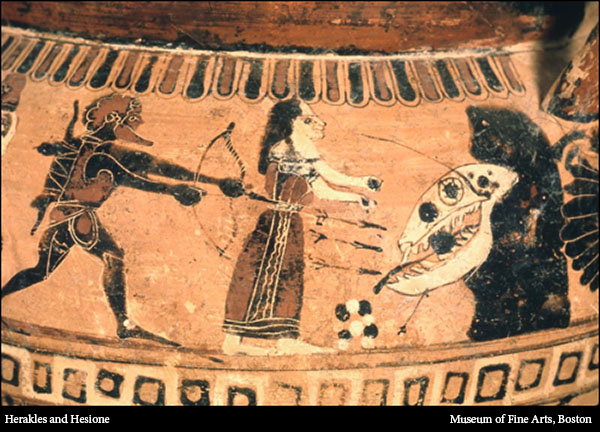
The above image is from the Greek Collection of the Museum of Fine Arts, Boston and complies with their fair use stipulations ... museum accession number 63.420.
Celebrating the completion of his Twelve Labors, Herakles initiated the first Olympic Games at Olympia, Elis ... only Immortals were allowed to participate in the games. To show their gratitude for Herakles's tenacity, each of the Immortals of Mount Olympos gave him a gift ... Poseidon gave him horses. It's not stated directly, but it might be assumed that one of those horses was the immortal Arion, the offspring of Poseidon and Demeter (goddess of the harvest).
Poseidon's brother Zeus assumed the guise of a bull and took a young woman named Europa from her home in Tyre, Phoinikia. Europa's brother Kadmos sailed westward into the Mediterranean Sea to search for his sister.
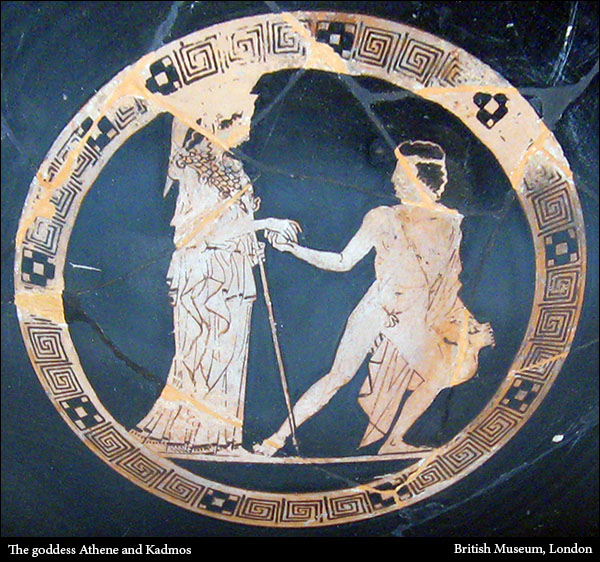
Kadmos and his shipmates made landfall on the island of Rhodes after they were nearly killed by a tempest. Thankful for his survival, Kadmos founded a temple of Poseidon and left several of his Phoinikian crewmen as overseers ... the Phoinikians formed a hereditary line of priests and introduced the Phoinikian alphabet to the Rhodians.
There was an unnamed Spartan commander who invented an ingenious but cowardly way of getting rid undesirable soldiers. He would order them to deliver a sealed message that read, "Kill this messenger." The recipient of the message would dutifully kill the messenger with no questions asked because the Spartans were notorious for their obedience to duty.
Finally, a soldier suspected what was happening ... when he was ordered to deliver a sealed message, he opened it ... his suspicions were confirmed ... his commander intended for him to die. The messenger took the message to the Spartan Ephors who oversaw all aspects of Spartan life ... the Ephors refused to act because the seal was broken and the message might have been aleterd. The soldier admitted he had opened the message but was unwilling to accept punishment for what he considered to be a justifiable crime ... he took refuge in a temple of Poseidon.
The Ephors were bound by the law and could not acquit the soldier for an admitted crime, however they suspected something was afoot and hid in the temple until the soldiers' commander came to confront him. The commander boldly admitted to his crimes because he assumed the soldier was doomed. The Spartan Ephors heard what was said and justice was done ... the sanctity of Poseidon's temple was preserved, the commander was punished, and the soldier was acquitted.
Conquering each city he encountered on his march into Asia Minor, Alexander the Great failed to take the city of Tyre because it was on an island adjacent to the city. To get access to the citadel, Alexander decided to build a mole (land bridge) from the shore to the citadel. The Tyrians jeered Alexander's workers by asking if they were trying to get the better of Poseidon. After much effort, the mole was abandoned because it proved to be an impossible task ... Alexander and the Tyrians agreed that Poseidon caused the construction of the mole to fail.
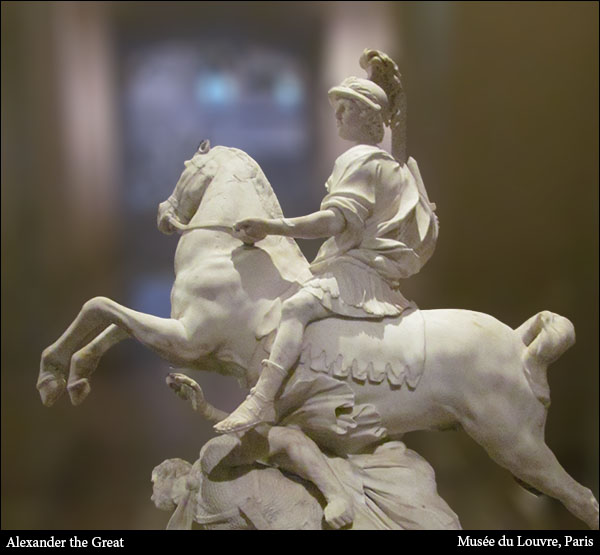
For the Immortals, a surname is often added to their given names to denote an honor or a unique characteristic.
Earth-Shaker
Shaker of the Earth
Earth-Embracer
Earth-Holder
Holder of the Earth
The Dark-Haired God
Dark-Haired Lord
Poseidon King
Poseidon of the House
Poseidon God of Kin
Poseidon God of Horses
Horse Poseidon
Poseidon God from Argos
Helikonian Poseidon
Onkhestian Poseidon
Lord of Helikon
Isthmian Poseidon
Poseidon Taenarum
Πελάγιος—of the Sea
Πελᾱγαῑος—Marine
Σωτήρ—Savior—Deliverer
Προσκλύστιος—Flooder—he who dashes against
Φυτάλμιος—Nurturer
Γενέσιος—Remembering the Birthday of the Dead
Ἀσφάλιος—Securer or Giver of Safety
Ἱπποκούριος—Horse-tending
Λαοίτας—a title of Poseidon and Zeus at Elis
Ἐπόπτου—Overseer
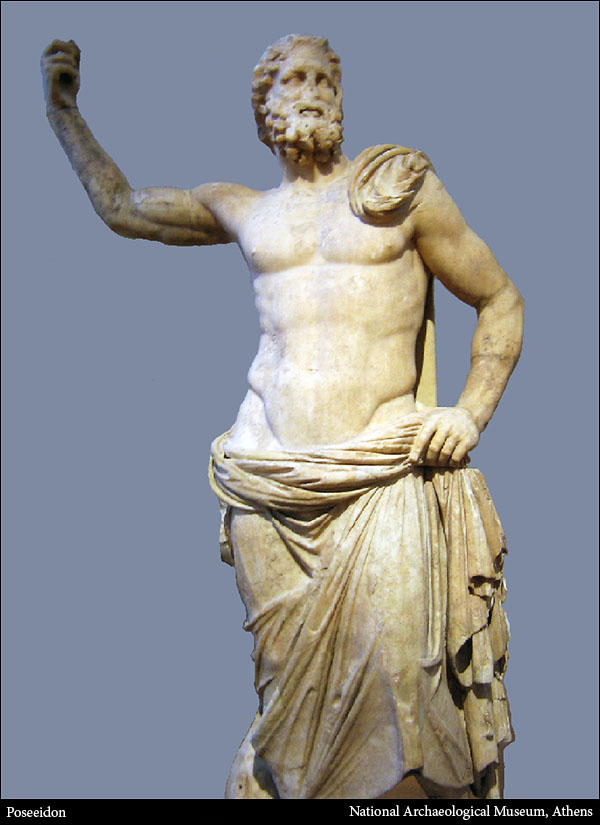
The Iliad
The Odyssey
Theogony
Works and Days
Catalogues of Women and Eoiae
Catalogue of Women
Shield of Herakles
Astronomy
Hymn to Pythian Apollon
Hymn to Hermes IV
Hymn to Aphrodite V
Hymn to Dionysos VII
Hymn to Poseidon XXII
Epigrams
Kypria
Sack of Ilion
Contest of Homer and Hesiod
The Argonautika by Apollonius of Rhodes
The Histories by Herodotos
Description of Greece by Pausanias
Library of History by Diodorus of Sicily