
| Different Types of Nymphs |
| Encounters with Nymphs |
| Notable Nymphs |
| Origins of the Nymphs |
| Where Are They Now? |
| Bibliography |
| Previous Page |
| Homepage |
| Site Search |
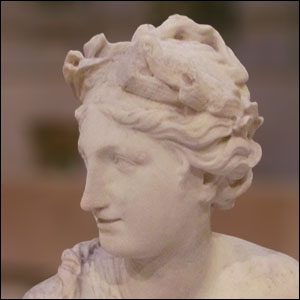
Nymph is a general term for the goddesses who coexist with rivers, springs, mountains or any type of natural life-form. The name Nymph literally means Bride. Although Nymphs can live for a very long time, they are not immortal ... they can die and be killed.
Nymphs were first mentioned in the ancient Greek texts after the mutilation of Ouranos (Heavens). Ouranos was the son and consort of Ge (Earth) ... his dominion was supposed to have been restricted to the heavens but he became presumptuous and intruded on Ge's earthly domain. She induced her Titan son Kronos to attack Ouranos with a sickle made of flint ... he mutilated Ouranos by cutting off his male members. The Meliae (Nymphs of the Ash Trees) were created from the blood of Ouranos as Ge absorbed it.
We next encounter the Nymphs in the War of the Titans—a bitter ten-year war between the Titan gods and their children. After mutilating his father, Kronos became the nominal leader of the Titans as well as the older, less powerful Immortals ... in many respects he was just as oppressive and overbearing as Ouranos.
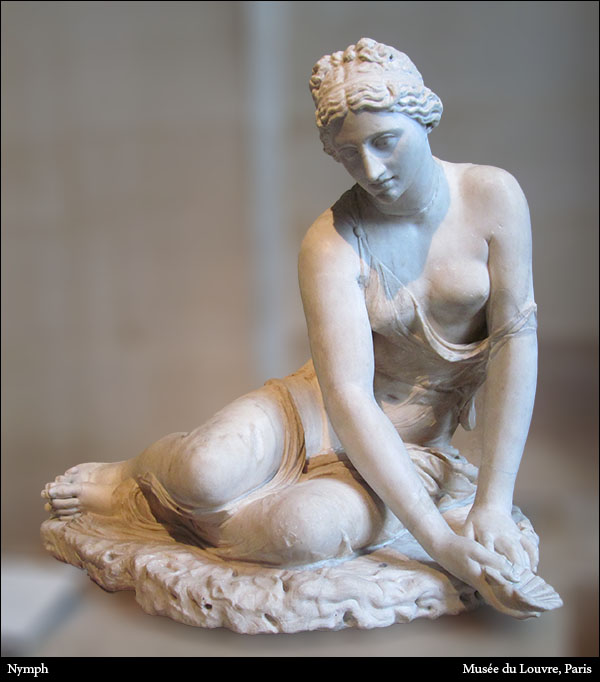
Kronos's son Zeus rallied the disenfranchised Immortals and asked them to fight against the Titans ... all of the Nymphs came to Zeus's assistance. From that time onward, Nymphs have been called the Daughters of Zeus even though he was not their actual father.
Nymphs have assumed the form of young, beautiful women with a loving and supportive nature. They have been the consorts of the Immortals and even taken mortal men as their lovers and companions. The children of Nymphs have lived lives as poets, soldiers and ordinary men and women. The role of Nymphs has generally been quite passive but there are instances where they became vengeful and assertive.
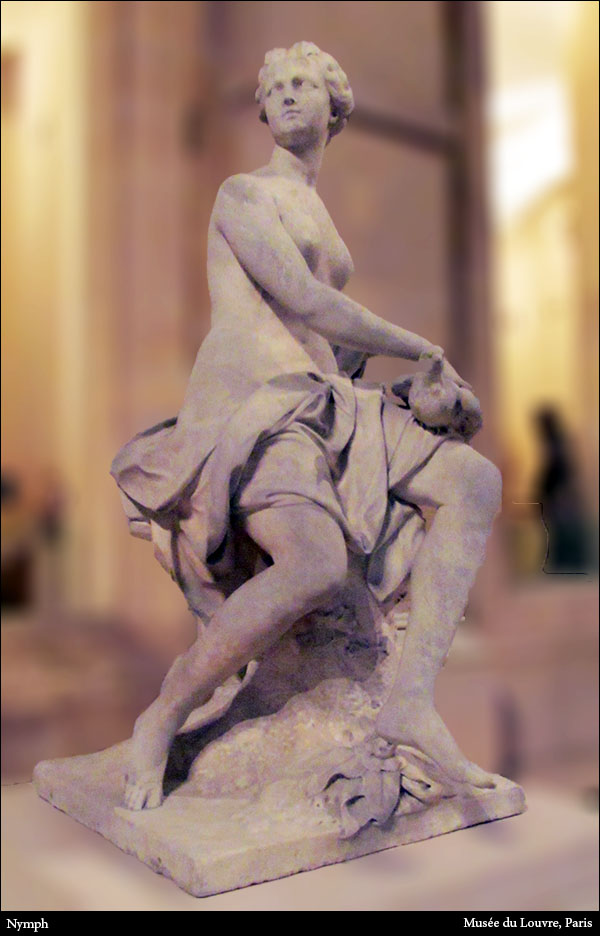
Nymphs have a special affection for Dionysos and Pan ... whenever these two vivacious gods caper through the mountains and woodlands, they will undoubtedly be in the company of Nymphs. Pan is the son of Hermes ... Dionysos is the son of Zeus ... their lust for life is contagious and the Nymphs who accompany them are there to help celebrate life and vitality.
Throughout his life, Dionysos was accompanied by Nymphs, Satyrs, and Maenads but the relationship between Dionysos and Nymphs began when he was very young.
Before he was old enough to enjoy the lascivious behavior of the Satyrs and Maenads, Dionysos was raised by the Nymphs of Mount Nysos—the Nysaean Nymphs or Nyseides. The location of Mount Nysos is disputed but it is either in Phoenikia near the streams of Aegyptus (the Nile) or in Upper Egypt in Aethiopia. Dionysos's name means, God of Nysos, i.e. Dios-Nysos.
There was a brutish man named Lykurgos who had proven his fighting skills and strategy but he made a tragic mistake when he attacked the Nymphs of Nysos. Lykurgos raged down the slopes of Mount Nysos with an ox-goad and scourged the Nymphs who cared for young Dionysos. The Nymphs dropped their wands to the ground and fled for their lives. Dionysos was so terrified of Lykurgos he jumped into the sea to escape the murderous brute. The goddess Thetis saved Dionysos but the assault was not unnoticed or forgiven by the other Immortals. Zeus blinded Lykurgos but he did not live long with his affliction because all the Immortals hated him for what he had done to Dionysos and the Nymphs of Nysos.
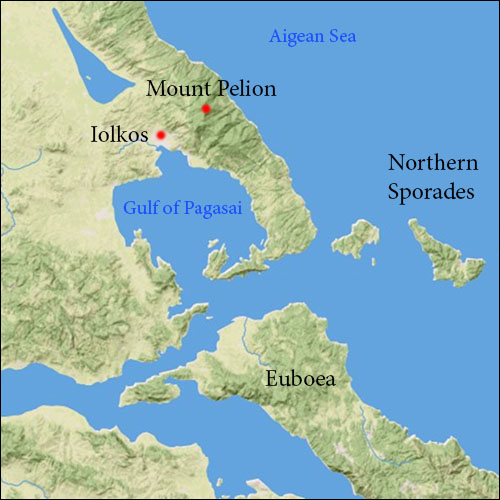
The Quest for the Golden Fleece required a ship of extraordinary quality and seaworthiness ... the Argo fit those qualifications. Wood from Mount Pelion was used for the construction of the Argo so it seems only fitting that the Nymphs of Mount Pelion would be on hand when the ship set sail on its epic journey. The Argo was built under the guidance of the goddess Athene and the Nymphs wanted to honor her. As the Nymphs watched, they were joined by the Centaur Kheiron, who had come to wish the Argonauts farewell and let young Achilles see his father Peleus depart.
A bit of backstory is required here ... the Quest for the Golden Fleece was one of the primary events of Greek prehistory. The Argonauts, commanded by Ieson (Jason), were a collection of remarkable heroes destined to sail to Kolkhis at the eastern edge of the Black Sea and retrieve the Golden Fleece ... the fleece of a divinely created ram. The Centaur Kheiron, like all Centaurs, had the body of a horse with the torso and head of a man ... he was noted for his wisdom and civility. Peleus was an Argonaut and his son Achilles became the greatest warrior in the Trojan War a generation after his father sailed with the Argonauts.

The Argonauts encountered various hardships and violent confrontations on their way to Kolkhis to retrieve the Golden Fleece. One sad event involved King Kyzikos, whose kingdom was on the eastern shore of the Hellespont (the Dardanelles Straits). The king welcomed the Argonauts when they arrived ... he even interrupted his marriage celebration to be a good host. When the Argonauts sailed away, they became disorientated and accidentally returned to Kyzikos's kingdom in the dead of night. Kyzikos thought his barbaric neighbors were attacking and led his army against the Argonauts ... King Kyzikos was killed in the fray.
Kyzikos and his new wife Kleite had not consummated their marriage when the Argonauts arrived. Learning of her husband's death, Kleite placed a noose around her neck and ended her life. Her suicide took place in a wooded grove ... the Nymphs of the grove were so distraught at Kleite's death a fountain was created from their tears ... the fountain was appropriately named the Fountain of Kleite.
One of the most dramatic encounters between a Nymph and a mortal man occurred when one of the Argonauts was abducted by a Naiad Nymph.
Sailing to Kolkhis to retrieve the Golden Fleece, the Argonauts came to the Kianian land by Mount Arganthon, near the outfall of the Kios River, slightly north of modern Istanbul. Before they could make landfall, the winds failed and the Argonauts were forced to row their ship, the Argo. Herakles was trying to inspire the other Argonauts by setting a rapid pace but his zeal and strength snapped his oar in half.
Making landfall, Herakles went in search of a suitable tree to make a new oar while his steward Hylas went to get water for the evening meal. Hylas found a spring called Pegae and as he arrived at the spring, the local Nymphs began their evening songs in praise of the goddess Artemis, goddess of the hunt. The Nymphs came from the hills and glens to sing for the goddess and as a Naiad was rising from the spring, Hylas approached. The moon was full and Aphrodite, goddess of love, filled the Nymph's mind with confusion and desire. When she saw Hylas's youthful beauty and sweet grace as he knelt by the spring, she reached up with her right hand and placed it behind his neck ... she grabbed his elbow with her other hand and pulled him into the water. Hylas was never seen by mortal men again.
The Argonauts encountered the blind prophet Phineus on the island of Thynias. Phineus's neighbor, a man named Paraebios, told an enlightening story about one of the Thynian Nymphs.
Seeking advice, Paraebios went to Phineus because no matter what he did or how piously he behaved, his life was filled with hardship and disappointment. Phineus perceived correctly that Paraebios was being punished for the youthful arrogance of his father.
Paraebios's father had been chopping wood in the mountains when a Hamadryad begged him not to destroy her oak tree. In his prideful disregard for the Immortals, Paraebios's father chopped down the tree and thus killed the Nymph who shared its life. As she died, the Nymph cursed Paraebios's father and his descendants until the proper rituals were performed and forgiveness was granted.
Paraebios was destined to toil without reward until he repented and atoned for his father's despicable actions. Taking Phineus's advice, Paraebios built an altar and offered prayers and sacrifices to the Thynian Nymph so that he might be relieved of his inherited burden. The sin was forgiven and Paraebios honored Phineus by bringing him food even though he knew that, due to the curse on Phineus, he would never be allowed to enjoy it. Phineus had offended the Immortals and was cursed with blindness and perpetual starvation.
A man of noble Trojan descent named Ankhises was seduced by Aphrodite, goddesses of love. When Ankhises first saw Aphrodite, she denied her divinity and told him she was a mortal woman who had been kidnapped by the god Hermes while dancing with the mountain Nymphs at her home in Phrygia. Ankhises willingly believed her lies and made love to the goddess ... Aphrodite then revealed her true identity to Ankhises and told him that after their son Aineias was born, she would bring the infant back to Mount Ida so he could be raised by the local Nymphs.
Aineias fought as a commander in the Trojan War. His official title was Dardanian Commander to signify his lineage from the first king of Troy, Dardanos. The Nymphs of Ida apparently did a remarkable job with the upbringing of Aineias because he was one of the very few Trojan men to survive the war.
An interesting and touching event involving Nymphs occurred after the death of King Eetion of Thebe in Mysia.
The Achaian Greeks raided different cities and islands to supply their army during the Trojan War. The Achaian commander Achilles was leading a raid on the city of Thebe and encountered King Eetion and his seven sons. Ruthless and unyielding, Achilles killed Eetion and his sons ... King Eetion's daughter Andromakhe was not in Thebe when the carnage took place because she had previously married Prince Hektor of Troy.
Achilles showed respect for King Eetion by not stripping him of his armor after he killed him. Achilles then burned Eetion's body and made a burial mound for the king's remains. The mountain Nymphs were so moved by Eetion's death, they planted elm trees over the burial site.
Kalypso was the Sea Nymph who detained Odysseus on the island of Ogygia. After the Trojan War was over (circa 1240 BCE), most of the victorious Greek commanders returned to their homes without incident ... King Odysseus of Ithaka was not so lucky. Odysseus incurred the wrath of Poseidon, lord of the sea, by maiming one of the god's sons. Poseidon swore vengeance against Odysseus but Zeus would not let Poseidon kill Odysseus ... the angry god had to be content with tormenting Odysseus and delaying his homecoming. As part of his ordeal, Odysseus became shipwrecked on Kalypso's island.
Odysseus was utterly without hope when Kalypso found him but his rugged good looks and noble character soon effected the lonely Nymph and she fell in love. Odysseus stayed with Kalypso for seven years but they were long, sad years for Odysseus. He resigned himself to the fact that there was no escape from the island but he still constantly longed for his wife and son.
Poseidon was determined to perpetuate Odysseus's punishment ... likewise, the goddess Athene was always looking for ways to help Odysseus. When she reminded Zeus that Odysseus had been on Ogygia for seven years, Zeus sent his son Hermes with a message for Kalypso ... she was to allow Odysseus to leave ... furthermore, she was to give him the assistance he needed to build a seaworthy craft.
Hermes arrived on Kalypso's island and was given a warm welcome ... he and Kalypso drank nectar and ate ambrosia. Finally, he told her of his mission and gave her Zeus's command. At first Kalypso was indignant ... she reminded Hermes of the many gods and goddesses who had taken mortal lovers and wondered why she could not keep Odysseus. Hermes told her that Zeus was adamant ... she must help Odysseus leave Ogygia and she was not permitted to use her charms to detain him.
Kalypso accepted her fate and agreed to let Odysseus leave unhindered. By that time, Odysseus was a cautious man. He had endured much trickery at the hands of the Immortals and did not believe Kalypso would actually help him. To ensure her sincerity, Odysseus made Kalypso swear a great oath on the waters of Styx ... the most sacred and binding oath an Immortal could make.
Kalypso sincerely swore the oath and gave Odysseus the tools he needed to build a seaworthy raft. When it came time for him to leave, Kalypso in her loving nature, gave Odysseus provisions and sent him on his way with a fair wind to speed him home.
During their time together, Kalypso and Odysseus had two sons—Nausithoos and Nausinoos.
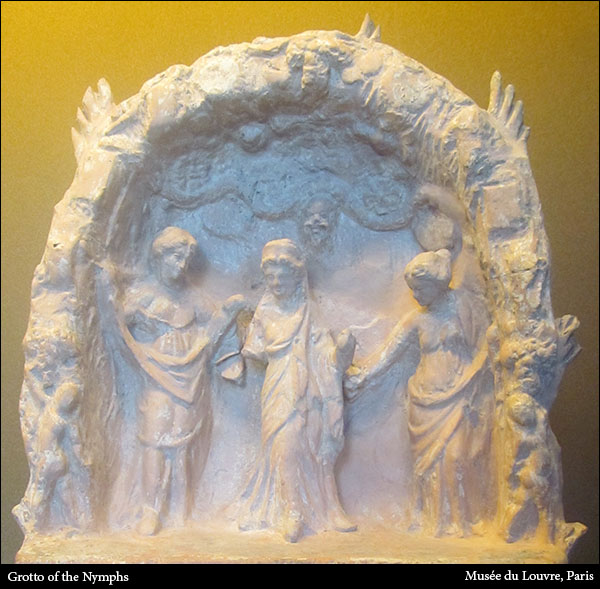
The harbor of Phorkys was located on the island of Ithaka. Near the shoreline of the harbor, an olive tree shaded a pleasant and sacred cave, which was made hallowed by the dancing feet of the Nymphs of the Wellspring.
Returning to Ithaka after his prolonged adventures following the Trojan War, Odysseus was put ashore near the cave of the Nymphs. The goddess Athene showed him the cave and explained that the Nymphs used the large stone looms in the cave to weave their purple webs, presumably meaning their "webs" of fabrics.
Odysseus was no stranger to the dancing and singing of Nymphs. Before he arrived on Ithaka, he had stayed briefly on the island of the Phaiakians ... while there, he had heard young girls singing and likened their sweet voices to the Nymphs of the high mountains, the meadows, rivers, and springs.
Odysseus prayed sincerely to the Naiad Nymphs and promised them gifts if they would bless his homecoming. Odysseus did not see the Nymphs of the cave but, again at the advice of Athene, stored the treasures he had accumulated in the cave until he could make sure his kingdom was secure after his twenty-year absence.
Eumaios was the swineherd of Odysseus and like Odysseus, very respectful towards the Nymphs of the island of Ithaka. When Odysseus arrived at Eumaios's humble home in disguise, the swineherd prepared a meal for what he though was a stranger ... he also placed food aside for the Nymphs and the god Hermes. When he and Odysseus were walking, they passed a fountain of cool water surrounded by a circle of poplar trees; at the center was an altar of the Nymphs ... the two men prayed to the Nymphs, addressing them as the daughters of Zeus.
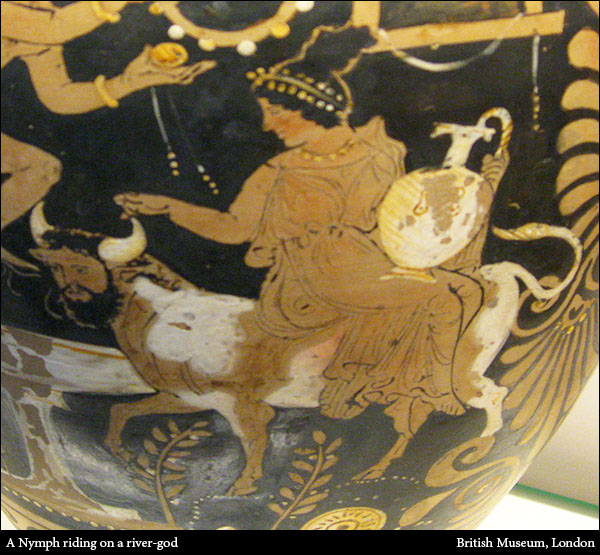
Abarbarea, a Naiad Nymph, encountered a man named Boukolion as he tended his flocks near her abode. Boukolion claimed his birthright from King Laomedon of Troy, but as a bastard son of Laomedon, Boukolion did not enjoy royal status. Abarbarea and Boukolion had twin sons—Pedasos and Aisepos. Both young men were killed as soldiers in the Trojan army.
Adrasteia was the nurse of Zeus when he was an infant.
The Titan god Kronos was devouring his children as soon as they were born to prevent one of them from usurping his authority. After his sister-wife Rhea gave birth to their sixth child, she hid the infant on the island of Krete.
Rhea named the child Zeus and hid him in a cave so Kronos could not find him. Adrasteia was one of Zeus's nurses. She is mentioned by name in the Argonautika when Aphrodite (goddess of love) was trying to enlist the help of Eros (the primal god of love) to help the Argonauts.
Aphrodite promised to give Eros "Zeus's all-beauteous plaything—the one which his dear nurse Adrasteia made for him, while he still lived a child, with childish ways, in the Idaean cave—a well-rounded ball; no better toy will you get from the hands of Hephaistos. All of gold are its zones, and round each double seams run in a circle; but the stitches are hidden, and a dark blue spiral overlays them all. But if you should cast it with your hands, lo, like a star, it sends a flaming track through the sky."
Aigina is one of the daughters of the river-god Asopos and the sister of Thebe, Kerkyra, Sinope, and Antiope ... the island Aigina was named after her.
Ankhiale was the mother of the Idaean Daktyls who lived on Mount Ida on the island of Krete ... the Daktyls were famous for their skills as metal workers and magicians.
The Anigrid Nymphs (Anigriades) dwell in the cave at the source of the sulfur springs of the Anigrus River in the western Peloponnesian Peninsula north of modern Lake Kaiapha. The Nymphs will heal skin diseases such as alphos or leuke if patrons pray and sacrifice before washing and swimming in the waters of the springs. Alphos and leuke are both forms of leprosy.
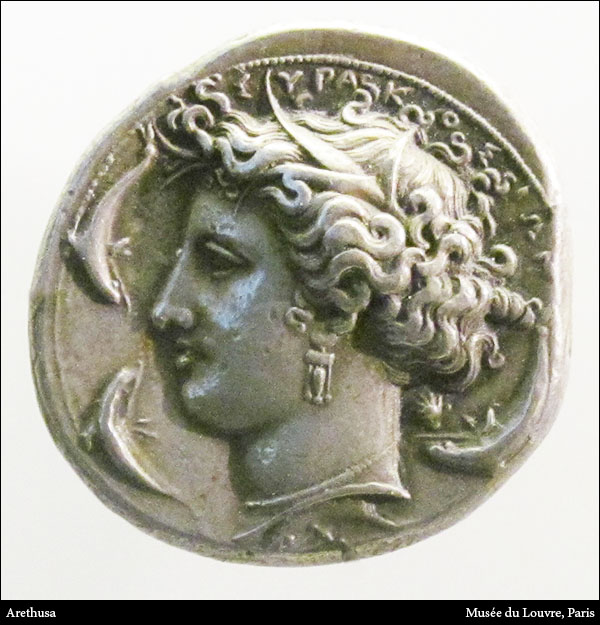
Arethusa was a Nymph who was changed into a spring by the goddess Artemis to save her when she was being pursued by the river-god, Alpheios. The spring of Arethusa is on the island of Ortygia in the harbor of Syracuse, Sicily. Artemis was born on Ortygia and the island was therefore sacred to her. Divine punishment awaits anyone foolish enough to eat the fish inhabiting the spring of Arethusa. In order to be close to Arethusa, Alpheios sent his river from the Peloponnesian Peninsula under the Tyrrhenian Sea and resurfaced on Ortygia.
There is also a spring named after Arethusa near the city of Khalkis on the island of Euboia.
Argiope was a Nymph who lived on Mount Parnassos until she became romantically involved with a man named Philammon and became pregnant. Philammon rejected Argiope and refused to allow her into his home ... Argiope left Mount Parnassos and settled among the Odrysae in Thrake where she gave birth to a baby boy ... she named him Thamyris.
Thamyris grew into a remarkable young man with phenomenal musical skills ... unfortunately his humility was not as keen as his talent. Thamyris boldly challenged the Muses to a musical contest and the results were as predictable as they were tragic ... for his temerity Thamyris lost his ability to play music. We don't know exactly how he was punished ... he might have been blinded, maimed or inflicted with amnesia ... regardless, he was never able to sing or play the lyre again.
To lament his defeat, Thamyris threw his lyre in the water of a nearby river that was thereafter named Balyra which was apparently derived from the Greek word ἀποβάλλω meaning, "eliminate or throw away."
Argyra is a Sea Nymph who fell in love with a handsome young man named Selemnus ... each night, she would rise from the sea to sleep by his side. The city and nearby spring took their name from Argyra. After some time, Argyra no longer found Selemnus attractive and deserted him. Selemnus was inconsolable in his grief and died of love-sickness. Aphrodite took pity on Selemnus and transformed him into a river but Selemnus remained hopelessly in love with Argyra and still grieved. Aphrodite intervened again and blotted out Selemnus's memory of Argyra.
With Apollon as her consort, Aria was the mother of Miletos, the eponymous founder of the city in Karia in Asia Minor, Miletos.
Asterodeia was a Nymph from the Caucasus Mountains who became the consort of King Aietes of Kolkhis ... Aietes, a son of Helios (Sun), was the keeper of the famous Golden Fleece. For an undisclosed reason, Asterodeia left Aietes and disappeared from the historical record. Aietes then married Eidyia, a daughter of Tethys and Okeanos (Ocean). Asterodeia gave Aietes a son named Apsyrtos who was killed by his half-sister Medeia and Ieson (Jason) after they took the Golden Fleece and fled Kolkhis.
Known as the Atlantides, the Hyades and Pleiades were the twelve daughters of Atlas and sisters of Hyas.
The tragic death of Hyas while on a lion (or boar) hunt caused his twelve sisters to die of grief. They were placed in the heavens in two groups. Seven were named Pleiades after their mother Pleione, a daughter of the Titan, Okeanos (Ocean). The other five were named after their brother, Hyas.
The Hyades were—Phaesyle, Koronis, Kleeia, Phaeo, and Eudora. They were placed in the heavens as an asterism in the constellation Taurus (the Bull). The name Hyades has also been interpreted to mean Raining Ones, which would imply that the sisters rise in the sky during the rainy season.
The author of Astronomy described the Pleiades as—"Lovely Teygata, and dark-faced Elektra, and Alkyone, and bright Asterope, and Kelaeno, and Maia, and Merope ..."
Maia was the most famous daughter of Atlas because she was the consort of Zeus and mother of the mischievous messenger god, Hermes.
Maia's father Atlas was of the same generation as Zeus so Maia would have been Zeus's niece. Zeus came to Maia in the darkness of night so his sister-wife Hera would not know of his amorous intentions towards the lovely Nymph. Maia lived in a secluded cave on Mount Kyllene in Arkadia ... Hermes was born ten months after Zeus's union with Maia.
While Hermes was still an infant, he tried and failed to outwit his stepbrother, Apollon. Maia tried to warn Hermes not to try his tricks on Apollon or Zeus but Hermes was a scoundrel from the start ... he stole Apollon's cattle and then lied to Zeus about it. Zeus did not begrudge Hermes his little pranks but warned him sternly about his place in the divine hierarchy.
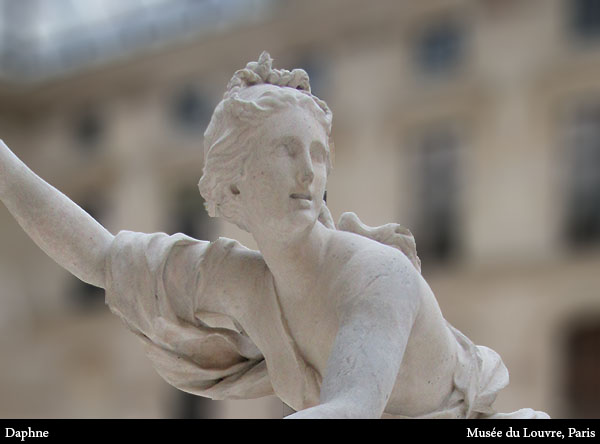
Daphne was a huntress Nymph who was determined to have no lovers and remain pure. A young man named Leukippus fell in love with Daphne and in an effort to be close to her, disguised himself as a girl and joined Daphne and some other Nymphs on a hunting expedition. While the Nymphs were bathing, Leukippus was discovered to be a man and they killed him. Daphne was later pursued by Apollon but the river-god Peneios, who was perhaps her father, saved her from Apollon by turning her into a laurel tree.
It was believed by the people of Phokis that Apollon's Oracle at Delphi was preceded by an Oracle of Ge (Earth) and that the Nymph Daphnis was Ge's prophetess.
Eidothea was the daughter of the Old Man of the Sea, Proteus.
King Menelaos of Sparta and his companions became lost and disorientated returning from Troy after the Trojan War. They were stranded on the island of Pharos when they encountered Eidothea. She emerged from the sea and said she could help Menelaos by telling him how to find her father, Proteus.
Eidothea skinned four seals and gave the reeking skins to Menelaos and three of his shipmates. She put ambrosia under their noses so they could endure the terrible stench of the dead seals. The seal skins would serve as disguises so Menelaos and his men could ambush Proteus and force him to answer questions about how they could get back on course and sail home. Eidothea showed Menelaos the cave where Proteus came out of the water to sleep. Menelaos and his men waited until Proteus was asleep and then attacked him. Proteus assumed the guise of a lion, a serpent, a leopard, a boar, fluid water and a tree but Menelaos would not release his grip. Proteus finally gave up the struggle and agreed help Menelaos.
Ekhidna is the daughter of Kallirhoe ... Ekhidna is "like nothing human," half Nymph with a fair face and the body of an enormous serpent ... she lives underground, apart from the other Immortals ... ἔχῖς means viper. Ekhidna was joined in love with Typhaon and their hard-tempered children were: Orthos (the watchdog of three-headed Geryon), Kerberos (the savage dog of Hades), and the multi-headed Hydra of Lerna ... all three of which Herakles faced as part of his Twelve Labors. The hero Theseus killed a fierce sow that was also the offspring of Ekhidna and Typhaon ... the sow was named after her keeper, Phaia.
Ekho was a mountain Nymph who unintentionally attracted the desires of the Goat-God Pan ... she did not want to become involved with him and did her best to evade him ... he was relentless ... when she refused to submit to him, he turned her into a disembodied voice that could only repeat the last word spoken to her ... her name literally means "a returned sound."
Erato was a prophetess of the Goat-God Pan at his sanctuary near Akakesium in Arkadia ... the sanctuary was noted for its eternal flame. Erato gave oracles in Pan's name and he would reward or punish the supplicants as he saw fit. Erato became the consort of Arkas, son of the Nymph Kallisto, and had three sons—Azan, Apheidas, and Elatus.
Ethemea was the wife of King Merops of the island of Kos. Ethemea and Merops had a son named Eumelos ... she was slain by Artemis (goddess of the hunt) for irreverence.
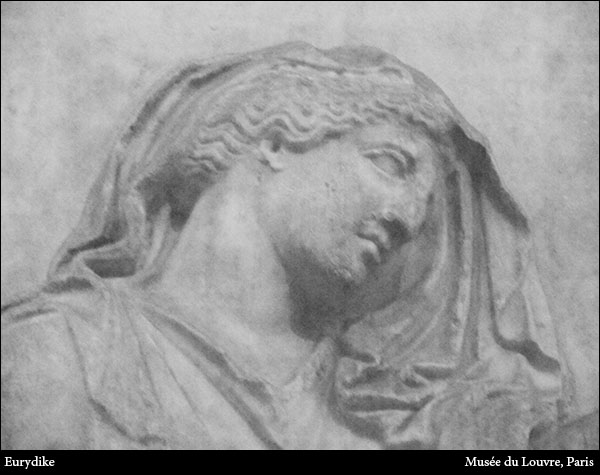
Eurydike was a Dryad Nymph who became the wife of the ultimate musician, Orpheus. After their marriage, Eurydike was bitten by a poisonous snake and died. The circumstances of her death are disputed by two Roman authors, Ovid and Virgil.
Virgil maintains that Eurydike was bitten by a snake while being pursued by Apollon's son, Aristaios. Ovid states that after an ill-omened marriage to Orpheus, Eurydike was capering in a meadow with other Nymphs when she was bitten by a poisonous snake. Regardless of the circumstances, Eurydike died from a snakebite and a descended into the House of Hades.
Orpheus could not accept Eurydike's death. He boldly ventured into the Underworld in an attempt to bring her back into the sunlight. Orpheus used his wit and phenomenal musical talents to charm Persephone (queen of the dead) and Hades (lord of the dead) ... they agreed to allow Eurydike return to the surface of the earth provided that Orpheus lead the way and not look back to see if she was following him. At the very last moment Orpheus was compelled to look around to be sure Eurydike was behind him. By doing so, all hope of possessing Eurydike evaporated as he watched her turn into vapor and return to the land of the dead.
The Nymph Harmonia mated with Ares, god of war, to produce the warlike women known as the Amazons. The Amazons made their home north of the Black Sea and were feared by all who encountered them in combat. Almost every hero and demigod of the ancient world did battle with the Amazons ... we might surmise that their rejection of men infuriated the kings and princes of all nationalities and prompted the hostilities towards the women warriors.
The Hesperides are Hespere, Erytheis, and Aegle ... they are the Nymph daughters of Nyx (Night).
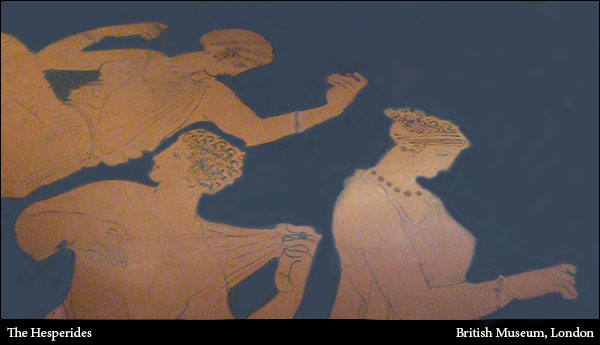
The marriage of Hera and Zeus prompted Ge (Earth) to present Hera with some Golden Apples ... their number and size were not revealed in the classical texts. Hera placed the Golden Apples in the Garden of the Hesperides for safe keeping ... a multi-headed dragon named Ladon served as guardian.
It was common knowledge that the Garden of the Hesperides was somewhere in "the west" but its exact location was a well-kept secret. Nereus, father of the Nereids, was one of the few Immortals who knew the way to the garden.
Hera tricked Zeus into making a man named Eurystheus king of Argos. That meant Zeus's son Herakles was a "subject" of Eurystheus and as such, required to perform the famous Twelve Labors. One of the most convoluted and dangerous Labors was to retrieve the Golden Apples of the Hesperides.
Herakles attacked Nereus and forced the ancient god to reveal the whereabouts of the Hesperides. After several almost fatal experiences, Herakles entered the Garden of the Hesperides, killed Ladon and took the Golden Apples.
The Argonauts were returning to Greece after successfully stealing the legendary Golden Fleece but were blown off course and became lost in Libya, where they encountered the Hesperides. Herakles had been an Argonaut but left the troop and subsequently took the Golden Apples from the Hesperides.
After the Golden Apples were taken, the Hesperides were without purpose ... they seemed to exist only as phantoms ... their corporal bodies turned to dust and dirt as the Argonauts approached. That was the condition in which the Argonauts found the Hesperides.
The Argonauts were on the verge of dying of thirst when they came upon the phantom Hesperides. The Argonaut Orpheus eloquently prayed to the Hesperides and asked to be shown a spring so they might survive. The Hesperides pitied the thirsty men and caused grass to grow and trees to sprout. Hespere took the form of a poplar tree, Eretheis an elm, and Aegle a willow.
Peering from the trunk of her tree, Aegle told the Argonauts how Herakles had been there on the previous day ... he killed the dragon and took their Golden Apples. She showed them where Herakles kicked a stone and created a spring in the middle of the desert. The grateful Argonauts drank their fill before continuing through the inhospitable terrain.
Not far from Olympia was a spring sacred to Nymphs called the Ionides, so named after Ion, the son of Gargettus, who migrated to that area from Athens. Those who bathe in the spring are cured of all sorts of aches and pains by the Nymphs Kalliphaeia, Synallasis, Pegaea, and Iasis.
Kallisto was the Nymph daughter of Lykaon ... she lived in Arkadia where she concerned herself with the wild beasts of the mountains in the company of Artemis, goddess of the hunt. Kallisto was seduced by Zeus and became pregnant. When Artemis saw Kallisto bathing, she was enraged to see that her companion was pregnant and changed Kallisto into a bear. Although she had the guise of a bear, Kallisto's child was a normal looking human ... she named him Arkas. Mother and son were eventually captured by some goatherds and returned to her father, Lykaon. Kallisto violated the law by going into the precinct of Zeus and was hunted down by Arkas and other Arkadians. Zeus saw her plight and placed her in the heavens as the constellation the Great Bear. Her name literally means Most-Beautiful.
The Goat-God Pan and his Nymphs occupied a cave on the southern slopes of Mount Parnassos long before Apollon built his temple at Delphi and long before the Nymph Korykia became the consort of Apollon. The cave was located approximately 6.8 miles (10.9 kilometers) from Delphi but had no specific name until Apollon and Korykia became lovers.
Korykia and Apollon had a son named Lykoros. The city of Lykoreia was named after Lykoros and Pan's cave on Mount Parnassos was called the Korykian Cave, after Korykia. The resident Nymphs of the cave were thereafter called the Korykian Nymphs.
When the traveler-historian Pausanias visited the Korykian Cave circa 160 CE he described the cave thus, "But the Korykian Cave exceeds in size those I have mentioned, and it is possible to make one's way through the greater part of it even without lights. The roof stands at a sufficient height from the floor, and water, rising in part from springs but still more dripping from the roof, has made clearly visible the marks of drops on the floor throughout the cave. The dwellers around Parnassos believe it to be sacred to the Korykian Nymphs, and especially to Pan. From the Korykian Cave it is difficult even for an active walker to reach the heights of Parnassos."
The parentage of the poet Homer has never been established with any surety but the people of ancient Smyrna sincerely believed Homer was of divine descent and the son of the river-god Meles (Meles's river flowed through Smyrna) and a Nymph named Kretheis. The proof for this line of reasoning was quite simple: 1) Homer's talent was so phenomenal that he could not have possibly been a mortal; and 2) his true name was Melesigenes, which denoted his heritage from Meles.
Kyrene was a maiden who lived an idyllic life as she tended sheep along the marsh-meadow of the Peneios River in Thessaly. As she guarded her flock by the river, Apollon carried her off and placed her among the Nymphs of Libya in northern Africa. She and Apollon had a son named Aristaios who was affectionately called Hunter and Shepherd. Apollon transformed Kyrene into a Nymph and she enjoyed a long life as a huntress ... their son Aristaios was given to the noble and benevolent Centaur Kheiron for an education. Kheiron, like all Centaurs, had the body of a horse with the torso and head of a man.
As Nymphs and daughters of Neaira and Hyperion, Lampetia and Phaethousa were placed on the island of Thrinakia to watch over the cattle, sheep, and oxen of Helios (Sun).
Leaving the city of Troy with their plunder, Odysseus and his comrades became stranded on Thrinakia without provisions. The Dread Goddess Kirke (Circe) warned Odysseus against killing any animal in Helios's herds on Thrinakia ... the consequence would be certain death. Odysseus tried to restrain his men but hunger and desperation overcame their reason. They killed some of Helios's animals with the vain promise to make appropriate sacrifices to Helios when they returned to their homes. Lampetia and Phaethousa informed Helios of the desecration and only Odysseus, who did not participate in the sacrilege, was allowed to live.
Leiriope was the Nymph who, in union with the river-god Kephisos, was the mother of the beautiful and vain man named Narkissos.
Either Aphrodite (goddess of love) or Nemesis (goddess of divine retribution) punished Narkissos's arrogance by causing him to become obsessed with his own image ... he spent his life gazing at his reflection and finally wasted away. After death he was transformed into a flower that still bears his name, the Narcissus.
The Nymphs Hilaeira and Phoibe were called Leukippides—the daughters of Leukippus. They were worshiped at Sparta were two young maidens served as priestesses and were called "the colts of Leukippus." The name Leukippus literally means White-Horse, therefore Hilaeira and Phoibe were sometimes referred to as the "white-horse maidens," thus their priestesses became "colts."
Two sons of Zeus—Kastor and Polydeukes—abducted Hilaeira and Phoibe. The outcome of the story is unclear in the Greek texts but the inference was that the association of Kastor and Polydeukes with Hilaeira and Phoibe resulted in the death of Kastor.
Libya was the daughter of Epaphos and Memphis ... she was the consort of Poseidon (lord of the sea) and the mother of Agenor.
Melie, or Bithynian Melie as she was called, became the consort of Poseidon, lord of the sea. Their son Amykos was king of the Bebrykians when the Argonauts stopped at his kingdom during their Quest for the Golden Fleece. Bithynia was located on the shores of the Black Sea east of the modern city of Istanbul. The Argonauts stopped at Bithynia on their way to Kolkhis, which was located at the eastern edge of the Black Sea. The Golden Fleece was kept at Kolkhis.
King Amykos decreed that no man could depart his kingdom until they faced him in a boxing match ... he was a cruel man and had forced many strangers to fight with him. The Argonauts were not ordinary seaman ... their number included several demigods including Polydeukes, the son of Zeus and Leda. Polydeukes agreed to fight Amykos only after the obnoxious king insulted and berated the Argonauts beyond endurance. The fight was short and brutal ... Polydeukes beat Amykos to death.
The Water-Nymph Melite, daughter of the river-god Aegaeus, encountered the hero Herakles at the home of Nausithoos and Makris, the nurse of Dionysos. Herakles love affair with Melite was unexpected but fruitful ... their son Hyllos was the result of their union.
Mideia was the consort of Poseidon, lord of the sea, and the mother of Aspledon. The city in Boeotia in which Aspledon was born was eponymously named after him.
Nephele was created in an unusual manner and played an important role in the prehistory of ancient Greece. She was the grandmother of the race of Centaurs and the co-creator of the ram with the Golden Fleece.
A scoundrel of a man named Ixion incurred the wrath of Zeus by trying to seduce Zeus's sister-wife, Hera. Zeus created Nephele as a cloud-woman to distract Ixion. Nephele and Ixion had a son named Kentauros who became the progenitor of the Centaurs when he mated with the Magnesian mares. The Centaurs had the body of a horse with the torso and head of a man.
Nephele later married King Athamas of Orkhomenos and had two children—Helle and Phrixus. Athamas rejected Nephele for a mortal woman named Ino, who then plotted to have Phrixus offered as a human sacrifice. Nephele and the god Hermes devised the escape of Helle and Phrixus on a flying ram with a Golden Fleece ... the youths flew from Orkhomenos on the ram but Helle fell from its back into the sea. The body of water where Helle drowned was thereafter called Hellespont—Helle's Sea. Phrixus continued on to Kolkhis and at the magical ram's request, sacrificed the animal and placed its Golden Fleece in the Garden of Ares. A generation later, the Quest for the Golden Fleece required Ieson (Jason) and the Argonauts to sail to Kolkhis to reclaim the sacred artifact.
Oenone was a Nymph of Mount Ida who was the lover of Trojan Prince Alexandros (Paris) but he deserted Oenone for Helen. This is but another example of the legendary beauty and charms of Helen of Argos (later, Helen of Troy). Alexandros rejected a fully divine Nymph for the affections of the semi-divine Helen.
Oinoie was a Water Nymph ... she was the consort of Thoas and the mother of Sikinos. Thoas was a son of the god Dionysos and king of the island of Lemnos circa 1285 BCE ... he was saved from certain death by his daughter Hypsipyle when the women of Lemnos went on a killing spree and killed all the men. Hypsipyle placed Thoas in a waterproof box and cast him adrift in the sea ... he eventually landed on Oinoie's island. Thoas and Oinoie became lovers and had a son named Sikinos ... Oinoie changed the name of her island to Sikinos to honor her son.
Pitys was the Nymph who resisted the affection of the Goat-God Pan and was punished by being transformed into a pine tree.
Syllis was the consort of Apollon and the mother of King Zeuxippus of Sikyon. Zeuxippus was the king of Sikyon circa 1260 BCE, which was just before the Trojan War began. When Zeuxippus died, Hippolytus became king ... King Agamemnon of Mykenai attacked and defeated Hippolytus making him subject to the Mykenaians.
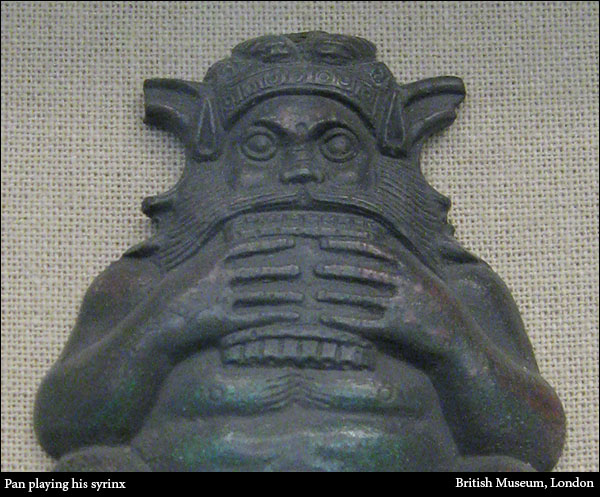
Syrinx was a Nymph who was loved by the Goat-God Pan and was turned into a reed so she could escape him. To honor Syrinx, Pan made a reed pipe that he would play as he capered through the fields ... the reed pipe was adopted by herdsman and either called a Pan-Pipe or simply a Syrinx.
Thebe was the daughter of the river-god Asopos and the sister of Aigina, Kerkyra, Sinope, and Antiope ... Thebe became the wife of Zethos ... he and his brother Amphion built the foundations and bulwarks of the city in Boeotia that came to be known as Thebes in honor of Thebe.
Thisbe was a Nymph of Boeotia who gave her name to a city near the sea. The modern city of Thisbe is located midway between Mount Pelion and Mount Olympos and shielded from the sea by the coastal mountains ... the land west of Thisbe slopes to a futile plain.
Thoosa was the consort of Poseidon (lord of the sea) and the mother of the Cyclops, Polyphemos. Like all Cyclopes, Polyphemos had one eye in the center of his forehead ... as a race, Cyclopes were notoriously brutish. As to how a lordly god like Poseidon and a comely Nymph like Thoosa could have such a barbaric son is difficult to understand.
The dauntless Achaian commander Odysseus encountered Polyphemos shortly after the Trojan War ended. Odysseus and his crew approached Polyphemos asking for hospitality and supplies to continue their journey home. Polyphemos ate several men before Odysseus blinded him, incurring the wrath of Poseidon.
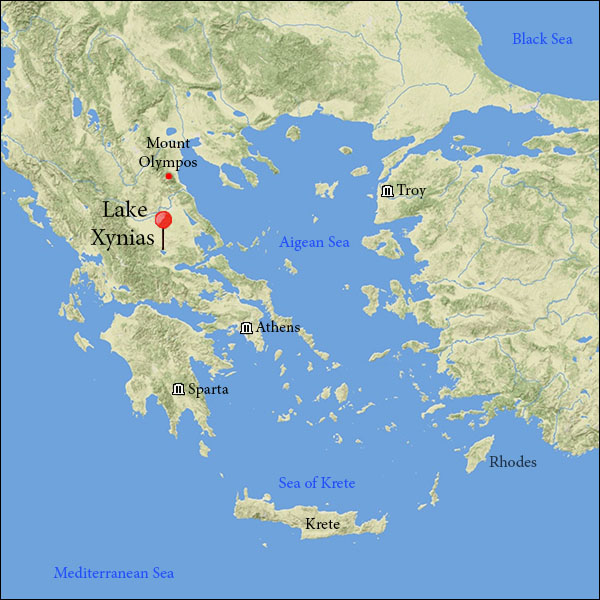
The Xynian Nymphs resided in central Thessaly and were notable because they gave their name to a lake in which they frequently bathe—Lake Xynias. We have no other details about their numbers or activities.
There are literally countless numbers of Nymphs. Where did they all come from?
There are several instances where we are told how certain Nymphs were created but that does not account for even a small percentage of the total. The master musician Orpheus sang to the Argonauts about the creation of the earth and "how the mountains rose, and how the resounding rivers with their Nymphs came into being and all creeping things." His song implies that Nymphs were among the first immortal beings to exist on the earth.
The Meliae are the Nymphs born from the blood of Ouranos (Heaven) at the time of his mutilation at the hands of his son, Kronos ... they are collectively called the Nymphs of the Ash Trees. We are not told how many Meliae there were or their names.
The Hyades and Pleiades were twelve Nymph daughters of Atlas who were placed in the heavens as stars.
Kalypso was also a daughter of Atlas. She was the lover and protector of Odysseus after he became lost on his voyage home after the Trojan War.
Without doubt, the largest number of Nymphs for which we know their parentage are the daughters of Okeanos (Ocean) and Tethys. These Nymphs are called Okeanids—daughters of Okeanos. There are thousands of Okeanids and we know the names of only a few. They are what seamen sometimes call mermaids. They are protectors of the seas and their inhabitants.
Most Nymphs are of unknown origin. They are often referred to as Daughters of Zeus because when the War of the Titans began, Zeus called all disenfranchised Immortals to Mount Olympos and asked for their assistance ... the Nymphs gave their support to Zeus without hesitation and were thereafter called the Daughters of Zeus. That title was also given to Aphrodite (goddess of love) and we know that she was not an actual daughter of Zeus and, in fact, preceded him by at least one immortal generation.
That leaves us with the compelling question ... From where did the Nymphs come? Speculation might be interesting but will in no way answer the question with any lasting satisfaction.
The simple answer is ... We do not know the origins of the majority of the Nymphs.
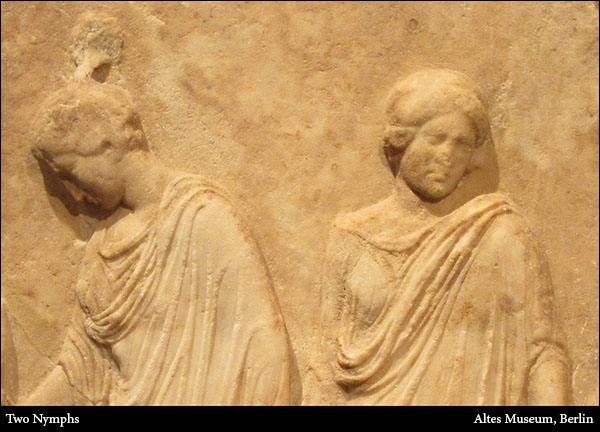
Nymphs have always been integral to the processes of nature and are readily perceived by the very young and the pure of heart. In ancient Greece, Nymphs were not a common sight but that did not inhibit the belief in their reality or the unwavering devotion of their worshipers. The natural world is fraught with 'strangeness' and Nymphs have made significant contributions to our perceptions and misperceptions of how the 'real' world works.
When the question is asked, "Are Nymphs still with us?" Be assured that most modern people will say, "No ... definitely not ... Nymphs are mythological and in no way real." People who say that sort of thing have probably called upon Nymphs for divine assistance without realizing what they were doing or why they were doing it.
You are surely familiar with the expression, "Knock on wood." Someone will say something like, "I'm sure the weather will be perfect for my vacation" and then realize that they might have jinxed themselves by saying that. They will then say "Knock on wood" as they rap their knuckles lightly on something made of wood ... that combination of word and deed will call forth a Nymph from the wood to act as a protector.
Nature is truly alive and that vitality can take many forms ... Nymphs are simply an expression of the life-force that resides in trees, lakes and even the air we breathe.
Are the Nymphs still with us? Yes ... yes they are.
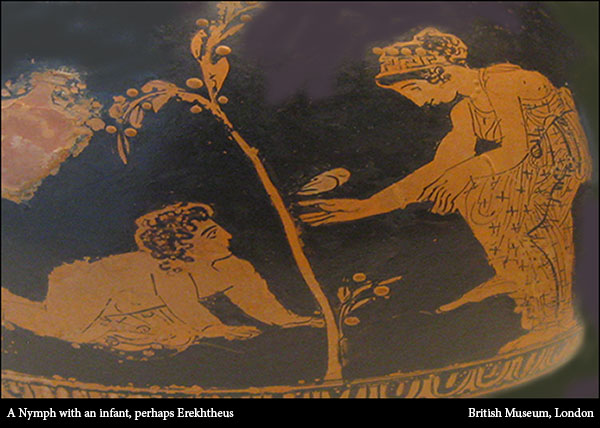
The Iliad
The Odyssey
Theogony
Astronomy
Contest of Homer and Hesiod
Precepts of Kheiron
Kypria
Telegony
Hesiod, Fragments of Unknown Position
Hymn to Aphrodite V
Hymn to Pan XIX
Hymn to Dionysos XXVI
The Argonautika by Apollonius of Rhodes
Library of History by Diodorus of Sicily
Description of Greece by Pausanias