
| Nereids in the Iliad |
| Nereids in Theogony |
| Other Classical References |
| Previous Page |
| Homepage |
| Site Search |
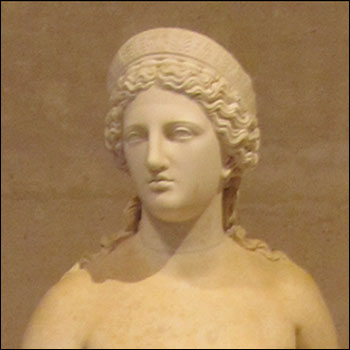
The Nereids are the daughters of Nereus and Doris. Their name simply means, Children of Nereus.
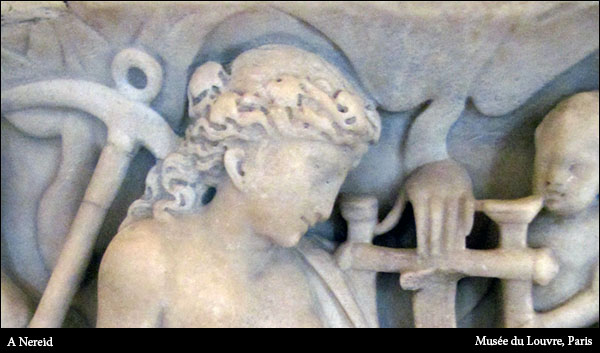
They are also called the Daughters of the Sea because that's where they make their homes but they are not sea-creatures in the traditional sense. They are capable of living on the land and flying through the sky as well as staying under water for infinite periods of time. Only Thetis is described in any physical detail so we can assume that her sisters were similar to her in appearance ... therefore, we can safely say that the Nereids do not have gills or fins and are in the form of young women. Hesiod uses adjectives like comely, rosy-armed, lovely and divine but, in many cases, their names describe their powers, such as: Wave-Receiver, Truthful, and Unerring.
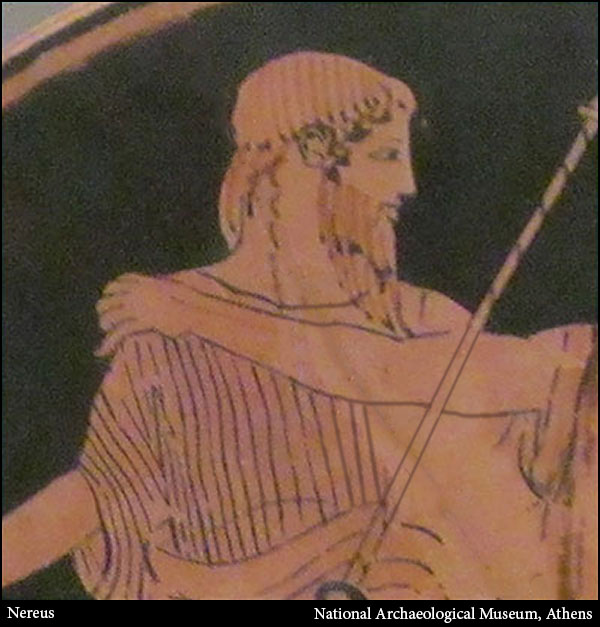
Nereus is appropriately called The Ancient of the Sea because he is primarily a sea dweller and truly ancient. Little is known about Doris other than that she was the mother of the Nereids.
Nereus had the ability to change shapes at will. He could assume the guise of an animal or a force of nature. He was also noted for his wisdom and his gift of prophecy. Zeus's son Herakles sought out Nereus when he was looking for the Garden of the Hesperides. Herakles was forced to overpowered Nereus in order to get the information he needed.
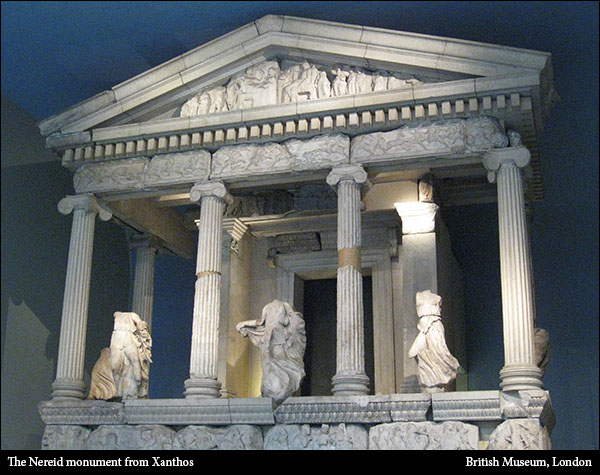
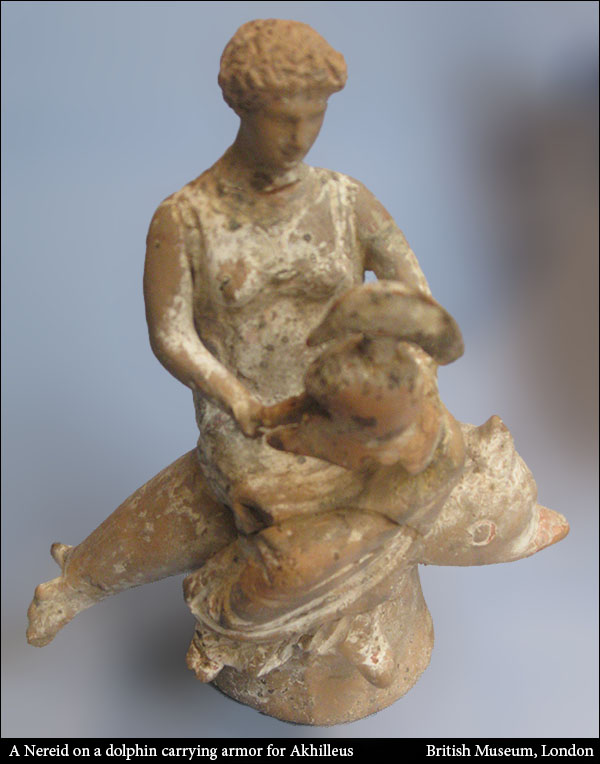
The oldest mention of the Nereids comes from a rather late literary source, Plato. When Plato was describing the Temple of Poseidon on the central island of Atlantis, he said that there was a golden statue of Poseidon with one hundred sculptured Nereids riding dolphins around the base of the statue. He further states that one hundred was the accepted number of Nereids at that time, which would have been prior to 9000 BCE.
Other than a passing reference to the individual daughters of Nereus, the only Nereid to receive any individual attention in the ancient literature was Thetis. As the mother of Achilles and one of the few goddesses to refuse the amorous intentions of Zeus, Thetis was unique. When the Immortals needed the Nereids, they called on Thetis to rally her sisters for whatever task was needed.
A generation before the Trojan War the Nereids encountered Ieson (Jason) and the Argonauts during their Quest for the Golden Fleece. The goddess Hera summoned Thetis to Mount Olympos and asked her to gather her sisters and help protect Ieson from the wrath of Zeus. Ieson and Princess Medeia had murdered Medeia's half-brother Apsyrtos in their haste to escape King Aietes with the Golden Fleece.
Zeus was intent on punishing Ieson and Medeia but Hera thought there was the possibility that they might be absolved of their blood-guilt by Medeia's aunt, the Dread-Goddess Kirke (Circe). In order to reach Kirke's island, Ieson and the Argonauts had to sail their ship, the Argo, past the six-headed Skylla and the whirlpool Kharybdis, and then navigate the waters of the forbidding Planktae, also known as the Wandering Rocks or the Rovers. The giant stone islands would clash together and destroy anyone and anything caught in their midst. The Planktae were so notorious and dangerous that doves carrying ambrosia to Zeus were killed when they tried to fly between them.

Thetis called her sisters and explained Hera's wishes. The Nereids swam to the Argonauts and a truly amazing spectacle took place. On one side of the sea passage was the steep rock of Skylla and on the other side Kharybdis spouted and roared ... further on, the Planktae boomed beneath the sea surge. As the Argo drew near the Planktae, the Nereids surrounded the vessel as Thetis grasped the rudder-blade under the ship. In a way reminiscent of dolphins, the Nereids darted upward and circled around the ship while Thetis guided its course.
When the Argo was about to smash against the Planktae, the Nereids immediately lifted the edge of their garments and darted up on the rocky cliffs above the waves and then jumped from one side to the other. As the ship was raised aloft by the waves, the Nereids caught it and toss it to and fro like young girls throwing a ball for sport. The waves rose like towering crags and then plummeted to the depths of the sea ... water poured over the Argo in floods. When Hera saw the ship being bounced and swamped by the waves, she was seized by fear and threw her arms around Athene for comfort. The frenzy continued until the Argo was clear of the Planktae and the Argonauts could catch the wind and sail on.
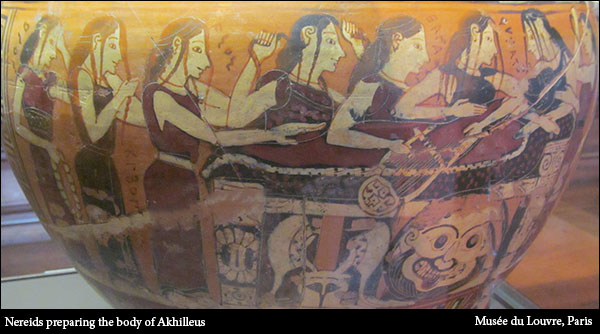
We next encounter the Nereids at the funeral of Patroklos. In the last year of the Trojan War, Achilles's companion Patroklos was killed.
Achilles took Patroklos's death very hard and called out to his mother Thetis for consolation. Thetis and the Nereids rose from the sea and graced the dead body of Patroklos with their divine presence. Thetis promised Achilles that she would protect body of Patroklos from all types of degradation until his body could be burned.
Not long after the funeral of Patroklos, the Nereids again rose from the sea to attend the funeral of Achilles. The death of Achilles was one of the most dramatic events of the Trojan War because he was without doubt the most feared warrior in the Achaian army ... he was of course feared by the Trojans but his own army feared him too because he was utterly ruthless. Also, as the son of Thetis, Achilles's death had a particular significance for the Nereids. When Achilles's body was laid on the funeral pyre, the Nereids marched onto the beach in a solemn procession ... the Muses sang and all the soldiers cried.
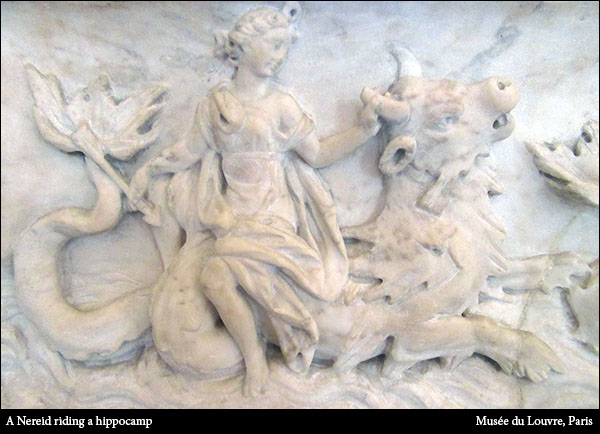
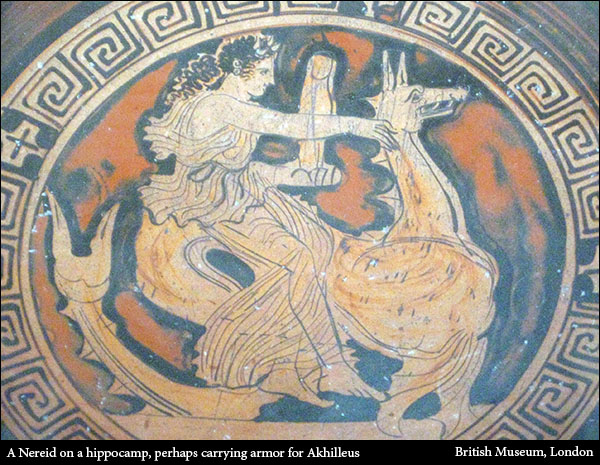
The Nereids are often seen riding on sea creatures such as hippocamps or dolphins. Their presence is always a favorable sign to sailors even though their father Nereus was awesome and forbidding.
Generally speaking, the Iliad is the oldest piece of western literature to survive into modern times. It is presumed to date from the eighth century BCE and to have been written by the poet, Homer. At the beginning of Book 18 the Nereids emerge from the sea to pay homage to the fallen hero, Patroklos. Thetis, the mother of Achilles, leads the procession.
(listed by book and line from four different translations)
(Richmond Lattimore—Loeb Classical Library—Robert Fagles—Robert Fitzgerald)
| Agaue Ἀγαυὴ | |
|---|---|
| Agauë 18.42 (Lattimore) | Agave 18.42 (Loeb) |
| Brilliance 18.49 (Fagles) | Agauê 18.47 (Fitzgerald) |
| Aktaie Άκταίη | |
| Aktaie 18.41 (Lattimore) | Actaeë 18.41 (Loeb) |
| Headlands’ Hope 18.48 (Fagles) | Aktaiê 18.45 (Fitzgerald) |
| Amatheia Ἀμάθεια | |
| Amatheia 18.48 (Lattimore) | Amatheia 18.48 (Loeb) |
| Strands of Sand 18.55 (Fagles) | Amathyia 18.53 (Fitzgerald) |
| Amphinome Ἀμφινόμη | |
| Amphinome 18.44 (Lattimore) | Amphinome 18.44 (Loeb) |
| Bather of Meadows 18.51 (Fagles) | Amphinomê 18.49 (Fitzgerald) |
| Amphithoe Ἀμφιθόη | |
| Amphithoë 18.42 (Lattimore) | Amphithoë 18.42 (Loeb) |
| Whirlpool 18.49 (Fagles) | Amphitoê (typo) 18.47 (Fitzgerald) |
| Apseudes Ἀψευδὴς | |
| Apseudes 18.46 (Lattimore) | Apseudes 18.46 (Loeb) |
| Truth 18.53 (Fagles) | Apseudês 18.51 (Fitzgerald) |
| Dexamene Δεξαμένη | |
| Dexamene 18.44 (Lattimore) | Dexamene 18.44 (Loeb) |
| Welcome Home 18.51 (Fagles) | Dexaménê 18.48 (Fitzgerald) |
| Doris Δωρὶς | |
| Doris 18.45 (Lattimore) | Doris 18.45 (Loeb) |
| Gift of the Sea 18.52 (Fagles) | Dôris 18.49 (Fitzgerald) |
| Doto Δωτώ | |
| Doto 18.43 (Lattimore) | Doto 18.43 (Loeb) |
| Bounty 18.50 (Fagles) | Dôtô 18.47 (Fitzgerald) |
| Dynamene Δυναμένη | |
| Dynamene 18.43 (Lattimore) | Dynamene 18.43 (Loeb) |
| Power 18.50 (Fagles) | Dynaménê 18.48 (Fitzgerald) |
| Galateia Γαλάτεια | |
| Galateia 18.45 (Lattimore) | Galatea 18.45 (Loeb) |
| Calm 18.52 (Fagles) | Galateia 18.50 (Fitzgerald) |
| Glauke Γλαύκη | |
| Glauke 18.39 (Lattimore) | Glauce 18.39 (Loeb) |
| Glitter 18.45 (Fagles) | Glaukê 18.43 (Fitzgerald) |
| Halie Ἁλίη | |
| Halia 18.40 (Lattimore) | Halië 18.40 (Loeb) |
| shadowy Cavern 18.46 (Fagles) | Haliê 18.44 (Fitzgerald) |
| Iaira Ἲαιρα | |
| Iaira 18.42 (Lattimore) | Iaera 18.42 (Loeb) |
| Suave-and-Soothing 18.49 (Fagles) | Iaira 18.45 (Fitzgerald) |
| Ianassa Ἰάνασσά | |
| Ianassa 18.47 (Lattimore) | Ianassa 18.47 (Loeb) |
| the one who rescues kings 18.54 (Fagles) | Ianassa 18.52 (Fitzgerald) |
| Ianeira Ἰάνειρα | |
| Ianeira 18.47 (Lattimore) | Ianeira 18.47 (Loeb) |
| Healer of Men 18.54 (Fagles) | Ianeira 18.52 (Fitzgerald) |
| Kallianassa Καλλιάνασσα | |
| Kallianassa 18.46 (Lattimore) | Callianassa 18.46 (Loeb) |
| the queen who rules the tides in beauty 18.53 (Fagles) | Kallianassa 18.51 (Fitzgerald) |
| Kallianeira Καλλιάνειρα | |
| Kallianeira 18.44 (Lattimore) | Callianeira 18.44 (Loeb) |
| Master’s Lovely Consort 18.51 (Fagles) | Kallianeira 18.49 (Fitzgerald) |
| Klymene Κλυμένη | |
| Klymene 18.47 (Lattimore) | Clymene 18.47 (Loeb) |
| Glory 18.54 (Fagles) | Klymene 18.52 (Fitzgerald) |
| Kymodoke Κυμοδόκη | |
| Kymodoke 18.39 (Lattimore) | Cymodoce 18.39 (Loeb) |
| swells' Embrace 18.45 (Fagles) | Kymodoke 18.43 (Fitzgerald) |
| Kymothoe Κυμοθόη | |
| Kymothoë 18.41 (Lattimore) | Cymothoë 18.41 (Loeb) |
| Race-with-the-Waves 18.48 (Fagles) | Kymothoê 18.45 (Fitzgerald) |
| Limnoreia Λιμνώρεια | |
| Limnoreia 18.41 (Lattimore) | Limnoreia 18.41 (Loeb) |
| Safe Haven 18.48 (Fagles) | Limnoreia 18.46 (Fitzgerald) |
| Maira Μαῖρα | |
| Maira 18.48 (Lattimore) | Maera 18.48 (Loeb) |
| Sparkler 18.55 (Fagles) | Maira 18.53 (Fitzgerald) |
| Melite Μελίτη | |
| Melite 18.42 (Lattimore) | Melite 18.42 (Loeb) |
| Glimmer of Honey 18.49 (Fagles) | Melite 18.46 (Fitzgerald) |
| Nemertes Νημερτής | |
| Nemertes 18.46 (Lattimore) | Nemertes 18.46 (Loeb) |
| Never-Wrong 18.53 (Fagles) | Nêmertês 18.53 (Fitzgerald) |
| Nesaie Νησαίη | |
| Nesaie 18.40 (Lattimore) | Nesaea 18.40 (Loeb) |
| Fair-Isle 18.46 (Fagles) | Nesaiê 18.44 (Fitzgerald) |
| Oreithyia Ὠρείθυια | |
| Oreithyia 18.48 (Lattimore) | Oreithyia 18.48 (Loeb) |
| Down-from-the-Clifts 18.55 (Fagles) | Oreithyia 18.53 (Fitzgerald) |
| Panope Πανόπη | |
| Panope 18.45 (Lattimore) | Panope 18.45 (Loeb) |
| Eyes of the World 18.52 (Fagles) | Panopê 18.50 (Fitzgerald) |
| Pherousa Φέρουσά | |
| Pherousa 18.43 (Lattimore) | Pherusa 18.43 (Loeb) |
| Speeder of Ships 18.50 (Fagles) | Pherousa 18.48 (Fitzgerald) |
| Proto Πρωτώ | |
| Proto 18.43 (Lattimore) | Proto 18.43 (Loeb) |
| First Light 18.50 (Fagles) | Prôtô 18.47 (Fitzgerald) |
| Speio Σπειώ | |
| Speio 18.40 (Lattimore) | Speio 18.40 (Loeb) |
| Mist 18.46 (Fagles) | Speiô 18.44 (Fitzgerald) |
| Thaleia Θάλειά | |
| Thaleia 18.39 (Lattimore) | Thaleia 18.39 (Loeb) |
| Spray 18.45 (Fagles) | Thaleia 18.43 (Fitzgerald) |
| Thoe Θόη | |
| Thoë 18.40 (Lattimore) | Thoë 18.40 (Loeb) |
| Spindrift 18.46 (Fagles) | Thoê 18.44 (Fitzgerald) |
Hesiod is considered to be one of the greatest Greek poets of all time. Hesiod presumably lived in the eighth century BCE and composed a number of poems including Theogony, which is considered to be the last word on the genealogy of the Greek gods and goddesses.
(listed by line number)
| Agaue Ἀγαυὴ 247 | Aktaie Ἀκταίη 249 |
| Alimede Ἁλιμηδη 255 | Amphitrite Ἀμφιτρίτη 243, 252 and 930 |
| Autonoe Αυτονοη 258 | Doris Δωρὶς 250 |
| Doto Δωτώ 248 | Dynamene Δυναμένη 248 |
| Eione Ἠιονη 255 | Erato Ἠρατώ 246 |
| Euagore Εὐαγόρη 257 | Euarne Εὐάρνη 259 |
| Eudora Εὐδώρη 244 | Eukrante Εὐκράντη 243 |
| Eulimene Εὐλιμένη 247 | Eunike Εὐνίκη 246 |
| Eupompe Εὐπόμπη 261 | Galatea Γαλάτεια 250 |
| Galene Γαλήνη 244 | Glauke Γλαύκη 244 |
| Glaukonome Γλαυκονόμη 256 | Halia Ἀλίη 245 |
| Hipponoe Ἱππονόη 251 | Hippothoe Ἱπποθόη 251 |
| Kymatolege Κυματολήγῃ 253 | Kymo Κυμώ 255 |
| Kymodoke Κυμοδόκη 252 | Kymothoe Κυμοθόη 245 |
| Laomedea Λαομέδεια 257 | Leagore Ληαγόρη 257 |
| Lysianassa Λυσιάνασσα 258 | Melite Μελίτη 247 |
| Menippe Μενίππη 260 | Nemertes Νημερτής 262 |
| Neso Νησώ 261 | Nesaie Νησαίη 249 |
| Panopeia Πανόπηια 250 | Pasithea Πασιθέη 246 |
| Pherousa Φέρουσά 248 | Ploto Πλωτώ 243 |
| Poulynoe Πουλυνοη 258 | Pontoporeia Ποντοπορεηα 256 |
| Pronoe Προνοη 261 | Proto Πρωτώ 248 |
| Protomedeia Πρωτομέδεια 249 | Psamathe Ψαμάθη 260 |
| Sao Σαώ 243 | Speio Σπειώ 245 |
| Themisto Θεμιστώ 261 | Thetis Θέτις 244 |
| Thoe Θόη 245 |
The Histories by Herodotos; book 7.191
The Argonautika by Apollonius of Rhodes; book 4, lines 824, 844, 859, 930, 936 and 1743
Plato; Kritias 116-E
Odes of Pindar; Isthmian Ode 6; Pythian Ode 11; Nemean Odes 4 and 5
Library of History by Diodorus of Sicily; book 4.72.6