
Muses
MOO seh
Μουσαι
Goddesses of the Creative Arts

The Muses are the nine daughters of Zeus and Mnemosyne (Memory). Zeus came to Mnemosyne on nine consecutive nights and the nine daughters were the result of those nine unions. Mnemosyne gave birth to the nine girls near the topmost peaks of Mount Olympos (Olympus). All nine girls are of one mind ... they are free spirited and have their hearts set upon song ... they sing of the laws of the Immortals and the goodly ways of a life. Their homes and bright dancing places are on Mount Olympos but they may appear to anyone as long as the performer is paying tribute to the immortal gods with their art.
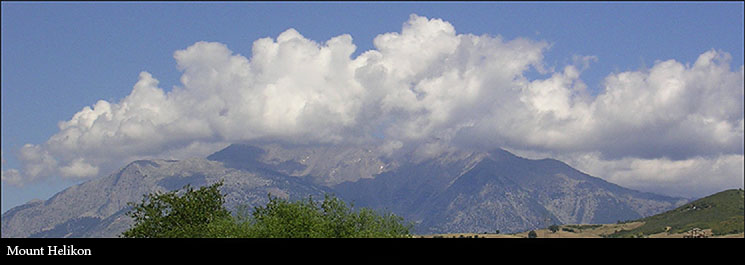
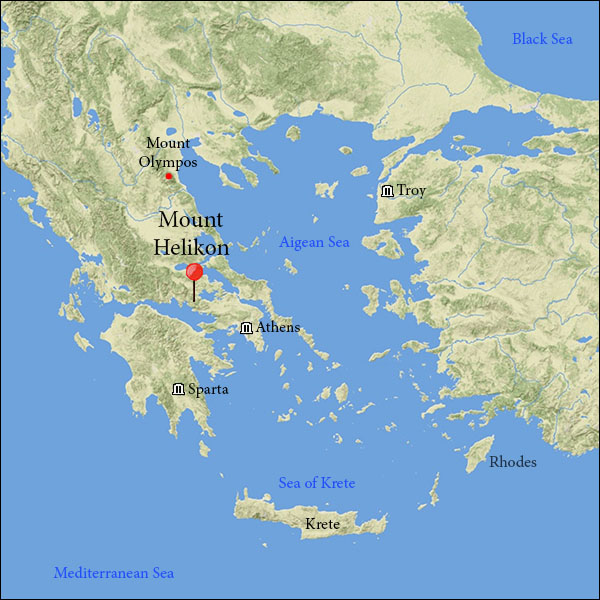
According to the poet, Hesiod, the Muses frequent Mount Helikon (Helicon) and the area around Mount Olympos known as Pieria. They arise by night and, shrouded in mist, walk the hills and bathe in springs. By calling upon and receiving the blessings of the Muses, a poet or dancer or musician can transcend the normal bounds of talent and rise to unimagined levels of creative insight.
The Muses are listed by name in the poem Theogony but the specific attributes of each goddess were added by later poets:
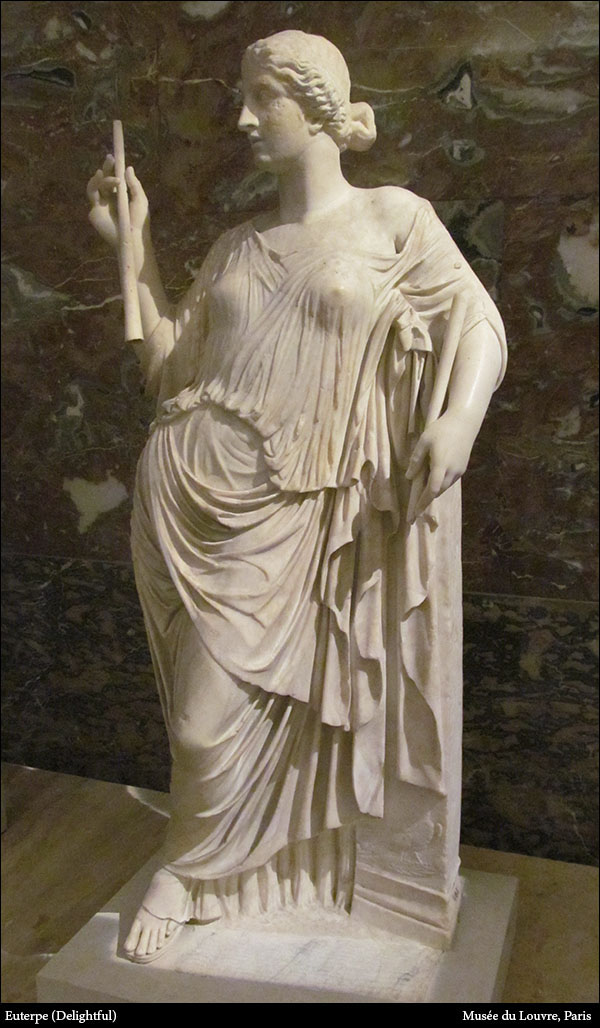
- Erato (the Lovely), Love Poems
-
- Euterpe (Delightful), Flute Playing
-
- Kalliope (Calliope) (the Beautiful-Voiced), Epic Poetry
-
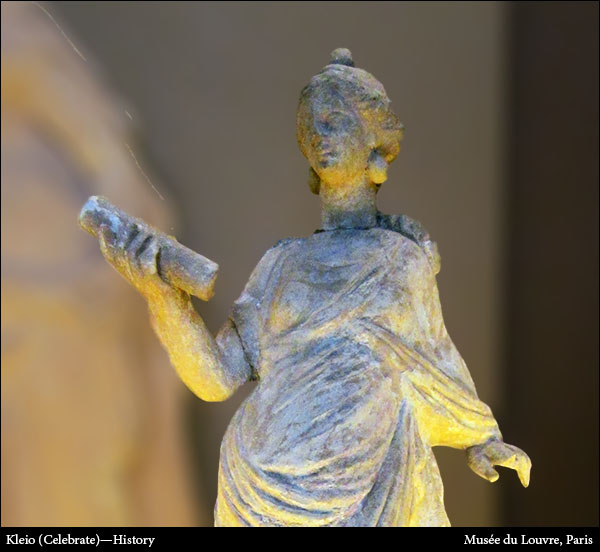
- Kleio (Klio or Clio) (to Celebrate), History
-
- Melpomene (the Songstress), Tragedy
-
- Ourania (Urania) (the Heavenly One), Astrology
-
- Polymnia (Polyhymnia) (of the Many Hymns), Sacred Music
-
- Terpsichore (the Dance-Enjoying), Dance
-
- Thaleia (the Blooming One), Comedy
Mount Helikon
Encounters with the Muses
Kalliope holds the highest rank of the Muses and attends the birth of kingly nobles and gives (or withholds) the gifts of the Muses as the Immortals deem fit. Mere mortals who are blessed by the Muses, can use the beauty of their song, or the grace of their dance, to heal the sick and comfort the heartbroken.
The Muses can bestow the gift of talent and insight but they can also viciously revoke their blessings.
One story tells of a singer and poet named Thamyris who belittled the Muses ... he mocked them and made light of their skills. For his insolence, Thamyris was maimed and lost his memory ... he could no longer remember his songs or poems.
King Pierus boasted that his nine daughters rivaled the Muses in beauty and talent ... all nine girls were turned into magpies for their father's impudence.
When the poet Hesiod encountered the Muses, they gave him a rod of laurel and said that they could say many false things as if they were true but when they wished, they could reveal the truth. They breathed a divine voice into him so that he could sing of things that will come to pass and things that came aforetime. Under the influence of their immortal guidance, Hesiod composed many poems but his crowning achievement might be considered Theogony, i.e. The Origins of the Gods. That poem demonstrates exactly what the Muses do best, sing the praises of the immortal gods and goddesses.
Even the author of The Battle of Mice and Frogs gave praise to the Muses in his comic poem satirizing The Iliad. After reading this poem, it is easy to see that comedy, like historical epics, requires the touch of divine genius that only the Muses can provide.
The Gifts of the Muses
The gifts of the Muses are subtle yet obvious. If there are men or women who are blessed by the Muses, their divine influence begins a birth. The Muses will pour sweet dew on the tongues of those they choose to honor and gracious words will flow from the lips of the people they bless.
Princes and kings are created by the grace of Zeus but there are certain princes and kings who also have the blessings of the Muses. Those who have been blessed by the Muses will be conspicuous in their speech and the way they look. Great quarrels will be resolved with gentle words and disputes in assemblies will be set right by leaders who have been blessed by the Muses. Leaders empowered by the Muses will be treated with the reverence accorded the Immortals when they are in the company of ordinary men and women.
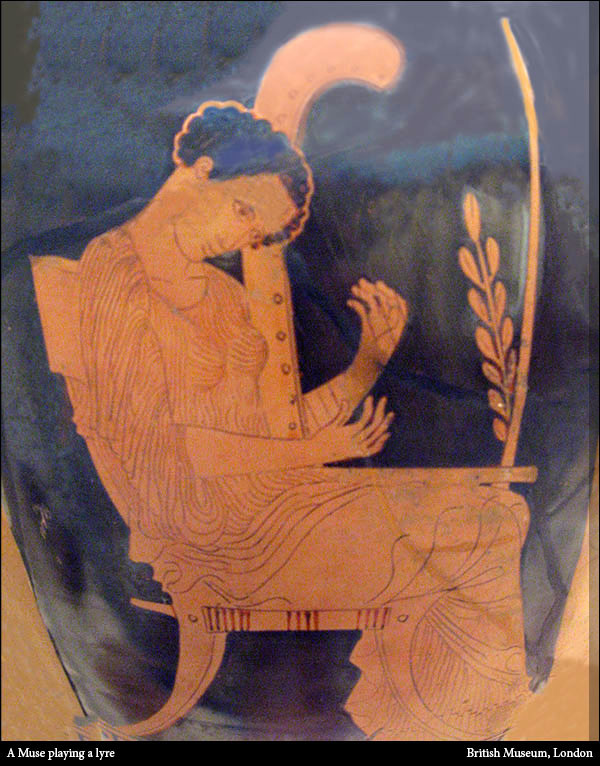
Without the blessings of the Muses and far-shooting Apollon, there would be no singers or lyre players upon the earth. The songs inspired by the Muses can act as a healing tonic for those with troubled minds and ailing bodies. The word Tonic, denoting the key of a musical composition, can also mean Remedy when music is inspired by the Muses.
The Muses and Apollon
The Muses attend the festivals on Mount Olympos and entertain and inspire the Immortals with their wit and charm. Apollon puts aside his bow and plays the lyre while the Muses sing of the unending gifts the Immortals enjoy and the plight of the mere mortals who must endure the pains of illness and the failings of old age. Hebe (goddess of Youth), the Graces, the Seasons, Harmonia, Artemis and Aphrodite (goddess of Love) hold hands as they join in the dance.
At the shrine for Apollon in Delphi, Artemis, the Muses and the Graces gather to dance and sing the praises of Leto for bringing her shining children into the world.
In the poem, The Contest of Homer and Hesiod, the author tells of how after Hesiod won the contest he dedicated the prize tripod to the Muses. He then went to Delphi to make a dedication to Apollon but as he was approaching the temple, the priestess had a divine revelation and warned Hesiod to avoid the precincts of Nemean Zeus. Hesiod misinterpreted the priestess and inadvertently went to live in the exact place the priestess had told him to avoid ... he was subsequently killed in a precinct sacred to Nemean Zeus.
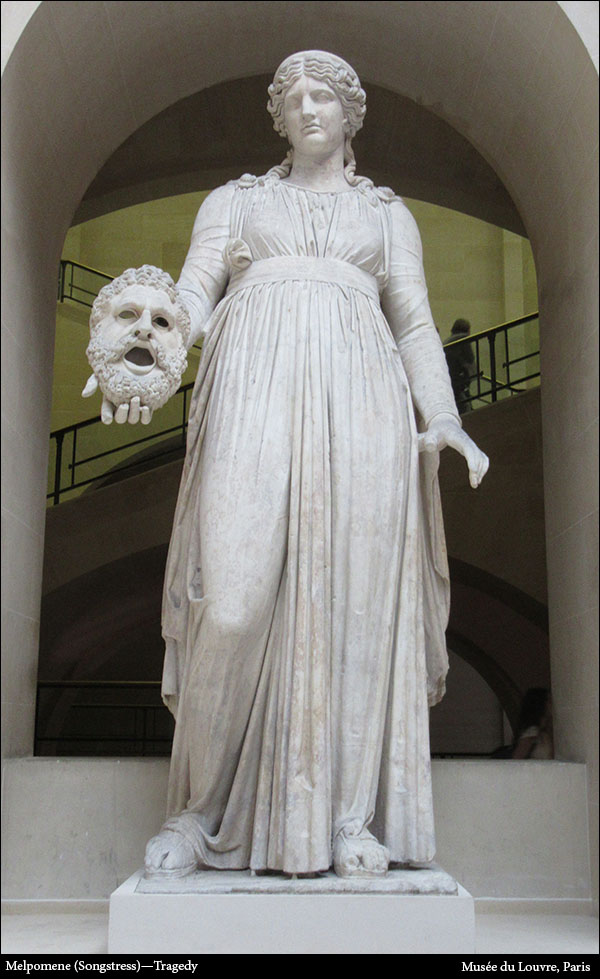
A Muse holding a mask; possibly Melpomene (the Songstress), the Muse of Tragedy.
The Muses in The Iliad
(listed by book and line from four different translations)
Richmond Lattimore
- 01.001 - Sing, goddesses [the Muses], the anger of Peleus' son Achilleus and its devastation, which put pains thousandfold upon the Achaians ...
-
- 01.604 - ... they [the Olympians] feasted, nor was anyone's hunger denied a fair portion, nor denied the beautifully wrought lyre in the hands of Apollo nor the antiphonal sweet sound of the Muses singing.
-
- 02.484 - Tell me now you Muses who have your homes on Olympos. For you, who are goddesses, are there, and you know things, and we have heard only the rumour of it and know nothing. Who then of those were the chief men and the lords of the Dannans?
-
- 02.491 - I could not tell over the multitude of them nor name them, not if I had ten tongues and ten mouths, not if I had a voice never to be broken and a heart of bronze within me, not unless the Muses of Olympia, daughters of Zeus of the aegis, remembered all those who came beneath Ilion.
-
- 02.594 - ... Dorion, where the Muses encountering Thamyris the Thracian stopped him singing as he came from Oichalia and Oichalian Eurytos ...
-
- 02.597 - ... he [Thamyris] boasted that he would surpass, if the very Muses, daughters of Zeus who holds the aegis, were singing against him, and these in their anger struck him maimed, and the voice of wonder they took away, and made him a singer without memory ...
-
- 02.761 - Tell me then Muse, who of them all was the best and bravest of the men, and the men's horses, who went with the sons of Atreus.
-
- 11.218 - Tell me now, you Muses who have your homes on Olympos, who was the first to come forth and stand against Agamemnon of the very Trojans, or their renowned companions in battle.
-
- 14.508 - Tell me now, you Muses who have your homes on Olympos, who was the first of the Achaians to win the bloody despoilment of men, when the glorious shaker of the earth [Poseidon] bent the way of the battle?
-
- 16.112 - Tell me now, you Muses who have your homes on Olympos, how fire was first thrown upon the ships of the Achaians.
Loeb Classical Library
- 01.001 - The wrath sing, goddesses, of Pelius' son Achilles, the accursed wrath brought countless sorrows upon the Achaeans ...
-
- 01.604 - ... they [the Olympians] feasted, nor did their hearts lack anything of the equal banquet, nor of the beauteous lyre that Apollo held, nor of the Muses that sang, replying one to the other with sweet voices.
-
- 02.484 - Tell me now, you Muses who have dwellings on Olympus—for you are goddesses and are present and know all things, but we hear only a rumor and know nothing—who were the leaders and lords of the Dannans.
-
- 02.491 - But the multitude I could not tell or name, not even if ten tongues were mine and ten mouths and a voice unwearying, and the heart within me were bronze, unless the Muses of Olympus, daughters of Zeus who bears the aegis, call to my mind all those who came beneath Ilios.
-
- 02.594 - ... Dorium, where the Muses met Thamyris the Thracian and made an end to his singing ...
-
- 02.598 - ... he [Thamyris] declared with boasting that he would win even if the Muses themselves were to sing against him, the daughters of Zeus who bears the aegis; but they in their wrath maimed him, and took from him his wondrous singing, and made him forget his artful playing ...
-
- 02.761 - But who was far the best among them do tell me, Muse—best of the warriors and of the horses that followed with the sons of Atreus.
-
- 11.218 - Tell me now, you Muses who have dwellings on Olympus, who it was that first came to face Agamemnon, either of the Trojans themselves or of their famed allies.
-
- 14.508 - Tell me now, you Muses who have dwellings on Olympus, who was first of the Achaeans to carry away the blood-stained spoils of warriors when once the famed Shaker of the Earth [Poseidon] had turned the battle.
-
- 16.112 - Tell me now, Muses, who have dwellings on Olympus, how fire was first flung on the ships of the Achaeans.
Robert Fagles
- 01.001 - Rage—Goddesses, sing of the rage of Peleus' son, Achilles, murderous, doomed, that cost the Achaeans countless losses ...
-
- 01.726 - ... they [the Olympians] feasted and no god's hunger lacked a share of the handsome banquet of the gorgeous lyre of Apollo struck or the Muses singing voice to voice in chorus, their vibrant music rising.
-
- 02.573 - Sing to me now, you Muses who hold the halls of Olympus! You are goddesses, you are everywhere, you know all things—all we hear is the distant ring of glory, we know nothing—who were the captains of Achaea? Who were the kings?
-
- 02.580 - The mass of troops I could never tally, never name, not even if I had ten tongues and ten mouths, a tireless voice and the heart inside me bronze, never unless you Muses of Olympus, daughters of Zeus whose shield is rolling thunder, sing, sing in memory all who gathered under Troy.
-
- 02.686 - ... Dorion, the Muses met the Thracian Thamyris, stopped his minstrel song ...
-
- 02.689 - ... boasting to high heaven that he [Thamyris] could outsing the very Muses, the daughters of Zeus whose shield resounds with thunder. They were enraged, they maimed him, they ripped away his voice, the rousing immortal wonder of his song and wiped all arts of harping from his mind.
-
- 02.864 - Now tell me, Muse, who were the bravest of them all, of the men and chariot-teams that came with Atreus' sons?
-
- 11.253 - Sing to me now, you Muses who hold the halls of Olympus, who was the first to go up against King Agamemnon, who of the Trojans or famous Trojan allies?
-
- 14.595 - Sing to me now, you Muses who hold the halls of Olympus, who was the first Achaean to drag off bloody spoils as the famous god of earthquakes [Poseidon] turned the tide?
-
- 16.135 - Sing to me now, you Muses, you who hold Olympus' vaulting halls, how fire was first pitched on Achaea's ships!
Robert Fitzgerald
- 01.001 - Anger be now your song, immortal one, Akhilleus' anger, doomed and ruinous, that caused the Akhaians loss on bitter loss ...
-
- 01.700 - ... and the measured feast [of the Olympians] matched well their heart's desire. So did the flawless harp held by Apollo and heavenly songs in choiring antiphon that all the Muses sang.
-
- 02.567 - Tell me now, Muses, dwelling on Olympos, as you are heavenly, and are everywhere, and everything is known to you—while we can only hear the tales and never know—who were the Danaan lords and officers?
-
- 02.575 - The rank and file I shall not name; I could not, of I were gifted with ten tongues and voices unfaltering, and a brazen heart within me, unless the Muses, daughters of Olympian Zeus beyond the stormcloud, could recall all those who sailed for the campaign at Troy.
-
- 02.702 - ... Dorion too, where once the Muses, meeting Thamyris, the Thracian, visiting Eurytos, the Oikhalian—ended his singing.
-
- 02.706 - Pride had made him [Thamyris] say he could outsing the very Muses, daughters of Zeus who bears the stormcloud for a shield. For this affront they blinded him, bereft of his god-given song, and stilled his harping.
-
- 02.907 - But tell me, Muse, of all the men and horses who were the finest, under Agamemnon?
-
- 11.251 - Heaven-dwelling Muses of Olympos, tell me who first, among the allies or Trojans, braved Agamemnon?
-
- 14.573 - Muses in your bright Olympian halls, tell me now what Akhaian most excelled in winning bloodstained spoils of war when the Earthshaker [Poseidon] bent the battle line.
-
- 16.132 - Now tell me, Muses, dwellers on Olympos, how fire first fell on the Akhaian ships!
The Muses in The Odyssey
(listed by book and line from four different translations)
Richmond Lattimore
- 01.001 - Tell me, Muse, of the man [Odysseus] of many ways, who was driven far journeys, after he had sacked Troy's citadel.
-
- 01.010 - From some point here, goddess, daughter of Zeus, speak, and begin our journey.
-
- 08.063 - The herald came near, bringing with him the excellent singer [Demodokos] whom the Muse had loved greatly, and gave him both good and evil. She reft him of his eyes, but she gave him the sweet singing.
-
- 08.073 - But when they had put away their desire for eating and drinking, the Muse stirred the singer [Demodokos] to sing the famous actions of men ...
-
- 08.480 - Odysseus: "For with all peoples upon the earth singers are entitled to be cherished and to their share of respect, since the Muse has taught them her own way, and since she loves all the company of singers."
-
- 08.488 - Odysseus says to Demodokos: "Surely the Muse, Zeus' daughter or else Apollo has taught you, for all too right following the tale you sing the Achaians' venture, all they did and had done to them ...
-
- 08.499 - He [Odysseus] spoke, and the singer [Demodokos], stirred by the goddess, began, and showed his song ...
-
- 24.060 - Odysseus: "And all nine Muses in sweet antiphonal singing mourned you [Achilleus] ...
-
- 24.062 - Odysseus: "... nor would you [Achilleus] have seen any one of the Argives not in tears, so much did the singing Muse stir them.
Loeb Classical Library
- 01.001 - Tell me Muse, of the man [Odysseus] of many devices, driven far astray after he had sacked the sacred citadel of Troy.
-
- 01.010 - Of these things, goddess, daughter of Zeus, beginning where you will, tell us in your turn.
-
- 08.063 - Then the herald approached leading the good minstrel [Demodocus], whom the Muse loved above all other men, and gave him both good and evil; of his sight she deprived him, but gave him the gift of sweet song.
-
- 08.073 - But when they had put from them the desire for food and drink, the Muse moved the minstrel [Demodocus] to sing of the glorious deeds of men ...
-
- 08.480 - Odysseus: "For among all men that are upon the earth minstrels win honor and reverence, for the Muse has taught them the paths of song, and loves the tribe of minstrels."
-
- 08.488 - Odysseus: "Demodocus, truly above all mortal men do I praise you, whether it was the Muse, daughter of Zeus, that taught you, or Apollo; for well and truly do you sing of the fate of the Achaeans ...
-
- 08.499 - So he [Odysseus] spoke, and the minstrel [Demodocus], moved by the god [the Muse] began ...
-
- 24.060 - Odysseus tells the ghost of Achilles: "And the Muses, all nine, replying to one another with sweet voices, led the dirge."
-
- 24.062 - Odysseus: "There you [Achilles] could not have seen an Argive but was in tears, so deeply did the clear-toned Muse move their hearts."
Robert Fagles
- 01.001 - Sing to me of the man [Odysseus], Muse, the man of twists and turns driven time and again off course, once he had plundered the hallowed heights of Troy.
-
- 01.011 - Launch out on his [Odysseus's] story, Muse, daughter of Zeus, start from where you will—sing of our time too.
-
- 08.072 - In came the herald now, leading the bard [Demodocus] the Muse adored above all others, true, but her gifts were mixed with good and evil both; she stripped him of sight but gave the man the power of stirring, rapturous song.
-
- 08.086 - All reached out for the good things that lay at hand and when they'd put aside desire for food and drink, the Muse inspired the bard [Demodocus] to sing the famous deeds of fighting heroes [at Troy] ...
-
- 08.439 - Odysseus: "From all who walk the earth our bards deserve esteem and awe, for the Muse herself has taught them paths of song. She loves the breed of harpers."
-
- 08.547 - Odysseus: "I respect you, Demodocus, more than any man alive—surely the Muse has taught you, Zeus's daughter, or god Apollo himself. How true to life, all too true ... you sing the Achaeans' fate ...
-
- 08.559 - Stirred now by the Muse, the bard [Demodocus] launched out in a fine blaze of song ...
-
- 24.064 - Odysseus tells the ghost of Achilles: "... and the Muses, nine in all, voice-to-voice in choirs, their vibrant music rising, raised your dirge."
-
- 24.067 - Odysseus: "Not one soldier would you [Achilles] have seen dry-eyed, the Muses' song so pierced us to the heart."
Robert Fitzgerald
- 01.001 - Sing in me, Muse, and through me tell the story of that man [Odysseus] skilled in all ways of contending, the wanderer, harried for years on end, after he plundered the stronghold on the proud height of Troy.
-
- 01.018 - Of these adventures, Muse, daughter of Zeus, tell us in our time, lift the great song again.
-
- 08.068 - The crier soon came, leading that man [Demodokos] of song whom the Muse cherished; by her gift he knew the good of life, and evil—for she who lent him sweetness made him blind.
-
- 08.079 - In time, when hunger and thirst were turned away, the Muse brought to the minstrel's [Demodokos'] mind a song of heroes whose great fame rang under heaven ...
-
- 08.513 - Odysseus: "All men owe honor to the poets—honor and awe, for they are the dearest to the Muse who puts upon their lips the ways of life."
-
- 08.521 - Odysseus: "Demodokos, accept my utmost praise. The Muse, daughter of Zeus in radiance, or else Apollo gave you skill to shape with such great style your songs of the Akhaians ...
-
- 08.533 - The minstrel [Demodokos] stirred, murmuring to the god [the Muse], and soon clear words and notes came one by one ...
-
- 24.067 - Odysseus tells the ghost of Akhilleus: "Then we heard the Muses sing a threnody in nine immortal voices."
-
- 24.070 - Odysseus tells the ghost of Akhilleus: "No Argive there but wept, such keening rose from that one Muse who led the song."
Other Text References
Theogony
- line 1 - Hesiod praises the Muses of Mount Helikon (Helicon) for the song he is about to sing
-
- line 25 - The Muses of Mount Olympos (Olympus), daughters of Zeus, told Hesiod that they can be as honest or deceitful as they desire
-
- line 36 - Hesiod begins his song by praising the Muses who gladden the heart of Zeus on Mount Olympos (Olympus)
-
- line 52 - The Olympian Muses, daughters of Zeus the aegis-holder
-
- line 54 - Mnemosyne, in union with Zeus, gave birth to nine daughters [the Muses]
-
- lines 75-79 - The Muses: Erato, Euterpe, Kalliope (Calliope), Kleio (Klio or Clio), Melpomene, Ourania (Urania), Polymnia (Polyhymnia), Terpsichore and Thaleia
-
- line 93 - Hesiod lists the gifts which the Muses can bestow on mortal men
-
- line 94 - It is because of the Muses and far-shooting Apollon that there are singers and harpers upon the earth
-
- line 96 - The people who are loved by the Muses are happy
-
- line 100 - A sorrowful man will forget his troubles when a singer inspired by the Muses begins to sing
-
- line 114 - Hesiod asks the Muses to tell him which of the Immortals first into being [Chaos]
-
- line 914 - The nine Muses were born to Mnemosyne with Zeus as the father
-
- line 966 - Hesiod asks the Muses to sing of the goddesses who had children by mortal men
-
- line 1022 - At the conclusion of Theogony, Hesiod asks the Muses to sing of the children of gods and mortal women [the poem dealing with this is called Catalogues of Women and Eoiae]
Works and Days
- line 1 - Hesiod prays to the Muses of Pieria to give him inspiration and glory for his song
-
- line 658 - Hesiod tells his brother Perses how he won a singing competition held by Amphidamas and dedicated the prize tripod to the Muses of Mount Helikon (Helicon)
The Shield of Herakles
- line 206 - Depicted on the elaborate Shield of Herakles was an animated image of the Muses of Pieria beginning a song
Catalogue of Women
(Loeb Classical Library vol. 503, Hesiod II)
- fragment 1, line 2 - And now sing of the tribe of women, sweet-voiced Olympian Muses, daughters of aegis-holding Zeus, of those who were best at that time and most beautiful on the earth ...
-
- fragment 23, line 11 - ... companions of the beautiful-haired Nymphs ... and the Muses on the wooded mountains ...
-
- fragment 157, line 8 - ... and that Apollo, leader of the Muses, was seized with desire for Macareus' daughter Euboea ...
-
- fragment 260 - ... of the Muses, who make a man very eloquent, one who speaks divinely ...
-
- fragment 306 - A Boeotian man spoke thus, Hesiod, servant of the sweet Muses: "whomever the immortals honor, him the fame of mortals too does follow."
Hymn to Helios XXXI
- line 1 - The poet asks Kalliope, daughter of Zeus, to sing the praises of Helios
Hymn to Pythian Apollon III
- line 189 - The Muses sing with Apollon on Mount Olympos (Olympus)
Hymn to Hermes IV
- line 1 - Muse, sing of Hermes, the son of Zeus and Maia
-
- line 430 - Hermes played his lyre and sang of Mnemosyne and her daughters, the Muses
Hymn to the Muses and Apollon XXV
- I will begin with the Muses and Apollon and Zeus. For it is through the Muses and Apollon that there are singers upon the earth and players upon the lyre; but kings are from Zeus. Happy is he whom the Muses love; sweet flows speech from his lips.
-
- Hail, children of Zeus! Give honor to my song! And now I will remember you and another song also.
The Little Iliad
- fragment 10 - Homer was said to have written: "Tell me Muse of the things which neither happened before nor will happen hereafter."
The Aethiopis
- fragment 1, line 28 - The Achaeans (Achaians) then bury Antilochos (Antilochus) and lay out the body of Achilles, while Thetis, arriving with the Muses and her sisters, bewails her son ...
The Contest of Homer and Hesiod
- section 314, line 8 - Some say that Kalliope was the mother of Homer
-
- section 314, line 35 - Hesiod was the descendant of Oeager and Kalliope through their child, Orpheus
-
- section 316, line 18 - Come Muse, sing not to me of things that are or that shall be or that were of old, but think of another song
-
- section 320, line 1 - Hesiod wants to know if Homer is honored by the Muses
-
- section 322, line 18 - Hesiod won the competition with Homer and was given a tripod which he dedicated to the Muses; the inscription on the tripod praised the Muses of Mount Helikon by saying, Hesiod dedicated this tripod to the Muses of Helicon after he had conquered divine Homer at Chalkis (Chalcis) in a contest of song
-
- section 322, line 26 - The priestess of Delphi tells Hesiod to beware of the grove of Nemean Zeus because death awaits him there
The Battle of Frogs and Mice
- line 1 - Here I begin; and first I pray the choir of the Muses to come down from Helikon (Helicon) into my heart to aid the lay which I have newly written in tablets upon my knee.
Fragments of Unknown Position
(Loeb Classical Library vol. 57, Hesiod)
- fragment 1 - So Ourania (Urania) bare Linus (Linos), a very lovely son; and him all men who are singers and harpers do bewail at feasts and dances, and as they begin and as they end they call on Linus ...
-
- fragment 5 - "Of the Muses who make a man very wise, marvellous in utterance."
-
- fragment 23 - ... even Hesiod, servant of the sweet Muses: "Whomsoever the immortals honor, the good report of mortals also follow him."
Argonautika
- book 1, line 24 - Kalliope and Oeagrus were the parents of Orpheus
-
- book 3, line 1 - Apollonius calls upon Erato to stand beside him and tell the story of the love affair between Jason and Medeia (Medea)