
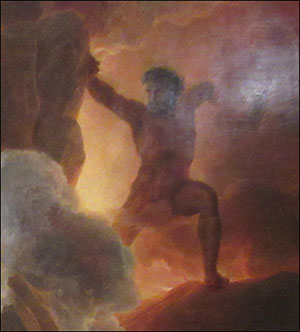
Kronos is one of the Titans, which was one of the earliest generations of Immortals to inhabit the earth. Kronos's mother was Ge (Earth) was the second Immortal to come into existence ... her first creation was Ouranos (Heaven). Ge and Ouranos joined to produce two very important groups of offspring.
The first group of Immortals to be conceived by Ge and Ouranos were the three brothers Briareos, Kottos, and Gyes ... they were monstrous ... each one had fifty heads and fifty arms sprouting from his massive shoulders.
When Ouranos saw the potential threat Briareos, Kottos, and Gyes posed to his authority, he refused to allow them to be born, by keeping them inside Ge's womb. This was an action for which Ouranos would be severely punished and Kronos was destined to be the instrument of that punishment.
The second group of Immortals created by the union of Ge and Ouranos was the Titans. Kronos is one of the Titans.
The birth of the Titans did not seem threatening to Ouranos but he quickly realized they were not going to be easily controlled. There were twelve Titans ... six males and six females. Ouranos named them Titans because they quickly demonstrated their complete lack of restraint ... the name Titans literally means Stretchers or Strainers ... they stretched and strained the limits of propriety and indulged themselves to the point of self-destruction. With Kronos as their nominal leader, the Titans not only brought about their own demise, they were also responsible for the demotion and mutilation of their father, Ouranos.
The Titans:
The Titans were the first generation of Immortals to have a human appearance and even though we associate the derivative term Titanic with something very large, the Immortals who preceded the Titans were truly enormous ... the Earth, the Heavens, the Mountains, and the Seas.
Kronos was the youngest of the Titans and his name is often preceded by a variety of unflattering adjectives—wily, crafty, devious, devising—nevertheless, when his mother Ge pleaded with her children for help, Kronos was the only one to come to her assistance.
Ouranos was not content to be in any way subservient to Ge ... his domineering tactics were at first an annoyance but Ge finally realized he would not relent until he became her master. Ge called her Titan sons together and told them of her dilemma ... she asked for one of them to step forward and confront Ouranos ... Kronos was the only one to volunteer to help his mother. In anticipation of the necessary violence to be used against Ouranos, Ge created the element flint and formed a sickle to be used as a weapon.
Ge gave Kronos the flint sickle with its jagged edge and hid him in a secret place so he could surprise Ouranos. Just as Ge predicted, Ouranos came to her as night fell ... Kronos leapt from his hiding spot, took the sickle in his left hand and struck his father ... Ouranos was caught unawares and did not have an opportunity to protect himself from the cruel flint ... his male members were cut off and the drops of blood were absorbed by Ge.
As the seasons passed, Ouranos's blood gave life to Erinys (punisher of the unfaithful), the Giants, and the Meliae (Nymphs of the Ash Tree). The remaining flesh fell into the sea and from the foam and water a maiden was created ... this maiden became the goddess of love, Aphrodite.
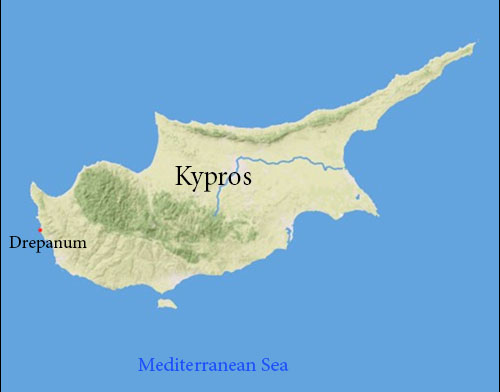
The site of the ambush is not known with certainty but there are two locations we might consider. There is a cape on the northern Peloponnesian Peninsula called Cape Drepanum, i.e. Cape Sickle ... the traveler-historian Pausanias thought this was the setting for the assault on Ouranos but that assumption ignores the creation of Aphrodite. The goddess of love is called Kypros and was created, like a good number of the Greek Immortals, in "the east" ... we should therefore look towards the island of Kypros (Cyprus) as her birthplace. There is a place on the western coast of Kypros named Drepanum (Sickle) and this is more than likely the place where Ouranos was castrated and bled into the sea creating Aphrodite.

The first generation of mortal men to live on the earth was created by the Immortals when Kronos was reigning from Mount Olympos ... they were called the Golden Generation and the time in which they lived was known as the Golden Age.
The Golden Generation lived like gods ... they had no sorrows and were free from all grief and toil ... all plants and animals were theirs for the taking and they lived and feasted beyond the reach of all evils.
The Golden Generation was truly loved by the Immortals and after a life of ease and peace, they died as though they were overcome with sleep. The earth eventually covered them but they remained as pure spirits dwelling on the earth. They are kindly spirits who assume the role of guardians of mortal men ... they roam everywhere over the earth clothed in mist as givers of wealth and keeping watch over judgments and cruel deeds.
Kronos became the most powerful and feared Immortal on earth. He chose Mount Olympos as his home and evicted the previous residents, Eurynome, a daughter of Okeanos (Ocean), and her consort Ophion. To further assist his mother, Kronos freed the awesome brothers Briareos, Kottos, and Gyes from her womb but he quickly came to regret that decision. Once he saw the three remarkable "boys" Kronos realized they were strong enough to usurp his authority and force him from Mount Olympos. Before the three brothers could grow into their full stature and virility, Kronos buried them under the earth and planned to keep them there until the end of time.
Kronos and his sister-wife Rhea began to have children. Ge and Ouranos warned Kronos that one of his children would eventually overthrow him and become the foremost Immortal. To prevent that possibility, Kronos decided that he would swallow any children that Rhea bore.
As soon as they were born, Kronos swallowed Rhea's first five children ... although Rhea was opposed to Kronos's self-indulgent behavior, there was nothing she could do to stop him ... or so she thought. When Rhea consulted Ge and Ouranos, they informed her that she could deceive Kronos and save the life of her next child. They told her that when she gave birth again, to conceal the infant and present a stone wrapped in swaddling clothes to Kronos. Rhea did as she had been advised ... she gave Kronos a stone instead of the baby and he hurriedly swallowed it down without realizing he had been fooled.
Rhea named the infant Zeus ... she secretly took the baby to the island of Krete and put him in the care of the Kouretes. The Kouretes were a militaristic group and not the type you would expect to be given the duties of caring for an infant ... the Kouretes gave the infant Zeus to the Nymphs of Mount Ida to be nurtured ... the Kouretes served a much more practical and protective role in Zeus's upbringing.
When Zeus cried or made other childlike noises, the Kouretes would drown out the commotion by dancing, chanting and clashing their weapons on their shields ... their objective was to keep Kronos from hearing Zeus ... they succeeded very well ... Kronos did not suspect that an immortal child was being reared on Krete and he certainly didn't suspect that he had a child growing to manhood who would eventually confront him and challenge his authority.
While Zeus was still hidden on Krete, Kronos indulged in at least one affair that produced a child. The creation of the famous and noble Centaur Kheiron was the result of an unlikely and accidental encounter between Kronos and a daughter of Okeanos (Ocean).
Philyra was one of the thousands of daughters of Okeanos and Tethys ... she lived on an island in the Black Sea. When Kronos saw Philyra he was filled with desire and made amorous advances towards the young goddess. Kronos did not want Rhea to know of his affair with Philyra and there was little chance of her finding out unless cruel fate somehow exposed his deeds ... indeed, fate was cruel to Kronos but not to his offspring.
Rhea happened to come upon Kronos and Philyra while they were in the act of making love ... Kronos hastily took the guise of a horse to hide his infidelity. Whether the adlib disguise fooled Rhea is debatable but the result of the union between Horse-Kronos and Philyra became absolutely clear when their child was born with the body of a Centaur.
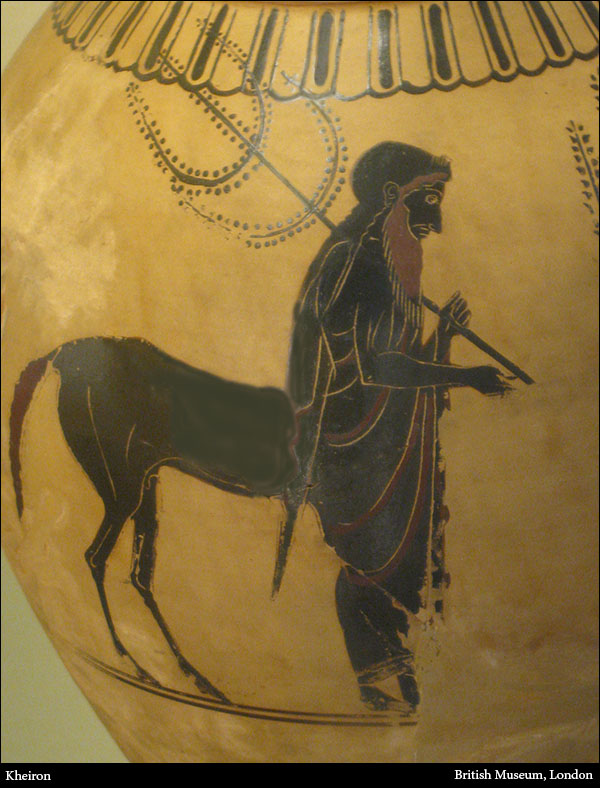
Philyra gave birth to a creature that was half horse and half god ... he had the characteristics of a Centaur, i.e. he had the body of a horse with the torso and head of a man ... he was named Kheiron. Although he had the appearance of a brutish Centaur, Kheiron was in fact one of the most intelligent and humane beings ever born ... his righteousness became legendary ... with the exception of the Olympians, Kheiron was the most extraordinary child Kronos fathered.
The five children Kronos swallowed were named Demeter, Hades, Histia, Hera, and Poseidon ... after being swallowed, they grew and matured in a "normal" fashion but were unable to extricate themselves from their father's infinite interior. As Zeus grew older there was little doubt that he would eventually confront Kronos and dethrone him ... the only question was when and how the prophecy of Ge and Ouranos would be fulfilled.
When the proper time came, Zeus went after Kronos ... he ambushed his father and caught him unawares ... Zeus kicked Kronos in the stomach with such violence the elder god vomited up the stone and the five children ... the stone came out first and Histia last ... Histia was the first to be swallowed and the last to disgorged ... she is therefore the oldest and the youngest of the swallowed children.
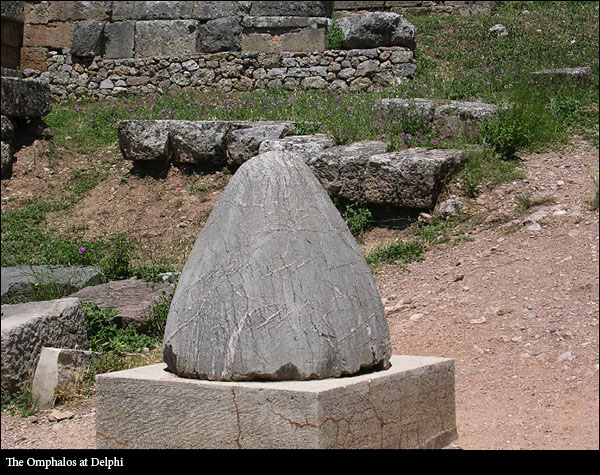
Zeus took the stone Kronos swallowed and placed it at the foot of Mount Parnassos near the city of Delphi ... he proclaimed that the stone would be a portent and marvel for the mortals of the earth for all time. The stone was called the Omphalos (Navel) and its location became known as the Navel of the Earth. The Omphalos was the symbol for the divine authority of the temple of Apollon at Delphi.
With his children now free, Kronos knew that the prophecy Ge and Ouranos had given him was being fulfilled ... even so, he refused to accept the possibility that he would be dethroned. With his Titan brothers and sisters at his side Kronos initiated a war against his own children ... the conflict came to be known as the War of the Titans.
Zeus gathered the Immortals who seemed inclined to become his allies against the Titans and promised that any Immortal who did not have an office or rights under Kronos would be elevated if they helped him defeat the Titans. Zeus also freed Briareos, Kottos, and Gyes from their subterranean prison ... they readily agreed to fight the Titans ... they were especially anxious to fight with Kronos and have their revenge for the many years he had kept them confined.
The War of the Titans shook the earth to its foundations ... the gods and goddesses battled for ten brutal years ... finally, Zeus unleashed all his fury against the Titans and their allies ... at the same time, Briareos, Kottos, and Gyes ripped up mountains to bury the Titans under an avalanche of boulders ... with that final barrage, the war was over.
Kronos and Rhea were forcibly removed from Mount Olympos ... Zeus and eleven other Immortals took control of the sacred mountain ... the Immortals who comprised the Olympians varied over the millennia but the number remained constant at twelve.
Zeus banished Kronos and his rebellious Titan brothers to an underground pit beneath Tartaros where they remained until after the Age of Heroes was over. Zeus had pity on Kronos and removed him to the Islands of the Blessed where he became the ruler of the departed heroes.
The ancient Greeks called the planets Wanderers because they were unlike the "fixed" stars and moved or wandered through the heavens. It seems likely that the first humans on the earth were not aware of the Wanderers and therefore did not name them but after Zeus became the Father of Gods and Men, the Wanderers were named ... the planet Kronos was renamed Saturn by the Romans and thus it remains.
The goddess Hera was very proud of the fact that she was the first daughter of devious, devising Kronos.
Next to the temple of Zeus at Olympia is a famous landmark called the Hill of Kronos. The poet Pindar referred to the Hill of Kronos with the adjectives like well-wooded and sunny ... the implication being that it was a very pleasant place.
The traveler-historian Pausanias saw a temple of Kronos and Rhea in Athens that was in existence at the time of the deluge of Deukalion, i.e. 11000 BCE.
The first temple built at Olympia was in honor of Kronos. Zeus and Kronos wrestled at Olympia and after defeating his father, Zeus held games to commemorate his victory ... apparently only the Immortals were allowed to compete in the first Olympic Games ... Apollon was the winner of the first games.
The Arkadians believed that Poseidon was not swallowed by Kronos and escaped that fate with the help of Rhea. The Arkadians told the traveler-historian Pausanias that when Poseidon was born, Rhea concealed him amongst a flock of lambs ... she told Kronos that she had given birth to a horse and gave him a foal to swallow instead of the child.
The ancient Egyptians believed Zeus and Hera were the children of Kronos and Rhea but they also believed Osiris and Isis were two of the five children of Zeus and Hera.
The differences between the Carthaginians of Northern Africa and the Greeks were quite dramatic in some cases ... the worship of Kronos was a perfect example. The Carthaginian general Hannibal died circa 183 BCE ... after his death, the Carthaginian army was beset with a superstitious belief that death-spirits were threatening them ... they immediately put a halt to their practice of desecrating religious monuments and to appease Kronos they offered a blood sacrifice by ritualistically killing a young boy ... also, a multitude of cattle were drowned in the sea as a tribute to Poseidon.
The Iliad
The Odyssey
Theogony
Works and Days
Hymn to Pythian Apollon III
Hymn to Aphrodite V
Hymn to Histia XXIX
Hymn to Herakles the Lion-Hearted XV
Hymn to Hermes XVIII
Hymn to Demeter XIII
War of the Titans
Kypria
Little Iliad
Shield of Herakles
Odes of Pindar
The Argonautika by Apollonius of Rhodes
Description of Greece by Pausanias
Library of History by Diodorus of Sicily