
| Daughter of the Sun |
| Kirke and Medeia |
| Kirke and Odysseus |
| The Reality of Kirke |
| Bibliography |
| Previous Page |
| Homepage |
| Site Search |
Kirke fascinated the ancient Greeks and Romans because the stories told about her were unbelievable but too enticing to ignore. She was called the Dread Goddess for a very good reason ... as a sorceress of the highest order, her skill with drugs and potions could only be compared to that of the Roaring Goddess Hekate. Depending on your literary source, Hekate was one of the most respected (Hesiod) or feared (Apollonius of Rhodes) goddess during the reign of Zeus and the Olympians.
Kirke used her supernatural skills to transform humans into lower-order animals ... from Kirke's point of view, humans are lower-order animals and transforming us into swine was not necessarily a step down the evolutionary ladder.
According to the early poets—Homer and Hesiod—Kirke lived on the island of Aiaia with Naiad Nymphs as her helpers. Her palace was in a tranquil forest populated with docile animals that would otherwise be fierce if they had not been drugged into passivity ... there is the strong possibility that the animals on Aiaia were once human beings that were changed into beasts to suit Kirke's whims.
We have two documented encounters between humans and Kirke but there were undoubtedly other hapless men and women who were stranded on Kirke's island, but their stories were lost along with their humanity when they were given Kirke's drugs. Odysseus and Ieson (Jason) survived Kirke's hospitality but only because they had the protection of an Immortal who was more powerful than Kirke. Hermes and Hera, respectively.
Kirke was the daughter of Helios (Sun) and the Okeanid, Perse, which would make her the grand-daughter of Okeanos (Ocean). Kirke was also the sister of King Aietes of Kolkhis, the keeper of the legendary Golden Fleece.
It was also believed that Kirke was the daughter of the goddess Hekate and King Aietes. According to that linage, Kirke would be the sister of the sorceress Medeia and the brother of Aigialeus. This speculation was put forth by Diodorus of Sicily and contradicts the long-held belief that King Aietes and Kirke were siblings, and that Medeia was Kirke's niece.
Kirke first entered the historical record when she was asked to absolve Ieson and Medeia of blood-guilt. The time frame for this encounter would have been circa 1475 BCE ... a generation before the Trojan War.
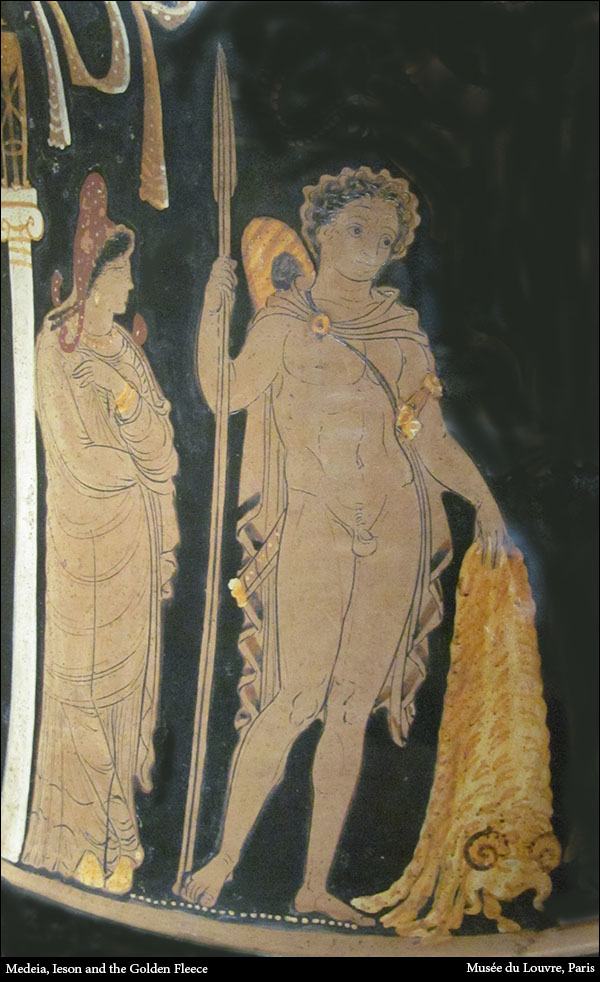
Ieson and an elite group of heroes called Argonauts sailed from Iolkos, Greece, to the eastern edge of the Black Sea to retrieve a Golden Fleece that was protected by Kirke's brother King Aietes of Kolkhis. With the blessings of the goddess Hera and the aid of Aietes's daughter Medeia, Ieson was able to take the Golden Fleece ... Ieson and Medeia fled Kolkhis with King Aietes's navy in hot pursuit.
Even though Ieson was an honorable man, his judgment became clouded after he left Kolkhis ... desperation overwhelmed him when it became obvious that Medeia's half-brother Apsyrtos and the Kolkhian navy would eventually capture them. Ieson and Medeia convinced Apsyrtos that they would surrender if they could meet with him alone and negotiate terms ... Apsyrtos believed them because he assumed his half-sister would deal honestly with him ... he was mistaken. Medeia distracted Apsyrtos so Ieson could murder him ... Apsyrtos died without being able to defend himself. The death of Apsyrtos left the Kolkhian fleet in confusion ... Ieson and Medeia escaped but they were not out of danger.
The goddess Hera informed Ieson that his fate was hanging by a thread because Olympian Zeus was incensed by Apsyrtos's murder. As the father of gods and men, Zeus's commands were indisputable. Hera told Ieson that the only way he and Medeia could escape Zeus's wrath was to seek out Kirke and ask her to perform a cleansing-ritual to absolve them of their blood-guilt. With no other options, Ieson and Medeia went to Aiaia and presented themselves to Kirke as supplicants.
Before Ieson and Medeia arrived, Kirke had been troubled by nightmares in which the walls of her palace dripped blood and flames consumed the drugs she used to bewitch strangers. She was bathing in seawater trying to wash away the aftereffects of the troubling dream when she became aware that a ship had landed on her island and a group of men accompanied by a maiden were approaching. Using a charmed hand-gesture, Kirke motioned for the Argonauts to follow her but Ieson ordered them to wait while he and Medeia followed Kirke to her palace. The goddess was slightly amazed to see that only Ieson and Medeia had obeyed her ... she asked them sit on a polished bench but they went to the hearth and assumed the posture of supplicants ... Ieson looked at the floor and Medeia hid her face in her hands.
Kirke immediately realized that her guests were guilty of murder. However, in reverence for Zeus, the god of supplicants, she began to offer the proper sacrifice to cleanse them of their guilt. She held a sow that had recently given birth above their heads and severed its neck ... she sprinkled their hands with blood ... the Naiad Nymphs attending Kirke cleaned away the defilements of the sacrifice. Next Kirke made propitiation with drink-offerings while she called upon Zeus the Cleanser, the protector of murder-stained supplicants ... Kirke burned atonement cakes without wine and prayed that the Furies and Zeus would forgive her guests for the crimes they had committed.
After the rituals were completed, Kirke invited Ieson and Medeia to sit on a bench facing her ... she asked them to clearly state the series of events that had brought them to her island as supplicants. When Medeia looked directly at Kirke, the goddess knew without doubt that the maiden was of the race of Helios and one of her kin ... a golden light shone from Medeia's eyes that clearly showed her heritage. Medeia began telling her aunt Kirke about the adventures and travels she and Ieson had endured but she carefully did not mention the murder of Apsyrtos ... Kirke knew that Medeia was not being completely honest and yet still pitied the young girl.
Kirke pondered the situation and told Medeia that King Aietes, Kirke's brother and Medeia's father, would soon exact a heavy wrath for the murder of his son ... she told Medeia that she would not add to her and Ieson's troubles by inflicting more suffering upon them but she was adamant that they leave her island at once and endure whatever fate Zeus and the other Immortals were sure to mete out.
Kirke had no further contact with Ieson or her niece, Medeia.
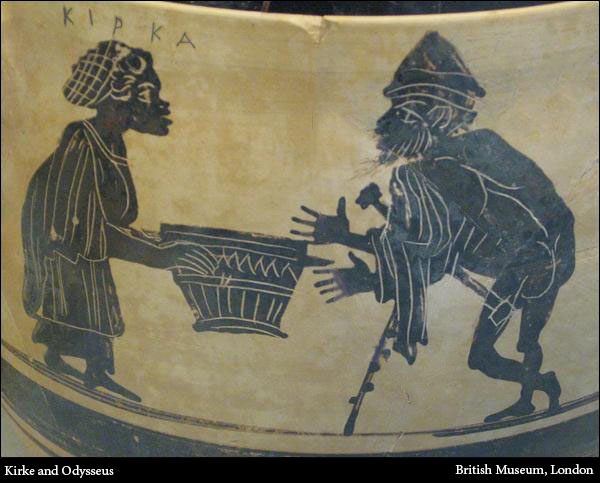
After the Trojan War was over (circa 1240 BCE), the majority of the victorious Greek commanders returned to their homes without incident ... King Odysseus of Ithaka was not so lucky. After leaving Troy, Odysseus inadvertently incurred the wrath of Poseidon, lord of the sea. Poseidon's Cyclops son Polyphemos captured Odysseus and several of his men while they were looking for food and water on an unfamiliar island. Polyphemos was trying to devour the men when Odysseus blinded the one-eyed brute. Poseidon wanted to kill Odysseus but Zeus would not allow it ... Poseidon had to be content with tormenting Odysseus and delaying his homecoming.
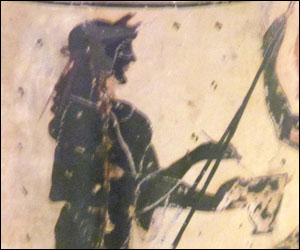
As Poseidon's punishment continued, Odysseus and his desperate crew went ashore on the island of Aiaia hoping to find desperately needed supplies ... Odysseus sent twenty-three men to explore the island. As the men walked from the beach, they could hear sweet singing from Kirke's home in a forest glen ... they were greeted by docile lions and wolves wagging their tails ... wild animals that had been drugged by Kirke. The goddess welcomed the sailors into her palace ... her beauty and grace charmed the unsuspecting men and they gladly accepted the potions she offered as refreshment. As Kirke's vile drugs took effect, she tapped each man with her wand and they began to change shape until they were fully transformed into swine. Kirke herded them into pens and fed them pig's food.
One of the members of the shore party managed to escape before Kirke could transform him into a beast ... his name was Eurylokhos ... he ran back to the ship and urged Odysseus to set sail immediately and not attempt to rescue the other men. He told Odysseus about the evil goddess and how she would surely turn them all into swine unless they left the island immediately. Unfortunately, his warning took on an air of cowardice and Odysseus almost killed him for showing such weakness. Odysseus was not frightened by Eurylokhos's story but it did make him cautious ... he ordered the remainder of the men to wait with the ship while he went alone to investigate.
Along the trail, Odysseus met the god Hermes in the guise of a young man. Hermes told Odysseus that he would help save the men Kirke had bewitched but it would be necessary for Odysseus to act decisively and to carefully follow instructions or he too might be transformed into a beast. Hermes reached down and pulled a plant called 'moly' from the ground and said that mere mortals found it difficult to dig-up the plant but he, as a god, could do all things. Hermes explained that when Kirke offered Odysseus one of her dreadful potions he was to secretly put the 'moly' in the concoction to render it harmless ... to complete the spell, it would be necessary for Kirke to touch Odysseus with her wand ... at that moment, Odysseus was to draw his sword and hold the goddess hostage until she released Odysseus's men from their animal forms.
Odysseus accepted the 'moly' from Hermes and went boldly into Kirke's palace. She welcomed him with false sincerity and offered him one of her vile potions ... Odysseus secretly put the 'moly' in the goblet and to Kirke's delight, drank it down. When Kirke thought the drug had taken effect, she tried to strike Odysseus with her wand but Odysseus drew his sword and sprang upon the goddess before she could defend herself. The astonished Kirke surrendered instantly. She released the twenty-two pig-men from their cage and ceremoniously anointed them with another one of her potions. The men were not only restored to their original forms, they were actually taller and more handsome than before they had been enswined.
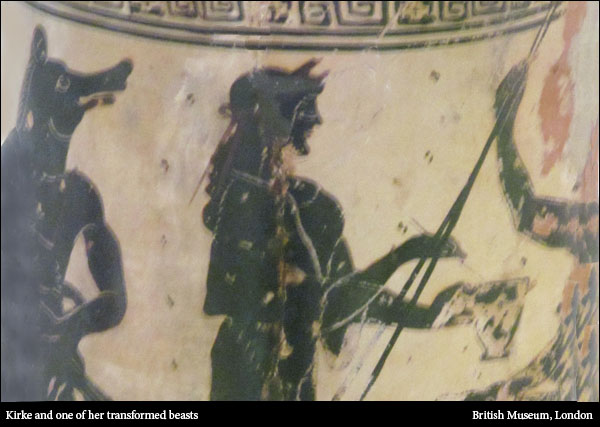
To show her good faith, Kirke opened her doors to the dispirited sailors and gave them every comfort she could offer. After the entire crew had been rested and nourished, Kirke told Odysseus that his journey would now take him to the House of Hades, lord of the dead. She said that Odysseus must consult with the soul of the seer Teiresias the Theban to find out how he could finally appease Poseidon and return to his home.
Kirke said that in order to reach the entrance to the Underworld, Odysseus and his crew would have to sail the treacherous waters between the precincts of the man-eating, six-headed Skylla and the ship-devouring whirlpool Kharybdis. She warned Odysseus that he could survive the passage but she also warned him not to be too bold and accept whatever fatalities the two supernatural creatures inflicted on his crew.
A tragedy took place before Odysseus and his men could leave Aiaia. The youngest member of the crew was named Elpenor ... he was not noted as a valiant or worldly man but he was a survivor of the Trojan War and had thus earned the respect of Odysseus and the other men. After drinking too much wine, Elpenor went to the roof of Kirke's palace to sleep ... when he awoke in a stupor he fell from the roof and broke his neck. Meaning no disrespect, Odysseus failed to give Elpenor a proper burial before leaving the island. When Odysseus was at the entrance to the Underworld, he encountered the 'shade' of Elpenor ... the spirit of the young man begged Odysseus to return to Aiaia and perform the funeral rites that would allow his soul to be at rest.
Upon returning to Kirke's island, Odysseus retrieved the body of Elpenor and performed the necessary funeral rites. After her Naiad handmaidens had given food and comfort to Odysseus's crew, Kirke warned him that he would face a new danger when he left her island. Kirke told Odysseus that he must avoid the island of Thrinakia, which is sacred to her father, Helios. She explained that if he made landfall on Thrinakia, his journey home would be sadder than he could imagine. Kirke knew Odysseus's voyage would be one of hardship and sorrow but she had given him all the comfort and advise her divine prescience could offer. She gave Odysseus a favorable wind and sent him on his way. Odysseus finally made it back to his home but the 1,380 men who accompanied him to Troy either perished in the war or were killed on the voyage home.
Kirke and Odysseus had three children: Agrios, Latinos, and Telegonos. The poet Hesiod stated that the children of Odysseus and Kirke made their homes in Tyrrhenia, which was a name for Italy.
The ancient authors who vehemently doubted the reality of Kirke pointed to their inability to definitively locate her island home, Aiaia. It's important to emphasize the fact that to many of the classical authors, facts put forth by Homer were indisputable. They conceded that he might have exaggerated certain aspects of his narratives but there was always a basis of fact in everything he wrote. To deny Homer's honesty was tantamount to blasphemy. From that perspective, Kirke and Aiaia must have existed.
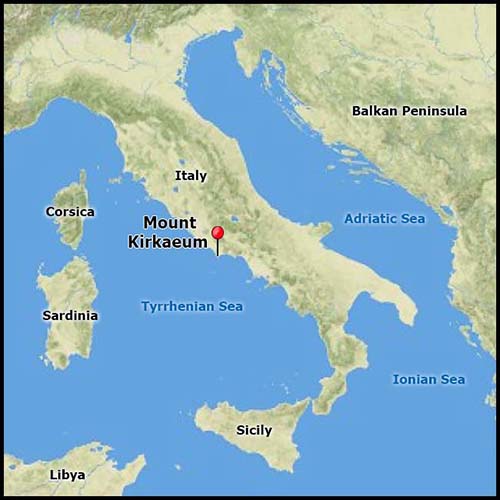
There was general agreement amongst Greek and Roman classical scholars that Kirke, Skylla and Kharybdis, if they existed, resided somewhere near the eastern coast of southern Italy. The geographer Strabo proposed a unique explanation as to why the location of Aiaia had eluded all inquiries. Strabo proposed that a mountain named Kirkaeum (Circaeum) might have once been an island ... the island of Aiaia.
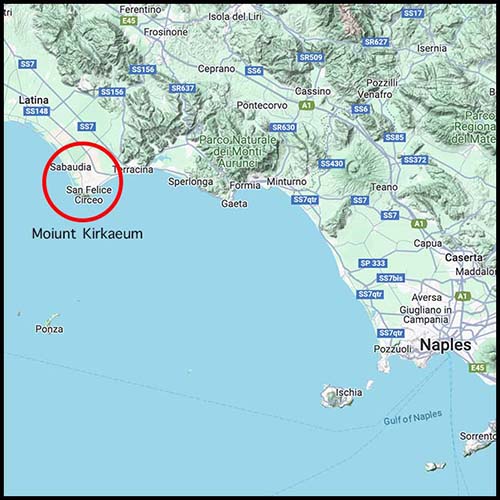
In Strabo's time (late first century BCE), Mount Kirkaeum was surrounded by swamps and bogs ... herbs and medicinal plants were abundant, supporting the notion that Kirke used such plants to make her potions. Assuming the swamps had once been inundated by the sea, the mountain would have literally been an island. The inhabitants of the area had a temple dedicated to Kirke and had no doubt that Mount Kirkaeum was indeed the ancient home of the goddess. The modern-day name for the area is San Felice Circeo.
The Odyssey by Homer
Theogony by Hesiod
Catalogues of Women and Eoiae by Hesiod
Epigrams of Homer XIV
Telegony
The Returns
The Argonautika by Apollonius of Rhodes
Library of History by Diodorus of Sicily
Description of Greece by Pausanias
Geography by Strabo