
| Goddess of the Rainbow |
| Iris and Styx |
| Iris and the Birth of Apollon |
| Iris and Demeter |
| Iris and the Trojan War |
| Bibliography |
| Previous Page |
| Homepage |
| Site Search |
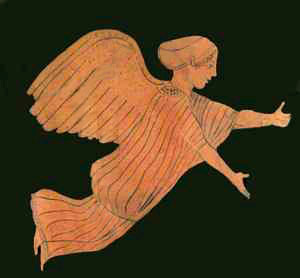
Iris flies on the wind and moves like a blast of bright air. She is called 'The Rainbow, Iris' thus implying that her presence is a sign of hope or perhaps symbolizing a bridge between heaven and earth.
Iris was the daughter of Thaumas, a son of Pontos (the Sea), and Elektra, a daughter of Okeanos (Ocean). Iris was the sister of the Harpies—Okypete and Aello.
Iris is generally considered to be a "minor" goddess in that she is submissive to the Olympians and has no specific domain. Her primary role in the Iliad seems to be that of the faithful messenger of Zeus. The Iliad by Homer was the poetic documentation of the Trojan War—the seige of Troy by the Achaian Greeks circa 1250 BCE.
Iris's sisters, Okypete and Aello were described by the poet Hesiod as, "Harpies of the lovely hair, winged women soaring aloft like birds." That is contrary to their stereotypical visage as vile and hideous creatures ... regardless of how the Harpies were perceived, the ancient Greeks never gave Iris a negative characterization.
A generation before the Trojan War, Ieson (Jason) and the Argonauts encountered Iris and her sisters, the Harpies ... that would have been circa 1280 BCE.
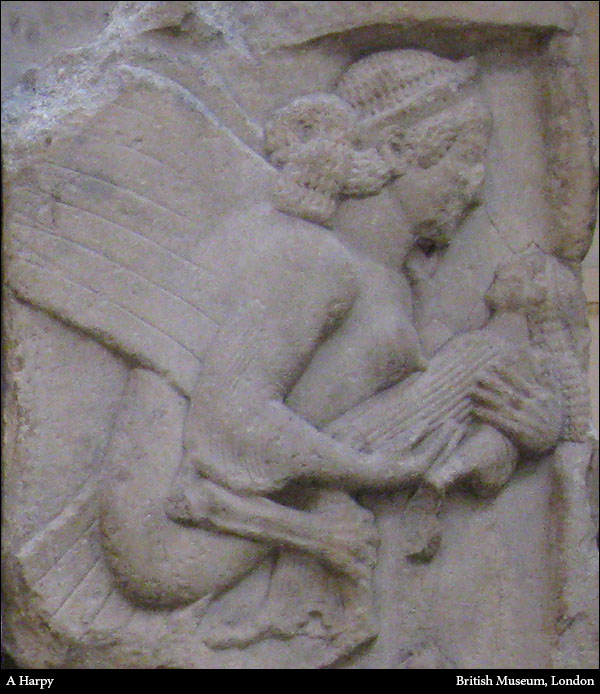
When Ieson and the Argonauts were seeking the Golden Fleece, they landed on the island of the blind seer, Phineus. Before the Argonauts met Phineus, he had been exiled to the island because he had offended Boreas (North Wind). Phineus married Kleopatra, daughter of Boreas ... after Kleopatra's death, Phineus married a cruel and vengeful woman. Phineus's new wife hated Kleopatra's sons and induced Phineus blind the boys. Boreas was infuriated by the harsh treatment of his grandsons and demanded justice. As punishment for such a horrendous act, Zeus offered Phineus blindness or death ... Phineus chose blindness ... he was then exiled to a remote island in the Black Sea.
Helios (Sun) was offended that Phineus would choose blindness rather than death so as further punishment, he sent the Harpies to torment Phineus by stealing his food ... the Harpies did not steal all of Phineus's food ... they would always leave reeking morsels so he could sustain himself and thus prolong his torment.
Two of the Argonauts—Kalais and Zetes—were the winged sons of Boreas. Phineus's plight was pitiable to Kalais and Zetes so they promised to help rid him of the Harpies ... the two young gods set a trap but the Harpies were very swift and the winged brothers could only claw at the fleeing women with their fingertips.
Iris rushed into the fray and chided the brothers for trying to harm the Harpies because they were there to punish Phineus with the consent of Zeus. Iris swore a sacred oath on the river Styx that if the brothers would stop their pursuit of her sisters, they would no longer torment Phineus. Thus Phineus, although he was still blind, was freed from one aspect of his curse and allowed to eat once more in peace. In the Catalogues of Women, the author states that Hesiod credits Hermes, and not Iris, for turning Kalais and Zetes away from the Harpies.
The Immortals are often placed in situations where they don't know who they can trust ... in order to protect themselves, they will sometimes demand that a sacred oath be administered ... the most sacred and binding oath the Immortals can swear is on the waters of Styx ... Styx is therefore called The Oath River even though she is not really a river. Styx is one of the daughters of Okeanos (Ocean) and Tethys, which means she is an Okeanid ... her brothers are rivers.
Styx resides in the Underworld near the halls of Hades and Persephone ... she lives apart from the other Immortals in a glorious house with a stone roof supported by silver columns. Iris is the only Immortal allowed to enter Styx's home.
When a dispute erupts on Mount Olympos, Zeus sends wind-footed Iris to Styx for a pitcher of water. Any Immortal who pours the waters of Styx and swears an oath, is solemnly bound to tell only the truth. The punishment for breaking such an oath is one year without ambrosia, nectar or AIR! If that's not enough, for nine additional years, the oath-breaker is not allowed to attend the festivals or share the company of the other Immortals.
Iris is not noted for taking sides in disputes between the Immortals but she is often called upon to relay messages between the conflicting deities ... the birth of Zeus's son Apollon is a perfect example of this type of situation.
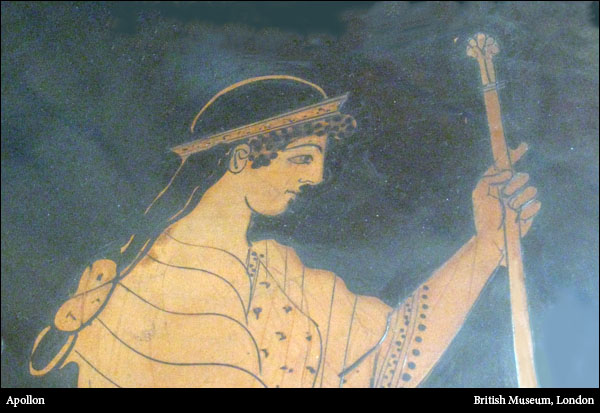
Zeus was married to his third wife Hera when he became infatuated with the goddess Leto ... his union with Leto produced Apollon and Artemis. Hera could do nothing to stop Zeus's philandering but she could make Leto's life complicated and painful.
When Leto was looking for a place to give birth to Apollon, she was rebuffed by the Nymphs and goddesses of every land and island she visited until she arrived on the island belonging to the goddess Delos ... the Nymphs and goddesses who refused to accommodate Leto were justifiably afraid that Hera would punish them if they assisted Leto. Delos was aware of the risks but she was also confident that Zeus would protect her as long as Apollon maintained his residence on her island. Delos made Leto swear an oath on the waters of the river Styx that Apollon would never abandon her island ... we are not told specifically that Iris retrieved Styx's waters for the oath but we can assume she did.
Leto swore the sacred oath and Delos was satisfied that Apollon would always have a shrine on her island. The birth process began but it was slow and painful. Iris and several other goddesses were attending Leto but Hera had purposely kept her daughter Eileithyia occupied so that she would not know of Leto's plight ... Eileithyia was the goddess of childbirth.
After nine days and nights of labor, Leto had still not given birth ... the goddesses in attendance sent Iris to Mount Olympos to find Eileithyia. Iris was very discreet when she arrived on the sacred mountain ... she carefully drew Eileithyia aside so Hera could not overhear their conversation. After explaining the situation to Eileithyia, Iris took her to Leto ... Apollon was born without further delay. Hera was satisfied with her interference and did not bother to hinder the birth of Artemis.
When Zeus gives Iris a message to be delivered to one of the Immortals it was always implicit that his word is law and that whatever he demands will be unquestionably done without delay ... on one important occasion, Iris delivered a message that was ignored and the entire human population of the earth was placed in peril.
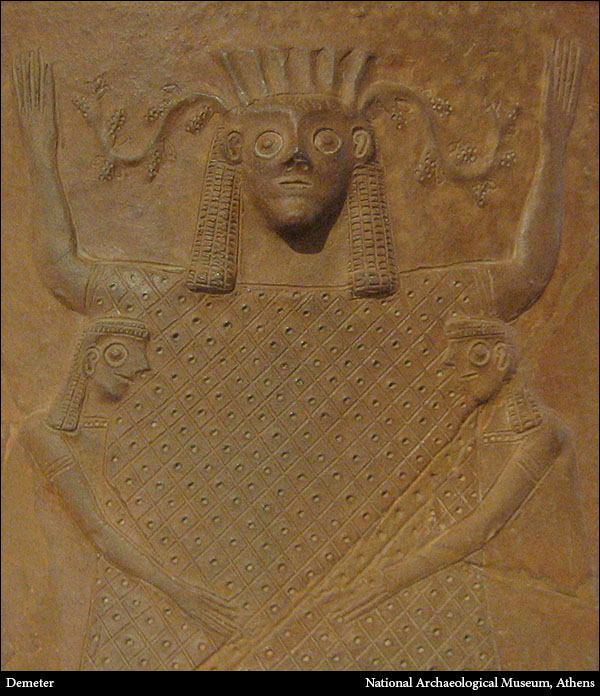
Hades, lord of the dead, abducted Persephone and took her to the Underworld ... Zeus had given his permission for the kidnapping but neither he nor Hades had bothered to consult Persephone's mother, Demeter. When she finally found out the details of the abduction, it was too late to save her daughter ... Persephone, the Maid, had become queen of the dead ... this was antithesis to Demeter's dominion, which is goddess of the harvest.
Demeter's grief at the betrayal was unbearable ... she abandoned her earthly duties and took the guise of an elderly woman so she could indulge her sorrow. The crops failed and the human inhabitants of the earth were facing genuine hardship. Zeus sent Iris to Demeter with instructions to give up her bitterness and restore her blessings to the orchards and fields ... Demeter wasted no words on Iris ... she refused to obey Zeus.
At Zeus's command, every god and goddess went to Demeter but it was her mother Rhea who finally convinced her that her best chance of seeing Persephone again was to return to Mount Olympos as Zeus wished.
Iris played a significant role in the Trojan War but not as a fighter or meddler ... she faithfully relayed the will of Zeus to the other Immortals who were fighting and meddling. Sometimes she would assume the guise of a man or woman and at other times she would reveal herself in all her glory.
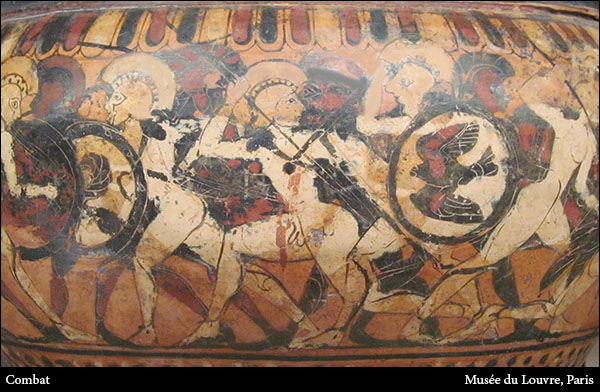
The Achaian commander Diomedes attacked and wounded Aphrodite, goddess of love, as she tried to protect her so Aineias. Iris swooped in to assist the staggering goddess from the battlefield and the god Apollon stepped in to help Aineias. Ares, god of war, had his chariot nearby ... Iris assisted Aphrodite into Ares's war chariot and the two goddesses flew to Mount Olympos so Aphrodite could be treated for her wound.
Iris took no side in the war and advised both armies as Zeus commanded. She helped the Trojans and the Achaians with equal faithfulness. Iris advised the Trojan commander Hektor to allow his allied captains to rally their own troops so that there would be no confusion due to language differences. Iris also assisted Achilles, Hektor's most hated enemy, by going to the house of Boreas (North Wind) to ask the Winds to help Achilles light the funeral pyre of his fallen companion, Patroklos.
Zeus would not allow the Immortals to engage in the actual fighting, but Poseidon could not restrain himself from defending the Achaians. Zeus instructed Iris to go to Poseidon and command him to withdraw. Hearing Iris's message, Poseidon launched into a long-winded tirade. Iris listened patiently and asked if Poseidon wanted her to take his hostile words back to Zeus. She reminded Poseidon the Erinyes (the Furies) always side with the elder brother, which in this case was Zeus. Poseidon understood the futility of his anger and praised Iris for being a messenger who knows what is proper.
The Romans worshipped a goddess named Iris who was also identified with the rainbow but the Roman Iris had a distinctly negative countenance and was a portent of sadness and doom.
The Iliad
Theogony
Catalogues of Women and Eoiae
Catalogue of Women
Hymn to Demeter II
Hymn to Delian Apollon
Kypria
The Argonautika by Apollonius of Rhodes