
| Bibliography |
| Previous Page |
| Homepage |
| Site Search |
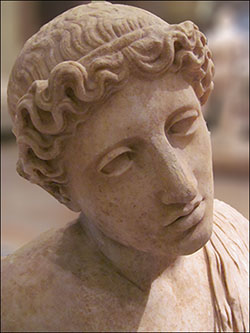
The story of Io is one of the most touching dramas in Greek prehistory. It's the story of a humble maiden who caught the eye of Zeus and paid a terrible price for her resistance to his amorous advances.
The new Olympians had taken control of all creation and Zeus was relatively new to the Throne of Eternity when he noticed Io. After having several wives, Zeus finally married his sister Hera ... she was the last wife Zeus would take. Zeus was not a faithful husband and Hera knew of most of his indiscretions but Zeus wanted to hide his infatuation with Io.
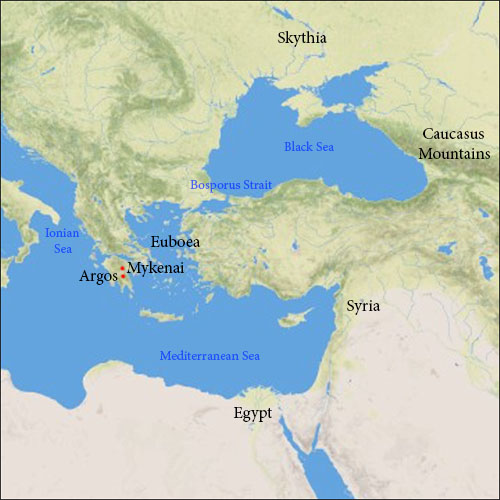
Io was the beautiful daughter of Inakhos and Piren (or Melia) ... she lived in Argos on the Peloponnesian Peninsula. Io's position as a priestess of Hera brought her to the attention of Zeus. Io began having strange dreams with voices and visions telling her to leave her bed and go into a field where Zeus could 'see' her. She told her father about the dreams and he sought advice from the oracles at Pytho (Delphi) and Dodona but they could offer no help. Finally, he sent an embassy to Loxias. For the oracle of Loxias, the meaning of Io's dreams was crystal clear. Inakhos was advised to disown his daughter, cast her into the streets and drive her from his country. If this was not done, the oracle warned, Zeus would eradicate Inakhos and his people without mercy. With a heavy heart, Inakhos obeyed the oracle and forced his innocent daughter from his house.
Io traveled north and east to the island of the Abantes. In a futile attempt to disguise Io, Zeus transformed the young woman into a black and white heifer. Thereafter, Abantes was called Euboia, the island of fine cows. Hera was not fooled by Io's disguise.
Hera wanted to be sure that Zeus could not be alone with his new infatuation so she sent the herdsman Argos to follow the Heifer-Maiden. Argos was called Argos Panoptes, meaning 'all seeing' because he had one hundred eyes. Argos captured Io and tethered her to a tree in Mykenai ... her situation seemed hopeless until Zeus sent his son Hermes to slay Argos. Even though Argos had been warned about Hermes, he was caught offguard and Hermes killed him with a stone-cast.
At Hera's bidding, a gadfly began to sting and pester the newly freed Heifer-Maiden, forcing her to run farther and farther from her home and happiness.
Io's travels became convoluted and complicated as she journeyed west, north, east and then south to what would become known as Egypt.* She went west to the Ionian Sea (Io's Sea) ... north to Illyria and the Balkan Mountains ... across the Bosporus Straits (Cow's Ford) ... north to Skythia and the land of the Amazon warriors ... south through the Caucasus Mountains.

According to the poet Aeschylus in his play Prometheus Bound, Io had an important interaction with the Rebel-God, Prometheus in the Caucasus Mountains. Prometheus had been chained to a mountain as punishment for defying Zeus. I addition to being chained, Prometheus was tormented by an eagle tearing at his immortal flesh ... his suffering was destined to last 13 generations of mortal men.
Io's conversation with Prometheus was quite moving. She told him of her sorrowful past, how she could never sleep in the same place two nights in succession because of the insistent gadfly. Because his name means 'Forethought,' Io begged Prometheus for his prediction of her future ... she simply wanted to know when her suffering would end. Even in his tortured condition, Prometheus tried to spare her feelings. She asked why he would not be forthright and he replied that he was afraid that if he told her the depth and duration of her suffering, the knowledge might break her spirit. She wanted to hear everything, no matter how dismal her future may be ... she wanted to hear it all.
Prometheus told Io of the long, lonely road she would have to tread. He advised her on which way to travel and where she might find help along the way. He told her to be strong because she would eventually be freed from the curse of Hera and her journey would end by the banks of the Nile River. He told her she would be restored to her original beauty and blessed with a glorious son named Epaphos. Prometheus also foresaw the ironic fact that one of her descendants would, after thirteen generations, come back to that lonely mountain and cut the bonds that held him to the rock-face.
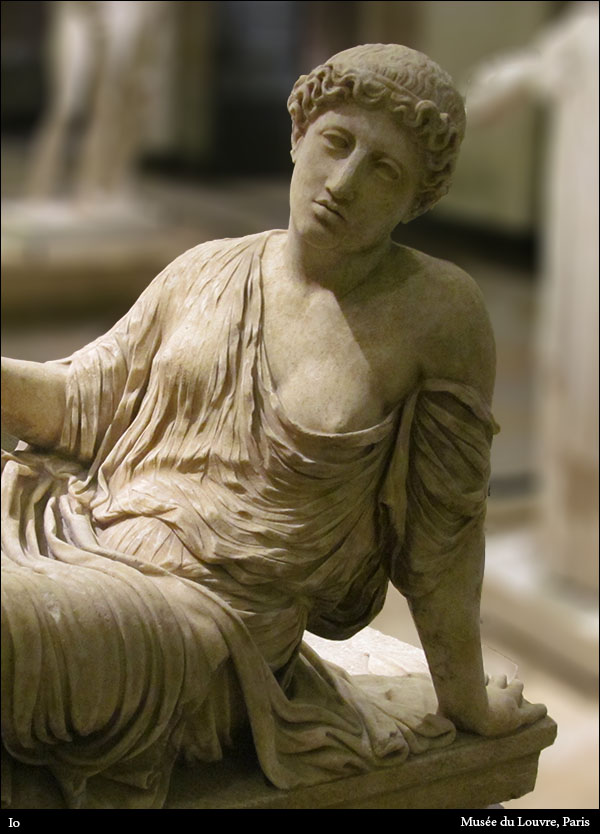
The predictions of Prometheus came true. After years of tortuous wandering Io arrived in Egypt. The curse was lifted when the hand of Zeus reached out and touched Io. She was restored to her youthful beauty but Hera's vengeance had not been sated. Io married a man named Telegonos and had a son, Epaphos. Hera induced a mysterious group (or divine tribe) called the Kuretes to kidnap Epaphos and spirit the child off to Syria. For their temerity, Zeus killed the Kuretes.
Dauntless, Io searched until she found Epaphos and returned him to their new home in Egypt where she and Telegonos reigned over the natives. Io set up an image of Demeter, whom the Egyptians called Isis and Io likewise they called by the name, Isis.
*The land at the mouth of the Nile River was named after Aegyptus, the great-great grandson of Io. The natives were called something other than Egyptians when Io and Telegonos ruled.
The Aegimius
The Histories by Herodotos
Library of History by Diodorus of Sicily
Description of Greece by Pausanias
The Library by Apollodorus