
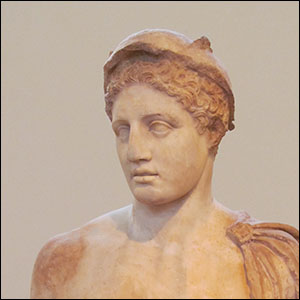
Hermes is a very ancient god ... his influence can be traced back to the earliest Egyptian records where he is credited with numerous contributions to the civilization of the human race:
Hermes has the power to enter the dreams of mortals ... he is guardian of gates and watcher in the night.
Hermes is the Wing-Shod messenger of the Olympian Immortals. He is the beloved son of Zeus and the Nymph, Maia.
Maia is a daughter of Atlas ... she and her sisters are known as the Pleiades. Zeus came to Maia in the darkness of night so his sister-wife Hera would not know of his amorous intentions towards the lovely Nymph. Maia lived in a secluded cave on Mount Kyllene in Arkadia, so Zeus's escapade went unobserved. Hermes was born ten months after Zeus's union with Maia.
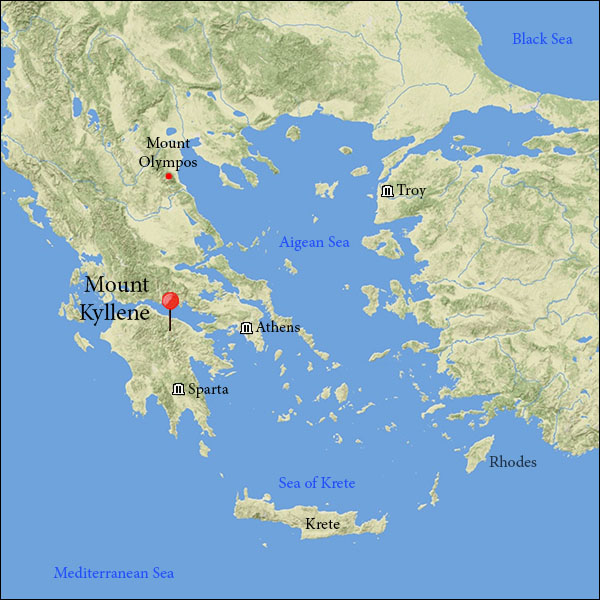

Immediately after being born, Hermes left his cradle and ventured from his mother's cave to an adjoining mountain that came to be known as Khelydorea—the mountain of the flayed tortoise. Hermes encountered a mountain tortoise and, as quick as a thought, scooped the animal from its shell, covered the shell with ox hide and attached two arms joined by a crosspiece on which he stretched sheep gut. Within minutes he had conceived and constructed the first seven-stringed lyre ... some ancient accounts suggest that Hermes's lyre had only three strings ... one for Spring, Summer and Winter. He sang of Zeus and his mother. He also sang of his mother's handmaidens and the cave in which he had been born.
Hungry for adventure, Hermes left Mount Kyllene and began to roam the countryside. He reached the mountains of Pieria by the time Helios (Sun) descended into the ocean. He found the sacred grove of Apollon and stole fifty cattle from Apollon's herd. Hermes drove the cattle from the grove and donned crude, overlarge sandals to leave gigantic footprints in order to confound anyone who might follow him. He also made the cattle walk backwards so that it would look as if a they were coming instead of going.
A farmer saw Hermes passing and the infant god told the old man to forget what he had seen and tell no one of the mysterious cattle passing in the night. After crossing the Alpheios River, Hermes sheltered the cattle and built the first fire on the face of the earth. He killed and roasted two of the beasts and dedicated the finest pieces of meat to the Immortals on Mount Olympos. He then stretched the hides to dry and made his way back to his mother's cave. Entering the cave through the keyhole as a vaporous mist, Hermes returned to his cradle and pretended to be a helpless infant. Maia was not fooled by his pretensions and scolded her son for being a rogue and liar. Hermes said that if he could not share in the affluence and honors of the other Immortals, he would become the chief of robbers.
At dawn of the next day Apollon began searching for his missing cattle. He questioned the farmer who had seen Hermes and quickly deduced that his cattle had been stolen and the likely identity of the thief. Apollon went swiftly to Mount Kyllene and confronted the infant Hermes ... he threatened to cast the impudent child down into Tartaros (the Pit) if he did not return the stolen cattle. Hermes found it easy to lie and declared that he knew nothing of the cattle. Apollon was not easily fooled. He took Hermes from his crib and set out for Mount Olympos so Hermes could be judged by Zeus.
Zeus listened to Apollon's truthful account of the theft of the cattle, but Hermes pretended innocence ... he said he was only born yesterday and too young to know the ways of deceit and falsehood. Zeus laughed at the child's roguishness and commanded Hermes to take Apollon to the cattle. Hermes obeyed without hesitation and soon he and Apollon were at the place where the cattle had been hidden.
Apollon was amazed that a mere infant had been able to kill two cows and stretch their hides to dry. Hermes began to play his lyre and again Apollon was amazed. Hermes sang of the first Immortals and how they divided creation into their dominions. Apollon said he had danced and sang with the Muses but had never heard such beautiful music or seen such a masterful musician. He promised Hermes many gifts and assured him a place of renown amongst the Immortals. Hermes accepted the blessings of Apollon and gave him the lyre as a token of his affection. Apollon immediately grasped the subtleties of the lyre and began to play masterfully. Inspired by Apollon's abilities on the lyre, Hermes created the musical pipes.
With the blessing of Zeus, Apollon pronounced that Hermes would become the lord over lions, boars, dogs and all animal herds on the face of the earth. Apollon also made Hermes the messenger of Hades (lord of the dead) but he would not give Hermes the gift of prophecy because that gift was his alone ... only Apollon was allowed to know the will of Zeus.
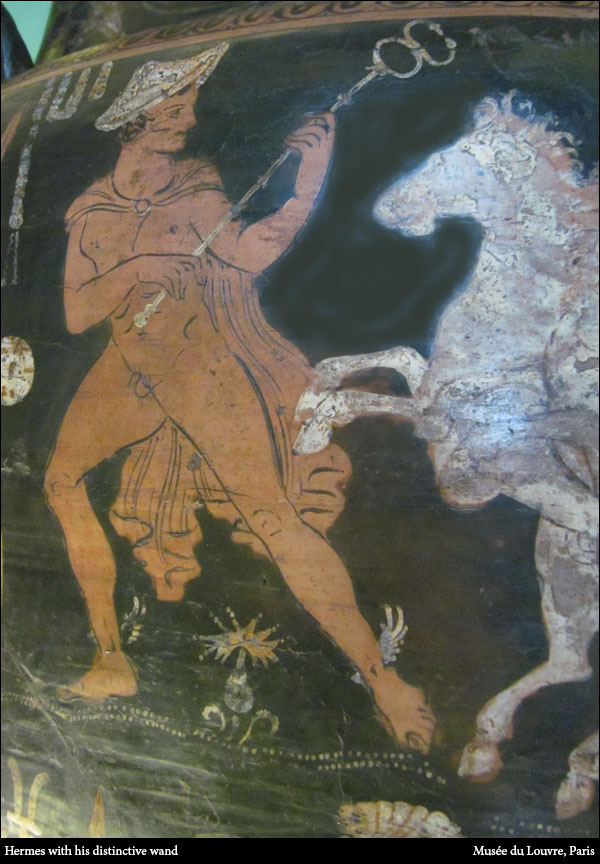
As a minor concession, Apollon told Hermes about three virgin goddesses who lived under the folds of Mount Parnassos and would flitter about and feed on yellow honey. After they had eaten the honey, they would only speak the truth ... if Hermes questioned them carefully, he would learn many things. He would then have the power to impart these truths to men of his choosing for their benefit. Apollon also gave Hermes a beautiful golden staff, which became the emblem for all heralds. The staff would protect the young god against harm and enforce the laws of righteous words and actions.
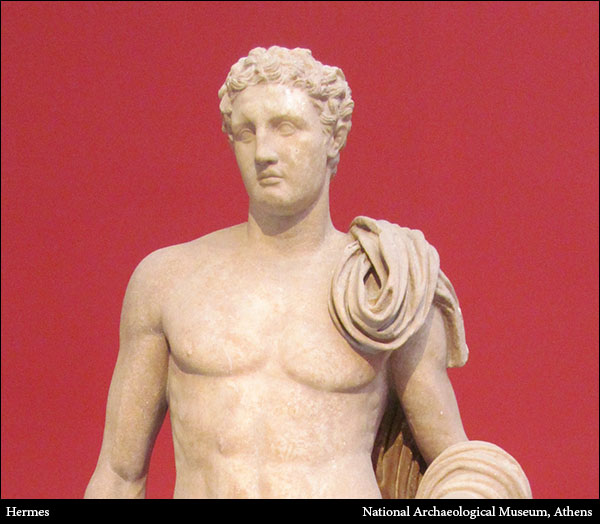
Hermes thus became the friend to the mortals of the earth. He introduced weights, measures and games of chance. He is the giver of good luck and has a hand in all secret dealings and stratagems. He is, of course, sacred to all heralds. From his name, we have the word hermetic which means sealed and impervious to outside influence. If a message is given to Hermes, it will be delivered faithfully to the intended recipient. His domain includes roads, traffic and markets. In ancient times, a statue indicative of Hermes was placed atop pillars to mark boundaries.
There had been several ages of mortal men on the earth before there were any women ... the creation of the first woman was intended as a curse but has become one of the greatest blessings the immortals have ever bestowed on mankind. The first woman was named Pandora.
Pandora's name means All-Endowed because, at the command of Zeus, she was given gifts from various Immortals and thus Endowed By All.
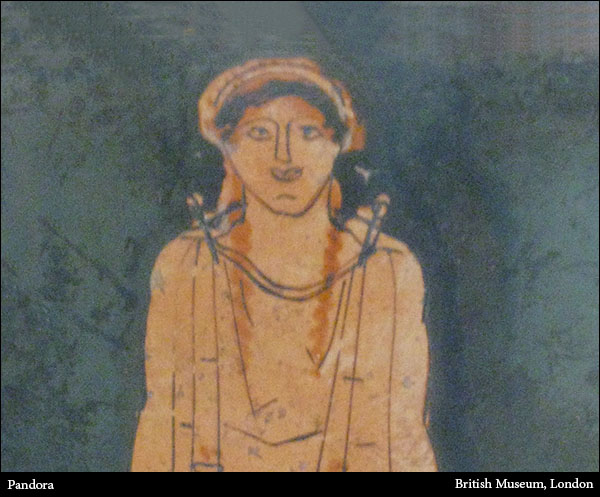
The creation of Pandora was the direct result of a confrontation between Zeus and his cousin, Prometheus. Earning the reputation of a rebel, Prometheus entered into a pointless rivalry with Zeus that resulted in his being chained to the Caucasus Mountains for twelve generations of mortal men. Prometheus stole fire from Zeus and gave it to the shivering men on the earth ... for that affront to Zeus's authority, Prometheus was chained to the mountainside. To further the punishment, Zeus commissioned the creation of Pandora as a "gift" for Prometheus's brother, Epimetheus.
Hephaistos molded Pandora's body from earth into the likeness of a modest young girl. Athene taught Pandora the skills of weaving and gave her dexterity. Aphrodite (goddess of love) put a mist upon her head to engender longings and desire. Hermes gave her the mind of a hussy and a treacherous nature. The Kharites (Graces) and Peitho (Persuasion) gave her necklaces of gold and the Horae (Seasons) put a halo of flowers on Pandora's head.
When Epimetheus accepted Pandora, he unleashed evil on the world. The only positive influence Pandora brought to the world of men was Hope (Ελπσ) and although women were designed as a curse to men, the only thing worse than marriage was for a man to live and die without the love of a woman.
Hermes is often called Argeiphontes—The Slayer of Argos—because the slaying of the herdsman Argos was a momentous event that had repercussions throughout the Greek and Egyptian worlds for generations after the event.
Io was the beautiful daughter of Inakhos, king of the city of Argos on the Peloponnesian Peninsula. She began having strange dreams with voices and visions telling her to leave her bed and go into a field where Zeus could 'see' her. She told her father of the dreams and he sought advice from the oracles at Pytho and Dodona, but they could offer no help.
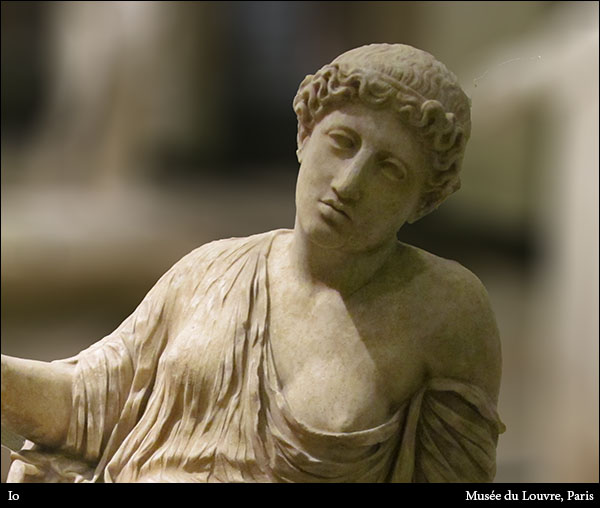
Finally, Inakhos received an oracle from Loxias (Apollon) that made the meaning of the dreams crystal clear. The oracle of Loxias advised Inakhos to disown his daughter, cast her into the streets and drive her from his country. If this was not done, the oracle warned, Zeus would eradicate Inakhos and his people without mercy. With a heavy heart, Inakhos obeyed the oracles and forced his young daughter Io from his house.
In a futile attempt to disguise Io, Zeus transformed the young woman into a black and white heifer. Hera wanted to be sure that Zeus could not be alone with his new infatuation so she sent the herdsman Argos to follow the Heifer-Maiden. Argos was called Argos Panoptes, meaning 'all seeing' because he had one hundred eyes. Argos captured Io and tethered her to a tree in Mykenai ... her situation seemed hopeless until Zeus sent Hermes to slay Argos. Even though Argos had been warned about Hermes, he was caught off-guard and Hermes killed him with a stone-cast.
As the goddess of love, Aphrodite was as mischievous as she was beautiful. Her affair with Ares, god of war, might have been just another one of her whimsical indulgences but when the two lovers were caught in the act by her husband, only Hermes had the last laugh.
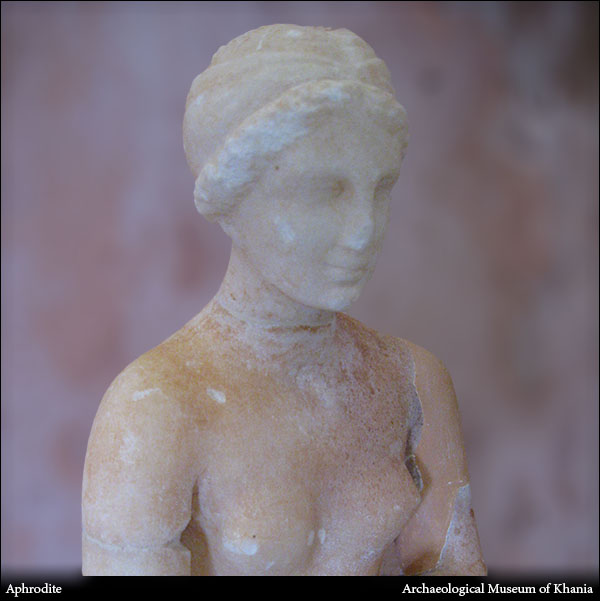
Even though Aphrodite was married to the lame god Hephaistos, she began flirting with Ares. The two lovers were very discrete, but Hephaistos found out about their secret trysts and began plotting his revenge. Hephaistos was the master of clever devices so it was not difficult for him to make a trap for Aphrodite and Ares that would be undetectable and inescapable.
Once the lovers were hopelessly ensnared, Hephaistos called forth the other Immortals to witness Aphrodite's unfaithfulness. Ares and Aphrodite could do nothing but suffer through the humiliation. Seeing the lovers caught in the act, Apollon asked Hermes how he would feel if he was trapped in such an embarrassing position. The lighthearted Hermes replied that he would "suffer thrice the bindings if only he could share the bed of Aphrodite the golden."
Apparently, Hermes did share the bed of golden Aphrodite because they had a child named Hermaphroditus who had the physical characteristics of both sexes.
Hermes was the father of many immortal and semi-divine children.
Perhaps the most famous and unusual child of Hermes was Hermaphroditus. With Aphrodite as the mother, Hermaphroditus was beautiful and delicate like his mother but also had the masculine virility of Hermes.
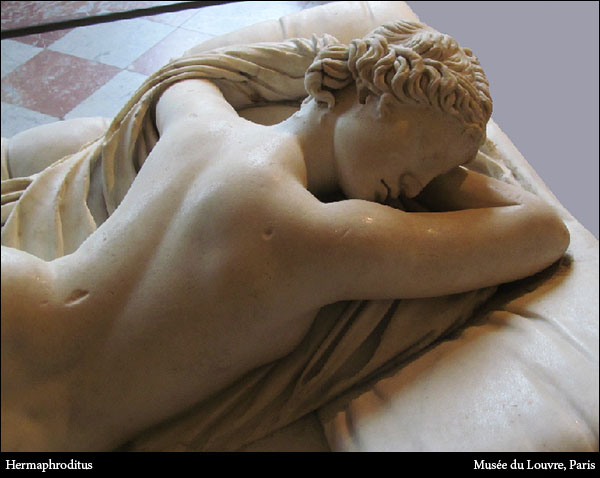
Aphrodite was without doubt the most enchantingly feminine goddess on earth ... Hermes likewise was the manliest and most virile of the gods. The union of such ultimate masculine and feminine divinity produced an entirely unique man-woman like Hermaphroditus.
The ancient Greeks were not sure whether Hermaphroditus was a monstrosity or a prophet. His appearance was striking but disturbing and people were not sure if his presence presaged good or evil.
The Goat-God
The birth of Pan was somewhat mysterious ... he was the son of Hermes and an unnamed mortal woman, but Pan's countenance was not godlike or human.
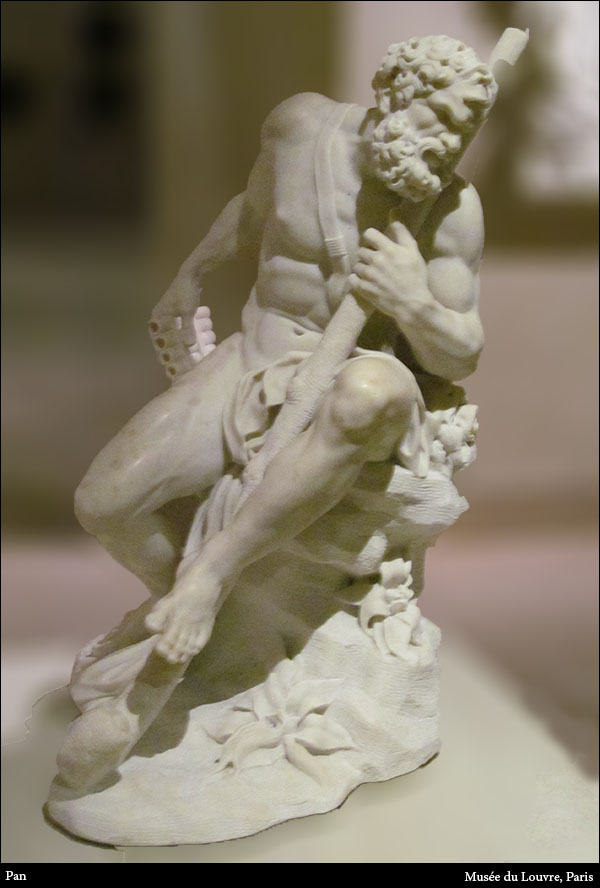
Hermes was tending the flocks of a man named Dryops and fell in love with Dryops's daughter. Hermes seduced the young woman and Pan was the result of that union. Pan had the ears and horns of a goat and goat-hooves for feet. The young mother and attending nurse saw Pan and fled in fear, but Hermes was proud of his new son.
Hermes wrapped the baby in the warm skins of mountain hares and showed him to Zeus and the other Immortals. The gods and goddesses were delighted with the strange child ... especially Dionysos. They named him Pan, which literally means All, because they all adored him.
The era of the Titan gods was ending but the Titans would not relinquish their authority without a fight. Pan fought alongside Zeus in the war against the Titans because of the kindly treatment he received when his father introduced him to the Immortals.
Eleusis was the son of Hermes and Daeira, a daughter of Okeanos (Ocean). Although not all ancient poets agree with Eleusis's parentage, we can be reasonably sure Eleusis was Hermes's son because of the importance he played in the establishment of the holy shrine of Demeter and Persephone at the city of Eleusis. Named after Eleusis, the city became the site of one of the most secretive and mysterious cult centers of the ancient world.
Bunus was the son of Hermes and Alkidamea. Bunus lived circa 1285 BCE and assumed lordship over the kingdom of Epliyraea. Before Aietes became king of Kolkhis, he ruled Epliyraea ... when he was offered the chance to move to Kolkhis, he entrusted Epliyraea to Bunus. One of Bunun's most notable accomplishments was setting up a temple of Hera in Korinth where the goddess is known as Hera Bunaea.
Epliyraea might have been the city of Korinth or "Korinth adjacent" because references to Bunun are always related to Korinth.
King Aietes of Kolkhis became an integral character in the Quest for the Golden Fleece, which also involved Hermes.
Sikyon, the founder of the city by the same name, had a daughter named Khthonophyle, she and Hermes were the parents of Polybos. Khthonophyle later mated with Dionysos and had a son named Androdamas.
Polybos eventually became king of Sikyon and was followed to the throne by Adrestos (Adrastus). We can deduce the timeframe of Polybos's kingship by noting that Adrastus's son in law, Diomedes, fought in the Trojan War. That would mean Polybos was king of Sikyon two generations before the Trojan War, i.e. circa 1300 BCE.
The city of Phere (or Pharae) in Lakonia was founded by Pharis, the son of Hermes and Phylodameia, the daughter of Danaus. Pharis's daughter Telegone had twin sons named Krethon and Orsilokhos (or Ortilokhos) who fought in the Trojan War on the side of the Achaians.
Neaera, the daughter of Pereus, married Autolykos, a son of Hermes. Little is known of Autolykos other than that he lived on Mount Parnassos and was raised by a man named Baedalion.
Myrtilus was a son of Hermes who was unceremoniously murdered for his unscrupulous behavior.
Myrtilus was the charioteer of King Oinomaos of Elis ... he betrayed Oinomaos for a bribe. King Oinomaos declared that no man would be allowed to marry his daughter Hippodamia unless the suitor could win a chariot race against his prize team. To ensure his teams' success, Oinomaos would try to injure the suitor while the race was in progress. An ambitious man named Pelops accepted the challenge and decided to ensure his victory by bribing Myrtilus.
Myrtilus accepted the bribe and deliberately lost the chariot race. Since his team lost the race, King Oinomaos was obliged to allow Pelops to marry Hippodamia. Being a true scoundrel, Pelops refused to pay the bribe to Myrtilus and then threw him into the sea where he died. Myrtilus was buried behind the temple of Hermes at Pheneus in Arkadia.
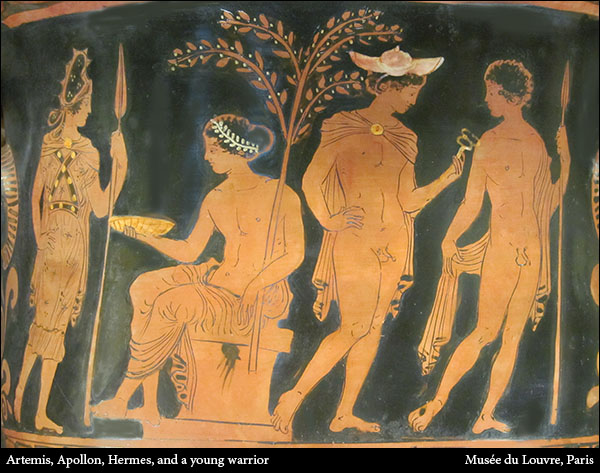
Evander was the son of Hermes and a Nymph daughter of the god of the Ladon River in Arkadia. Evander set out from the Arkadian city of Pallantium and founded a new city on the banks of the Tiber River in Italy. He named the new city Pallantium and it eventually became a part of Rome. The name of the city was changed to Palatium by the Roman emperor Antoninus who ruled from 138 to 161 CE.
The Kretans insist that Kydon was the son of Hermes and Akakallis, daughter of King Minos of the island of Krete. Kydon was the eponymous founder of the city of Kydonia, modern Khania. It is asserted by non-Kretans that Kydon was actually the son of a man named Tegeates.
The role of Kydonia during the Minoan period (circa 1200 BCE) is not known with certainty but its strategic location makes it easy to believe that it was a viable port for all sorts of commerce. The proximity of Krete to Egypt and the Greek islands as well as the Greek mainland made it an excellent stop-over point for trading throughout the eastern Mediterranean.
Norax was the son of Hermes and Erytheia, the daughter of Geryon. Geryon was the three-bodied man slain by Herakles as part of his Tenth Labor. Norax was an Iberian who led an expedition to the island of Sardinia and founded the city of Nora.
Daphnis was a son of Hermes and an unnamed Nymph. Daphnis was born on the island of Sicily in a region called the Heraean Mountains, north of Mount Aetna. The glens surrounding the mountains were lush with trees and all forms of life-sustaining plants. Daphnis was born in a grove consecrated to the Nymphs and got his name from the sweet-smelling bay plant (daphne) that grew in profusion in the sacred grove.
Unlike Pan, Daphnis's appearance was entirely human, and very handsome. His love affair with a mountain Nymph proved to be his undoing. She made him promise to love no one but her ... he broke the vow and was blinded for his unfaithfulness. Daphnis spent the remainder of his life singing mournful songs in the pastures of Sicily.
Saon may have been a son of Hermes but it was also believed that he was actually a son of Zeus. If Saon was a son of Hermes, his mother would have been Rhene. Saon was born on the island of Samothrake and his name was derived from that of the island. After The Deluge (11,000 BCE?), Saon gathered the survivors who had been scattered around the island and organized them into five tribes that his sons ruled in accordance with the laws Saon created.
Aithalides was son of Hermes and Eupolemeia. Aithalides was one of the Argonauts and the half-brother of the Argonauts, Erytos and Ekhion.
Just like his father, Aithalides had an indelible memory, for that reason he was logically chosen to be the herald of the Argonauts. There is a brief mention of Aithalides's eventual fate in the Argonautika by Apollonius of Rhodes ... Aithalides entered the whirlpools of the Acheron River in the Underworld and for an unstated reason, doomed to sometimes abide among the living and at other times dwell with the dead.
Eudoros was the son of Hermes and Polymele. When Polymele became the mother of Eudoros, a kindhearted man named Ekhekles recognized the fact that Eudoros was the child of an Immortal. Ekhekles married Polymele and raised Eudoros as if he were his own.
Autolykos was a thief, and a very good one. As the son of Hermes and Khione, Autolykos possessed the power of changing the shape of whatever he stole and making it and himself invisible. Autolykos was the father of Antikleia thus making him the maternal grandfather of Odysseus, the king of the island of Ithaka and an Achaian commander in the Trojan War.
Dolops was a son of Hermes and the eponymous ancestor of the Dolopians, i.e. the inhabitants of Dolopia.
One generation before the Trojan War, Hermes was a part of one of the greatest adventures of the ancient Greek world—the Quest for the Golden Fleece by Ieson (Jason) and the Argonauts. Several of Hermes's sons were Argonauts ... the brothers Erytos and Ekhion as well as Aithalides, who served as the herald for the Argonauts.
The Golden Fleece that Ieson and the Argonauts sought was from a golden ram, which had been created by Hermes and the Nymph, Nephele (Cloud).
Nephele married a mortal named Athamas who was king of Orkhomenos. They had two children—a girl named Helle and a boy named Phrixus. Eventually Athamas rejected Nephele for a mortal woman named Ino. Athamas's new wife had no love for Nephele's children and plotted to kill Phrixus by offering him as a sacrifice.
In order to save Phrixus's life and prevent any future harm to Helle, Nephele and Hermes created a golden, flying ram to carry the two children to safety. The youths flew away from Orkhomenos on the ram but Helle fell from the ram's back and drowned in the sea. The body of water into which Helle plunged was thereafter called the Hellespont, i.e. Helle's Sea. Phrixus escaped to the land of Kolkhis and was given sanctuary by King Aietes.
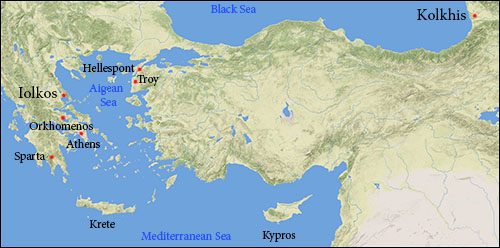
Phrixus offered the ram as a sacrifice at the altar of Zeus and hung the ram's Golden Fleece in the Garden of Ares. The quest of Ieson and the Argonauts was to retrieve the fleece and return it to Greece. Arriving safely in Kolkhis, Ieson took the wand of Hermes from Aithalides and proceeded to Aietes's palace. The goddess Hera hid the delegation in a mist until they were inside the king's court. When the mist was lifted, it was as if Ieson and his companions had materialized out of thin air. Aietes and his entourage were suitably impressed.
King Aietes demanded that Ieson complete a series of trials to validate his claim for the Golden Fleece. Ieson proved worthy but Aietes still refused to surrender the fleece. With the aid of the king's daughter Medeia, Ieson stole the fleece and made his escape from Kolkhis.
The ultimate fate of the fleece from the golden ram Hermes helped create was not recorded in the classical literature. It's assumed that Ieson had the fleece with him when he returned to Iolkos and then relocated to Korinth but after his ignoble death in Korinth, the fleece seems to have vanished.
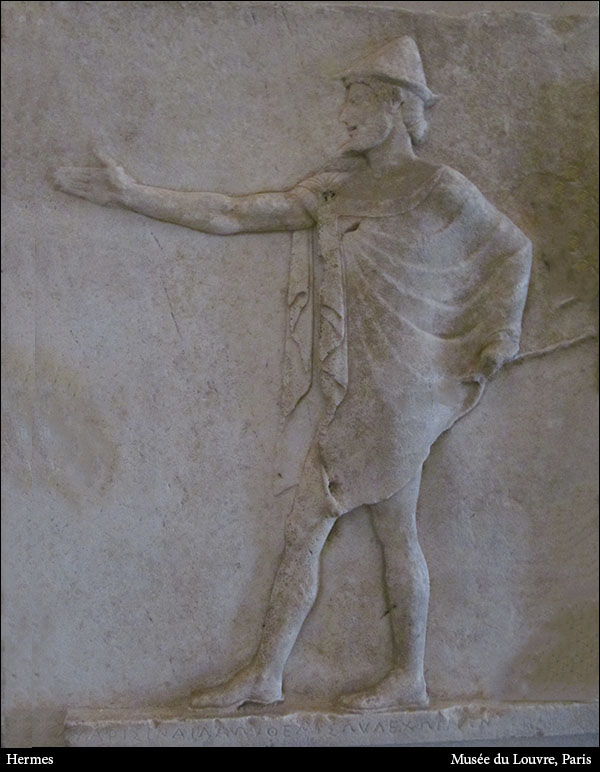
In the Iliad by Homer, Hermes was chosen by Zeus to escort King Priam through the battle-lines to retrieve the body of his fallen son, Hektor. Achilles killed Hektor and refused to return his body to his family for a hero's burial. Zeus sent Thetis, Achilles mother, to command Achilles to return Hektor's body. To sooth Achilles's pride, Priam was required to pay a ransom.
After Priam and his servant left the safety of the walls of the city of Troy, Hermes disguised himself as a young man and waited for them on the road. Hermes took the guise of Eriunios, the Helper. Priam was a leader and king because of his quick mind, he immediately recognized the scruffy stranger as an Immortal and treated him with respect.
Hermes took Priam across the battlefield and past the Achaian guards without being seen. Hermes easily opened the massive gates to Achilles's compound and then disappeared into thin air. Priam went to murderous Achilles as a supplicant and begged for the return of his son's body so he and his family could give the Trojan hero a proper funeral.
Achilles knew that the return of Hektor's body was the commandment of Zeus, therefore Priam's request could not be refused. While Achilles's servants prepared Hektor's body, Priam slept. As Eos (Dawn) approached, Hermes roused Priam and safely led the grieving father with the body of his once glorious son back to Troy.
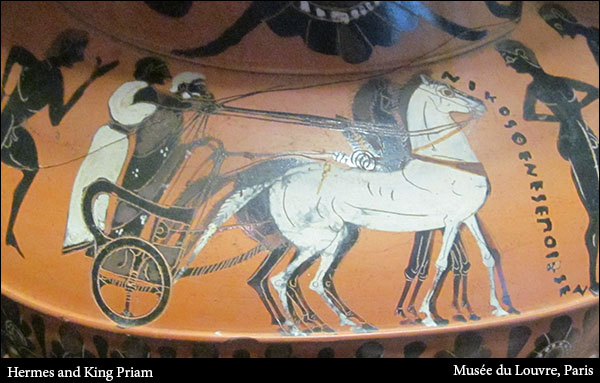
The Trojan War ended circa 1240 BCE. Most of the victorious Greek commanders returned to their homes without incident ... King Odysseus of Ithaka was not so lucky. His ten-year voyage home was epic in every way. Odysseus would have not survived his ordeal without Hermes's intervention.
Blundering onto the island of the Cyclopes, Odysseus incurred the wrath of Poseidon, lord of the sea, by maiming one of the god's sons. Poseidon swore vengeance against Odysseus, but Zeus would not let Poseidon kill Odysseus ... the angry god had to be content with tormenting Odysseus and delaying his homecoming. At the will of Poseidon, Odysseus was put in peril at the hands of two formidable Nymphs—Kirke (Circe) and Kalypso. Barely escaping the machinations of the Kirke, Odysseus became hopelessly stranded on Kalypso's island.
At the mercy of the wind and sea, Odysseus and his comrades came to the island of Aiaia, the home of the Dread Goddess Kirke.
Odysseus sent out a scouting party and only one man returned. The survivor reported that his companions had been turned into pigs with human faces by the goddess of the island. Odysseus was determined to save his companions from such a cruel fate but did not want to endanger any more crewmembers ... he went alone through the lonely forest to Kirke's palace.
Along the trail, Odysseus met Hermes in the guise of a young man. Hermes told Odysseus that he would help save the men Kirke had bewitched but it would be necessary for Odysseus to act decisively and carefully follow instructions or he too might be transformed into a beast.
Hermes reached down and pulled a plant called 'moly' from the ground and said that mere mortals found it difficult to dig-up the plant but he, as a god, could do all things. Hermes explained that when Kirke offered Odysseus one of her dreadful potions he was to secretly put the 'moly' in the concoction to render it harmless ... to complete her evil spell, it would be necessary for Kirke to touch Odysseus with her wand ... at that moment, Odysseus was to draw his sword and hold the goddess hostage until she released Odysseus's men from their animal forms.
Odysseus accepted the 'moly' from Hermes and went boldly to Kirke's palace. She welcomed him with false sincerity and offered him one of her vile potions ... Odysseus put the 'moly' in the goblet and to Kirke's delight, drank it down. When Kirke thought the drug had taken effect, she tried to strike Odysseus with her wand, but Odysseus drew his sword and sprang upon the goddess before she could defend herself. The astonished Kirke surrendered instantly.
Kirke released the twenty-two pig-men from their cage and ceremoniously anointed them with another one of her potions. The men seemed to be restored to their original forms, but they were taller and more handsome than before they had been enswined.
An interesting thing about Odysseus's confrontation with Kirke is that when Odysseus drew his sword and threatened Kirke, she knew at once that Odysseus was the man Hermes had told her to expect. Apparently, Hermes had gone to Kirke and informed her of future events before they happened.
In the Odyssey by Homer, the long-suffering hero Odysseus was stranded on the island of Ogygia for seven years as the captive-guest of the Nymph Kalypso. By the time Odysseus reached Ogygia, all of his shipmates were dead. Kalypso offered Odysseus immortality and a life of ease if he would only consent to stay with her, but the stubborn man was intent on returning to his family and could not be tempted by anything Kalypso had to offer.
The goddess Athene had repeatedly tried to intervene on Odysseus's behalf, but Zeus continually sided with his brother Poseidon and allowed Odysseus's torment to continue. Finally, Zeus decided that the time had come for Odysseus to continue his long voyage home. He instructed Hermes to go to Ogygia and speak with Kalypso ... Zeus was quite clear about the fact that Odysseus had spent enough time with Kalypso and should be sent on his way home.
Hermes went to the Nymph goddess and tried to use gentle persuasion before he pronounced the uncontestable will of Zeus. Hermes informed Kalypso that Odysseus must be allowed to leave, and she was not to hinder him in any way. Kalypso argued with Hermes and recounted the numerous mortals who had been chosen by Immortals to be their companions. Her arguments were in vain. She knew that Hermes was simply the messenger and that no matter how much he sympathized with her situation he could not alter the will of Zeus.
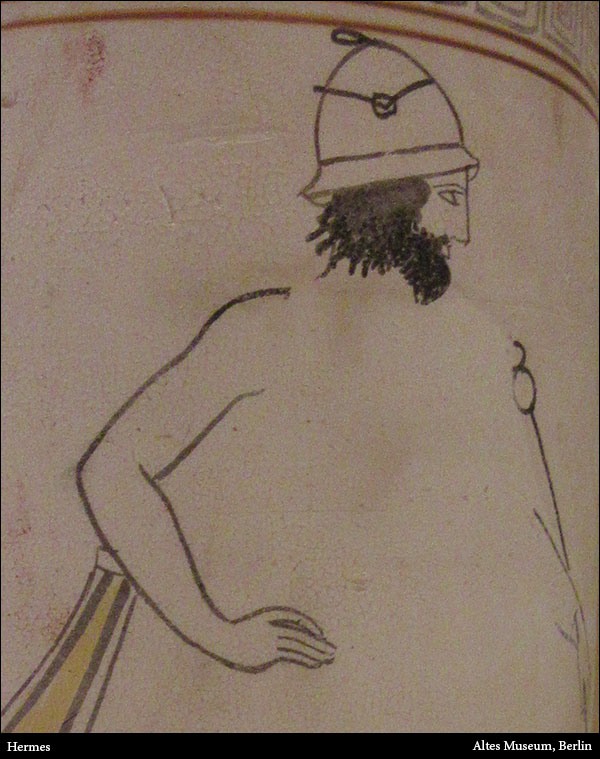
If you are mortal, you will eventually meet Hermes because he is the escort for souls to the House of Hades.
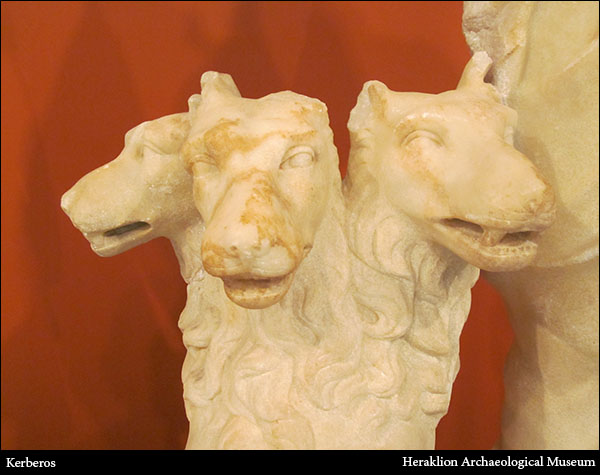
Although Hermes is most often engaged by Hades as the guide for souls to the Underworld, he was once called upon to make sure that Hades's watchdog Kerkeros made a safe round-trip from the Underworld to the surface of the earth and then back to the Underworld.
Herakles was required to complete Twelve Labors for his cousin Eurystheus ... his Twelfth Labor was to retrieve Kerberos from the Underworld and present the hound to Eurystheus in Mykenai. Herakles was given the task because it was presumably impossible but Eurystheus underestimated Herakles's determination and clout. Herakles went to the House of Hades and politely asked his uncle Hades to allow him to take Kerberos to Mykenai so he could finish his last Labor. Hades agreed but only under the condition that he be accompanied by Hermes to make sure no harm came to Kerberos.
There are several places on the Peloponnesian Peninsula that claim to be the spot where Hermes, Herakles, and Kerberos emerged from the Underworld but since this event happened before the Trojan War, it's understandable that there would be some confusion as to exactly where it happened. When the trio arrived at Mykenai there was an unforgettable scene ... Eurystheus was so terrified he hid in a giant urn until Kerberos was on his way back to the Underworld.
Hermes made sure that Kerberos was returned safely to lord Hades.
The victorious Achaian Greeks returned to their homes after the Trojan War ended. The Achaian commander-in-chief Agamemnon was expecting a hero's welcome but found his palace rife with deadly intrigue. Agamemnon's ten-year absence allowed his cousin Aegisthus to seduce Klytemnestra, Agamemnon's wife. To compound Aegisthus's misdeed, he and Klytemnestra were plotting to kill Agamemnon when he returned to Mykenai.
Two attempts were made to save Agamemnon from certain death but both failed.
The ghost of Achilles appeared to Agamemnon before he left the ruins of Troy to sail home. Achilles died in the war but his 'shade' emerged from the Underworld to warn Agamemnon of the danger awaiting him at his home ... Agamemnon ignored the warning.
Zeus sent Hermes to Aegisthus and made it very clear that Agamemnon was not to be harmed ... Aegisthus ignored Zeus's command and killed Agamemnon anyway. For defying Zeus, Agamemnon's son Orestes killed Aegisthus.
The Athenian politician and general Alkibiades was alternately admired and despised by the people of Athens. He earned their admiration for his military campaigns but was forced to flee Athens because of the desecration of a Hermae—a statue of Hermes carved in stone with his head atop a square column and a protruding phallic member on the front. Hermae were common in Athens and most Greek cities because they demonstrated the virility and manliness of Hermes in a very graphic and appropriate way.
Apparently, Alkibiades suffered some sort of break with sanity or at the very least, a lapse of good sense. He was found guilty of vandalizing a Hermae ... the most obvious way to commit such an outrage on a Hermae is to break off the phallus ... the most obvious way to incur the wrath of Hermes would be to insult his virility.
Alkibiades was forced to flee Athens ... he lived in Sparta until his assassination by the Persians in 404 BCE. It should be no surprise that after the desecration of the Hermae, Alkibiades lived in disgrace and was finally unceremoniously murdered.
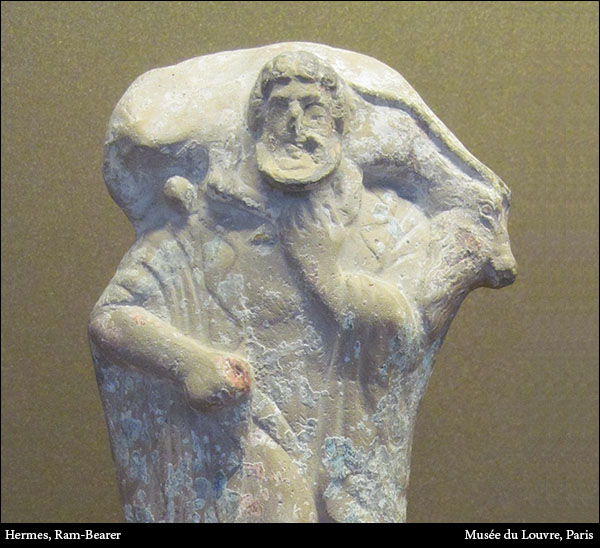
Tanagra was a town in ancient Boeotia south of the town of Delium. There were several temples and sanctuaries in Tanagra, but the most interesting ones were the sanctuaries of Hermes Ram-Bearer and Hermes Champion.
The surname Ram-Bearer was given to Hermes when he rescued the city from a pestilence by carrying a ram on his shoulders around the city walls. To commemorate that event a sanctuary was commissioned with an iconic statue by an artist named Kalamis ... also, each year the most handsome young man in Tanagra would go 'round the walls at the feast of Hermes, carrying a lamb on his shoulders.
The surname Champion was bestowed on Hermes when he led the young men of Tanagra against an invasion by the forces from the city of Eretria, which was on the adjacent island of Euboia. Hermes routed the Euboians and secured a stunning victory, thus saving the city. The sanctuary of Hermes Champion had a wild strawberry-tree under which the inhabitants of Tanagra believed Hermes was nourished.
As is the custom of the Immortals, Zeus and Hermes were wandering the countryside disguised as mortals to observe and test the devotion of their subjects. When they came upon the humble abode of Baukis and her husband Philemon, the two gods were welcomed with sincere friendliness. When a flood threatened to wash away their home and kill Baukis and Philemon, the gods transformed them into trees as a reward for their hospitality.
Hippolytus was one of the huge monsters collectively known as Giants. The Giants were the children of Ge (Earth) engendered by blood from the severed genitals of Ouranos (Heavens).
The Giants waged an unsuccessful war on the Olympians and were severely punished after their defeat. Hermes as well as many other Immortals participated in the extermination of the Giants. During the battle, Hermes donned the Helm of Hades and became invisible. He attacked and killed Hippolytus.
The god Apollon had relations with a mortal woman named Kreusa and became the father of Ion. Kreusa did not understand the ways of the Immortals and was shamed to have had a child without a legal father. She took the infant to a cave and left it to die. Hermes saw the callous deed and rescued the child.
Hermes took the infant to the temple of Apollon at Delphi where he was named Ion. As the years passed, Kreusa and her husband Xuthus went to Delphi because they were childless ... they sought guidance from the Pythia—the priestess of Apollon.
The Pythia told them to adopt the first child they encountered after leaving the temple. When they met young Ion, Kreusa thought she saw a resemblance to her husband and erroneously thought Ion was the illegitimate son of Xuthus by another woman. Kreusa was going to kill Ion but the Pythia showed her the swaddling clothing in which the infant was wrapped when he had been left at the temple.
Kreusa accepted the fact that Ion was her abandoned child. She and Xuthus took Ion to Athens where, according to the goddess Athene, a prophecy had been fulfilled whereas Ion would become the founder of the Ionian race.
Perseus was the son of Zeus and Princess Danae of Argos. Danae's father hid her in a bronze vault so she could not have contact with a man ... he was afraid that if she had a son, the boy would eventually kill him. Zeus came to Danae as a shower of gold and Perseus was the result of Zeus's touch ... Perseus was indeed destined to kill Danae's father but first he had to kill the Gorgon, Medusa.
The Gorgons were formidable creatures with snakes on their heads, around their waists and around their wrists ... one look into their eyes could turn any creature to stone. Medusa was mortal but her two Gorgon sisters were immortal.
Perseus was required to make careful preparations before his confrontation with Medusa. He first sought out the sisters of the Gorgons, the Graiai, who were gray from birth and shared one tooth and one eye between them. Perseus stole their tooth and eye, and using them as ransom, forced the Graiai to give him the location of the Nymphs who had possession of the Cap of Hades (which would make him invisible), a pair of winged sandals (for flying) and a kibisis (a bag to hold Medusa's head).
Perseus still needed a suitable weapon. He obtained a sword (or sickle) from Hermes and set out to slay Medusa. Using the weapon provided by Hermes, Perseus decapitated Medusa and made a hasty escape with Medusa's sisters on his heels. Although Hermes supplied only one element to the sequence of Medusa's death, the feat could not have been accomplished without his assistance.
Thyone was the daughter of Queen Harmonia and King Kadmos of Thebes. Thyone became the consort of Zeus and thus incurred the wrath of Zeus's sister-wife Hera. The deception of Thyone by Hera was twofold ... Hera first enchanted the maiden and prompted her to pray to Zeus for eternal life ... secondly, Hera induced Thyone to ask Zeus for the ability to see him in all his immortal glory. Zeus agreed to Thyone's requests but when he revealed his true nature of thunder and lightning, she was consumed in flames ... before she was destroyed, Zeus transformed her into an immortal being ... she assumed the name of Semele.
Zeus could not allow his unborn son to die with Thyone's mortal body. He sent Hermes to rescue the babe and take it to a safe place. Hermes did as he was instructed and gave the infant to Makris, daughter of Aristaios, on the island of Euboia. Makris soothed the child but was soon driven from her home by Hera. Zeus took the premature infant and sewed it into his thigh so it would have his protection. Zeus named his son Dionysos because he was "re-born" on Mount Nysos. The name Dionysos literally means God of Nysos
Amphion is credited as being the first human harpist ... he was given the harp (kithara) and taught to play by Hermes. Amphion's songs were so enchanting, beasts and inanimate objects would be drawn to him ... Amphion built the foundations and bulwarks of the city of Thebes by moving the stones with the enchanting music of his kithara.
Amphion had many advantages but the favor of the gods did not protect him or his children from the vain indulgences of his wife, Niobe. Amphion was the son of Zeus and Antiope, and he obviously had the support of Hermes but when Niobe insulted the goddess Leto by bragging that she had many children and Leto only had two, divine wrath was inevitable. Leto sent her incomparable children Apollon and Artemis to murder all but two of Amphion and Niobe's children.
Amphion was the first to set up an altar to Hermes but that did not help him when he went to the House of Hades where he was punished because of Niobe's despicable behavior.
Argeiphontes—Slayer of Argos
Diaktoros—Minister or Messenger of Zeus
Eriunios—Helper
Kriophoron—Ram-Bearer
Promakhon—Champion
The Iliad
The Odyssey
Theogony
Works and Days
Catalogues of Women and the Eoiae
Great Eoiae
Catalogue of Women
Astronomy
Hesiod, Fragments of Unknown Position
Hymn to Demeter II
Hymn to Pythian Apollon III
Hymn to Hermes IV
Hymn to Aphrodite V
Hymn to Hermes XVIII
Hymn to Pan XIX
Hymn to Histia XXIX
Kypria
The Argonautika by Apollonius of Rhodes
The Histories by Herodotos
Library of History by Diodorus of Sicily
Description of Greece by Pausanias