
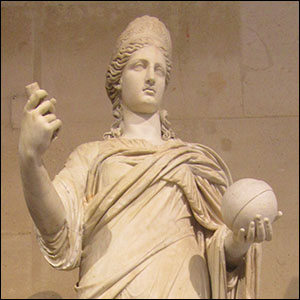
Hera's elevation to the eminent position of queen of the Immortals was by no means assured. Her parents were Titans, which means Hera was the granddaughter of one of the primal Immortals, Ge (Earth), but her noble heritage did not exempt Hera from hardships and dangers.
Hera was a daughter of the Titans Kronos and Rhea. The Titans were an indulgent and arrogant race ... their exploits became legendary because of their complete disregard for discretion and restraint. Hera's father Kronos was given a prophecy by Ge and Ouranos (Heavens) that one of his children would usurp his powers and take his Throne of Eternity. In a vain attempt to prevent the prophecy from coming true, Kronos swallowed each of his children as they were born ... Hera was thus swallowed with four other children. Kronos's wife Rhea was determined to save her sixth child from Kronos's obsessive fear ... she substituted a stone for the child. In his haste to swallow his newest child, Kronos did not notice the deception. Rhea named her sixth child Zeus and secreted him away so he could mature and eventually confront his father.
The prophecy of Ge and Ouranos came true when Zeus attacked Kronos ... Hera and the other four gods and goddesses inside Kronos's body were vomited up in the violent struggle. Hera was thus 'born' as a mature adult along with her four siblings—Poseidon, Hades, Demeter, and Histia. As their savior, Zeus was regarded as the leader of the newly born gods and goddesses.
Zeus, Hera, and their brothers and sisters not only took away the Titans' authority, they removed Kronos from his throne on Mount Olympos. The Titans would not surrender their indulgences without a fight, so a war began, which has come to be known as the War of the Titans. After a ten-year struggle, the Titans were defeated and forced onto Tartaros (the Pit). The era of the new Olympians began, and Hera became the queen of the Immortals.
Creation was divided amongst the children of Kronos and Rhea:
Zeus became the master of the sky;
Poseidon became lord of the sea;
Hades became lord of the dead;
Histia became the goddess of the hearth;
Demeter became the goddess of the harvest; and
Hera became the queen of the Immortals.
Hera's dominion was not as clearly defined as that of her brothers and sisters, but she demanded the respect of mortals and Immortals alike. Her authority was only exceeded by that of Zeus.
Hera was without doubt the most beautiful goddess ... she was even more beautiful than the goddess of love, Aphrodite. Hera was without doubt the most beautiful goddess ... she was even more beautiful than the goddess of love, Aphrodite. Each year Hera would bathe in a spring called Kanathos near Korinth where the waters of the spring restored her youth and virginity.
Relationships with Hera were always complicated. She demanded respect, which was sometimes misperceived as arrogance or excessive pride. The Immortals had conflicting feelings towards Hera that vacillated between fear and reverence. Some of the gods and goddesses who once feared Hera eventually came to love her as a mother and sister.
As with the Titans, it was common for the new Olympians to marry their brothers and sisters. Marriages of this type were not considered to be incestuous ... they were a practical way of preserving the purity of the immortal bloodlines. Hera was not Zeus's first wife, but she was his last. After Hera married Zeus, they had three children—Ares (god of war), Hebe (goddess of youth), and Eileithyia (goddess of childbirth).
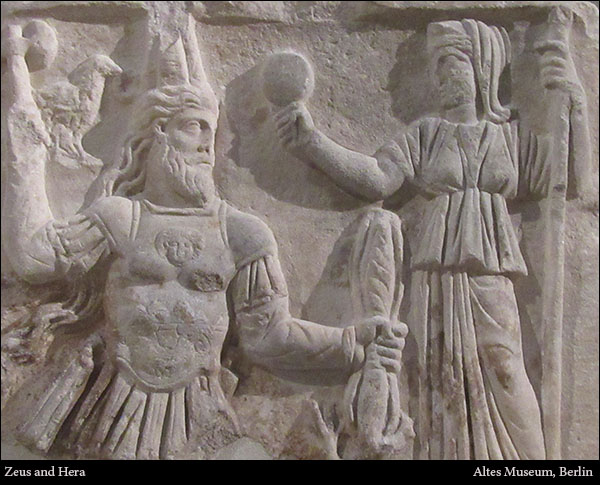
Zeus was not a faithful husband and, in most cases, did not try to hide his romantic affairs from Hera. When Hera was trying to distract Zeus from the battlefield of Troy, she cloaked herself in irresistible sensuality and seduced Zeus on Mount Ida. Zeus was overwhelmed with Hera's beauty and freely recounted his many affairs and indiscretions as his way of telling her that she was the most desirable of all his lovers.
There was an interesting interaction between Hera and Zeus that demonstrated the playfulness that was woven through their often-confrontational relationship. Zeus and Hera had been arguing for one reason or another and Hera retreated to the island of Euboia. Zeus was in the city of Plataia visiting King Kithaeron who was noted for his cleverness. At Kithaeron's prompting, Zeus made a wooden statue and wrapped it up to conceal the identity of the image. Again, following Kithaeron's crafty suggestions, Zeus let it be known that the statue was of Plataia, the daughter of Asopos, and that he intended to marry her. Plataia was the eponymous patron of the city, Plataia.
The news of Zeus's impending marriage spread fast and Hera soon arrived on the scene to denounce Zeus for his latest infidelity. When she confronted Zeus, he unveiled the statue and the image was of Hera and not Plataia. Hera was disarmed by Zeus's playfulness ... their differences were reconciled, and the couple reunited. To commemorate the occasion, a festival called the Daedala was established in Plataia ... the word daedala simply means "wooden image."
For her part, Hera was not always concerned with Zeus's best interests. Her relentless punishment of the maiden Io was unforgiving and without merit because Io had resisted Zeus's amorous advances ... there was no reason for Hera to inflict such ill treatment on Io. Hera's vengeful reaction towards Zeus's son Herakles was nothing less than malicious. Hera also heartlessly tried to punish the wayward Zeus by giving birth to her sons Hephaistos and Typhaon without consort, i.e. without a biological father.
When Zeus began his amorous pursuit of the young maiden Io, Hera became truly infuriated. Her relentless torment of Io is a very sad story.
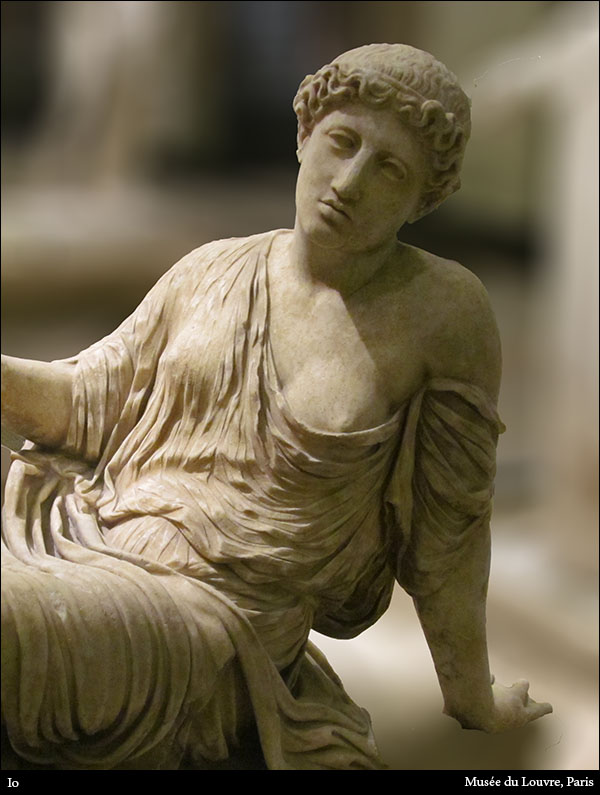
Io was the beautiful daughter of Inakhos of Argos. She began having strange dreams with voices and visions telling her to leave her bed and go into a field where Zeus could 'see' her. She told her father of the dreams and he sought advice of several oracles. For the oracle of Loxias (Apollon), the meaning was crystal clear. They advised Inakhos to disown his daughter, cast her into the streets and drive her from his country. If this was not done, the oracle warned, Zeus would eradicate Inakhos and his people without mercy. With heavy heart, Inakhos obeyed the oracle and forced his young daughter Io from his house.
In a futile attempt to disguise Io, Zeus transformed the young woman into a black and white heifer. Hera wanted to be sure that Zeus could not be alone with his new infatuation so she sent the herdsman Argos to follow the Heifer-Maiden. Argos was called Argos Panoptes, meaning 'all seeing' because he had one hundred eyes. Argos captured Io and tethered her to a tree in Mykenai ... her situation seemed hopeless until Zeus sent his son Hermes to slay Argos. Even though Argos had been warned about Hermes, he was caught off-guard and Hermes killed him with a stone-cast.
At Hera's bidding, a gadfly began to sting and pester the newly freed Heifer-Maiden, forcing her to run farther and farther from her home and happiness. Hera's punishment did not end until Io reached Egypt ... the curse was lifted, and Io's descendants became the founders of the Egyptian civilization.
King Ixion of Thessaly was guilty of a despicable crime that initiated a series of events that eventually resulted in the creation a race of sentient beings having the body of a horse with the torso and head of a man—the Centaurs.
Ixion wanted to marry a woman named Dia but did not want to pay the customary dowry. The matter of the dowry became irrelevant when Ixion arranged to have Dia's father fall into a pit of burning coals. Zeus was magnanimous and forgave Ixion for his crime, but the arrogant king was not humbled or repentant.
Without regard for the consequences, Ixion tried to seduce Hera. Zeus created a counterfeit Hera in the form of a cloud and allowed Ixion to mate with the cloud-woman, who was named Nephele. She had a son named Kentauros who became the progenitor of the Centaurs when he mated with the Magnesian mares.
For his contemptuous behavior towards Hera, Zeus condemned Ixion to spend eternity on a revolving wheel in the Underworld.
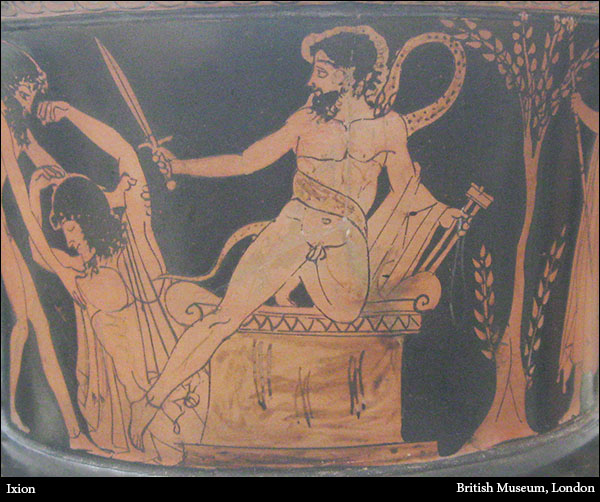
The above image shows Ixion being attacked by a snake as he's being fastened to the revolving wheel in the House of Hades. The woman being carried away might be Dia.
With no regard to Hera's reaction, Zeus mated with the goddess Metis... the glorious result of that union was Athene. Hera was infuriated with Zeus and to show her distaste, conceived Hephaistos without consort. Her intent was to have a son more magnificent than Athene, but Hephaistos had lame legs, much to Hera's chagrin. Hephaistos was destined to become one of the greatest Olympians but that possibility did not occur to Hera.
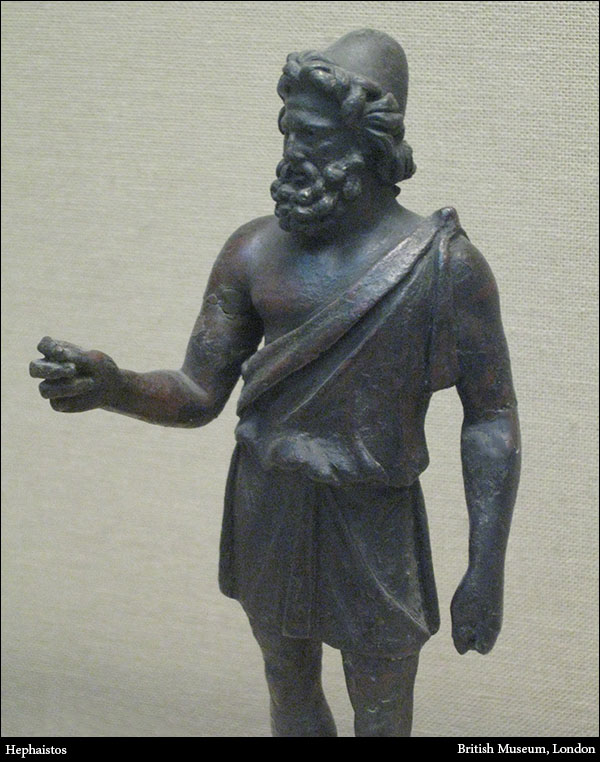
Early in his life, Hephaistos was thrown from Mount Olympos by either Zeus or Hera ... there are two versions of how that happened.
In the Iliad by Homer, we are told that at the climax of a domestic dispute between Zeus and Hera, Zeus caught Hephaistos by the foot and hurled him from the magic threshold of Mount Olympos to the earth far below. Three days later Hephaistos landed on the island of Lemnos, broken and nearly lifeless. The goddesses Thetis and Eurynome found the shattered god and nursed him back to health. They were responsible for saving his life and he never forgot their kindness. Hera would have done Hephaistos further harm had not Thetis and Eurynome hidden him. He worked secretly with the two goddesses for nine years perfecting his inventive and metallurgical skills before emerging to claim his rightful place among the Olympians.
Hera tells a different story of how Hephaistos was ejected from Mount Olympos. In the Homeric Hymn to Apollon, she says she, not Zeus, cast Hephaistos from Mount Olympos. Hera also curses Thetis for caring for Hephaistos and complains that surely there must have been other services Thetis could have performed for the Immortals without encouraging her lame son.
After Hephaistos returned to Mount Olympos, his relationship with his mother was tumultuous. At one point his anger prompted him to devise a golden chair fitted with invisible fetters that he presented to Hera as a gift. As soon as she was seated in the chair, Hera was unable to free herself. It's not clear whether it was Hera or one of the other Immortals who persuaded the god Dionysos to go to Hephaistos and encourage him to release his mother. Dionysos did what he does best, he made Hephaistos drunk and then unceremoniously returned the drunken god to Mount Olympos on the back of a donkey. Hephaistos freed Hera from the golden chair but the antagonistic mother-son relationship continued until the beginning of the Trojan War.
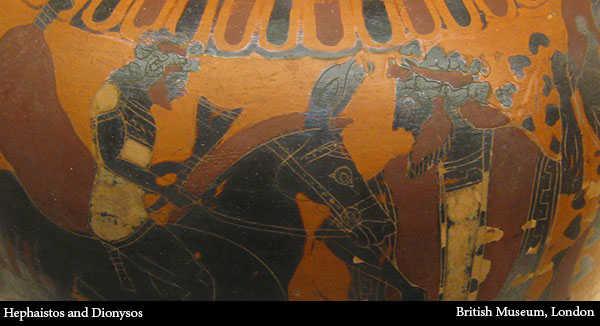
The above image shoes Dionysos with the inebriated Hephaistos riding a donkey.
Typhaon was the son of Hera but unlike Hephaistos, Typhaon's had no attributes that would allow him to become one of the Olympians ... he was violent and cruel in the extreme.
Angry with Zeus, Hera vented her rage to the assembled Immortals and swore she would devise an evil thing to punish Zeus. Hera left the presence of the Immortals and called upon the ancient deities to aid her. She prayed as she struck the ground with her hand and called on the Titan gods who had been forced into Tartaros beneath the earth. She continued to lash the earth with her hand until Ge (Earth) heard her prayer and had mercy on the distraught goddess. Without consort, Hera became pregnant.
To prove that the child was not the son of Zeus, Hera stayed away from her husband for a full year. When the time came, Typhaon was born and in appearance he was not like a mortal or one of the Immortals. He was cruel and destined to become a plague to all who encountered him.
Hera gave Typhaon to "the dragoness" Pytho who, with Typhaon, dealt death to all who came to her precincts near Delphi. Apollon finally killed Pytho but Typhaon survived to be a terror to the tribes of men on the earth.
Typhaon joined in love with the Nymph-serpent, Ekhidna and fathered the two-headed dog Orthos, the hound of Hades, Kerberos, and the Hydra.
The goddess Leto was another of Zeus's lovers and Hera was once again filled with rage. After Leto became pregnant with twins, there was not much Hera could do other than to make the birth of Leto's children as difficult as possible.
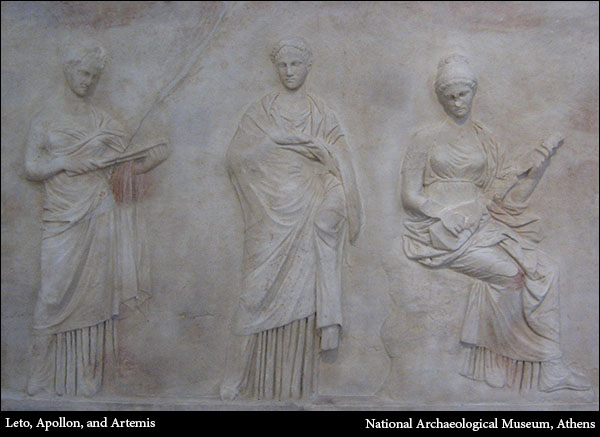
Leto had a great deal of difficulty finding a place to give birth. The goddesses and Nymphs of the various territories and islands were afraid of what Hera might do to them if they assisted Leto. Finally, the goddess Delos agreed to help Leto with the birth of her son. Delos made Leto swear a sacred oath on the waters of the River Styx declaring that her son would not abandon her (Delos's) island after he was born. An oath on the waters of Styx was the most binding oath an Immortal could invoke.
When the time came for Leto's son to be born, numerous goddesses were in attendance, but the goddess Eileithyia was not there. As the daughter of Zeus and Hera, Eileithyia was given dominion over childbirth and it was crucial that she be present when Leto's gave birth.
Hera arranged for Eileithyia to be distracted so she would not notice Leto's labor pains. Leto was in labor for nine days and nights before the goddesses in attendance sent Iris to Mount Olympos to fetch Eileithyia. Iris drew Eileithyia aside so Hera would not interfere and told her Leto's plight. Eileithyia immediately went to Leto ... Apollon was born without further delay. Hera did not prevent the birth of Apollon, but she managed to make Leto suffer needlessly as punishment for her role in Zeus's infidelity.
Apparently, Hera thought Leto had suffered enough and did not interfere with the birth of Apollon's twin sister, Artemis. Leto went westward to the island of Ortygia, which is in the harbor of Syracuse, Sicily. Artemis was born without incident and became known as the virgin goddess of the hunt. Her skill with the bow was only equaled by her brother, Apollon.
Thyone was the daughter of Queen Harmonia and King Kadmos of Thebes. Thyone became the consort of Zeus and thus incurred Hera's wrath. The deception of Thyone by Hera was twofold ... Hera first enchanted the maiden and prompted her to pray to Zeus for eternal life ... secondly, Hera induced Thyone to ask Zeus for the ability to see him in all his immortal glory. Zeus agreed to Thyone's requests but when he revealed his true nature of thunder and lightning, she was consumed in flames ... before she was destroyed, Zeus transformed her into an immortal being ... she assumed the name of Semele.
Zeus could not allow his unborn son to die with Thyone's mortal body. He sent Hermes to rescue the babe and take it to a safe place. Hermes did as he was instructed and gave the infant to Makris, daughter of Aristaios, on the island of Euboia. Makris soothed the child but was soon driven from her home by Hera. Zeus took the premature infant and sewed it into his thigh so it would have his protection. Zeus named his son Dionysos because he was "re-born" on Mount Nysos. The name Dionysos literally means God of Nysos.
It's odd that the name Herakles actually means Hera's Glory when in actuality, her treatment of Herakles was the opposite of glorious.
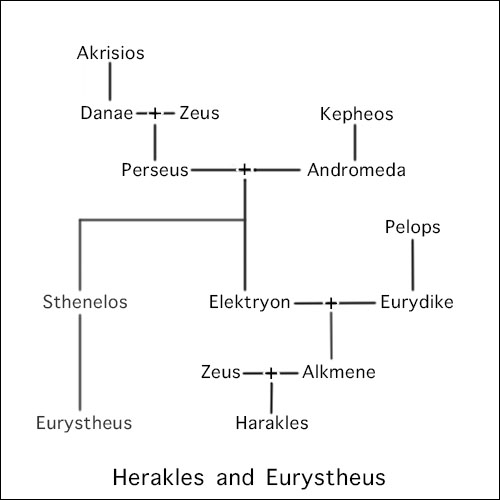
In one of his many acts of infidelity, Zeus had relations with a mortal woman named Alkmene. Zeus hoped their child would be a king and an incomparable leader of men. When Hera learned of the impending birth of Herakles, she began to plot and scheme against the unborn child.
Hera persuaded Zeus to take a solemn oath that the next son born in the bloodline of Perseus, also a son of Zeus, would become the king of Argos. Since Hera was often called Hera of Argos, Zeus did not perceive the trickery hidden beneath Hera's demand for an oath. Zeus agreed because he assumed that the next son born in the bloodline of Perseus would be Herakles. Hera asked her daughter Eileithyia to delay the birth of Herakles so another child in the bloodline of Perseus could be born first and claim the title of king of Argos. Thus, Eurystheus was born before Herakles and became Herakles's earthly master.
Hera was not content to humble Herakles and humiliate Zeus ... she wanted murder. She placed two vile serpents in Herakles's crib with the intention of killing him before he was able to defend himself. The infant Herakles grabbed a snake in each hand and strangled them before they could harm him.
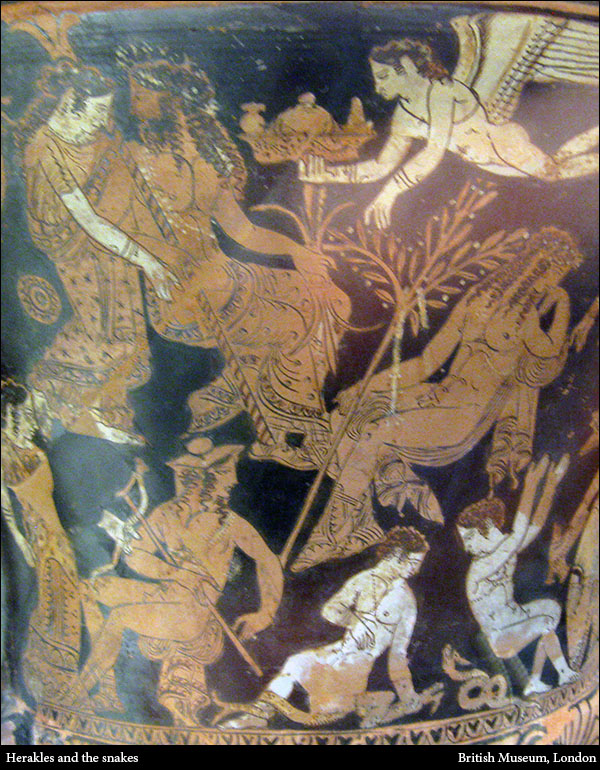
Hera and Zeus (upper left) watch as Herakles fights the snakes Hera put in his crib.
Perhaps the most troubling and destructive thing Hera did was instigating the murder of Herakles's children. While Herakles was still a teenager, he settled a dispute for King Kreon of Thebes. As a reward for his services, Herakles was allowed to marry Megara, the king's daughter. After he and Megara had several children, Hera cast a spell of confusion and madness on Herakles ... in a state of utter bewilderment Herakles killed his children. Some accounts say that Herakles also killed Megara but different authors and examples of ancient artwork dispute that accusation.
The precise role Hera played in the domination of Herakles by Eurystheus was not clearly defined but the tasks known as The Twelve Labors of Herakles were the direct result of Eurystheus being born before Herakles. Eurystheus assigned Herakles twelve impossible Labors that were intended to kill or at least humiliate Herakles. Hera could not resist the urge to continually complicate the life and Labors of Herakles. Two of the monsters Herakles fought and killed were 'pets' of Hera.
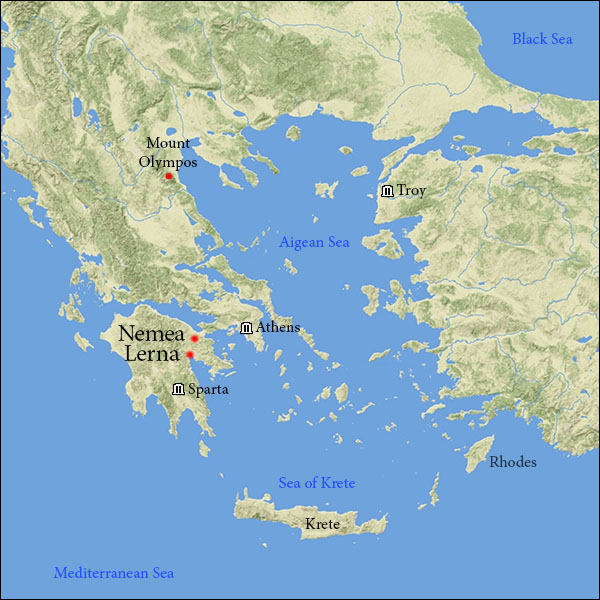
The multi-headed Hydra was nourished by Hera and given free reign to terrorize the people of Lerna until Herakles killed it. Likewise, the Nemean lion was brought up by Hera and induced to haunt the hills of Nemea on the Peloponnesian Peninsula. The people of Nemea suffered the brutality of the lion until Herakles killed it as his First Labor. Hera was honored in Nemea and Lerna, but her hatred of Herakles made her ignore the welfare of her worshippers and put their homes and families in jeopardy.

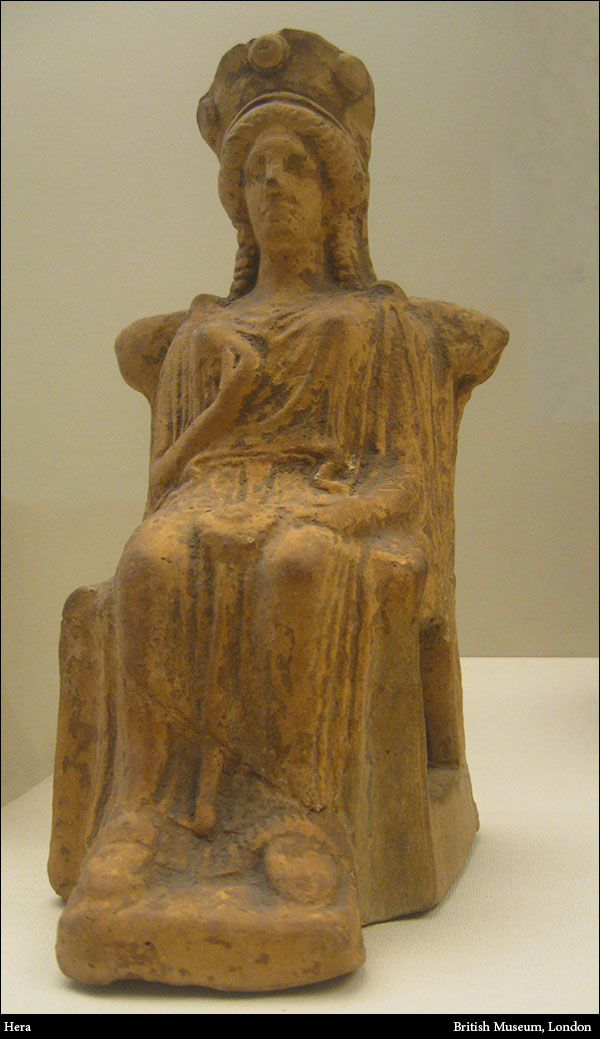
After Herakles finished his Labors and his mortal life came to an end, Hera put away her anger and resentment. She accepted Herakles as her son and initiated a symbolic ceremony to demonstrate her recognition of the fact that he was now immortal and beloved by Zeus. Hera put on a long, billowing dress and concealed Herakles in the folds of the dress. The Immortals gathered to watch as Herakles emerged from between Hera's legs as if he was being born. Hera also agreed to allow Herakles to marry her daughter, Hebe. Despite her initial hatred of Herakles, Hera finally and sincerely welcomed him into her family.
King Pelias of Iolkos usurped the inheritance of Ieson (Jason), setting the stage for punishment and glory in the Quest for the Golden Fleece.
The machinations of King Pelias necessitated drastic measures to protect a young Ieson. Aeson, Ieson's father, sent his son into hiding to be nurtured and tutored by the Centaur Kheiron. The half-man, half-horse Kheiron was renowned for his intelligence and noble character.
The goddess Hera on one of her frequent excursions into the world of mortal humans, disguised herself as an old woman and waited on the banks of the river Anauros for a kind stranger to help her cross the surging waters. Ieson, now a young man, assisted Hera across the river and by this simple demonstration of his chivalrous character, earned the eternal love and protection of the queen of the Immortals.
King Pelias, on the other hand, earned Hera's wrath by neglecting her at his sacrifices. Hera's love of Ieson and hatred of Pelias combined to set the stage for a series of intertwined events—the Quest for Golden Fleece, Ieson's love affair with Princess Medeia and the cruel death of King Pelias.
Pelias had been given an oracle that said a youth wearing one sandal would come to Iolkos and take his throne. Ieson lost one of his sandals in the Anauros River when he assisted Hera and entered Iolkos just as the oracle had predicted. Pelias was foolish and arrogant enough to think he could thwart the will of the Immortals and avoid his prescribed fate by sending Ieson on a seemingly hopeless quest. He commanded Ieson to retrieve the Golden Fleece from King Aietes in the far-off land of Kolkhis. Pelias knew that King Aietes would never surrender the Golden Fleece willingly and if Ieson was lucky enough to survive the dangerous sea voyage to Kolkhis, he would undoubtably be killed by King Aietes.
A ram with a Golden Fleece was created by Hermes and Nephele ... Hermes was the messenger of the Immortals and Nephele was a 'cloud woman' created by Zeus.
Nephele was the wife of King Athamas of Orkhomenos ... they had two children—Phrixus and Helle. Athamas abandoned Nephele and took a new wife named Ino ... Phrixus and Helle fled Orkhomenos when Ino began plotting against them. To help Phrixus and Helle escape their dangerous situation, Hermes and Nephele crated a flying ram with a Golden Fleece to carry them away. As they flew from Europe to Asia, Helle fell from the back of the ram and drowned in the sea ... the narrow straits where she drowned was named Hellespont (Helle's Sea). Phrixus flew on to Kolkhis at the eastern edge of the Black Sea.
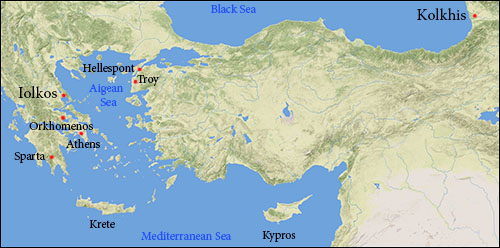
Phrixus arrived safely at Kolkhis and was welcomed by King Aietes ... the king did not miss the significance of the flying ram and the good fortune it might bring to his kingdom. He welcomed Phrixus into his household ... he arranged for Phrixus to marry his daughter Khalkiope without payment of the customary dowry.
The divinely created ram had only one purpose and once Phrixus had been delivered to Kolkhis, its mission had been accomplished. The ram asked to be sacrificially killed ... Phrixus complied ... he sacrificed the ram to Zeus, god of fugitives, and then placed the ram's Golden Fleece in the Grove of Ares where it was thereafter guarded by an ever-vigilant dragon.
Ieson and most of the Argonauts survived the arduous voyage to Kolkhis but Hera was not content to allow things to proceed without her intervention. Athene and Hera were both intent on helping Ieson but when Hera suggested they enlist the help of Aphrodite, Athene hesitated. She said she would accompany Hera to see Aphrodite but when they came face-to-face with the goddess of love, Hera had to do all the talking. Athene was a virgin and unfamiliar with the ways of love.
Hera swallowed her pride when Aphrodite greeted her with a mocking tone. Hera and Aphrodite had a tenuous relationship. Regardless, Hera proceeded to make a heartfelt plea for Aphrodite's help. Aphrodite became speechless and filled with awe at Hera's sincerity. Hera suggested that Aphrodite go to Eros, the primal god of love, and ask him to wound King Aietes's daughter Princess Medeia with one of his golden arrows of love. Hera reasoned that if Medeia swooned for Ieson, the Quest for the Golden Fleece would be more likely to succeed.
Aphrodite admitted that she and Eros were not on the best of terms and said it might be best if Hera and Athene spoke with him instead. Hera took Aphrodite's hand and urged her to be gentle with Eros so he would to obey her. The goddess of love could not resist Hera's plea ... she went to Eros on Hera's behalf and after some scolding mixed with kind words and the promise of a gift, persuaded him to help Ieson seduce Princess Medeia.
Argonauts arrived at Kolkhis without a specific plan for approaching King Aietes ... should they be bold or respectful? Hera and Athene observed the sailors as they pondered their options. It was decided that Ieson should go to the palace and make a formal request for the Golden Fleece. Hera wrapped Ieson in a mist as he started towards the city and concealed him until he stood before Aietes's throne.
Normally, Princess Medeia would have been in the temple of Hekate where she was a priestess, but Hera induced her to be in attendance when Ieson approached the king. It was then that Eros shot Medeia with the golden arrow of irresistible love for Ieson.
Medeia was bewildered by her feelings for the handsome stranger and retreated to her residence in a state of confusion. As a sorceress skilled in the use of drugs and potions, Medeia seriously considered using one of her concoctions to kill herself until Hera invisibly prompted the troubled girl to put away her drugs and surrender to her feelings of love for Ieson.
Hera arranged for Ieson and Medeia to meet without the king's knowledge but the Argonauts who were with Ieson were hesitant to leave him alone with the potentially dangerous sorceress. Hera used the voice of a crow to scold the Argonauts in order to make them leave the two lovers alone.
When Ieson professed his love, Medeia shuddered at the implications of such a forbidden romance. Just as Hera planned, Medeia promised to help Ieson steal the Golden Fleece. To ensure Medeia's loyalty, Hera inflicted the poor girl with grievous fear that her father would find out she had betrayed him. When Medeia again thought of suicide, Hera calmed her fears and made her a "willing" participant in the theft of the Golden Fleece.
King Aietes's navy pursued Ieson and Medeia as they hastily sailed away with the Golden Fleece. Hera sent a favorable wind to speed them to safety. Her loyalty did not waver even when Ieson and Medeia cold-bloodedly murdered Medeia's half-brother, Apsyrtos. Hera kept Apsyrtos's men from catching Ieson by bringing down terrible lightning from the sky thus thwarting their pursuit.
Having lost their bearings, the Argonauts became hopelessly lost in the maze of rivers in Europe. Hera warned them that they were going the wrong way by descending from the heavens and shouting so loud that the firmament shook. Her prompting and guidance finally led them to the Mediterranean Sea.
Zeus was furious about the murder of Apsyrtos and intended to severely punish Ieson for such cowardly behavior. In an effort to protect Ieson and the Argonauts, Hera used the keel of the Argo, which had been crafted by Athene, to warn them ... she urged them to go to the goddess Kirke and beg for atonement. Kirke was Medeia's aunt and offered what help she could.
The last part of the Argo's journey was perhaps the most dangerous ... it was necessary to sail past the double threat of Skylla and Kharybdis. Skylla would swoop down from her cliff-face home and snatch sailors from passing ships with her six greedy heads. Kharybdis was a whirlpool that would alternately suck-down and spew-out vast amounts of seawater thus destroying any ship that ventured too close to her maw. Hera sent the goddess Iris to watch over the Argo and then enlisted the help of Hephaistos and the Nereids to protect the Argonauts from Skylla and Kharybdis.
The Quest for the Golden Fleece was a dangerous and deadly adventure ... many were killed, and many lives were ruined. Without the direct intervention of Hera, the sorrow and hardship would have been far worse.
The Trojan War was caused by the kidnapping of Helen of Argos ... at least that's what we mortals have been led to believe. The Trojan War was started by the Immortals in order to kill off the generation of demigods, i.e. the semi-divine beings who were becoming a burden to humanity and an embarrassment to the Immortals. Hera's manipulative hand was ever present at Troy. By whatever means necessary—covert or overt—she was bound and determined to see the walls of Troy topple and would stop at nothing to achieve that goal.
At the wedding of Peleus (a mortal) and Thetis (a Nereid), Eris, goddess of discord, threw down a golden apple with the inscription, "For the most beautiful one." Aphrodite, Athene, and Hera all assumed the golden apple was intended for them ... a conflict soon arose. Zeus commanded his son Hermes to escort Hera, Athene, and Aphrodite to Mount Ida to allow Alexandros (Paris) to be the judge as to which goddess was the most beautiful ... this dramatic event has come to be known as The Judgment of Paris.
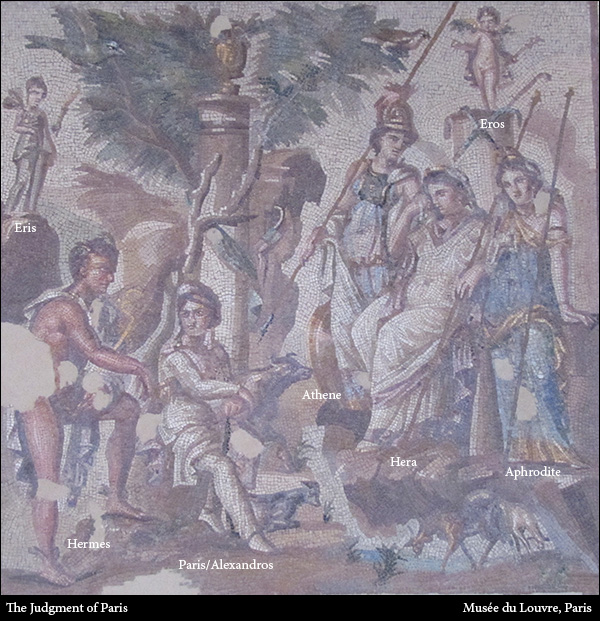
The Trojans were directly descended from Zeus and it seemed appropriate that a Trojan prince should be appointed as a judge to determine which goddess was the most beautiful ... Prince Alexandros (Paris) of Troy was given that dubious honor.
There should have been no doubt as to which goddess deserved the golden apple ... Hera was of course the most beautiful goddess. Alexandros's choice should have been simple, but Aphrodite offered him a bribe he could not refuse ... she promised to give him Helen of Argos.
Helen was the daughter of Zeus and a mortal woman named Leda ... Helen was without doubt, the most beautiful woman on earth ... her beauty was so profound that a thousand years after her death, poets still evoked her name whenever they wanted to describe a woman of incomparable beauty and grace. Aphrodite arranged for Alexandros to take Helen from her Spartan husband and make her Helen of Troy.
Athene and Hera were smoldering mad. ... of all the goddesses to offend, they were the worst. Athene was called The Spoiler for a very good reason and Hera was well known for her peculiar brand of vengeance and lack of tolerance.
In a moment of weakness, Prince Alexandros doomed his city to utter destruction and his family to slavery and death.
During the Trojan War, Hera was clearly on the side of the Achaian Greeks and aggressively fought against the Trojans.
Achilles, son of the goddess Thetis, was the most fearless and feared warrior in the Achaian army. Hera tried to protect Achilles even though she distrusted Thetis. The river-god Xanthos rose from his banks to kill Achilles but Hera intervened and saved him. When Achilles was at the peak of his murderous frenzy, Hera cast a mist about the Trojans so that they could not escape his sword and spear.
Hera sent the Oneiroi (the tribe of dreams) to Agamemnon, commander-in-chief of the Achaian army, to encourage him to press the fight against the Trojans. When he donned his armor for battle, Hera and Athene caused thunder to resound in the heavens to show their approval.
Hera's son Ares actively supported the Trojans. To curtail Ares's aggressiveness against the Achaians, Hera instructed Athene to attack Ares ... the fight left Ares severely wounded. Returning to Mount Olympos to be treated for his injuries, Ares complained to Zeus about his rough treatment. Zeus said he should just accept his wounds because Hera was unstoppable in her anger towards the Trojans.
When the Trojans were gaining the upper hand in the battle, Mount Olympos shook with Hera's anger. She secretly encouraged Athene and Poseidon to defy Zeus and assist the Achaian Greeks on the battlefield. Hera even drove Helios (Sun) into the depths of Okeanos (Ocean) to shorten the day and avert a victory by the Trojans.
Zeus orchestrated the Trojan War from beginning to end ... from the Judgement of Paris to the actual fighting on the battlefield. Generally speaking, the Immortals complied with Zeus's command to stay out of the fighting ... he overlooked minor infractions with fatherly aplomb. Finally, Zeus adamantly forbade the Immortals from entering the battle and retired to Mount Ida to watch the carnage.
Hera devised a plan to distract Zeus and allow their brother Poseidon to openly fight on the side of the Achaians. First, Hera went to Aphrodite and asked the goddess for a special charm that would make Zeus receptive to love. In the past, Hera had mocked Aphrodite and even called her a dog-fly because she took the side of the Trojans but now, Hera was polite and respectful. Aphrodite agreed to help and gave Hera a love charm that could be hidden under her clothing.
Next, Hera flew to the island of Lemnos to enlist the help of Hypnos, god of sleep. Hypnos was hesitant to assist Hera because his last attempt to cast a sleep-spell on Zeus was not completely successful ... Hypnos barely escaped a severe punishment. Even so, Hypnos agreed to help Hera because she promised to arrange his marriage to Pasithea, one of the Kharites (Graces). She also said he could have a throne made by her son, Hephaistos. Hypnos agreed after Hera swore an oath on the river Styx, making her promise inviolate.
Hera went to Zeus on Mount Ida and told him she was on her way to the depths of the sea to visit Tethys, the wife of Okeanos (Ocean). Zeus was affected by the love charm Hera had concealed in her clothing and asked her to stay with him so they could renew their love. Hera's plan was working perfectly.
Zeus was dulled in the afterglow of love as Hypnos wove his spell ... Zeus drifted off to sleep. Hypnos then took the form of a bird and following Hera's instructions, swooped down to the battlefield to tell Poseidon that he could enter the fray without Zeus knowing.
Zeus awoke abruptly to the sound of Poseidon bellowing on the battlefield. He realized he had been tricked and lashed out at Hera but her feigned pleas of innocence calmed his anger. He dismissed Hera and told her to return to Mount Olympos. She was so visibly shaken that the other Olympians could tell she had narrowly escaped the wrath of Zeus.
The final battles fought at Troy were epic. Mortal men and heroes died in the dust as the Immortals watched the gory spectacle from Mount Olympos. Zeus had banned all Immortals from the battlefield, but that injunction would soon end, and the war would finally come to its predestined conclusion. Zeus called the Immortals together and told them to do as they wished ... they could join the war or not ... he was giving them a free hand. Hera, Hephaistos, Athene, Poseidon, and Hermes descend Mount Olympos as a group and took up positions alongside the Achaians . . the city of Troy and the Trojan people were doomed.
Hera was fighting on several fronts at the same time. She had to balance her aggression towards the Trojans against what she knew to be the will of Zeus. She had already defied Zeus by encouraging Hypnos to lull him to sleep and she was afraid of what Zeus might do if she disobeyed him again. Two of the demigod heroes were of particular interest to Zeus ... he wanted Aphrodite's son Aineias to survive the war and he also wanted to make sure Thetis's son Achilles was killed by Prince Alexandros (Paris) ... to guarantee that Achilles would die in the prescribed way, Zeus gave Apollon the task of assisting Alexandros.
Hera and Athene had sworn oaths that they would never help a Trojan. This posed a problem when Achilles was preparing to fight with Aineias. Zeus had made it clear that he wanted Aineias to survive the war and Achilles would surely kill Aineias if they fought. Hera prompted Poseidon to intervein and save Aineias. The will of Zeus had been served and Hera did not have to violate her oath. As far as the other Trojan soldiers and allies were concerned, Hera had no interest in their survival. Hera went so far as to shroud the battlefield in mist so they could not escape the murderous attacks of Achilles.
Hera wanted to encourage Achilles, so she took control of one of his chariot horses and gave it a human voice. She told Achilles that his companion Patroklos had been killed by Apollon and that he too would soon die at the hands of a mortal and an Immortal. Achilles was not surprised at what Hera said ... he knew full well that he was destined to die at Troy and didn't care to know the details of his death.
Achilles was carving a bloody path through the Trojan defenses when he encountered the river-god, Xanthos. Achilles was killing Trojans and throwing them into Xanthos's waters faster than the current could carry them away ... the river was clogged with bodies. Xanthos rose from the depths and threatened Achilles but the hero paid no attention to the threats.
Xanthos knew Achilles had to be stopped so he struck out at the murderous demigod with gigantic waves. Hera sent her son Hephaistos to reason with Xanthos, but the river-god was beyond rationality. When he rose from his banks to drown Achilles, Hera instructed Hephaistos to set the battlefield ablaze ... the waters of Xanthos boiled and the trees along the riverbank were incinerated. After several more desperate attempts to kill Achilles and at the same time ward off Hephaistos's fiery attack, Xanthos realized his situation was hopeless. Xanthos cried out to Hera to make Hephaistos stop ... Hera heard the river-god's plea and ordered Hephaistos to withdraw. Xanthos retreated into the depths of his river and left the fighting to the more powerful Immortals.
When the Immortals began to enter the fighting, they primarily faced off against one another. Athene fought Ares and beat him to the ground ... Artemis unwisely took a position opposite Hera.
Hera berated Artemis with insults ... she said that the young goddess was bold and shameless to stand before her in battle ... she said that Artemis might be a worthy foe for women and wild beasts, but she was no match for the formidable queen of the Immortals. When Artemis did not retreat, Hera grabbed both of Artemis's wrists with her left hand and knocked the bow and quiver from her shoulders with her right hand. Hera smiled as she slapped the humiliated goddess about the ears and turned her this way and that. When Hera released her grip, Artemis fled the battlefield in tears, leaving her bow and arrows where they lay.
The walls of Troy toppled and Hera was appeased ... she had made a deal with Zeus that if he allowed her to destroy Troy, he would have the right to do the same to any city she held dear ... whether he held her to that promise is not known.
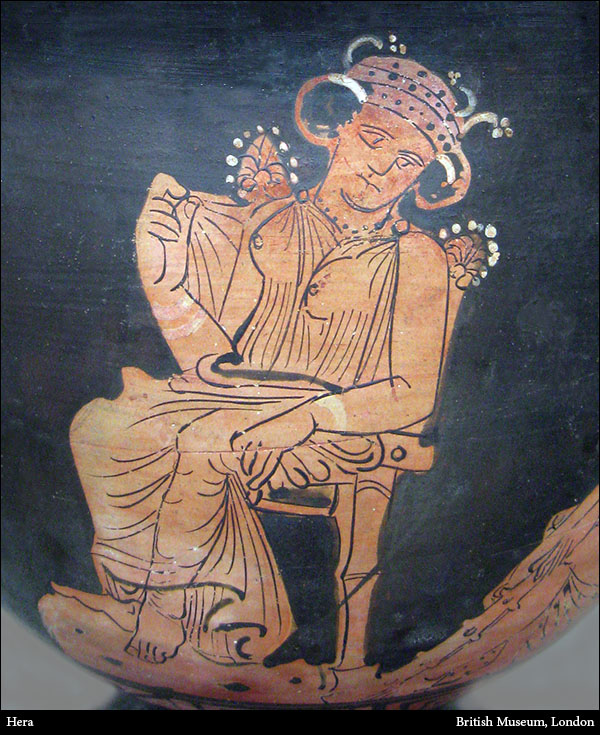
The Trojan War ended circa 1240 BCE. The death of the numerous demigods in the war seemed to minimalize the interactions between mortals and the Immortals. The worship of Hera and the other Immortals was in no way dampened by the lapse of time or the apparent absence of the Immortals on earth. Hera and the other Immortals began to limit their personal appearances to a few priests, priestesses and sometimes, ordinary people.
It has been correctly observed that if a divinity is too involved in human affairs, the followers become over-dependent and unmotivated ... however, if a divinity becomes uninvolved in earthly affairs, people quit believing in them. It would seem that the most beneficial role a divinity could assume would be one where their influence is so subtle that people aren't sure where the divine begins and the mundane ends.
Have no fear if you are righteous ... tremble if you're not ... Hera is nearer than you think.
The Iliad
The Odyssey
Theogony
Catalogues of Women and the Eoiae
Great Eoiae
Catalogue of Women
Melampodia
Aegimius
Kypria
Taking of Oikhalia
The Battle of Frogs and Mice
Hymn to Hera XII
Hymn to Delian Apollon
Hymn to Pythian Apollon
Hymn to Hermes IV
Hymn to Hermes XVIII
Hymn to Aphrodite
Hymn to Dionysos
The Argonautika by Apollonius of Rhodes
The Histories by Herodotos
Library of History by Diodorus of Sicily
Description of Greece by Pausanias