
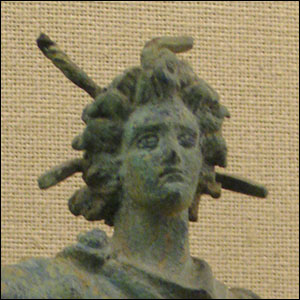
Helios is the Sun ... Helios is the son of the Sun ... Helios became the Sun ... although these statements seem contradictory, all are true.
Like many of the Immortals, Helios has a very complicated existence. He was born several generations after the first Immortals came into existence but an "immortal generation" cannot be measured by any earthly standard so we're not sure exactly when Helios, or any of the early Immortals, came onto existence. Helios's father was the Titan Hyperion ... his mother might have been one of three goddesses ... Basileia, Euryphaessa, or Theia.
There are three different stories as to who Helios's mother might have been, but I tend to accept the account put forth by Hesiod in Theogony rather than the other explanations presented in the Homeric Hymn to Helios and by Diodorus of Sicily from an unnamed source.
In Theogony we are informed that the Titans Hyperion and Theia were the parents of Helios, Selene (Moon), and Eos (Dawn). Similarly, in the Homeric Hymn to Hermes we are told that the Titans Hyperion and Euryphaessa were the parents of Helios, Selene, and Eos. Diodorus of Sicily states that Hyperion and a goddess named Basileia were the parents of Helios and Selene ... there was no mention of Eos being their sister.
Even though Theogony and the Homeric Hymns are assumed to have been written at approximately the same time (750 BCE), Theogony is considered to be the definitive reference for the generations of the Greek Immortals ... for that reason, I believe the mother of Helios was probably Theia but we must consider the other possibilities.
The attributes of Helios, Selene, and Eos seem clearly defined by the names they were given but we must not forget that their existence is not symbolic or otherworldly ... Helios, Selene, and Eos participate in earthly events in a very flesh and blood way ... Helios, Selene, Eos, their lovers, and their children were important to the continuation of the Greek people.
Hyperion is often called "the Sun" but according to Diodorus of Sicily, Helios actually became the Sun after he was murdered and resurrected. The goddesses Basileia and Rhea were daughters of Ouranos (Heavens) ... Basileia had two children, Helios and Selene. Because of her prudence and understanding, Basileia was given the Immortal title of Great Mother. The brothers of Basileia were fearful that Hyperion would not share his power, so they conspired to kill Hyperion and Helios. Hyperion was put to the sword ... Helios was thrown into the Eridanus (Po) River to drown. When Selene learned of the murder of her father and brother, she threw herself from a rooftop and died from the fall.
When Basileia was searching the river for her sons' body, she had a supernatural vision in which Helios comforted her ... he told her that her Titan brothers would be punished for their crimes and that he and Selene would be transformed into beings with immortal natures, and that which had formerly been called the "holy fire" in the heavens would thereafter be called Helios ("the sun") and that the heavenly body which had formerly been known as "mene" would be called Selene ("the moon").
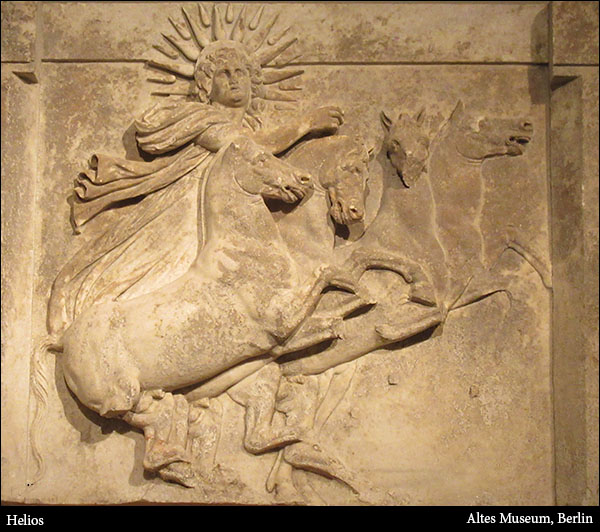
Helios rises from Okeanos (Ocean) each morning and drives his four-horse chariot to the highest point of the heavens and then drives westward until he reaches Okeanos again. Dressed in flowing robes and wearing a golden helmet he radiantly gazes on all the deeds of mortals and Immortals alike.
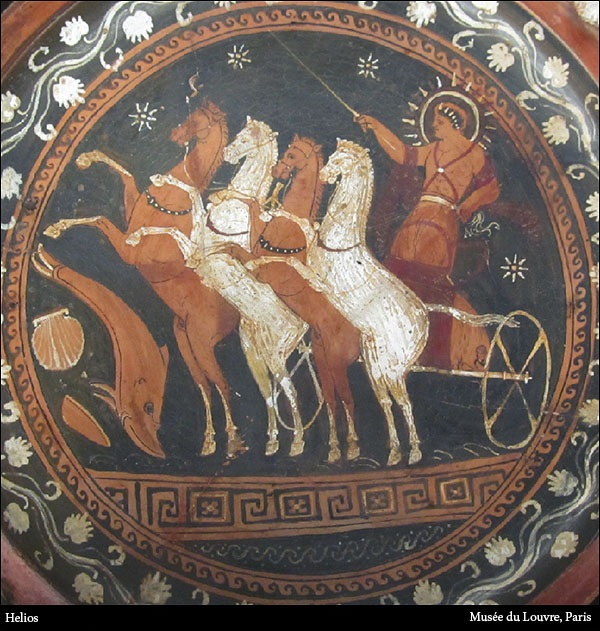
On one occasion, Helios relinquished the reins of his chariot and allowed his son Phaethon to be the charioteer ... the results were disastrous and yet wonderful.
The combination of Phaethon's inexperience and the willfulness of Helios's chariot horses are blamed for Phaethon's inability to control the chariot. The horses sensed Phaethon's youthful innocence and strayed from their usual course ... they traversed the heavens and set it afire creating what we now call the Milky Way. Finally, the chariot swooped down to the earth and scorched a considerable portion of the land and sea. Phaethon was half-consumed by the fiery ride and fell to earth in the spring that feeds the Eridanus (Po) River. The daughters of Helios morn the occasion with constant wailing, shedding tears of amber.
The creation of the Milky Way speaks for itself ... it's clearly there. The fact that Phaethon's wild ride scorched the earth is less obvious. When the Athenian statesman-poet Solon was visiting Egypt, he befriended a priest who told him that compared to the Egyptians, the Greeks were mere children. The priest said the Egyptians had historical records that went back thousands of years and that many of the "myths" the Greeks preserved were actually historical events that had been half-forgotten ... the scorching of the earth by Phaethon was one of those "mythological" events that according to the Egyptian priest, was entirely true.
During the final year of the Trojan War, the goddess Hera found it necessary and convenient deceive Zeus by using a charm of enchantment she obtained from Aphrodite, goddess of Love. Zeus succumbed to the love charm and began to praise Hera for her beauty and sensuality ... he pulled a golden cloud over Hera and himself specifically so Helios could not observe them. In that instance Helios was kept in the dark.
Hera enthusiastically supported the Achaian Greeks throughout the Trojan War. She became distressed when the Trojans were on the offensive and pushing the Achaians back to their encampment and their beached ships. Desperate to save the Achaians from certain defeat, Hera used her authority to drive the unwilling Helios into the depths of Okeanos before his appointed time.
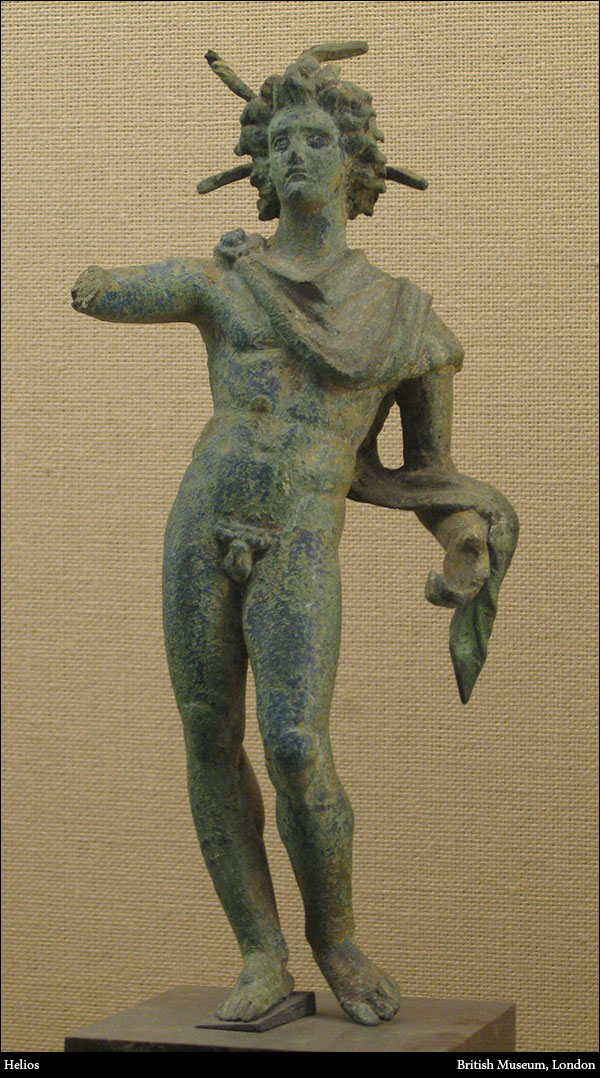
Even though Helios observes many things, he is often hesitant to reveal what he has seen. Such was the case with the kidnapping of Persephone.
Persephone was the daughter of Zeus and Demeter, goddess of the harvest. Zeus arranged for Hades, lord of the dead, to take Persephone as his wife ... Hades was given permission to literally "take" Persephone. Zeus, Hades, and Demeter were brothers and sister ... Persephone was Hades's niece.
While Persephone was playing with her friends, Hades emerged from a hole in the ground and kidnapped the young goddess. Persephone's friends did not see what had happened but the goddess Hekate heard a distant cry. Demeter began searching desperately for her daughter but was unable to find her. Finally, she encountered Hekate and was given her first clue ... Hekate told Demeter that she heard Persephone cry out but had seen nothing ... she suggested that Demeter ask Helios if he had seen what happened to the girl.
Yes ... Helios knew all the facts. Once asked, he readily told Demeter that Hades had taken Persephone with Zeus's permission, and that her daughter was now residing in the Underworld as the queen of the dead. Demeter's search was over but forcing Hades to return Persephone to the surface of the earth was not quick or easy. Using the information provided by Helios, Demeter was able to successfully negotiate the return of Persephone for a portion of each year ... spring and summer ... Persephone spends winters with Hades.
In the Odyssey by Homer, the singer Demodokos tells the tale of how Aphrodite and Ares became secret lovers ... and were observed by Helios who in turn informed Aphrodite's husband, Hephaistos ... retribution was important and inevitable.
Hephaistos got his revenge, embarrassing Aphrodite and Ares with the other Immortals looking on. No one seemed to blame Helios for his meddling, but we might assume that all concerned learned a lesson in daytime discretion and nighttime frivolity.
The Okeanid Perse joined in love with Helios and produced King Aietes of Kolkhis, King Perses of the Taurik Khersonese, and the Dread Goddess Kirke (Circe).
Helios gave Aietes a portion of Greece near the city of Korinth called Epliyraea but Aietes abandoned Epliyraea and moved to the eastern edge of the Black Sea and became the king of Kolkhis, which was originally called Aia.
King Aietes had many advantages as the son of Helios. For example, his palace was constructed by the artificer of the gods, Hephaistos, as a gesture of appreciation to Helios for his assistance during the war with the Giants. Hephaistos was one of the Olympians who fought fiercely against the Giants but when he became faint from exhaustion and collapsed, Helios put him in his chariot and carried the debilitated god to safety. Hephaistos repaid the debt by giving divinely crafted gifts to King Aietes, including a magnificent palace.
Aietes had a reputation for being a cruel king but when a young refugee named Phrixus came to Kolkhis on a flying ram with a Golden Fleece, he welcomed the young outcast and allowed him to marry his daughter without a dowry. Aietes realized that the Golden Fleece was of divine origin and by accepting Phrixus he gained possession of the priceless artifact. King Aietes placed the Golden Fleece in the Grove of Ares where it was guarded by a dragon ... there it remained for one generation of mortal men.
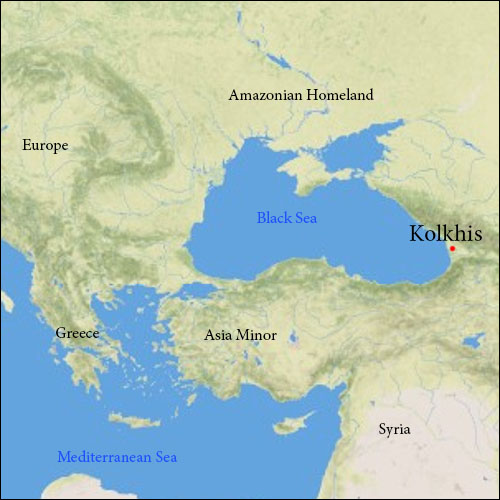

As the son of Helios, Aietes had divine favor. Hephaistos, the smith of the Immortals, built Aietes a majestic palace and in addition to the dragon that guarded the Golden Fleece, Athene gave Aietes some of the magical dragons' teeth that were used to populate the city of Thebes ... when planted in the ground, the dragons' teeth would produce Earth-Born warriors to do the king's bidding. The most frightening supernatural possession King Aietes had were fire-breathing, bronze-hoofed bulls.
When Ieson (Jason) and the Argonauts arrived at Kolkhis and asked Aietes for the Golden Fleece, the king pretended to be sympathetic to their quest ... he agreed to surrender the Golden Fleece to Ieson if the young hero could complete a series of seemingly impossible feats. First, Ieson would have to yoke the fire-breathing bulls and plow a field where he would then plant the dragons' teeth ... as the Earth-Born warriors sprang from the ground, Ieson would have to fight and defeat them. Aietes fully expected Ieson to fail because he did not suspect that his sorceress daughter would help Ieson. Princess Medeia was the granddaughter of Helios and a priestess of Hekate ... she made it possible for Ieson to defeat the fire-breathing bulls and Earth-Born warriors by using charms and enchantments.
Aietes was furious when Ieson survived the ordeals with his supernatural creatures but he did not suspect his daughter of betrayal ... regardless, he had no intention of giving Ieson the Golden Fleece. When Medeia used her magic to distract the guardian dragon while Ieson stole the Golden Fleece, Aietes clearly saw his daughters' treachery ... he mounted the chariot Helios had given him and gave chase, but he was too late to stop his daughter and Ieson.
King Perses of the Taurik Khersonese was considered to be an exceedingly cruel man ... an appellation that was also given to his brother Aietes.
Perses had the distinction of being the father of the Roaring Goddess Hekate, a favorite of Zeus. Hekate was feared and respected by all sensible men and women. She was the master of drugs and potions and passed her experimental knowledge along to the Dread Goddess Kirke (Circe) and the sorceress, Princess Medeia.
After a series of bloody adventures, Princess Medeia returned to her father's home only to find that Aietes had been dethroned and Perses was the new king. Medeia's son Medus killed Perses and allowed Aietes to resume as king of Kolkhis.
The Dread Goddess Kirke, like her brother Aietes, had a dark side that overshadowed her divinity. Kirke lived on an island named Aiaia which was located near "the shore of the Tyrrhenian mainland" ... this has been taken to mean that Kirke's island was located near the western coast of central Italy but other sources indicate that her home was in the far east near where her father Helios rose from Okeanos (Ocean) every morning.
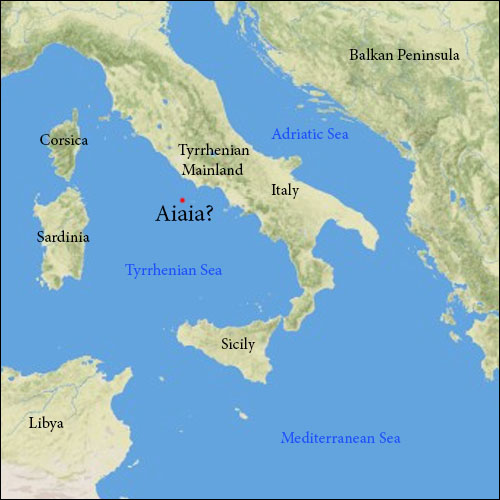
When Ieson and Medeia made their escape from Kolkhis, they killed Medeia's half-brother Apsyrtos ... actually, they didn't just "kill" Apsyrtos, they ambushed and murdered him. The blood guilt was on their hands and Zeus was not inclined to forgive such cowardly behavior. The goddess Hera, in an effort to protect Ieson and Medeia from Zeus, told them to go to Kirke and ask the Dread Goddess to absolve them of their crime. The fugitive couple had little choice ... they sailed directly to Aiaia.
Kirke had been troubled with bloody nightmares that she did not understand until Ieson and Medeia arrived on her island. She was not sure who the two strangers were but she knew they were stained with blood-guilt and seeking absolution. It wasn't until Kirke looked into Medeia's eyes that she knew the young princess was a descendant of Helios ... there was a light in Medeia's eyes that could only come from the bloodline of Helios. Kirke quickly surmised that the young woman standing before her was the daughter of her brother, Aietes. Without asking for details, Kirke performed the necessary rites to cleanse Ieson and Medeia thus mitigating Zeus's wrath.
A generation after Ieson and Medeia came to Kirke, the Trojan War veteran Odysseus landed on her island. Kirke bewitched several members of Odysseus's crew but with the help of the god Hermes, Odysseus was able to subdue and seduce Kirke, making her not only harmless but helpful. Kirke warned Odysseus that after leaving her island he would be tempted to land on the island of Thrinakia. She told him the island was sacred to Helios and should be avoided. The warning went unheeded.
Sailing for home after the Trojan War, Odysseus and his comrades were hoping for an uneventful voyage. A chance encounter with a Cyclops named Polyphemos forced Odysseus to blind the one-eyed brute to escape certain death. Polyphemos was a son of Poseidon ... the god swore revenge. From that moment on, Odysseus's determination and resourcefulness could not save him from constant hardships and escalating sorrows.
Odysseus and his crewmates were forced ashore on Thrinakia even though he had been warned by Kirke to avoid Helios's sacred island. Odysseus cautioned his crew that under no circumstances were they to kill any of the sheep or cattle on the island. He carefully explained that the animals were the property of Helios and if they incurred the wrath of Helios as well as Poseidon's, they would never be able to return to their homes.
Helios had placed the Nymphs Lampetia and Phaethousa on Thrinakia to guard his herds ... they were the daughters of the Nymph Neaira and Hyperion and therefore stepsisters of Helios.
Odysseus and his crewmen waited patiently for the winds to become favorable so they could sail on their way, but the winds would not allow it. Finally, Odysseus's crewmen could not restrain themselves. When their hunger became unbearable, they decided to kill a few animals and eat them ... they justified their decision by saying they would build a temple to Helios when they returned home ... a promise they did not live to fulfill.
Lampetia and Phaethousa were quick to inform Helios that his sacred herds had been defiled ... the punishment for such an act was, and still is, death. Since Odysseus did not participate in the sacrilege, his life was spared.
Phineus was the king of Salmydessus on the Black Sea a generation before the Trojan War. He was the son of King Agenor of Tyre and the brother of Kadmos and Europa. Kadmos founded the city of Thebes and Europa was the consort of Zeus and the progenitor of the Minoan Culture on the island of Krete. Even though Phineus was from noble stock and had the gift of prophecy, his life was fraught with suffering and misery.
Phineus married Kleopatra, daughter of Boreas (North Wind). When she died, Phineus married a woman who resented Kleopatra's children ... his new wife convinced Phineus to punish Kleopatra's sons by blinding them. Boreas demanded justice for his grandsons and Zeus complied ... Phineus was given the choice of death or blindness ... he chose blindness. Phineus was exiled to an island in the Black Sea vaguely described as near the coast of Bithynia.
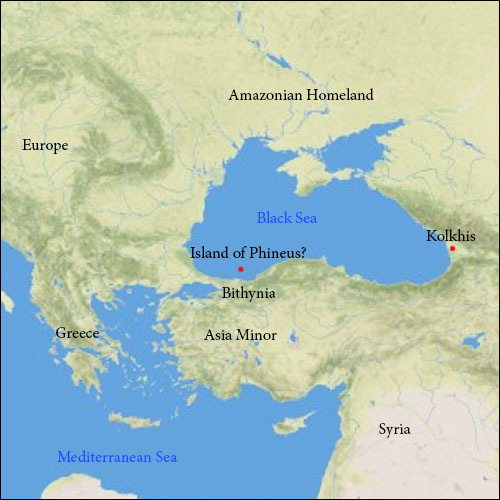
Helios was infuriated! He could not understand why, given the choice, anyone would rather be blind than dead. He decided to add an additional punishment to Phineus's sentence ... he sent the Harpies to steal Phineus's food. The Harpies were two winged women who were variously described as hideous and comely but regardless of their appearance, at the prompting of Helios the Harpies ate most of Phineus's food and left only a few filthy morsels to sustain his miserable existence.
When Ieson and the Argonauts encountered Phineus, he offered to use his prophetic gift to help them find the Golden Fleece. Two sons of Boreas were Argonauts—Kalais and Zetes. They were particularly sympathetic to Phineus's plight and offered to drive the Harpies away. Before Kalais and Zetes could injure the Harpies or themselves, the goddess Iris intervened. Phineus's blindness could not be undone because it was the will of Zeus, but Iris promised that Helios's curse would thereafter be lifted ... the Harpies would no longer harass Phineus.
In addition to Kirke and Aietes, Helios and the Okeanid Perse had another child named Pasiphae.
Pasiphae was forced to become the instrument of punishment for the crimes of her husband, King Minos of Krete. Minos was the son of Zeus and a mortal woman named Europa, so he was only semi-divine whereas Pasiphae was fully divine. The Minoans were a seafaring culture and honored the god Poseidon because they wanted his protection for their seamen and the continued prosperity of their extensive sea-trade network.
It was the custom of Minos to ritually sacrifice bulls to Poseidon but on one occasion the sacrificial bull was so majestic Minos substituted an inferior animal and kept the magnificent bull for himself. This was an insult to Poseidon ... the spiteful god made the punishment suit the crime ... Pasiphae became pregnant with a child that was half bull and half human. When the monstrosity was born it was called Minotaur meaning Minos's-Bull.
Pasiphae was disgraced but Minos was unperturbed ... he placed the Minotaur in a labyrinth and used the combination of the maze and the monster to punish the Athenians for killing his son, Androgeos.
The famous hunter Orion was unrepentantly indulgent ... he used people as he used animals, for sport ... even so, Orion enjoyed the protection and sympathy of several of the Immortals ... including Helios.
Orion refused to learn from his mistakes. A hunting expedition on the island of Krete with the goddesses Artemis and Leto prompted Orion to boast that he would kill every animal on the earth. Ge (Earth) could not tolerate such outrageous behavior ... she sent a giant scorpion to kill Orion. Artemis and Leto defended Orion's actions and persuaded Zeus to place him in the heavens as a constellation.
Helios named the island of Rhodes after his beloved consort, Rhodos. She was descended from the original inhabitants of the island ... the children she had with Helios were preeminent in the development of science and culture.
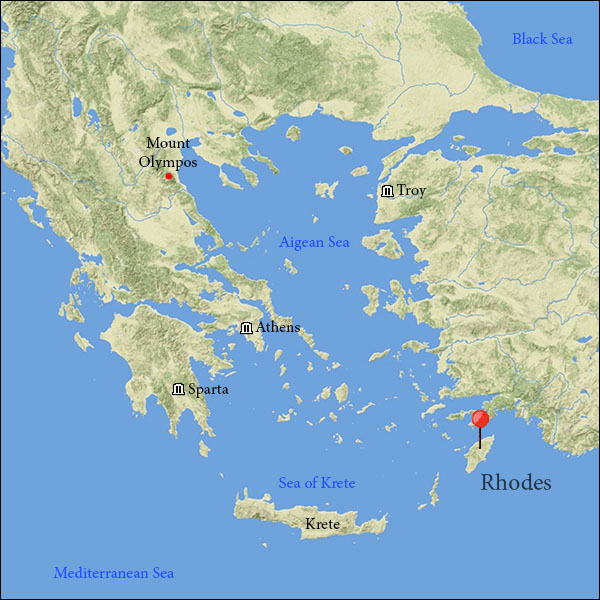
Rhodes was first inhabited by a race of sea creatures known as the Telkhines. Rhodos's mother Halia was said to be the sister of the Telkhines, which is odd in that she was not included as one of the Telkhines but simply as their sister. The Telkhines were children of Thalassa (an aspect of the sea) and usually thought of as dog-headed sea creatures possessing artistic abilities and supernatural powers. They gave Zeus his sickle and Poseidon his trident ... they could also control the weather. It's unclear whether Halia shared the artistic and supernatural abilities of her brothers or their physical appearance ... likewise, we do not have a physical description of Rhodos.
Rhodos was the only daughter of Poseidon and Halia but they had seven arrogant and insolent sons who came to an evil end when they offended Aphrodite (goddess of love) ... she drove the young men mad with lust. In their deranged state of mind, they assaulted their mother ... when Poseidon learned of their horrendous behavior, he buried his sons on Rhodes, and they became known as the "Eastern Demons." Halia was so shamed by her son's wanton actions, she threw herself in the sea and was afterwards given the name of Leukothea.
Even though the Telkhines were the first inhabitants of the island, others soon joined their numbers. The island gave birth to Nymphs of various types and a race of people who were "sprung from the earth itself." Zeus visited the island and took a Nymph named Himalia as his consort ... their sons were named Spartaeus, Kronios, and Kytos.
The Telkhines perceived that the island was going to suffer a cataclysmic flood and fled, never to return. Many of the inhabitants perished in the flood but the survivors retreated to the highlands with Zeus's sons as their leaders.
The island was devastated by the flood, but Helios dried the land and made it habitable again. It was at that time that Helios took Rhodos as his consort and named the island after her. Rhodos and Helios were the parents of seven sons—Okhimos, Kerkaphos, Makar, Aktis, Tenages, Triopas, and Kandalos. Their eight child was a daughter named Elektryone, who died while still a maiden but was given honors like those accorded to a hero.
Helios told his sons that the first mortals to offer a sacrifice to the goddess Athene would win her undying protection. The customary way to make sacrifices was to burn the sacrificial animal but Helios's sons were in such a hurry to gain the goddesses' favor, they neglected to burn the sacrifice. Realizing that their method was uncouth but their intentions noble, Athene accepted their sacrifice and it thereafter became the custom on Rhodes to offer unburned sacrifices to the Immortals.
The sons of Rhodos and Helios surpassed all other men in knowledge, especially in astrology. They introduced many new practices in seamanship and established the division of the day into hours. The Egyptians learned art and science from the sons of Rhodos and Helios even though most historical accounts say or imply that the Greeks learned the sciences from the Egyptians. Rhodos's son Aktis sailed to Egypt and founded the city of Heliopolis, naming it after his father. Aktis taught the Egyptians about the stars and the laws of astrology.
The reason the Greeks and the sons of Rhodos and Helios in particular are not credited with their pioneering achievements is because another devastating flood, which might be properly called a Deluge, devastated most of the world. The death toll was enormous and almost all traces of civilization were lost, especially on the Greek mainland and the Greek islands. The only remnants of history to survive were in the form of myths and legends.
It should be no surprise that when the Rhodians wanted to build a wondrous monument to the Immortals, they chose Helios as their inspiration.
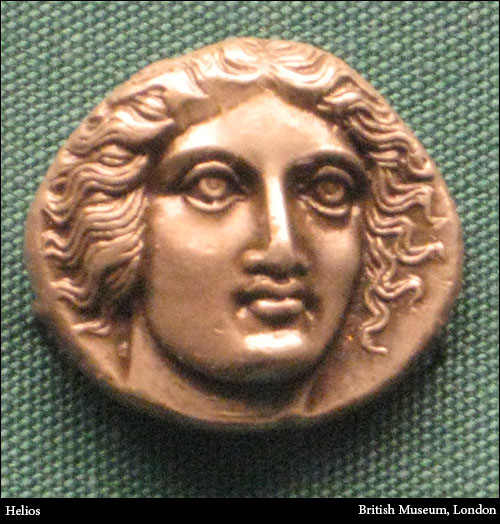
The Colossus of Rhodes was so extraordinary it became one of the Seven Wonders of the Ancient World. It was designed and constructed by Khares of Lindus as a 110 foot (33.5 meter) bronze statue of Helios. The imposing statue was erected in 290 BCE and toppled in an earthquake sixty-six years later in 224 BCE.
The popular conception of the Colossus of Rhodes standing with its legs spanning the entrance to the harbor is imaginative but inaccurate. The statue was a representation of Helios as a free-standing erect figure at the entrance to the harbor of the city of Rhodes. The statue was situated on a stone base with an iron frame that supported the bronze casing of the body of Helios. The hollow structure was filled with stones to add weight and give stability.
Helios was one of the first god-kings of Egypt ... according to the Egyptians, he ruled approximately twenty-three thousand years before Alexander the Great. The Egyptians considered the Nile River to be the equivalent of Okeanos (Ocean) and thus the birthplace of human culture as denoted by cities such as Heliopolis (Sun City), which was named after Helios.
Another interesting relationship between the Egyptians and Helios revolves around the sacred bird called the phoenix. The historian Herodotos never saw a live phoenix, but the people of Heliopolis told him that the phoenix had red and gold feathers, and was in size and shape like an eagle.
Every five hundred years a phoenix will encase his dead father in a hollowed-out "egg" of myrrh and fly the corpse from his home in Arabia to the temple of Helios in Egypt. The common conception of the phoenix is of a bird that burns itself on a funeral pyre and then rises from the ashes in the freshness of youth to live through another cycle of years. This rebirth is reminiscent of the way in which the Sun "dies" and is then "reborn" each day.
The Iliad
The Odyssey
Hymn to Helios XXXI
Theogony
Hymn to Demeter II
Hymn to Pythian Apollon
Hymn to Hermes IV
Astronomy
The Histories by Herodotos
Description of Greece by Pausanias
The Argonautika by Apollonius of Rhodes
Library of History by Diodorus of Sicily