
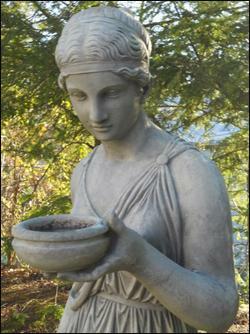

Hebe
EE vee
'Ηβη
Goddess of Youth

Daughter of Zeus and Hera
Hebe is the daughter of Zeus and Hera and the sister of Ares (god of War) and Eileithyia (goddess of Childbirth). Her name literally means Youth and for that reason she is sometimes thought of as the goddess of Youth and Spring.
Hebe, the Graces, the Seasons, Harmonia and Aphrodite join hands and dance when Apollon leaves his shrine in Pytho and travels to Mount Olympos (Olympus). He sings, with the Muses and his sister Artemis, of the unending gifts the Immortals enjoy and the plight of the mere mortals who must endure the pains of illness and the failings of old age.
Hebe's role in The Iliad seems to be one of gentle cooperation and selfless affection towards her mother, Hera, and her brother Ares. When Hera prepared to leave Mount Olympos, Hebe attended her mother's chariot and when Ares was wounded on the battlefield of Troy, Hebe comforted him.
After his tragic mortal life had ended, Herakles (Heracles) ascended to Mount Olympos where he wedded Hebe "of the golden crown." Hebe's marriage to Herakles can only be seen as a reward for the long suffering hero and a blessing for the kindhearted young goddess. Herakles and Hebe had one son, Alexiares.

Hebe is often confused with the Roman goddess, Juventas.
Hebe in The Iliad
(listed by book and line from four different translations)
Richmond Lattimore
- 04.002 - As the gods sat in council, Hebe poured nectar as wine into golden drinking-cups
-
- 05.722 - Hebe made Hera's chariot ready to depart Mount Olympos
-
- 05.730 - Hebe attaches the golden and splendid yoke of Hera's chariot
-
- 05.905 - Hebe washed Ares (god of War) clean and put delicate clothing on him after he had been healed by Paieon of the wounds inflicted by Athene at Troy
Loeb Classical Library
- 04.002 - As the gods sat in assembly, queenly Hebe poured nectar into golden goblets
-
- 05.721 - Hebe quickly made Hera's chariot ready to depart Mount Olympus
-
- 05.731 - She (Hebe) bound the fair golden yoke of Hera's chariot
-
- 05.904 - Hebe bathed Ares (god of War), and clad him in beautiful clothes, after he had been healed by Paeeon of the wounds inflicted by Athena at Troy`
Robert Fagles
- 04.0002 - As the gods sat in council, Hebe poured them rounds of nectar into golden beakers
-
- 05.0827 - Hebe made Hera's chariot ready to depart Mount Olympus
-
- 05.0838 - She (Hebe) fastened the gorgeous golden breast straps of Hera's chariot
-
- 05.1048 - Hebe washed Ares (god of War) clean and dressed him in robes to warm his heart, after he had been cured by the Healer of the wounds inflicted by Athena at Troy
Robert Fitzgerald
- 04.0002 - As the gods were seated in council, Hebe served them nectar in cups of gold
-
- 05.0820 - Hebe, eldest daughter of old Kronos, harnessed the team of Hera's chariot so she could depart Mount Olympos
-
- 05.0830 - Hebe fitted the handsome golden yoke to Hera's chariot
-
- 05.1034 - Hebe bathed Ares (god of War) and mantled him afresh, after he had been healed by Paieon of the wounds inflicted by Athena at Troy
Other Text References
Theogony
- line 17 - The poet asks the Muse to sing of the Immortals; among the other gods and goddesses, they sing of Hebe with the crown of gold
-
- line 922 - Lastly, Zeus wedded Hera and she bare Hebe, Ares (god of War) and Eileithyia (Eilithyia) (goddess of Childbirth)
-
- line 950 - After he had finished his grievous toils, Herakles (Heracles), the valiant son of Alkmene (Alcmena), made Hebe his shy wife
Homeric Hymn to Pythian Apollon
- line 195 - The Graces, the Seasons, Harmonia, Hebe and Aphrodite (goddess of Love) dance while Apollon plays his lyre
Homeric Hymn to Herakles the Lion-Hearted
- After living a hard and violent life, Herakles (Heracles) was allowed to marry neat-ankled Hebe