
| Bibliography |
| Previous Page |
| Homepage |
| Site Search |
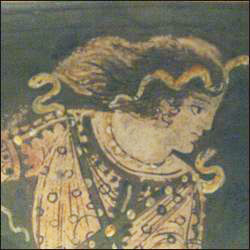
The presence of Erinys foreshadows misery shrouded in darkness. She is the punisher of the unfaithful and protector of supplicants. She should be treated with fear and respect because she will harass and injure her prey but not kill them ... her brass wings make escape impossible ... her ripping claws make her torment relentless and horrible.
Erinys is called Fury, Mist-Walker, Wrecker of Houses, and Murderous Spirit ... and strangely enough, the Kindly One.
There is another dimension to the concept of Fury ... three daughters of Nyx (Night) are called the Erinyes (Ἐρινὺας) or Furies or Eumenides (the gracious goddesses). Their names are Tisiphone, Megaera, and Alekto. Their mission is essentially the same as Erinys, but they work as a team or perhaps it might be better to think of them as a pack of wolves or jackals. The ancient Greek writers and poets were always careful to differentiate Erinys from the Erinyes.
We might imagine the Erinyes to be winged women of fierce countenance but according to the traveler-historian Pausanias (fl. 160 CE), their images on the Acropolis at Athens were not fierce or supernatural.
The following three examples demonstrate interactions with the Erinyes that did not end in disaster because proper respect and supplication was wisely offered.
The Quest for the Golden Fleece was not only a grueling and dangerous sea voyage, it was also a constant battle against Erinys and the Erinyes.
Sailing eastward across the Black Sea towards Kolkhis, the Argonauts made landfall on an island where a blind prophet named Phineus resided. The Argonauts took pity on Phineus because Zeus and Helios (Sun) were punishing the wretched man by having the winged women known as Harpies defile his food. Phineus explained that the Fury put her foot on his eyes, and he was now doomed to spend the rest of his life in darkness. The Argonauts were unable to restore Phineus's eyesight but did manage to alleviate his suffering by driving off the Harpies.
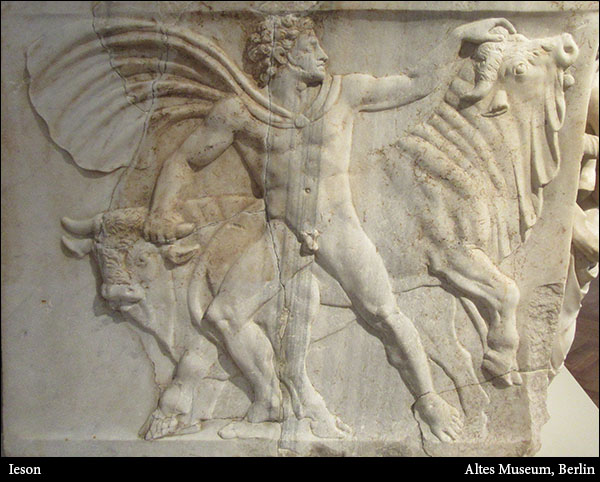
Princess Medeia of Kolkhis assisted Ieson (Jason) and the Argonauts because of a love spell cast upon her by Eros, the primal god of love. Medeia was the niece of the Dread-Goddess Kirke (Circe) and a priestess of the Roaring Goddess Hekate. Medeia knew many charms and spells and was well acquainted with the Dark Spirits that could be called down to inflict punishment on the weak and uninitiated.
The Golden Fleece was guarded by an ever-vigilant dragon, but Medeia lulled the dragon to sleep with chants and undiluted potions. Ieson, Medeia, and the Argonauts took the fleece and fled with the Kolkhian navy in hot pursuit. Medeia began to suspect that Ieson was going to abandon her so to protect herself, she threatened to call down the Erinyes to punish him if he did not fulfill his oath to take her to his home and marry her. Ieson quickly renewed his oath in fear of the divine powers he had personally seen her summon with her skills as a sorceress.
Ieson avoided having Medeia call down the Erinyes but he blindly called them down upon himself when he and Medeia made plans to ambush Medeia's half-brother Apsyrtos. Medeia lured Apsyrtos to a lonely spot and Ieson killed him without mercy ... Ieson even drank Apsyrtos's blood.
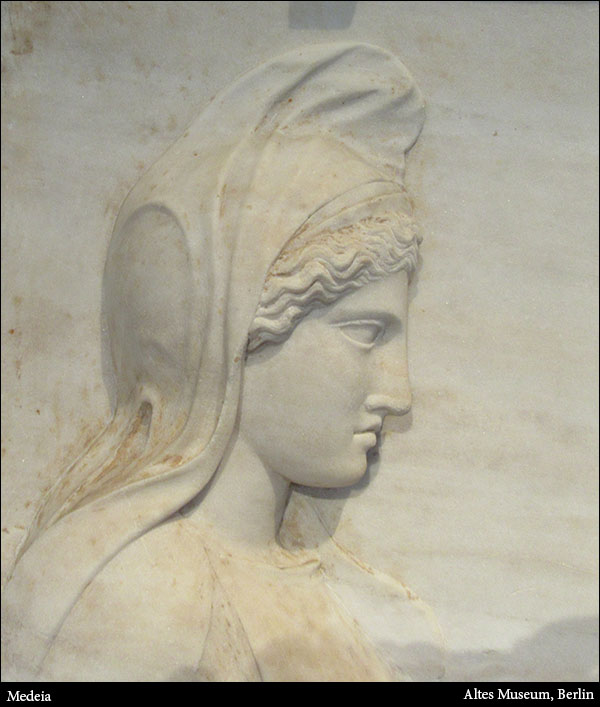
Ieson and Medeia sought sanctuary on the island of the Phaiakians to evade capture by the pursing Kolkhians. Phaiakian King Alkinoos and Queen Arete knew the fugitives had stolen the Golden Fleece, but they did not know of the blood-guilt Ieson and Medeia had incurred. Medeia commanded the Phaiakians to protect her and honor her sanctity as a supplicant ... otherwise, she swore she would call down Erinys to avenge her. They believed her without question and gave Ieson and Medeia sanctuary on the condition that they marry one another. This was only a momentary reprieve ... a more lasting solution was needed if the murderous couple was going to be freed of their blood-guilt and the retribution of the Erinyes.
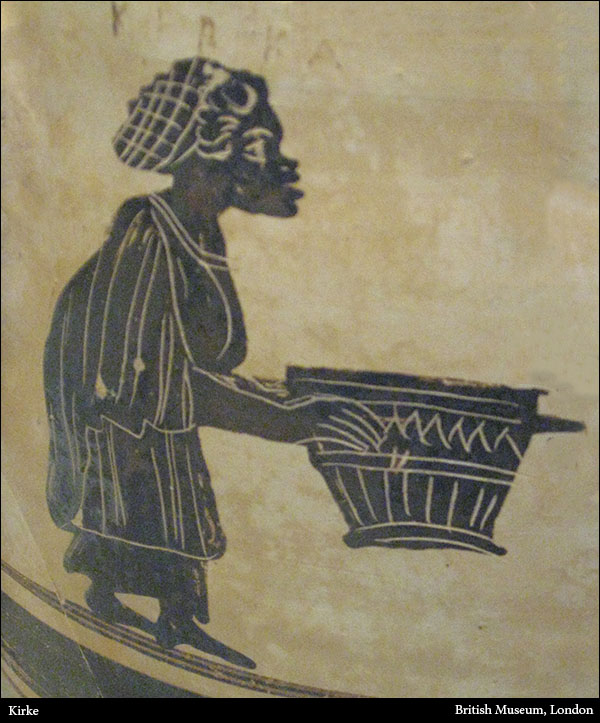
The departure from the island of the Phaiakians only served to place the Argonauts in more danger. The goddess Hera informed Ieson that his fate was hanging by a thread because Zeus was incensed by Apsyrtos's murder. Hera told Ieson that the only way he and Medeia could escape Zeus's wrath was to seek out Medeia's aunt, the Dread Goddess Kirke, and ask her to perform a cleansing ritual to absolve them of their blood-guilt. With no other options, Ieson and Medeia went to Kirke's island and presented themselves as supplicants.
Anticipating the arrival strangers, Kirke was troubled by nightmares in which the walls of her palace dripped blood and flames consumed the drugs she used to bewitch strangers.
She bathed in seawater to wash away the aftereffects of the troubling dreams until she became aware of a ship landing on her island. There was a group of men accompanied by a maiden approaching her. Using a charmed hand-gesture, Kirke motioned for the Argonauts to follow her but Ieson ordered them to wait while he and Medeia followed Kirke to her palace. The goddess was slightly amazed to see that only Ieson and Medeia had obeyed her ... she asked them sit on a polished bench, but they went to the hearth and assumed the posture of supplicants ... Ieson looked at the floor and Medeia hid her face in her hands.
Kirke immediately recognized that her guests were guilty of murder ... in reverence for Zeus, the god of supplicants, she began to offer the proper sacrifice to cleanse them of their guilt. She held a sow that had recently given birth above their heads and severed its neck ... she sprinkled their hands with blood ... the Naiad Nymphs attending Kirke cleaned away the defilements of the sacrifice. Next, Kirke made propitiation with drink offerings while she called upon Zeus the Cleanser, the protector of murder-stained supplicants ... Kirke burned atonement cakes without wine and prayed that the Erinyes and Zeus would forgive her guests for the crimes they committed.
Kirke's supplications were effective ... the Argonauts returned to Greece without further interference from the Erinyes.
Agamemnon was the commander-in-chief or the Achaian Greeks at the siege of Troy. After successfully capturing Troy, Agamemnon returned home but instead of a hero's welcome, he was murdered by his wife Klytemnestra and his cousin Aegisthus, who had become Klytemnestra's lover. The murder of Agamemnon took place circa 1240 BCE and his son Orestes would have probably been in his late teens.
Fearful that Aegisthus would kill him to gain direct access to the throne of Mykenai, Orestes went into hiding for eight years. Accompanied by his friend and loyal companion Pylades, Orestes returned to Mykenai to avenge his father's murder. Without mercy or hesitation, Orestes killed his mother and Aegisthus. The justice of the crime was overshadowed by the fact that matricide was one of the most heinous crimes a man could commit.
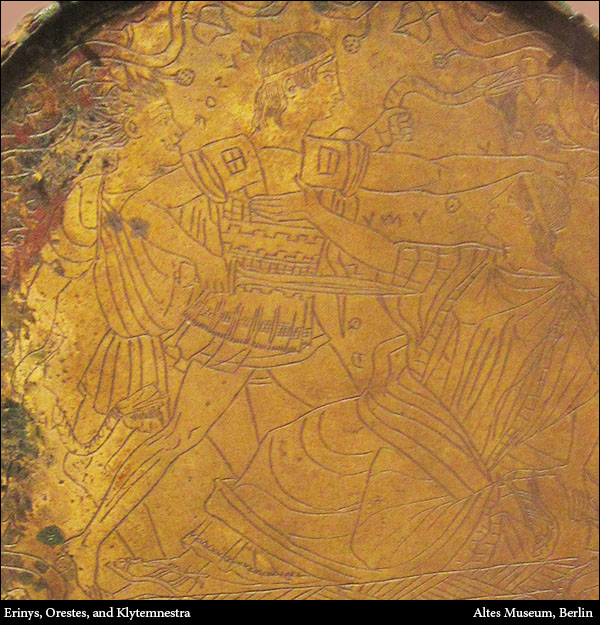
Orestes fled Mykenai but could not escape the punishment of the Furies. While traveling through Messene on the Peloponnesian Peninsula, Orestes was overtaken by madness induced by the Erinyes. In his deranged state of mind, he bit off one of his fingers. The locals documented the event by naming the place Maniae (Madnesses) and burying the severed finger in what was called the Tomb of the Finger, which was marked by a carved stone finger protruding from the burial mound. Not far from the Tomb of the Finger was the place where Orestes recovered his senses, it was called Ake (Remedies). Orestes saw the Erinyes dressed in black before his bout with madness and dressed in white when he recovered.
Orestes traveled throughout the Peloponnesian Peninsula seeking absolution for his crime. Outside the temple of Apollon at Troezen was the Booth of Orestes where he stayed because no citizen would allow him in their home until after he had been cleansed. Also, at Troezen, there was a Sacred Stone on which nine men from Troezen purified Orestes.
The ritual purification was only half of Orestes's ordeal. He was taken to Athens to stand trial for murder. The court was convened on the Hill of Ares with the goddess Athene defending Orestes. The Erinyes wanted Orestes to be found guilty, but Athene demanded mercy, saying that Orestes acted in the name of "justice" and not "revenge." Athene placated the Erinyes by offering them a shrine on the Acropolis. After his acquittal, Orestes was allowed to return to his home and assume the kingship of Mykenai and Sparta.
One of the great clans of the Spartans, the Aegidae, owe their survival to their sincere appeasement of the Erinyes. The children of the Aegidae were dying and leaving no heirs. When the Spartans consulted an oracle for a solution, they were told to erect a temple for the Erinyes of Laius and Oedipous, meaning that the Spartans should build a place of worship honoring the Erinyes who punished the infamous kings of Thebes, Laius and Oedipous.
Laius and Oedipus were not associated with Sparta in any way but the manner in which they treated their sons made them infamous throughout Greece.
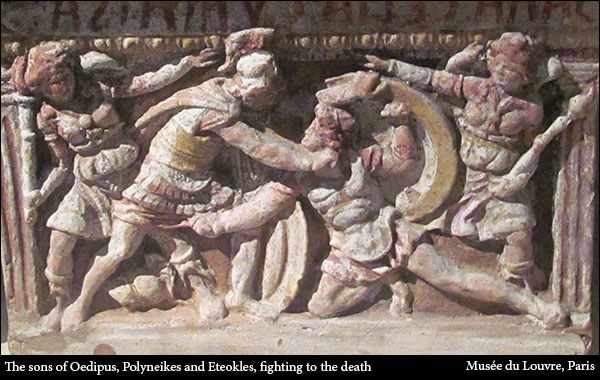
Fearing a prophecy stating that his son would kill him, King Laius of Thebes had his infant son hobbled and abandoned in the mountains. The child was rescued and taken to Korinth where he was named Oedipous, swollen foot. As an adult, Oedipous received a prophecy stating that he would murder his father. A chance meeting fulfilled both prophecies. Oedipous became king of Thebes but abdicated the throne when he discovered that by marrying Laius's widow, he had actually married his mother. Oedipous and his mother had sons who became bitter rivals for Oedipous's throne. Oedipous knew his sons would kill each other but did nothing to stop them.
The curse afflicting the Spartans was caused by an Aegidae named Theras who cursed his son for disobedience. Theras called his son Oeolykos, which meant that he was a sheep among wolves. This act of disrespect inflamed the Erinyes. In accordance with the oracle, a temple was built for the Erinyes of Laius and Oedipous ... pleased with the sincerity of the gesture, the Erinyes lifted the curse and allowed the Aegidae bloodline to continue.
The Iliad
The Odyssey
Theogony
Works and Days
Catalogue of Women
The Thebaid
The Histories by Herodotos
The Argonautika by Apollonius of Rhodes