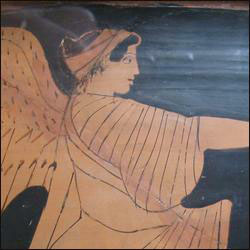
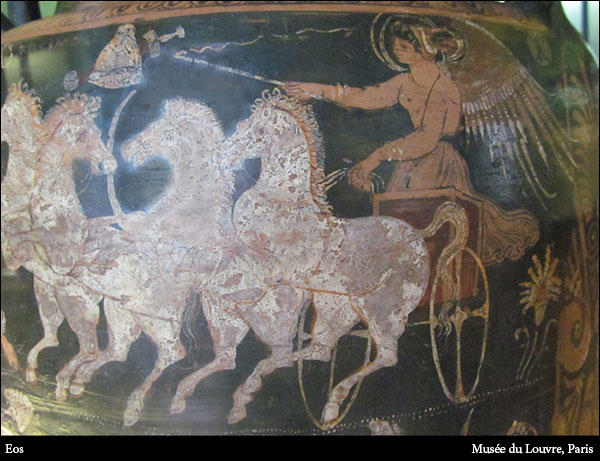
Eos
EE os
Ηως
Erigeneia, The Dawn

In the Homeric Hymn to Helios, we are told that Hyperion married his sister, Eryphaesa, and begot tireless Helios (the Sun), rosy Eos (the Dawn) and fair tressed Selene (the Moon). However, in the poem Theogony (line 372) by Hesiod, the Titan, Theia, is said to be the mother of Eos, Helios, and Selene.
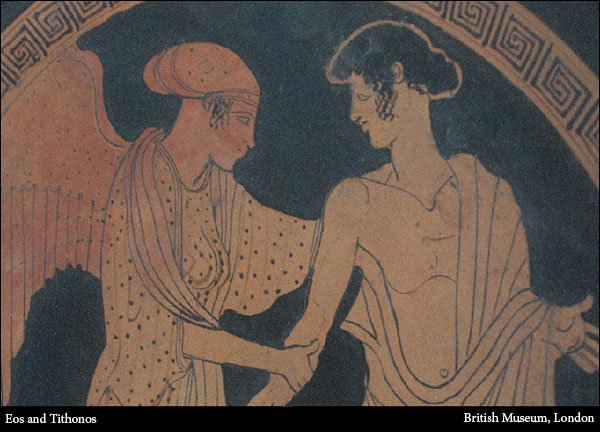
In the Homeric Hymn to Aphrodite, the goddess tells the story of Eos and her abducted lover Tithonos (Tithonus). When Eos went to Zeus to request immortality for her mortal lover, Zeus nodded and made it so. With Tithonos she bore Memnon, the ancestor of Agamemnon. In her haste for Zeus’ approval, Eos did not ask for perpetual youth for Tithonos and, as the years passed, he began to age until he finally lost all strength in his limbs. Eos, with love and pity, put him in a private room and shut the shining doors. We can only assume that he is still there. (Theogony, line 984)
Eos, as the consort of Astraios, is the mother to the Winds: Zephyros (West Wind), Boreas (North Wind) and Notos (South Wind). She also bore a host of shining stars including Eosphoros, the dawn star.
When Eos mated with Kephalos (Cephalus), their son, Phaethon, inherited the radiant beauty of his mother and was so lovely that Aphrodite (goddess of Love) stole him away and kept him as her temple-keeper.
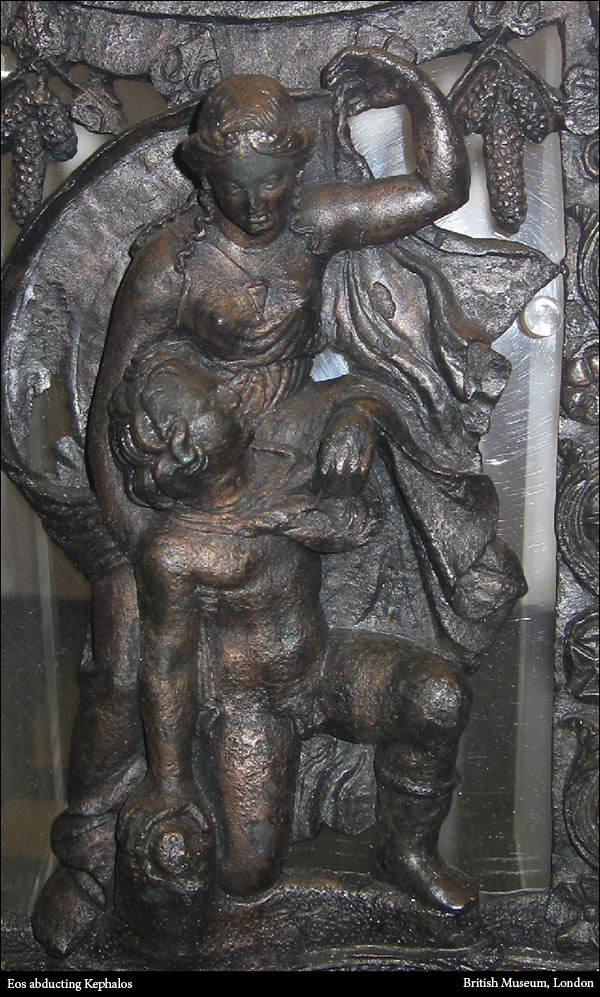
Eos abdicting Kephalos
Eos in The Iliad
(listed by book and line)
The line numbers listed here correspond fairly well with the Lattimore and Murray/Wyatt translations of The Iliad. Other translations (Fitzgerald, Fagles et al) do not correspond as well but, with a small amount of effort, you should be able to find the reference you need regardless of the translation you use. Lattimore (ISBN 0226469409); A.T. Murray/William F. Wyatt Vol. I & II (ISBN 0674995791 and 0674995805); Robert Fitzgerald (ISBN 0374529051); Robert Fagles (ISBN 0140275363)
- 01.477 - After sacrificing to Apollon, Odysseus and his crew left the island of Tenedos as Eos (Dawn) with rosy fingers appeared
-
- 02.048 - Eos (Dawn) takes the message of light to Zeus as Agamemnon calls the Achaeans (Achaians) to an assembly
-
- 08.001 - Zeus sat on Mount Olympos (Olympus) and addressed the other Immortals as yellow robed Eos (Dawn) appeared
-
- 09.240 - Hector prays that the divine Eos (Dawn) will come soon as he fights at the ships of the Argives
-
- 09.662 - Phoinix (Phoenix) sleeps in the tent of Achilles and waits for the divine Eos (Dawn)
-
- 10.251 - Odysseus speaks to Diomedes of The Dawn
-
- 11.001 - As Eos (Dawn) rose from her bed with her lover, Tithonos (Tithonus), Zeus sent Erida (Hate) to the ships of the Argives
-
- 11.722 - Nestor tells of when he was young and how he and his fellow Pylian warriors waited for the divine Eos (Dawn) to attack the
Epeians
-
- 18.255 - Poulydamas (Polydamas) addresses the Trojans and advises them not to wait for the divine Eos (Dawn) before they retreat to the safety of the city walls
-
- 19.001 - When yellow robed Eos (Dawn) rose above Okeanos (Oceanus), Thetis came to her son, Achilles
-
- 23.109 - When the ghost of Patroklos (Patroclus) appeared to Achilles it departed when Eos (Dawn) showed herself
-
- 23.227 - As Achilles buried the bones of Patroklos (Patroclus), Eos (Dawn) followed the dawn star, Eosphoros, into the sky
-
- 24.695 - Priam took the body of Hector back to the city of Troy as Eos (Dawn) appeared in her yellow robe
Eos in The Odyssey
(listed by book and line)
The line numbers listed here correspond fairly well with the Lattimore and Murray/Dimock translations of The Odyssey. Other translations (Fitzgerald, Fagles et al) do not correspond as well but, with a small amount of effort, you should be able to find the reference you need regardless of the translation you use. Richmond Lattimore (ISBN 0060931957); A.T. Murray/George E. Dimock Vol. I & II (ISBN 0674995619 and 0674995627); Robert Fitzgerald (ISBN 0374525749); Robert Fagles (ISBN 0140268863)
- 02.001 - Telemachos (Telemachus) awakes as young Eos (Dawn) appears
-
- 03.404 - Nestor awakes as young Eos (Dawn) appears
-
- 03.491 - When Eos (Dawn) of the rosy fingers appeared, Telemachos (Telemachus) and Peisistratos (Peisistratus) mounted their chariot and left Nestor’s home
-
- 04.187 - While at the house of Menelaos (Menelaus) and Helen, Telemachos (Telemachus) hears how the son of Eos (Dawn) had killed Antilochos
-
- 04.306 - Menelaos (Menelaus) puts on his clothes and sword as Eos (Dawn) of the rosy fingers appears
-
- 04.431 - Planning to meet the Old Man of the Sea (Proteus), Menelaos (Menelaus) is on the beach as Eos (Dawn) of the rosy fingers appears
-
- 04.576 - Menelaos (Menelaus) and his crew prepare to sail to Egypt as young Eos (Dawn) appears
-
- 05.001 - Eos (Dawn) and Tithonos (Tithonus) rose from their bed as the council of the Immortals convened
-
- 05.121 - Kalypso (Calypso) tells Hermes that none of the Immortals objected when Eos (Dawn) chose Orion as a mate and therefore they should not interfere with her love affair with Odysseus
-
- 05.228 - Odysseus and Kalypso (Calypso) prepare for his departure as young Eos (Dawn) appears
-
- 05.390 - Eos (Dawn) of the lovely hair rose three times while Odysseus was adrift in the storm-tossed sea
-
- 06.048 - Eos (Dawn) rose in splendor and awakened Nausikaa
-
- 08.001 - When young Eos (Dawn) arose, Odysseus and Alkinoos (Alcinous) went to a meeting of the Phaiakians (Phaeacians)
-
- 09.076 - Odysseus and his crew rowed their ships as fair haired Eos (Dawn) rose three times prior to their encounter with the Lotus Eaters
-
- 09.153 - Divine Eos (Dawn) arose as Odysseus and his crew landed on the island of the Cyclops
-
- 09.170 - On the island of the Cyclops, Odysseus and some of his companions went ashore as young Eos (Dawn) appeared
-
- 09.306 - Odysseus and his companions are trapped in the cave of the Cyclops, Polyphemos (Polyphemus), when divine Eos (Dawn) arose
-
- 09.436 - When divine Eos (Dawn) appears, Odysseus and his companions escape the cave of the blinded Cyclops, Polyphemos (Polyphemus)
-
- 09.560 - After escaping the Cyclops, Polyphemos (Polyphemus), Odysseus rejoins his companions on a nearby island as young Eos (Dawn) appears
-
- 10.144 - After landing on Kirke’s (Circe) island, Odysseus and his crew rested for two days but as fair haired Eos (Dawn) arose on the third day he began to explore the island
-
- 10.187 - As young Eos (Dawn) arose on the forth day, Odysseus sent twenty three men to explore Kirke’s (Circe) island
-
- 10.541 - As Eos (Dawn) arose from her golden throne, Odysseus and Kirke (Circe) dressed in preparation for his departure
-
- 12.003 - After leaving the Underworld, Odysseus and his crew returned to Kirke’s (Circe) island which was near the home of Eos (Dawn) and Helios
-
- 12.007 - Odysseus and his crew slept until divine Eos (Dawn) appeared and they could retrieve the body of Elpenor from Kirke’s (Circe) island
-
- 12.142 - Eos (Dawn), the goddess, arises as Odysseus leaves Kirke’s (Circe) island for the second time
-
- 12.316 - Young Eos (Dawn) arose as Odysseus and his crew awoke on the island of Thrinakia (Thrinacia) which was sacred to Helios
-
- 13.018 - When young Eos (Dawn) arose, the Phaiakians (Phaeacians) took gifts to Odysseus’ ship in preparation for his departure
-
- 13.094 - Odysseus landed on his home island of Ithaka (Ithaca) as young Eos (Dawn) arose
-
- 14.502 - The disguised Odysseus tells a tale to Penelope’s suitors and mentions how he rested until Eos (Dawn) came
-
- 15.056 - Menelaos (Menelaus) rises from his bed after Eos (Dawn) appears in the sky and addresses Telemachos (Telemachus)
-
- 15.189 - As young Eos (Dawn) appears, Telemachos (Telemachus) and Peisistratos (Peisistratus) approach the city of Pylos
-
- 15.250 - Eos (Dawn) carried Kleitos (Cleitus) away to live among the Immortals because of his beauty
-
- 16.368 - Penelope’s suitors waited through the night and the divine Eos (Dawn) in a failed ambush for Telemachos (Telemachus) as he returned to the island of Ithaka (Ithaca)
-
- 17.001 - Telemachos (Telemachus) leaves Odysseus and goes to the city as young Eos (Dawn) appears
-
- 17.497 - The handmaid, Eurynome, wishes that Penelope’s suitors would all be dead when Eos (Dawn) rises in her splendor on the next day
-
- 18.319 - The disguised Odysseus sends the maids away and tells them that he will keep the fires burning for Penelope’s suitors until Eos (Dawn) appears
-
- 19.050 - The disguised Odysseus awoke to the divine Eos (Dawn) and plotted how to best kill Penelope’s suitors
-
- 19.319 - Penelope tells the maids to make the disguised Odysseus comfortable until Eos (Dawn), of the gold throne, comes again
-
- 19.342 - The disguised Odysseus tells Penelope that he has spent many sleepless nights awaiting Eos (Dawn)
-
- 19.428 - Odysseus recounts the story of how he got the scar on his leg to the maid, Eurykleia, and tells how he went hunting as young Eos (Dawn) appeared
-
- 20.091 - Penelope cried through the night until Eos (Dawn) of the gold throne arose
-
- 22.197 - Melanthios (Melanthius) is tied up and left dangling from the roof beams to wait for young Eos (Dawn)
-
- 23.241 - Eos (Dawn), of the rose fingers, is preparing to awaken Odysseus and Penelope
-
- 23.244 - Athene (Athena) holds back Eos (Dawn) so that Odysseus and Penelope can sleep
-
- 23.246 - Lampos (Lampus) and Phaethon, are the horses of Eos (Dawn)
-
- 23.348 - Athene (Athena) allows Eos (Dawn) to rise and awake Odysseus and Penelope