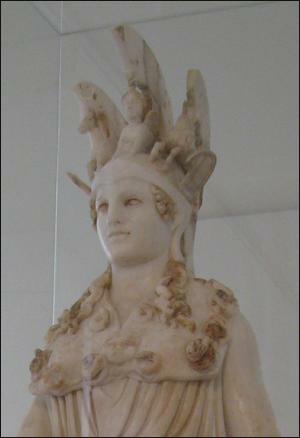

Athene
ah THEE nee
Αθηνη
Athena
ah thee NA
Αθηνα
Goddess of Wisdom

The Daughter of Zeus and Metis
Athene is the daughter of Zeus and Metis. She is the virgin goddess of wisdom and craft but that is not to imply that she is reserved or reflective. Athene can be bold and cruel or thoughtful and protective depending on the situation.
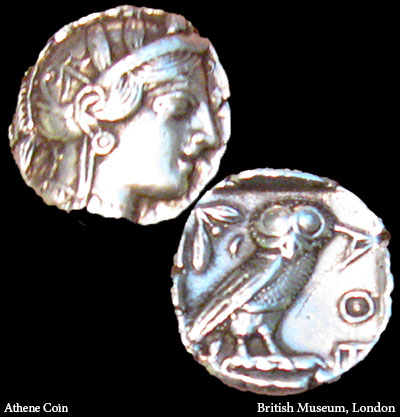
She is called Athene in The Iliad and The Odyssey but after 500 BCE the spelling of her name was changed slightly and she was thereafter referred to as Athena. She has various other names: Pallas Athene (Young Woman Athene) and Glaukopis (Bright Eyed). She is also called Tritogeneia because she was raised by the Nymphs of the Tritonian lake (or river) in Libya.
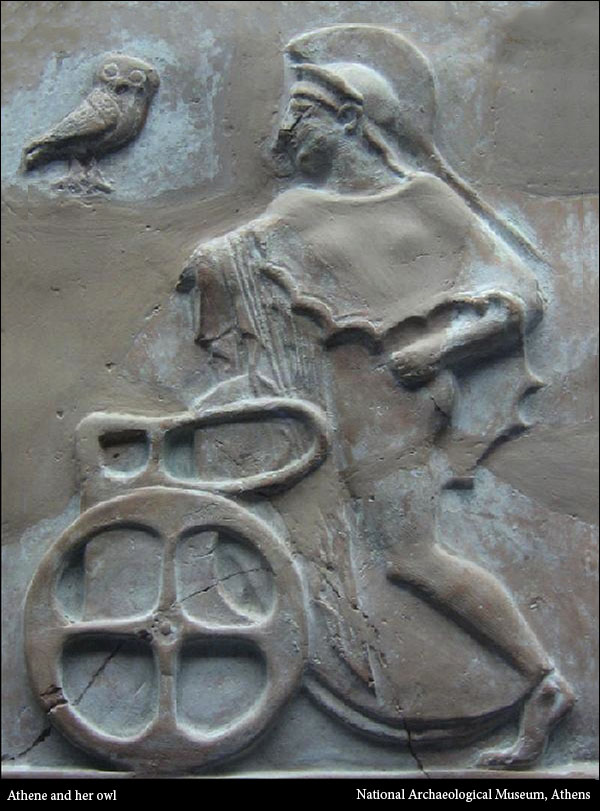
Athene is the guardian of cities ... fierce to her enemies and gentle to her followers. She is the goddess of wisdom, craft, intellect and invention. She taught men how to construct war chariots and inspired women to engage in crafts which would make their homes more efficient and comfortable. She delights in battle and strides beside her stepbrother Ares (god of War) when she is not fighting against him.
The Birth of Athene
Zeus took the goddess Metis as his first wife and she soon became pregnant. Gaia (Earth) and Ouranos (Heavens) warned Zeus that Metis's children would have the power to depose him. Being fearful and prudent, Zeus swallowed Metis and in the vastness of his being, the goddess Athene was born. Metis gave her daughter weapons and clothed her in armor ... Athene then burst from Zeus's head, fully armed and armored shaking her spear in the face of Zeus. Helios (the Sun) halted his chariot in the sky, the earth shook and the sea tossed violently as the fierce goddess stood defiantly before the astonished Immortals. Finally, Athene stripped off her armor to reveal her elegant feminine form and divine beauty ... Helios began to move through the sky once more and the troubled sea became quiet.
Her mother's name, Metis, means 'Wisdom' or 'Thought,' it might therefore be more proper to call Athene, The Daughter of Wisdom instead of The Goddess of Wisdom.
Athene is one of only three goddesses who can resist the love charms and spells of Aphrodite. Histia (Hestia) and Artemis are the other two. Histia is goddess of the Hearth and Artemis is goddess of the Hunt.
Athene and Hera
When Athene was born, Hera became extremely angry with Zeus because she thought she could have given him a child of Athene's quality. Hera cursed Zeus and swore a bitter oath that she would spite him with a child of her own that would be as repugnant as Athene was perfect. Hera conceived, without consort, the monstrous snake-bodied thing named Typhaon. Also adding to Hera's misery, she had just given birth to a son named Hephaistos (Hephaestus). To add to her humiliation, when Zeus and Hera argued over Hephaistos, the young god was thrown from Mount Olympos (Olympus) and severely injured his legs when he finally hit the earth. From that time on, Hephaistos was lame and therefore Hera did not consider him to be a worthy son for the queen of the Immortals. Hera blamed Athene as much as Zeus for the embarrassment Hephaistos caused her.
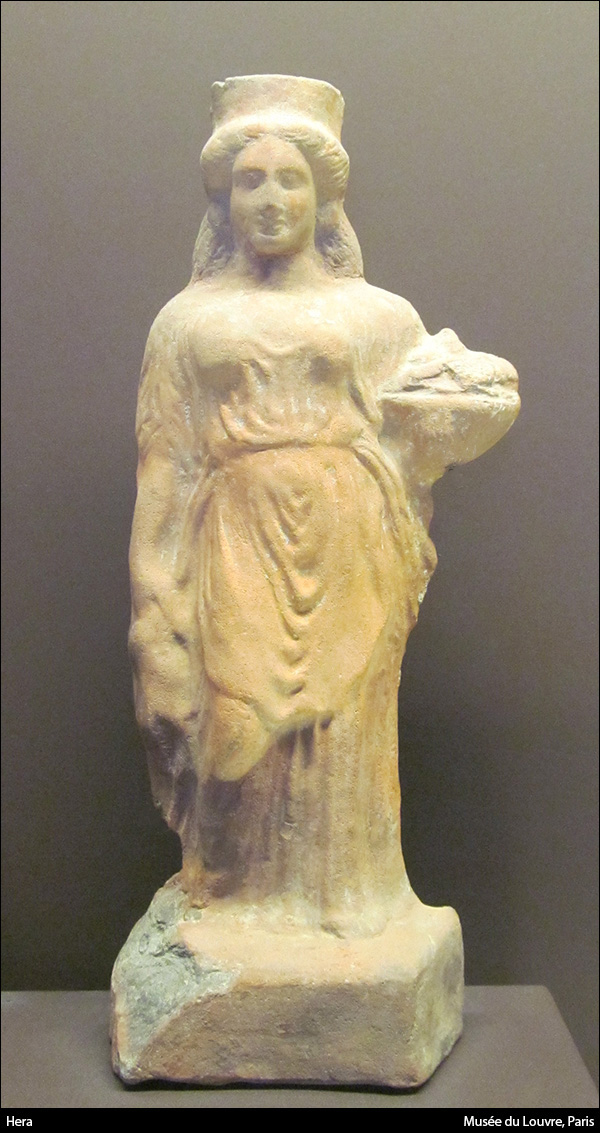
As Athene grew older and Hera became more secure with Zeus's affections, the two goddesses became allies and friends. Since Athene was a chaste goddess and did not compete on the battlefield of love, Hera came to appreciate the young goddess for her cleverness and fierceness.
Hera and Athene conspired on several occasions to thwart the will of Zeus and although their efforts were clearly known to Zeus, the two schemers often succeeded in altering Zeus's commandments and softening the punishments he meted out to the other Immortals and mortals who had offended him.
The two most notable collaborations between Hera and Athene were in assisting Jason and the Argonauts in their Quest for the Golden Fleece and assuring victory for the Achaean (Achaian) Greeks in the Trojan War.
The most notable confrontations between Hera and Athene were caused by Herakles (Heracles) and Prince Paris (Alexandros) of Troy. Hera hated Herakles and tried to kill him on many occasions but Athene protected Herakles and foiled Hera's plots with subtle manipulations and direct intervention. The dispute which arose involving Prince Paris at first pitted the two goddesses against one another but eventually united them against the goddess of Love, Aphrodite.
Athene and Pandora

At the dawn of time, mortal men lived without mates on the cruel and pitiless earth. The first woman was created as a gift and punishment to mankind. The actions of the god Prometheus indirectly caused this incredible event.
Prometheus is the son of the Titans, Iapetos (Iapetus) and Klymene (Clymene). Although he fought for Zeus and his siblings so that they could become the Olympians and thus the ultimate deities, he still disagreed with the way the mortal men on the earth were being treated. In direct defiance to the command of Zeus, Prometheus gave men fire. Zeus was outraged and had Hephaistos shackle Prometheus to the side of a crag, high in the Caucasus Mountains.
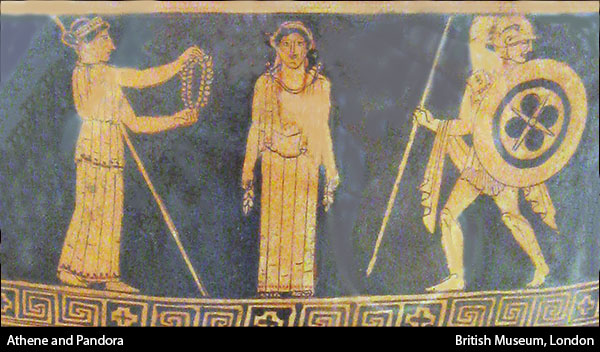
As a punishment to mankind for Prometheus's gift of fire, Zeus ordered the creation of the first woman, her name was Pandora meaning All-Endowed, i.e. given attributes by all the Immortals. Hephaistos molded Pandora's body from earth into the likeness of a modest young girl. Athene taught Pandora the skills of weaving and gave her dexterity. Aphrodite put a mist upon her head to engender longings and desire. Hermes gave her treachery and shamelessness. The Graces and Peitho (Persuasion) gave her necklaces of gold and the Seasons put a halo of flowers on Pandora's head.
Zeus intended Pandora for Prometheus's brother Epimetheus and despite dire warnings from Prometheus, Epimetheus accepted Pandora because she was irresistible. When Epimetheus accepted Pandora he unleashed all the evils on the world. The only positive influence that Pandora brought to the world of men was Hope.
Athene and Herakles
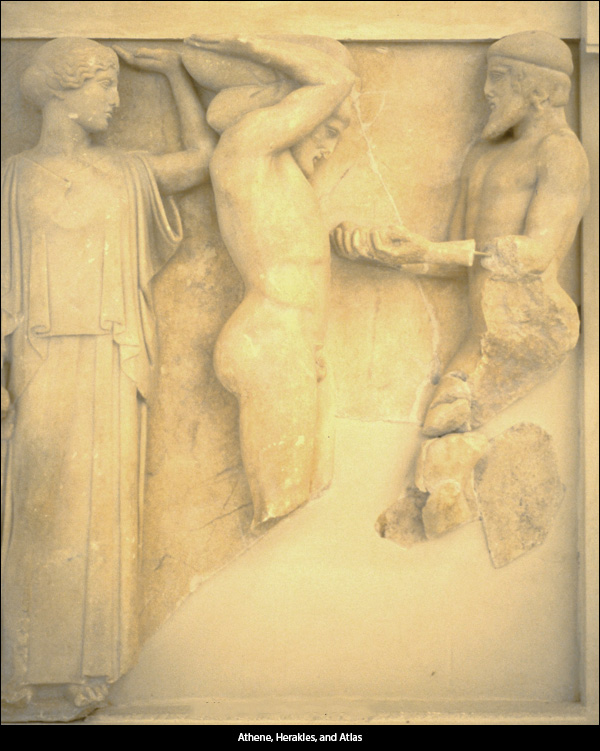
Even the greatest hero of all times needed a protector. Athene fulfilled that role by being Herakles's guardian and advisor. There were numerous occasions where Herakles benefited from Athene's divine intervention but this is not to imply that Herakles could not have succeeded in his many Labors and Deeds without Athene's help. Athene simply made the tragic and difficult life of Herakles a little less painful.
The goddess Hera hated Herakles and devised a series of hardships to torment the hero. Herakles was the son of Zeus and Alkmene (Alcmene) and Hera was unforgiving of Zeus's wanton infidelity. When Hera learned that Alkmene was pregnant, she tricked Zeus into promising that the next son to be born in the bloodline of Perseus would rule Argos. Zeus was sure that Herakles would be that son but Hera delayed Eileithyia, the goddess of Childbirth, from attending Alkmene and allowed a man named Eurystheus to be born before Herakles. Herakles was later bound to Eurystheus and required to perform the labors which have become known as the Twelve Labors of Herakles.
Athene assisted Herakles in six of his Twelve Labors:
Labor Number 2 - Killing the Hydra;
Labor Number 4 - Capturing the Boar of Mount Erymanthos;
Labor Number 5 - Cleaning the Stables of Augeas;
Labor Number 6 - Killing the Stymphalosian Birds;
Labor Number 11 - Retrieving the Golden Apples of the Hesperides; and
Labor Number 12 - Bringing Kerberos (Cerberus) from the Underworld.
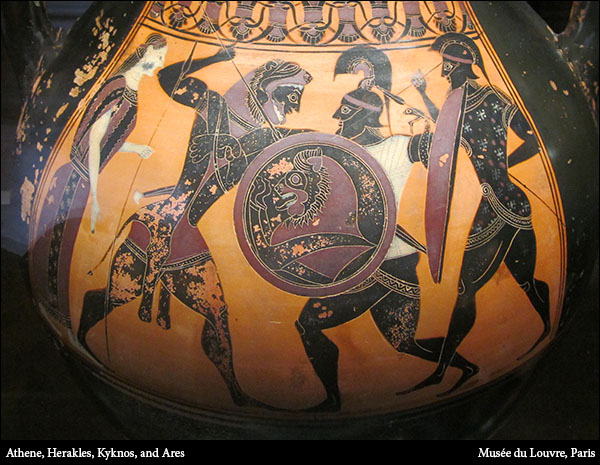
Athene helped Herakles in other ways too. When Herakles had to fight one of the sons of Ares named Kyknos (Cycnus), Athene protected Herakles from the wrath of Ares. Kyknos had offended Zeus when he stole the sacrificial hecatombs intended for his son, Apollon. Herakles was sent to kill Kyknos and was given a shield of divine creation to insure his success. After the fight, Kyknos was dead. Ares was furious and attacked Herakles but Athene stood in front of Herakles turned Ares's spear away. She told Ares that it was at the command of Zeus that Kyknos should die and that Ares was to take no revenge against Herakles.
With Athene's assistance, Herakles also killed a man named Periklymenos (Periclymenus). He was the eldest son of Neleus and Chloris, and one of the Argonauts who sailed to retrieve the Golden Fleece.
Periklymenos's grandfather Poseidon (lord of the Sea) gave him boundless strength and the ability to assume any shape he desired. Periklymenos could transform into an eagle, an ant, a swarm of bees, a snake or any other form. Herakles came into conflict with Periklymenos in a rather sad and roundabout way.
Herakles committed many atrocious acts in his life and one of them involved the murder of a man named Iphitos (Iphitus). Herakles went to Periklymenos's father Neleus and asked for absolution for his crime. Neleus refused. In a fit of rage, Herakles killed Neleus, Periklymenos and his brother Chromios. During the fight with Periklymenos, the goddess Athene warned Herakles about Periklymenos's shape-shifting abilities. When Periklymenos assumed the shape of a bird and perched on the yoke-boss of Herakles's chariot, Herakles killed Periklymenos with an arrow.

Alkmene looks down helplessly as an infant Herakles fights the snakes which Hera sent to destroy him. Herakles's brother Iphikles tries to escape as Athene (right) leans on the aegis and simply looks on.
Athene and The Argonauts
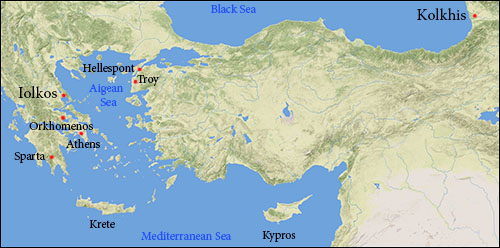
The Quest for the Golden Fleece would not have been attempted or completed without the assistance of Athene and Hera. The two goddesses worked closely together so that a seemingly impossible task could be accomplished and become known as one of the most remarkable adventures of all time. The Quest took place one generation before the Trojan War which would date the Quest to circa 1480 BCE.
The primary mortal characters in the Quest were:
Pelias - the king of Iolkos (Iolcus);
Aeson (Aison) - the father of Jason;
Jason - the rightful heir to the throne of Iolkos;
Aietes (Aeetes) - the king of Kolchis (Colchis);
Medeia (Medea) - a princess of Kolchis.
Pelias usurped the throne of Iolkos and made Aeson an outcast in his own kingdom. Aeson sent his infant son Jason into hiding so that Pelias could not harm him but when Jason became a man, he returned to Iolkos to claim the throne which was rightfully his. Pelias said that he would relinquish the throne if Jason would go to the distant land of Kolchis and retrieve the Golden Fleece.
From the very beginning, Hera was involved in orchestrating the Quest because of her love of Jason and also because she wanted to punish Pelias for his disrespectful behavior towards her.
Jason accepted Pelias's challenge and began making preparations for his journey. A ship was built and the finest young heroes in Greece joined the crew, some of the heroes came at the bidding of Athene.
The ship was called the Argo, meaning Swift. The Argo was inspired by Athene and constructed by a man named Argos (Argus) to be the most magnificent and seaworthy ship ever built. The keel of the Argo was made of oak which Athene cut in Dodona and endued with a human voice. The crewmembers of the Argo were called Argonauts, i.e. Argo Seaman. When the Argo set sail, the Nymphs of Mount Pelion marveled as they beheld the work of Athene.
As vital as the Argo was to the Quest, Athene also gave Jason a wondrous shield to protect him and then drifted down on a cloud and into the sea to speed the Argo on its way. The Argo soon reached the Clashing Rocks which were two gigantic rocks the size of islands. When any ship attempted to pass between the rocks, they would clash together and crush it. When the Argo tried to sail between the Clashing Rocks, Athene held one of the rocks with one hand and pushed the ship safely through with the other.
As the Argonauts approached Kolchis, Athene and Hera tried to think of a way to help Jason obtain the Golden Fleece. They correctly assumed that King Aietes would never surrender the Golden Fleece voluntarily so a plan had to be devised to thwart Aietes's interference. They decided to enlist the help of Aphrodite and hesitantly approached the goddess of Love. Aphrodite was willing to help and suggested that Eros (the primal god of Love) might be induced to cast a love spell on Jason and King Aietes's daughter, Princess Medeia. Eros obeyed Aphrodite and shot Medeia with an arrow that infused her with an irresistible love for Jason. After being blinded by love, Medeia willingly helped Jason take the Golden Fleece without her father's knowledge.
The voyage back to Iolkos was not an easy one. Athene and Hera repeatedly helped calm the seas and inspire other Immortals to assist the Argonauts. When the Argonauts were stranded in the Libyan desert, the Nymphs of the desert helped them because they had once helped Athene when she had been born by the waters of nearby Lake Tritonian.
Before reaching home, the Argonauts built a shrine to Minoan Athene on the island of Crete to show their appreciation for all the help the goddess had given them during their perilous journey.
The Judgment of Paris
The Immortals all have a common heritage and it would seem that they should also share common goals and values. The actuality of the situation is quite different from the ideal. The Judgment of Paris caused a seemingly trivial rivalry between three goddesses to escalate into a conflict of truly epic proportions.
The Nereid Thetis was given in marriage to Peleus (a mortal) because of his undying devotion to the gods on Mount Olympos (Olympus). The marriage was also a punishment for Thetis because she had rejected Zeus's amorous advances. The wedding of Thetis and Peleus was the prelude for a dramatic event which set the stage for the Trojan War. This event has come to be known as The Judgment of Paris although, at that time, it was just another demonstration of the frivolous jealousies of the Immortals.
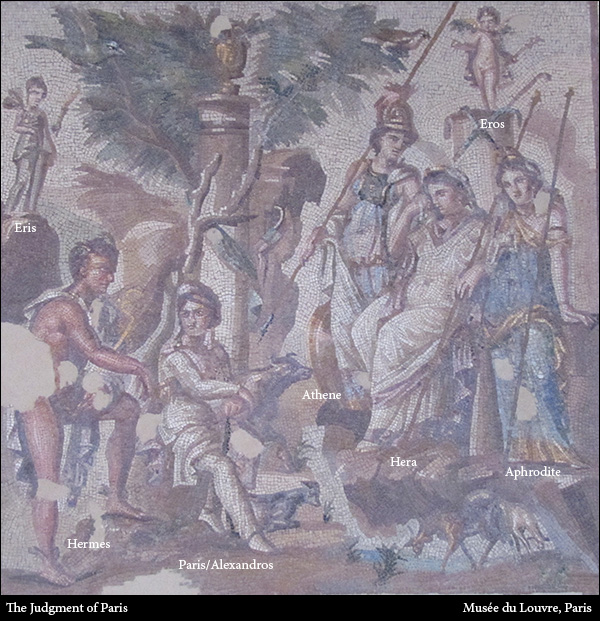
In order to honor Thetis, Hera invited all the Immortals to the wedding. Athene polished an ashen spear which she, Cheiron (Chiron) and Hephaistos had fashioned for Peleus. The goddess Eris (Discord) was in attendance but she did not come to celebrate ... she came to do what she does best, cause trouble. Eris cast down a golden apple with the inscription, 'For the most beautiful one.' Hera, Athene and Aphrodite all assumed that the prize was for them and when the intended conflict arose, the Trojan prince Paris (Alexandros), was asked to make the final decision as to which goddess deserved the golden apple. Aphrodite promised Paris the hand of the most beautiful mortal woman in Greece, Helen. Paris could not refuse such a prize ... he chose Aphrodite as the most beautiful goddess. Hera and Athene never forgave the insult ... the walls of Troy toppled and all of Paris's family paid with their lives for his greed and desire.

Paris (right, barely visible), Hera, Athene (center) and Aphrodite (heavily cloaked).
Athene at Troy
One of the most defining events of the ancient Greek world was the kidnapping of Helen and the resulting war at the gates of the city of Troy. This conflict was known as the Trojan War and divided the Greeks of the Balkan Peninsula from the Greek colonists along the coast of Asia Minor. The Trojan War also divided the Immortals of Mount Olympos ... Athene took the side of the Greeks and spared no effort to see the Trojans vanquished.
After ten brutal years of warfare, the armies decided to stop the fighting and let the two major figures of the dispute face one another in hand-to-hand combat. Helen's lawful husband, Menelaos (Menelaus), and her Trojan lover, Alexandros (Paris), agreed to fight ... the winner would take possession of Helen (and her dowry) and the war would be over. As the two men began to grapple, Pallas Athene descended from Mount Olympos and strode between the two armies to inspire a Trojan archer named Pandaros (Pandarus) to commit a supreme act of treachery. Pandaros, against all sworn oaths, loosed the arrow which broke the fragile peace ... when the arrow injured Menelaos, Aphrodite spirited Alexandros away from the battlefield to the safety of his bedchamber. The bloody war was resumed to the delight of the Olympians.
To avenge Aphrodite's meddling, Athene gave the Greek warrior Diomedes the ability to see the Immortals on the battlefield and advised him to avoid them, but she suggested that if he saw Aphrodite, to attack her. Diomedes obeyed and Aphrodite was the first Immortal to be wounded on that bloody day.
The final conflict in the battle of Troy was not fought on the battlefield ... the Greeks resorted to an ingenious idea that has survived to this day as the icon of Greek treachery and ingenuity ... the Trojan Horse. Athene inspired the craftsman Epeios (Epeius) to construct a giant Wooden Horse that could be left as a tantalizing gift for the Trojans and give the illusion that the Greeks had given up the war and sailed home. The Greeks hid their best men inside the horse, burned their encampment and pretended to leave in their ships. When the Trojans saw the giant Wooden Horse outside their gates, they assumed that the war was over and that Greeks had left it as a peace offering. The Torjans debated the issue and the only man to suspect the deceit was a seer named Laokoon (Laocoon). Poseidon was also on the side of the Greeks and sent one of his sea creatures to quickly silence Laokoon. King Priam of Troy reasoned that the death of Laokoon was a favorable sign from the gods and ordered that the horse be brought into the city ... the Trojans celebrated their apparent victory. Helen was not convinced that the Trojan Horse was an innocent peace offering. She walked around the Wooden Horse imitating the voices of the wives of the men she thought most likely to be concealed inside but the goddess Athene distracted Helen to protect the men hiding in the horse. When the Trojans were exhausted from their merriment, the Greek warriors emerged from the hollow belly of the horse and began the final, victorious assault on Troy. It's ironic that Athene would inspire the device that would bring about the destruction to Troy because when the Trojans brought the Wooden Horse into the city, they wanted to dedicate the trophy to the Grim-Goddess as a tribute to her divine protection.
When the Achaeans were preparing to return to their homes with the spoils of Troy, Athene engineered a quarrel between the brothers Agamemnon and Menelaos. Agamemnon wanted to remain at Troy and appease Athene for the destruction of her temple but Menelaos wanted to leave as quickly a possible. Menelaos returned safely home with a few detours but Agamemnon sailed directly home to meet his death at the hands of his vengeful wife Klytemnestra (Clytemnestra) and her lover, Aegisthus (Aigisthos).

Athene and Odysseus
During the final battle for Troy, the greatest Achaean (Achaian) warrior was killed ... the death of Achilles was the signal that the Trojan War was near its completion. The heroes had been given glory and death in equal measures and Zeus was content that all the old debts had been paid. When the body of Achilles was laying in the dust of the battlefield, both armies fought to gain possession of the body and his divine armor. While Odysseus fought to keep the Trojans away, Aias (Ajax) dragged the body of Achilles back to the Achaean encampment. At that point a bitter argument arose between Odysseus and Aias ... both men thought that they deserved Achilles's armor. The aged hero Nestor suggested that the dispute be settled by sending a spy to the walls of Troy to eavesdrop on the Trojans to see which of the two fighters, Odysseus or Aias, was most respected and feared. The eavesdropper heard two young women talking about the terrible fight for Achilles's body ... one woman remarked that Aias was the better man because he had actually carried Achilles's body from the fighting but at the contrivance of Athene, the other woman replied that even a woman could have carried the body from the fighting but only a brave and strong man like Odysseus could have withstood the fierce attack of the Trojan warriors. On this testimony, Odysseus was awarded Achilles's armor. Aias either killed himself in sorrow or was killed by Poseidon after he left Troy ... regardless, when Odysseus met the 'shade' of Aias in the Underworld, the sullen hero would not speak or acknowledge Odysseus even though they had fought side by side for ten long years.
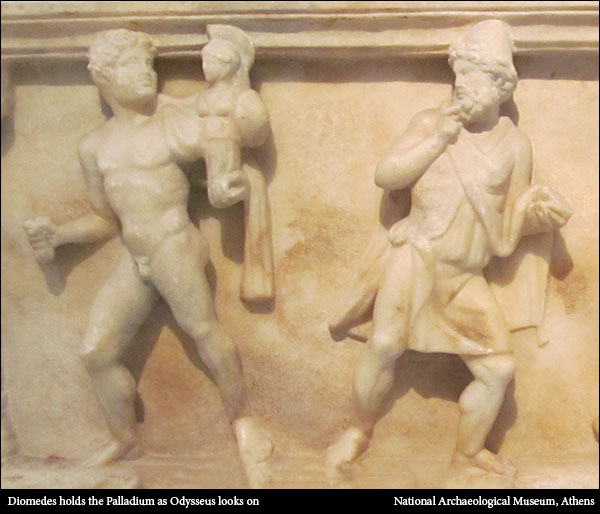
When Troy was in ruins, Odysseus rescued the statue of Athene (the Palladium) from her temple inside the burning city. The Trojans claimed that they had made a duplicate of the Palladium and that the statue that Odysseus took was not the real one but Athene's hatred for the Trojans and her protection of Odysseus and his family suggests that the Trojan account was not true.
After the Trojan War was over (circa 1240 BCE), Athene did not abandon Odysseus or his family but she could not shield him from the vengeance of her uncle, Poseidon. Odysseus and his crew landed on the island of the Cyclops, Odysseus killed Poseidon's son Polyphemos (Polyphemus) in self-defense. Poseidon was outraged but Zeus would not allow him to kill Odysseus. Zeus said he would permit Poseidon to torment Odysseus and delay his homecoming but that the hero was not fated to die.
Athene tried her best to mitigate Odysseus's punishment but was not able to directly intervene until Odysseus was in the last stages of his homeward journey. When Odysseus was floundering in the sea near the island of the Phaiakians (Phaeacians), Athene quieted the winds and waves to allow him to swim to the inhospitable shore. Odysseus would have been dashed against a rocky crags if Athene had not inspired him to grab the rock-face and cling to it. After the crushing wave had subsided, Odysseus was able to swim out beyond the breakers and find a more suitable place to come ashore.
Scheria, the island of the Phaiakians, was to be the last delay before Odysseus returned to Ithaka. Once Odysseus was safely ashore, Athene guided the actions and thoughts of everyone who came in contact with him to insure that he would be taken to Ithaka without further hindrance.
The Phaiakians
Princess Nausikaa was the daughter of King Alkinoos (Alcinous) and Queen Arete of the Phaiakians. Instead of revealing herself or using a disguise, Athene contrived a plan where she would appear to Nausikaa in a dream and use the young girl to guide Odysseus to the king and queen.
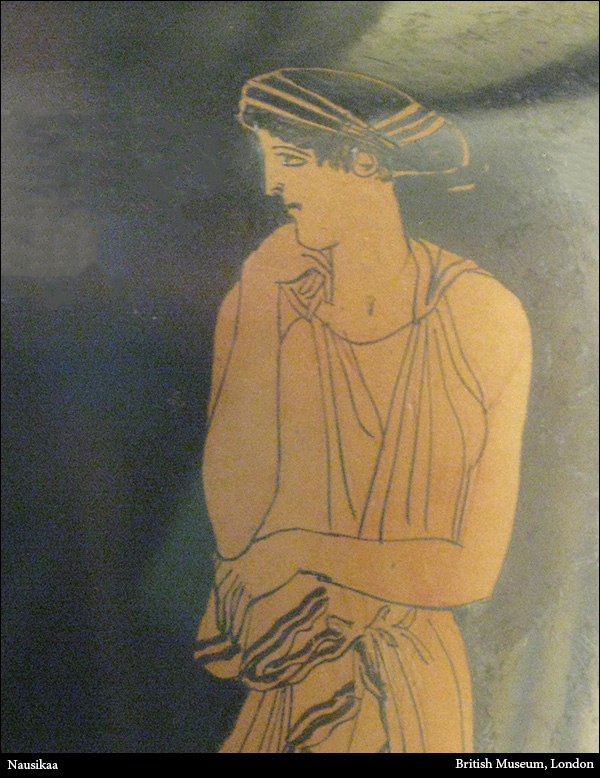
Princess Nausikaa
Nausikaa slept in an elaborate bedchamber with four handmaidens. Athene came into the room like a breath of air and stood above Nausikaa's head. The goddess gave Nausikaa a divine dream where she likened herself to a girl named Dymas because she was Nausikaa's friend and of the same age.
In the dream, Dymas (Athene) scolded Nausikaa for being heedless of her parents. Dymas reminded her that she was of marrying age, and yet her beautiful garments were unwashed. Dymas urged Nausikaa to rise at the break of day and go to the river to wash her clothes.
Remembering the divine dream when she awoke the next morning, Nausikaa and her handmaidens went to the river to wash their clothes. Athene had arranged for Nausikaa to be at the river at precisely that time so that the laughter of the playful girls would awaken Odysseus from his sleep. Odysseus thought he heard the voices of Nymphs but still fearing that he might be in a lawless land, emerged from the underbrush like a lion.
Odysseus looked so wild and filthy that the handmaidens fled in terror. Athene put courage in Nausikaa's heart and took fear from her limbs. Nausikaa stood where she was and allowed Odysseus to approach her. He wondered if she was a mortal girl or a goddess because she resembled Artemis (goddess of the Hunt) in stature and form. Seeing the kindness in her eyes, Odysseus told Nausikaa of his journeys and the troubles he had endured on his quest for his home. Listening to him speak, Nausikaa correctly judged Odysseus not to be a bad man or lacking in understanding the ways of the gods and men.
Nausikaa called to her handmaidens and reminded them that the Phaiakians were dear to the Immortals and that no one had ever been allowed to come to their island with hostility. She instructed them bathe Odysseus in a sheltered part of the river but due to his modesty, Odysseus insisted that he wash himself. The handmaidens left him a cloak and tunic, and olive oil to anoint his weathered body.
When Odysseus finished bathing, Athene made him appear taller and stronger. She made his hair flow with curls and shed grace upon his head and shoulders. Nausikaa saw how magnificent Odysseus looked and secretly told her handmaidens that this noble stranger had come to them by the will of the Immortals, perhaps even to become her husband.
Nausikaa told Odysseus to accompany her back to the city and to the palace of her father. She told Odysseus that when they reached the city walls he should to turn aside and wait at the Grove of Athene until she had time to reach her father's palace.
Odysseus followed behind Nausikaa as she drove her wagon to the city and then turned aside when they reached the Grove of Athene. Once inside the sacred precinct, Odysseus prayed to Atrytone, the child of Zeus of the aegis, because he knew who his protector had been. The goddess was pleased with Odysseus but still did not want to reveal herself because she did not want to rekindle the wrath of Poseidon against Odysseus. When Odysseus left the sacred grove and ventured into the city, Athene put a mist around him so that the Phaiakians could not see him.
Odysseus encountered a young Phaiakian maiden carrying a pitcher and began to question her. The young maiden was Athene in disguise. She called him father and cautioned him against making eye contact with the Phaiakians they encountered or questioning them, knowing full well that the mist prevented them from seeing him. Athene, as the young maiden, told Odysseus of the heritage of the Phaiakians and particularly of Queen Arete. She said that the queen was held in high regard and settled disputes even among the men of the island. She told Odysseus to be bold when he entered the palace and to seek out Queen Arete for assistance.
When Odysseus entered the palace he was still shrouded in mist. He walked past the Phaiakian men in their council and went directly to Queen Arete. Athene dissolved the mist and everyone was astounded to see the strange man kneeling before the queen. Odysseus praised the queen's heritage and begged her to grant him conveyance to his home. Having said his piece, Odysseus sat humbly in the ashes of the fireplace.
Queen Arete and King Alkinoos welcomed Odysseus and arranged for a celebration to be held in his honor. Athene assumed the guise of King Alkinoos's herald and went through the city encouraging everyone to attend. Odysseus wept when he heard songs about the Trojan War because he remembered his companions and friends who went to the war but never returned. Athene induced the Phaiakian men to bestow gifts on Odysseus and made preparations for a ship to carry him to Ithaka.
The Phaiakian ship was fast as thought and sailed directly to Ithaka. Odysseus was asleep when they arrived so the Phaiakian sailors left him on the beach with the many gifts Athene had induced King Alkinoos and the other Phaiakians to give him. Athene had put a mist on the island so Odysseus did know where he was. When he awoke, the first person he encountered was a young herdsman who was actually Athene in disguise. The young man told Odysseus that he was on the island of Ithaka but the clever hero hid his delight and lied to the goddess as to his identity.
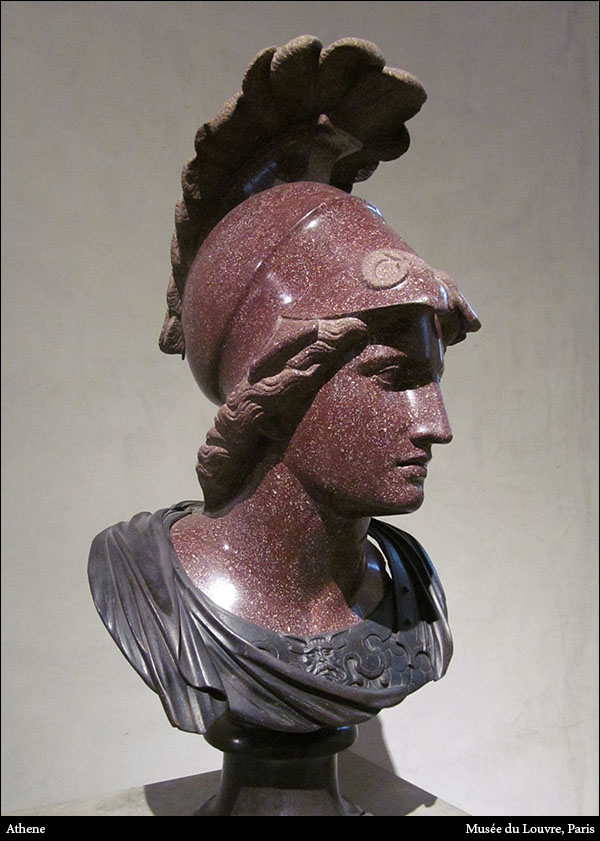
Athene was amused with Odysseus and transformed herself into a tall woman so that Odysseus would know who she was. She told him that she actually admired his cleverness and had tried to protect him as best she could but she had to be careful not the further evoke the wrath of her uncle, Poseidon.
Athene removed the mist from the land so that Odysseus could see that he was indeed home. In somber gratitude, he prayed to the Naiad Nymphs and Athene the Spoiler. Athene helped Odysseus hide the Phaiakian gifts in a cave of the Nymphs and then sealed the entrance with a stone.
Athene told Odysseus that the suitors of Penelope had been despoiling his home for the past three years and that she would stand beside him when the time came for him to spatter blood and brains. She also assured him that his son Telemachos was safe because she was protecting him. She then touched Odysseus with her wand and he took on the guise of an old and tattered man. He was now ready to explore the island and see first-hand how the suitors were squandering his possessions.
Telemachos
When it became obvious the Odysseus would be returning home soon, Zeus allowed Athene to go to the island of Ithaka to assure Telemachos (Telemachus) that his father was not dead and that preparations should be made for his homecoming. Athene assumed several disguises in order to move freely around Ithaka and help Telemachos.
In the guise of a man named Mentes, Athene went to Odysseus's home to observe Penelope and the suitors who had invaded her house hoping to marry her when Odysseus was finally declared dead. Telemachos was the first to see Mentes and welcomed him with food and drink. Mentes said that he had been a guest/friend of Odysseus and that he did not understand the presence of the suitors. Telemachos explained that the suitors were only interested in eating, dancing and consuming Odysseus's property. Mentes advised Telemachos to call an assembly of the citizens of Ithaka and announce that he planed to go abroad in search of news of his father. Athene put hope in Telemachos's heart, gave sweet slumber to Penelope and then departed like a soaring bird. Telemachos knew that Mentes was not a man but in actuality the immortal goddess Athene.
When Telemachos was ready to address the assembly of citizens, Athene cast an enchantment of grace on him. He announced that he would leave Ithaka to search for news of his father and that he hoped that Zeus would punish the suitors for their indulgences. When Zeus heard the sage words of Telemachos to Penelope's suitors, he sent two eagles as a sign of his protection of Telemachos and as a warning to the suitors. In their arrogance, the suitors ignored the divine message and began plotting ways to kill Telemachos.
After the assembly, Telemachos walked along the shore and prayed to Athene for help. The goddess took the guise of Telemachos's tutor, Mentor, and told him that his journey to find news of Odysseus would not be in vain. Mentor then told Telemachos to return to his home and make the necessary preparations to sail to Pylos and Sparta.
Athene took the guise of Telemachos and went to the city to make arrangements for a ship and crew. Afterwards she cast a spell of slumber on Penelope's suitors so that Telemachos could leave the island unhindered. Penelope was not told that Telemachos was sailing for Pylos and when she finally realized that he had gone, she prayed to Athene to protect her son. Using the guise of Penelope's sister Iphthime, Athene spoke to Penelope in a dream to assure her that Telemachos was being protected.
When Telemachos arrived at Pylos, Athene (as Mentor) told him that he must trust his heart and the Immortals, and to be honest when he spoke with King Nestor. The goddess led Telemachos to King Nestor and sat with them as they drank wine. She gave Telemachos courage so that he could speak forthrightly. Nestor told Telemachos that Athene, the Gray-Eyed One, had been harsh with many of the warriors during the Trojan War but that she had always loved and protected Odysseus ... he likewise hoped that Athene would safeguard Telemachos.
After their meeting was over, Athene amazed everyone when she changed from Mentor to a vulture and soared into the heavens. Nestor had no doubt that Telemachos was protected by the goddess and made suitable sacrifices to honor her. Telemachos went from Pylos to Sparta to consult with King Menelaos (Menelaus). Menelaos recounted incidents from the Trojan War and commented that Athene had hated Aias (Ajax) and had thus given the armor of Achilles to Odysseus. After a brief stay at Sparta, Athene advised Telemachos to return to Ithaka. She sent a favoring wind to speed him on his way so that he could rendezvous with his father.
Odysseus's Revenge
After hiding the Phaiakian gifts in the cave of the Nymphs, Odysseus followed the path Athene showed him and soon came to the house of the swineherd, Eumaios (Eumaeus). When Telemachos arrived at Eumaios's home, Athene again touched Odysseus with her wand so that Telemachos could see that his father had indeed returned. Odysseus assured Telemachos that Athene and Zeus would fight with them against the suitors when the proper time came but until then, his presence should be kept a secret. Athene touched Odysseus with her wand again and he resumed the guise of a tattered old man.
Odysseus went to his home to mingle with the suitors and devise a plan for their destruction. His ragged appearance irritated the suitors and they instigated a fight with a beggar named Iros (Irus). Athene magnified Odysseus's strength and he gave Iros a severe beating. After the fight, the suitors became more unruly because Athene wanted to make them as obnoxious as possible so that Odysseus would have no choice but to kill them. She put a charm of enchantment on Penelope so that the suitors would desire her and act more aggressive thus inciting Odysseus's wrath.
In preparation for the inevitable fight, Athene held a lamp as Odysseus and Telemachos removed the weapons from the Great Hall so that the suitors would not be able to use them. Penelope came down from her chambers and insisted in speaking with the tattered stranger thinking that she might hear news of Odysseus. When she was satisfied that the stranger had once been a friend of her husband, she ordered the nurse Eurykleia to wash the pathetic looking old man. Eurykleia saw the childhood scars of Odysseus and knew his true identity but Athene turned Penelope's attention so that she could not share in the revelation.
The following day as the suitors were enjoying their usual indulgences, they began harassing and laughing at Telemachos. Athene put the thought in Penelope's mind to challenge the suitors to try Odysseus's bow. She suggested that any man who could string and accurately shoot Odysseus's bow would be the equal of her long departed husband. Before the contest began, Penelope left the Great Hall and Athene cast sleep upon her eyes so she would not see or hear the horrific fight which was about to occur.
After the each suitor tried and failed to string Odysseus's bow, Telemachos insisted that the tatted old man be given a chance to try his strength. The suitors were outraged but Telemachos placed the bow in Odysseus's hands. Odysseus notched the bowstring and Athene lifted his disguise. The battle began. Six suitors threw their spears at Odysseus but Athene deflected them. She waved the aegis of Zeus before the suitors and they became bewildered. With the aid of Telemachos and the loyal servants, Odysseus killed all the suitors and their henchmen.
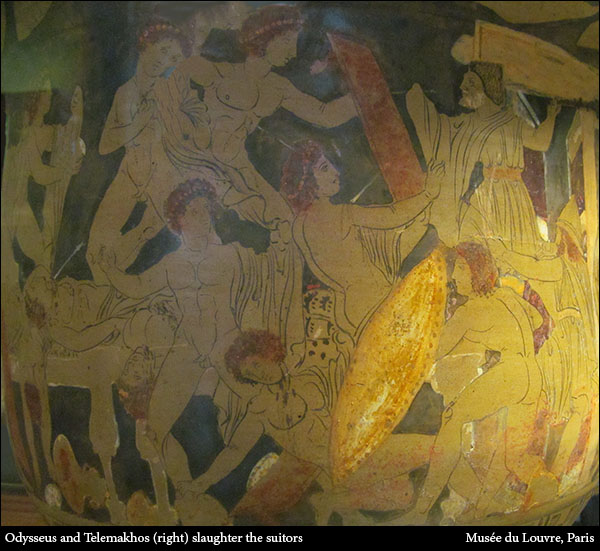
When the fighting was over, Odysseus bathed and went to Penelope. In order for Odysseus and Penelope to renew their love, Athene went to Eos (the Dawn) and would not let her harness her chariot until she was sure that Odysseus had had enough rest and contentment.
Odysseus knew that the relatives of the dead suitors would seek revenge so he decided to leave the city and make a stand at his father's house in the country. Shrouded in darkness provided by Athene, Odysseus, Telemachos and the loyal servants went to Laertes's country home and waited for the angry relatives.
On Mount Olympos, Athene asked Zeus how he intended to resolve the conflict between Odysseus and the enraged relatives of the dead suitors. Zeus told her to do whatever she wished.
As Odysseus prepared for the fight, Athene joined him in the guise of Mentor. Odysseus's father Laertes prayed to Athene to restore his youthful strength. She answered his prayer and made him stronger and more robust.
When the angry relatives reached Laertes's home, Athene called out to them and told them that they could settle their differences with Odysseus without bloodshed. Instead of hearing the reason of what was being said, fear infused them and they threw down their weapons and fled. When they began to retreat, Athene and Odysseus charged after them until Zeus hurled a lightning bolt in their path. Knowing her father's wrath, Athene told Odysseus to stop his attack and, still in the guise of Mentor, accepted the pledges of Odysseus and the angry relatives to settle their differences.
The Grim Goddess
Athene is rightly called the Grim Goddess because she delighted in warfare and carried the aegis of Zeus into battle. The aegis was made by the goddess Themis and was decorated with scenes of battles with Amazons and Giants but the dominant image on the aegis was the head of the Gorgon, Medusa.
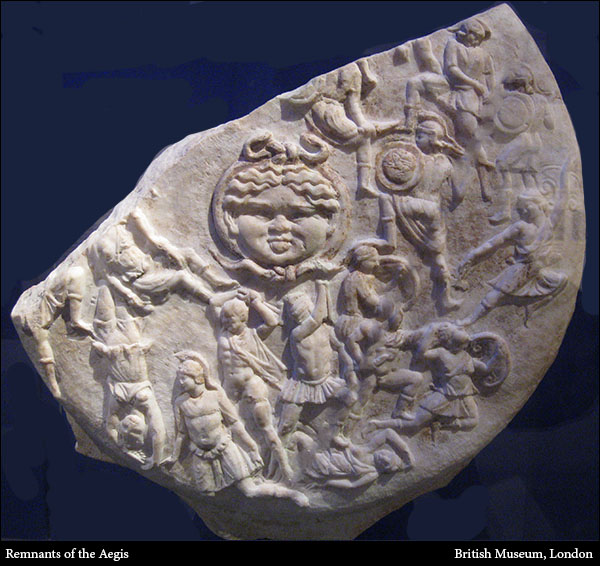
Athene was recognized as a powerful goddess by the ancient Greeks and her worship was fundamental to daily life in prehistoric Athens. The city of Athens was named after Athene in ancient times when she competed with her uncle Poseidon for domination of the unnamed city.
A competition was proposed to see which of the two Immortals could devise the most cunning gift for the mortals of the earth. Poseidon crafted the horse and Athene brought forth an olive tree. The olive tree was such a wonderful creation that Athene won the competition and Athens was named her. The olive was used as food, oil and the wood from the larger trees was used for building ships. Poseidon's gift of the horse was by no means unappreciated ... the horse literally changed the shape of the ancient Greek world.
According to Plato, the city of Athens existed before 8600 BCE and was concurrent with Atlantis. The city was destroyed several times by natural disasters and then rebuilt with the guidance of Athene.
Although Athene was harsh and sometimes vengeful, the people of Greece adored her. Her 'Grim' attributes were accepted because she gave them skills and crafts which made their daily lives easier and richer.
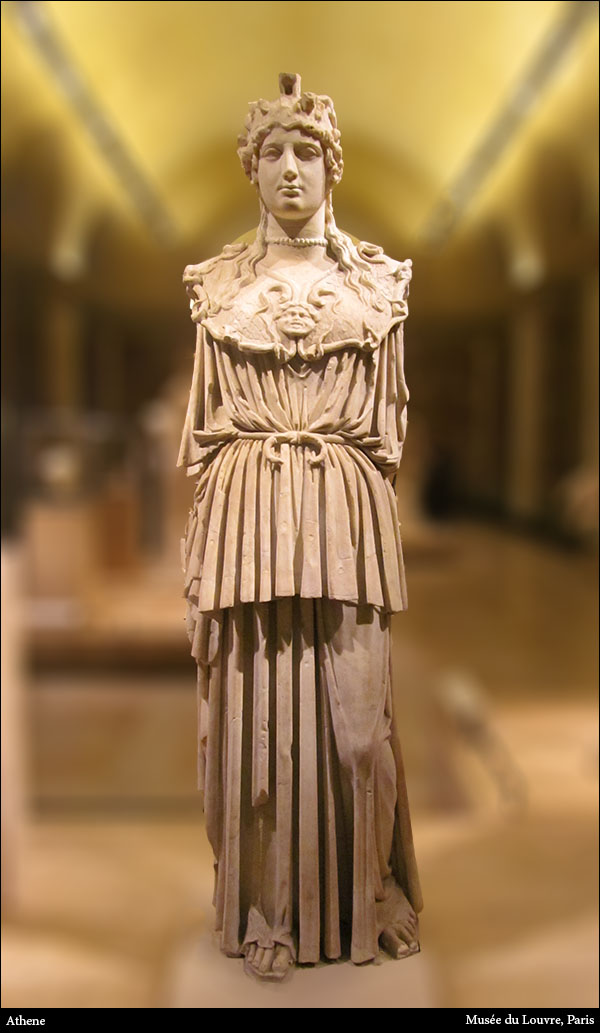
A Prayer to Athene
One interesting prayer to Athene is from the makers of pottery ... it is from the Epigrams of Homer XIV:
Potters, if you will give me a reward, I will sing for you. Come, then, Athene, with hand upraised over the kiln. Let the pots and all the dishes turn out well and be well fired; let them fetch good prices and be sold in plenty in the market, and plenty in the streets. Grant that the potters may get great gain and grant me so to sing to them. But if you turn shameless and make false promises, then I call together the destroyers of kilns, Syntribos (Shatter) and Smaragos (Smash) and Asbetos (Char) and Sabaktes (Crash) and Omodamos (Crudebake) who can work this craft much mischief. Come all of you and sack the kiln-yard and the buildings: let the whole kiln be shaken up to the potter's loud lament. As a horse's jaw grinds, so let the kiln grind to powder all the pots inside. And you, too, daughter of the Sun, Kirke (Circe) the witch, come and cast cruel spells; hurt both these men and their handiwork. Let Cheiron (Chiron) also come and bring many Centaurs—all that escaped the hands of Herakles (Heracles) and all that were destroyed: let them make sad havoc of the pots and overthrow the kiln, and let the potters see the mischief and be grieved; but I will gloat as I behold their luckless craft. And if anyone of them stoops to peer in, let all his face be burned up, that all men may learn to deal honestly.

On the Lighter Side
In the comic epic, The Battle of Frogs and Mice, the frogs and mice went to war ... the enormity (and ridiculousness) of the conflict caught the attention of the Immortals on Mount Olympos ... Zeus called upon Athene to go to the aid of the mice but she replied that she would do no such thing because when she was traveling, the mice ate holes in her fine robe and drank the oil from her lamp. She also said that she would not help the frogs because they had made such a racket that she could not sleep and gave her a headache. Without her divine intervention, the frogs and mice were destined to resolve their differences in the same way that mortals and Immortals have done throughout the ages, i.e. war.
Athene is often confused with the Roman goddess, Minerva.
Athene in The Iliad
(listed by book and line)
The line numbers listed here correspond fairly well with the Lattimore and Murray/Wyatt translations of The Iliad. Other translations (Fitzgerald, Fagles et al) do not correspond as well but with a small amount of effort, you should be able to find the reference you need regardless of the translation you use.
- 01.194 - At Hera's request, Athene descends from the sky and stands behind Achilles when he addresses Agamemnon and the assembled Achaeans (Achaians)
-
- 01.200 - Achilles recognized Pallas Athene (Athena) by her terrible shining eyes
-
- 01.202 - Achilles refers to Athene as 'child of Zeus'
-
- 01.206 - The Gray-eyed Athene speaks to Achilles and says that she has come to stay his anger against Agamemnon
-
- 01.221 - Athene returns to Mount Olympos (Olympus)
-
- 01.400 - Achilles reminds his mother Thetis of the time she summoned Briareus (Briareos) to free Zeus from the shackles which Hera, Athene and Poseidon had put on him
-
- 02.156 - Hera speaks to Athene and asks her to go among the Argives and prevent their departure
-
- 02.157 - Hera addresses Athene as 'Atrytone, daughter of Zeus'
-
- 02.166 - Gray-eyed Athene descends Mount Olympos (Olympus) and goes among the Argives
-
- 02.172 - Athene stands beside Odysseus and urges him not to leave Troy without fighting for Helen
-
- 02.279 - Gray-eyed Athene stands beside Odysseus in the guise of a herald as he addresses the assembled Achaeans (Achaians)
-
- 02.280 - Athene quiets the Achaeans (Achaians) while Odysseus speaks
-
- 02.371 - Agamemnon invokes Zeus, Athene and Apollon as he listens to Odysseus speak
-
- 02.446 - Athene holds the aegis immortal
-
- 02.450 - Athene sweeps through the Achaeans (Achaians) urging them into battle
-
- 02.547 - Athene had once tended king Erechtheus of the city of Athens
-
- 03.439 - Alexandros (Paris) tells Helen that Menelaos (Menelaus) defeated him with the help of Athene
-
- 04.008 - Zeus says that Hera of Argos and Athene have stood by their people
-
- 04.020 - In response to Zeus, Athene and Hera mutter to each other devising doom for the Trojans
-
- 04.022 - Athene remained silent and contained her anger for Zeus at his harsh words to her and Hera
-
- 04.064 - Hera asks Zeus to send Athene to rouse war between the Trojans and Achaeans (Achaians)
-
- 04.069 - Zeus tells Athene to go to Troy and cause the Trojans to be the first offenders in the fight
-
- 04.073 - Athene descends Mount Olympos (Olympus) on her way to Troy
-
- 04.078 - Pallas Athene plunged between the two armies in the likeness of a falling star
-
- 04.086 - Athene assumed the likeness of a man named Laodokos (Laodocus) and sought the Trojan bowman, Pandaros (Pandarus)
-
- 04.089 - Athene found the Trojan bowman Pandaros (Pandarus) in the ranks of the Trojan army
-
- 04.092 - Athene speaks to Pandaros (Pandarus) and urges him to shoot an arrow at Menelaos (Menelaus)
-
- 04.104 - Athene convinced the Trojan bowman Pandaros (Pandarus) to shoot an arrow at Menelaos (Menelaus)
-
- 04.128 - Athene, 'the spoiler', deflects an arrow away from Menelaus (Menelaus)
-
- 04.130 - Athene brushes away an arrow before it strikes Menelaos (Menelaus)
-
- 04.288 - Agamemnon wishes to Father Zeus, Athene and Apollon that all his fighters had the spirit of the two Aiantes, i.e. Telamonian Aias and Lesser Aias
-
- 04.390 - Pallas Athene gave strength to Tydeus when he stood against the Kadmeians (Cadmeians)
-
- 04.514 - Athene, Zeus's daughter Tritogeneia, strode through the ranks of the Achaeans (Achaians) and urged the stragglers forward into the fight
-
- 04.541 - Pallas Athene stood with the Achaeans (Achaians) and drove back the volley of spears thrown at them
-
- 05.001 - Pallas Athene gave strength to Diomedes
-
- 05.029 - Gray-eyed Athene speaks to Ares and suggests that they leave the battlefield
-
- 05.035 - Athene leads Ares out of the battle
-
- 05.061 - Phereklos (Phereklus), a smith, was taught his craft by Pallas Athene
-
- 05.115 - The wounded Diomedes prays to 'Atrytone, daughter of Zeus' to grant him victory
-
- 05.117 - Diomedes asks Athene to allow him to kill the Trojan bowman, Pandaros (Pandarus)
-
- 05.121 - Pallas Athene hears the prayer of Diomedes
-
- 05.123 - Athene speaks to Diomedes and says that she has given him the strength of his father and has lifted the mist from his eyes so that he can see the Immortals on the battlefield
-
- 05.131 - Athene tells Diomedes that he should not confront any Immortal except Aphrodite
-
- 05.133 - Gray-eyed Athene left Diomedes on the battlefield
-
- 05.256 - Diomedes tells his charioteer that Pallas Athene will not let him run from the charge of Pandaros (Pandarus) and Aineias (Aeneas)
-
- 05.260 - Diomedes refers the goddess as 'Athene of the counsels'
-
- 05.290 - Pallas Athene guides Diomedes's fatal spear to the head of the Trojan bowman, Pandaros (Pandarus)
-
- 05.333 - Diomedes stabs at Aphrodite knowing that she has no skill in warfare, unlike Athene and Enyo
-
- 05.405 - Dione tells Aphrodite that it was Gray-eyed Athene who caused Diomedes to stab her
-
- 05.418 - Hera and Athene mock Aphrodite after she had been injured by Diomedes
-
- 05.420 - Gray-eyed Athene speaks to Zeus and asks if Aphrodite might have injured herself with a golden needle
-
- 05.430 - Zeus tells Aphrodite to leave war to Athene and Ares
-
- 05.510 - Apollon and Ares take the side of the Trojans when they see that Pallas Athene has left the battlefield
-
- 05.676 - Athene turns Odysseus's anger away from Zeus's son, Sarpedon
-
- 05.713 - Hera berates Pallas Athene when she sees Ares helping the Trojans
-
- 05.714 - Hera calls Athene 'Atrytone, daughter of Zeus'
-
- 05.719 - The Gray-eyed Athene prepares her chariot so she can go to Troy
-
- 05.733 - Athene stands outside Zeus's chambers and dresses for battle
-
- 05.736 - Athene removes her elaborate dress and dons the war tunic of Zeus
-
- 05.738 - Athene put the aegis of Zeus across her shoulder; the shield had the head of the Gorgon in the center
-
- 05.765 - Zeus tells Hera to set 'The Spoiler, Athene' against Ares
-
- 05.793 - Athene found the wounded Diomedes on the battlefield
-
- 05.800 - Athene speaks to Diomedes and rebuffs him for withdrawing from the battle
-
- 05.815 - Diomedes tells Athene that he has withdrawn from the battle because Ares is fighting with the Trojans
-
- 05.825 - Athene tells Diomedes not to be afraid of Ares and to steer his chariot directly at the War God
-
- 05.840 - Pallas Athene goes against Ares
-
- 05.845 - Athene put on the Helm of Death so that Ares could not see her
-
- 05.853 - Athene deflects Ares's spear from Diomedes
-
- 05.856 - Pallas Athene guides Diomedes's spear into Ares's stomach
-
- 05.879 - Ares angrily speaks to Zeus about Athene and asks if he will continue to allow 'this girl' to act so violently
-
- 05.908 - Hera of Argos and Athene return to Mount Olympos (Olympus) after driving Ares from the battlefield
-
- 06.087 - The seer Helenos (Helenus) tells Aineias (Aeneas) and Hector to assemble the honorable women of Troy at the temple of Gray-eyed Athene
-
- 06.092 - The women of Troy are to lay a prized robe on the knees of the statue of Athene and promise sacrifices to the goddess
-
- 06.269 - Hector instructs his mother Hekabe (Hecabe) to go to the temple of 'the spoiler, Athene' to dedicate a robe and promise sacrifices to the goddess
-
- 06.273 - Hekabe (Hecabe) is to go to the statue of Athene in Troy to seek mercy for the Trojans
-
- 06.279 - Hector tells his mother Hekabe (Hecabe) to go to the temple of the spoiler, Athene
-
- 06.293 - Hekabe (Hecabe) chooses her finest robe as a gift for Athene
-
- 06.297 - The Trojan women go to the temple of Athene on the peak of the citadel inside the walls of Troy
-
- 06.300 - Theano, priestess of Athene, lays a robe on the knees of the goddess' statue
-
- 06.303 - The priestess Theano prays to Athene
-
- 06.304 - The priestess Theano prays that Athene will protect the Trojans and break the spear of Diomedes
-
- 06.305 - Athene is called Troy's defender
-
- 06.311 - Athene ignores the prayers of the priestess, Theano
-
- 06.379 - Hector is told that his wife Andromache might have gone to the house of Athene with the other Trojan women to pray to the Grim Goddess
-
- 06.384 - Hector is told that his wife Andromache has not gone to the house of Athene with the other Trojan women to pray to the Grim Goddess but instead has gone to the walls of Troy to watch the battle
-
- 07.017 - Athene descends Mount Olympos (Olympus) to meet Apollon at Troy
-
- 07.032 - Apollon addresses Athene and calls her 'goddess immortal' and says that he knows that she wants the destruction of Troy
-
- 07.033 - Athene answers Apollon and asks how the two of them can stop the two armies from fighting
-
- 07.043 - Apollon suggests that he and Athene encourage a man-to-man battle with Hector fighting for the Trojans
-
- 07.058 - Athene and Apollon become vultures and settle in an oak tree to watch the fighting
-
- 07.132 - Nestor wishes to Zeus, Athene and Apollon that he had his youth back so he could fight Hector
-
- 07.154 - Nestor recalls how Pallas Athene gave him glory when he killed a man named Ereuthalion
-
- 08.030 - After Zeus forbids the Immortals to enter the war with the Trojans and Achaeans (Achaians), Athene acknowledges his power and strength but pleads for the lives of the men who are destined to die because of Zeus's anger
-
- 08.038 - Zeus assures Athene that he is not angry with her and calls her 'Tritogeneia'
-
- 08.287 - Agamemnon praises Teukros (Teucer) and says that after the sack of Troy he will be honored after Zeus and Athene are appeased
-
- 08.351 - Hera rebukes Athene for neglecting the protection of the Danaans
-
- 08.357 - Athene answers Hera and says that she cannot help the Danaans because Zeus has commanded her to stay aloof from the fighting
-
- 08.362 - Athene tells Hera how she had rescued Herakles (Heracles)
-
- 08.384 - Athene stands outside Zeus's chambers and dresses for battle; she removes her elaborate dress and dons the war tunic of Zeus
-
- 08.391 - Athene prepares to fight those who have angered her
-
- 08.406 - Zeus instructs Iris to turn 'the Gray-eyed goddess' away from Troy so that she does not incur his wrath
-
- 08.426 - Hera speaks to Pallas Athene and says that she will not defy Zeus by going to Troy and fighting
-
- 08.436 - The goddesses Hera and Athene return to Mount Olympos (Olympus) and seat themselves on golden couches with the other Immortals
-
- 08.444 - Hera and Athene sit away from Zeus on Mount Olympos (Olympus)
-
- 08.447 - Zeus addresses Hera and Athene as they sit on Mount Olympos (Olympus) and asks why they are so sorrowful
-
- 08.457 - In response to Zeus, Athene and Hera mutter to each other devising doom for the Trojans
-
- 08.459 - Athene was silent and contained her anger for Zeus
-
- 08.540 - Hector wishes that he was as honored as Athene and Apollon so he could bring destruction to the Achaeans (Achaians)
-
- 09.254 - Peleus reminded Achilles that Athene and Hera grant strength only if it pleases them
-
- 09.390 - Achilles says that he would not marry a daughter of Agamemnon even if she was as lovely as Aphrodite or as skilled as Gray-eyed Athene
-
- 10.245 - Diomedes wants Odysseus to accompany him when he sneaks into the Trojan camp because he believes that Odysseus is loved and protected by Athene
-
- 10.274 - Pallas Athene sent an heron as a sign to Odysseus and Diomedes that she was watching them; they could not see the bird but they heard it cry as it flew overhead
-
- 10.277 - Odysseus hears the bird that Athene sent as an omen and prays to her
-
- 10.280 - Odysseus prays to Athene that he will come back safely from the Trojan camp
-
- 10.284 - Diomedes prays to Atrytone, daughter of Zeus, that she will protect him as she did his father, Tydeus
-
- 10.290 - Diomedes calls Athene the 'Divine Goddess' as he prays to her for protection
-
- 10.295 - Pallas Athene hears the prayers of Diomedes and Odysseus
-
- 10.366 - Athene gave strength to Diomedes so that he could catch the Trojan spy, Dolan
-
- 10.460 - Odysseus killed the Trojan spy Dolan and held the spoils aloft as a dedication to Athene, the spoiler
-
- 10.461 - Odysseus prayed to Athene after killing the Trojan spy, Dolan
-
- 10.482 - Gray-eyed Athene breathed strength into Diomedes as he began killing the sleeping Thracians
-
- 10.497 - By the design of Athene, Diomedes killed the Thracians as they slept and dreamed
-
- 10.507 - Athene warns Diomedes to end his slaughter of the sleeping Thracians and return to the Achaean (Achaian) camp
-
- 10.516 - Apollon had been watching Athene as she encouraged Odysseus and Diomedes to kill the sleeping Thracians and now aroused them to fight the intruders
-
- 10.553 - When Odysseus and Diomedes have safely returned to the Achaean (Achaian) camp, Nestor says that the fine horse team they brought back could be the gift of Zeus or the Gray-eyed maiden, Athene
-
- 10.571 - Odysseus laid out the bloody spoils he had taken from the Trojan spy Dolan and dedicated them to Athene
-
- 10.579 - After Diomedes and Odysseus had bathed, they made an offering of wine to Athene
-
- 11.045 - As Agamemnon dressed for battle, Hera and Athene caused thunder to clash about him to show their approval and protection
-
- 11.437 - Pallas Athene saves Odysseus from the attack of the Trojan, Sokos (Socus)
-
- 11.713 - Nestor remembers when Athene, as a messenger, had come down from Mount Olympos (Olympus) to warn him of an impending attack by the Epeians
-
- 11.720 - Nestor remembers when Athene guided the battle against the Epeians
-
- 11.728 - Nestor remembers when he sacrificed a bull to the river Alpheios (Alpheius), a bull to Poseidon and a cow to Gray-eyed Athene
-
- 11.735 - Nestor remembers when he and the other soldiers prayed to Zeus and Athene before the battle with the Epeians
-
- 11.757 - Nestor remembers that having routed the Epeians, Athene halted him and the other Pylians from giving chase
-
- 13.827 - Hector tells Aias that if he was honored like Apollon and Athene the Achaeans (Achaians) would suffer great evil
-
- 14.178 - Hera dons a robe that Athene made for her
-
- 15.071 - Zeus tells Hera that after Hector kills Patroklos (Patroclus), the fighting will be pushed back from the camp of the Achaeans (Achaians) and move to the walls of Troy through the designs of Athene
-
- 15.123 - Athene stops Ares from leaving Mount Olympos (Olympus) and joining the fighting because he would be in defiance of Zeus's command
-
- 15.128 - Athene addresses Ares and calls him a madman for wanting to defy Zeus
-
- 15.213 - Poseidon tells Iris that if Zeus destroys Troy without allowing Athene, Hera, Hermes and Hephaistos to bring glory to the Achaeans (Achaians), he will not relent in his anger towards Zeus, who he considers to be his equal
-
- 15.411 - The battles fought on both sides of the conflict were well crafted like the skills of an expert carpenter who had been schooled by Athene
-
- 15.614 - Zeus gave Hector glory because his life was to be short; Pallas Athene was working through Achilles to bring death ever closer to Hektor
-
- 15.668 - Nestor encouraged each man to be brave and fight valiantly as Athene lifted the mist from their eyes
-
- 16.097 - Achilles wishes by Father Zeus, Athene and Apollon that he and Patroklos (Patroclus) could breach the walls of Troy
-
- 17.398 - The fight for the dead body of Patroklos (Patroclus) was so fierce that neither Ares nor Athene would have found fault in the carnage
-
- 17.544 - Zeus sends Athene to stir the fighting spirit of the Danaans in the battle for the dead body of Patroklos (Patroclus)
-
- 17.551 - Athene, hidden in a shimmering cloud, walked among the Achaeans (Achaians) and wakened their fighting spirit
-
- 17.556 - Athene speaks to Menelaos (Menelaus) in the voice of Phoinix (Phoenix)
-
- 17.561 - Menelaos (Menelaus), not knowing that he was addressing Athene, wished for the protection of the goddess
-
- 17.567 - The Gray-eyed goddess, Athene, gave Menelaos (Menelaus) strength because she was pleased that she was the first Immortal he beseeched for help
-
- 18.202 - After Iris encouraged Achilles to stand on the battlement so the armies could see him, Athene invisibly gave him the aegis of Zeus for protection and circled his head with a flaming, golden cloud
-
- 18.217 - Pallas Athene screams and the Trojans fall back in fear
-
- 18.227 - The Trojans were aghast when they saw the flaming, golden cloud that the Gray-eyed Athene had placed around the head of Achilles
-
- 18.311 - When Hector says that he will face the murderous Achilles in battle, the Trojan soldiers cheer because Pallas Athene has taken away their wits
-
- 18.516 - Ares and Pallas Athene led the Achaeans (Achaians) against the Trojans
-
- 19.341 - Zeus speaks to Athene and tells her to go to Achilles and comfort him
-
- 19.349 - Athene, in the guise of a hawk, descends Mount Olympos (Olympus) to comfort Achilles
-
- 19.352 - As Zeus has instructed, Athene secretly gives ambrosia to Achilles to nourish him
-
- 19.355 - Athene returns to the house of her father after comforting Achilles
-
- 20.033 - Hephaistos (Hephaestus), Hera, Athene, Poseidon and Hermes descend Mount Olympos (Olympus) to join the Achaeans (Achaians) on the battlefield
-
- 20.048 - Standing by the defensive ditch the Achaeans (Achaians) had built, Athene bellowed
-
- 20.069 - Athene stood against Enyalios (Enyalius) in the battle-lines
-
- 20.094 - Aineias (Aeneas) says that he should have died at the hands of Achilles because Athene had given him such power
-
- 20.115 - Hera speaks to Athene and Poseidon and asks their council as to how to deal with Aineias (Aeneas) because he wants to fight against Achilles
-
- 20.146 - Poseidon led the gods to the stronghold of Herakles (Heracles) which was a mound that had been built by Athene to protect the hero from the Sea Beast when he had been at Troy a generation previous
-
- 20.192 - Achilles speaks to Aineias (Aeneas) and reminds him that he once chased Aineias to Lyrnessos (Lyrnessus) and with the help of Athene and Zeus, stormed the city
-
- 20.313 - Hera speaks to Poseidon and tells him that she and Pallas Athene have taken oaths not to prevent the eventual fall of Troy
-
- 20.358 - The mass of fighters was so great that neither Ares nor Athene could fight their way through
-
- 20.438 - Hector faced Achilles but when he threw his spear, Athene blew against it and turned it away
-
- 21.284 - Poseidon and Athene took the guise of mortals and stood beside Achilles to assure him
-
- 21.290 - Poseidon tells Achilles that he will not die by the banks of the river Skamandros (Skamander) because, by the command of Zeus, he (Poseidon) and Athene will protect him
-
- 21.304 - Achilles was given strength by Athene to withstand the rage of the river Skamandros (Skamander)
-
- 21.392 - Ares enters the battle against Athene
-
- 21.394 - Ares speaks to Athene and calls her a dog-fly
-
- 21.403 - Ares engages Athene and stabs at her
-
- 21.405 - Ares is hit on the neck by Athene with a boulder
-
- 21.408 - After knocking Ares to the ground, Athene stood above him and laughed
-
- 21.410 - With Ares lying at her feet, Athene speaks to the fallen god
-
- 21.418 - After seeing Aphrodite assisting Ares from the battlefield, Hera speaks to Pallas Athene
-
- 21.420 - Hera addresses Athene as 'Atrytone, daughter of Zeus' and reprimands her for allowing Aphrodite to assist the wounded Ares
-
- 21.423 - Athene attacks Aphrodite as the goddess of Love tries to assist the wounded Ares
-
- 21.426 - Athene speaks to Aphrodite and Ares after she has knocked them to the ground and says that all Immortals who assist the Trojans will suffer the same fate
-
- 22.177 - Zeus has second thoughts about allowing Achilles to kill Hector; Athene asks her father if he is going to save a mortal man who is doomed to death
-
- 22.183 - Zeus addresses Athene and calls her 'Tritogeneia'
-
- 22.186 - After receiving Zeus's blessing, Athene descends Mount Olympos (Olympus) and returns to the fighting at the city of Troy
-
- 22.214 - Athene stands beside Achilles and assures him that, together, they will kill Hector
-
- 22.224 - After Athene speaks to Achilles, he is ready to fight Hector
-
- 22.226 - Athene assumes the guise of Deiphobos (Deiphobus) and advises Hector to stand against Achilles even though she knows Achilles will kill him
-
- 22.232 - Hector does not recognize Athene and thanks her for urging him into battle against Achilles
-
- 22.238 - The disguised Athene continues to fool Hector and in the guise of his brother Deiphobos (Deiphobus), falsely promises to stand beside him in a fight against Achilles
-
- 22.247 - Athene in the guise of Deiphobos (Deiphobus), leads Hector into the battle and to his eventual death at the hands of Achilles
-
- 22.271 - Achilles speaks to Hector and tells him that he will soon die because Pallas Athene will guide the spear that kills him
-
- 22.276 - When a spear-throw missed Hector, Pallas Athene retrieved the spear and placed it back in the hands of Achilles
-
- 22.446 - Andromache sat in her chamber weaving and did not know that Pallas Athene had helped Achilles kill her husband, Hector
-
- 23.388 - During the funeral games for Patroklos (Patroclus), Athene saw Apollon interfere with the chariot race by knocking the horsewhip from Diomedes's hands; Athene returned the whip to Diomedes
-
- 23.392 - During the funeral games for Patroklos (Patroclus), Athene smashed the chariot of Eumelos (Eumelus)
-
- 23.399 - During the funeral games for Patroklos (Patroclus), Athene inspired the chariot horses of Diomedes to take the lead in the race
-
- 23.405 - During the funeral games for Patroklos (Patroclus), Antilochos (Antilochus) tells his horses that Athene has given speed to the horses of Diomedes and there is no chance of catching them
-
- 23.769 - During the funeral games for Patroklos (Patroclus), Odysseus prays to Gray-eyed Athene to help him win the footrace
-
- 23.771 - During the funeral games for Patroklos (Patroclus), Pallas Athene hears Odysseus's prayer and makes his limbs light so that he can win the footrace
-
- 23.774 - During the funeral games for Patroklos (Patroclus), Pallas Athene tripped Aias so that Odysseus could win the footrace
-
- 24.026 - All the Immortals were saddened at the way Achilles desecrated the dead body of Hector except Athene, Hera and Poseidon, who hated Hector even in death
Athene in The Odyssey
(listed by book and line)
The line numbers listed here correspond fairly well with the Lattimore and Murray/Dimock translations of The Odyssey. Other translations (Fitzgerald, Fagles et al) do not correspond as well but with a small amount of effort, you should be able to find the reference you need regardless of the translation you use.

- 01.044 - Answering Zeus, Athene says that the death of Aegisthus (Aigisthos) was well deserved because he murdered Agamemnon
-
- 01.068 - Zeus tells Athene that Odysseus is being punished by Poseidon because of the blinding of the Cyclops, Polyphemos (Polyphemus)
-
- 01.080 - Athene tells Zeus that she wants to go to the island of Ithaka (Ithaca) and assure Odysseus's son Telemachos (Telemachus) that his father will return home
-
- 01.096 - Athene departs Mount Olympos (Olympus) bound for the island of Ithaka (Ithaca)
-
- 01.105 - Athene, disguised as Mentes, goes to Odysseus's home and sees Penelope's suitors
-
- 01.113 - Telemachos (Telemachus) is the first to see Athene disguised as Mentes, as she enters his house
-
- 01.118 - Telemachos (Telemachus) goes to the disguised Athene as she enters his house
-
- 01.125 - Telemachos (Telemachus) welcomes the disguised Athene and bids her to follow him into the house to be fed and entertained
-
- 01.156 - Telemachos (Telemachus) tells the disguised Athene that Penelope's suitors only think of food and singing
-
- 01.178 - When asked what brings her to the island of Ithaka (Ithaca), Athene lies to Telemachos (Telemachus) and says her name is Mentes and that he was a guest/friend of Odysseus
-
- 01.221 - The disguised Athene comforts Telemachos (Telemachus) and pretends not to understand the presence of Penelope's suitors in Odysseus's house
-
- 01.252 - Athene understands the frustration that Telemachos (Telemachus) feels towards Penelope's suitors and advises him to call an assembly of the citizens of the island of Ithaka (Ithaca) to announce that he is leaving to seek news of his father, Odysseus
-
- 01.314 - The disguised Athene takes her leave of Telemachos (Telemachus) and promises to return
-
- 01.319 - Athene puts hope in the heart of Telemachos (Telemachus) and then leaves like a soaring bird
-
- 01.327 - In the home of Odysseus, Phemios (Phemius) sings of how Pallas Athene gave the Achaeans (Achaians) a bitter homecoming after the walls of Troy were toppled
-
- 01.364 - Athene gave Penelope sweet slumber to ease her worries
-
- 01.420 - Telemachos (Telemachus) speaks of the recent visitor Mentes as if he were a mortal man but he knows in his heart the visitor was really the immortal goddess, Athene
-
- 01.444 - Telemachos (Telemachus) ponders the journey that Pallas Athene has suggested to him
-
- 02.012 - Athene put an enchantment of grace on Telemachos (Telemachus) as he prepared to address an assembly of the citizens of Ithaka (Ithaca)
-
- 02.116 - While addressing an assembly of the citizens of Ithaka (Ithaca), Telemachos (Telemachus) compares the wisdom that Athene gave to his mother Penelope to the queens of old: Tyro, Alkmene (Alcmene) and Mykene (Mycene)
-
- 02.261 - Telemachos (Telemachus) walks along the beach and prays to Athene for guidance
-
- 02.267 - Athene hears the prayers of Telemachos (Telemachus) and appears to him in the guise of his teacher, Mentor
-
- 02.270 - Athene, in the guise of Mentor, speaks to Telemachos (Telemachus) and tells him that his journey to find news of his father will not be in vain
-
- 02.296 - Telemachos (Telemachus) listened to the disguised Athene and then went into his home to face his mother's suitors
-
- 02.382 - The Gray-eyed Athene disguised herself as Telemachos (Telemachus) and went through the city making preparations for the upcoming journey to find news of Odysseus
-
- 02.393 - Athene casts a spell of slumber on Penelope's suitors so that Telemachos (Telemachus) can leave his home unhindered
-
- 02.399 - Athene assumes the guise of Mentor and tells Telemachos (Telemachus) to make ready for his departure
-
- 02.405 - Pallas Athene, in the guise of Mentor, leads the way as Telemachos (Telemachus) follows her to the seashore
-
- 02.416 - Pallas Athene, in the guise of Mentor, boards the ship with Telemachos (Telemachus)
-
- 02.420 - Athene sent a favoring wind to help Telemachos (Telemachus) on his way
-
- 02.434 - Telemachos (Telemachus) and the other sailors poured libations to the Immortals but especially Zeus's Gray-eyed daughter, Athene
-
- 03.012 - Arriving at Pylos, Athene, in the guise of Mentor, proceeds Telemachos (Telemachus) from the ship and encourages him to be honest with Nestor
-
- 03.025 - Athene, in the guise of Mentor, tells Telemachos (Telemachus) that he must trust his heart and the gods when speaking to Nestor
-
- 03.029 - Pallas Athene, in the guise of Mentor, leads Telemachos (Telemachus) to Nestor
-
- 03.042 - Nestor gives wine to Telemachos (Telemachus) and the disguised Pallas Athene
-
- 03.076 - After they had eaten, Nestor asked Telemachos (Telemachus) why he had come to Pylos; Athene gave Telemachos (Telemachus) courage so that he could speak forthrightly
-
- 03.135 - Nestor tells Telemachos (Telemachus) that many of the Argives did not return from Troy because of the anger of Athene, 'the Gray-eyed One'
-
- 03.145 - Nestor tells Telemachos (Telemachus) that Agamemnon had prayed to Athene but in her deadly anger, she had not listened to him
-
- 03.218 - Nestor wishes that Athene would love Telemachos (Telemachus) as she did his father, Odysseus
-
- 03.222 - Nestor tells Telemachos (Telemachus) that Pallas Athene protected his father, Odysseus
-
- 03.229 - When Telemachos (Telemachus) says that he can not hope for the protection of the goddess Athene, she, in the guise of Mentor, scolds him and urges him to have faith
-
- 03.330 - Nestor tells Telemachos (Telemachus) to go to Menelaos (Menelaus) for news of his father, Odysseus; Athene tells Nestor that his words are wise and orderly
-
- 03.337 - The words of Athene, the daughter of Zeus, were listened to by Nestor and Telemachos (Telemachus)
-
- 03.343 - Athene and Telemachos (Telemachus) prepare to leave Nestor
-
- 03.356 - Gray-eyed Athene praises Nestor for the good advice he gave Telemachos (Telemachus)
-
- 03.371 - Athene tells Nestor to help Telemachos (Telemachus) and then departs in the form of a vulture
-
- 03.378 - Nestor tells Telemachos (Telemachus) that it is obvious that he has the protection of the daughter of Zeus, Tritogeneia, i.e. Athene
-
- 03.380 - Nestor prays to Athene and addresses her as 'Queen'
-
- 03.385 - Pallas Athene hears the prayer of Nestor
-
- 03.394 - Nestor pours a libation to Athene, the daughter of Zeus of the aegis
-
- 03.419 - Nestor orders his children to prepare a formal sacrifice for Athene
-
- 03.435 - Athene attends Nestor's sacrificial rites
-
- 03.446 - Nestor makes a sacrifice and prays to Athene
-
- 04.289 - Menelaos (Menelaus) recalls that Pallas Athene distracted Helen from the Trojan Horse
-
- 04.341 - Menelaos (Menelaus) prays to father Zeus, Athene and Apollon that Odysseus will return home and punish Penelope's suitors
-
- 04.502 - Menelaos (Menelaus) recalls that Athene hated Aias
-
- 04.752 - Penelope's nurse urges her to pray to Athene for the safe return of her son, Telemachos (Telemachus)
-
- 04.762 - Penelope prays to Athene for the safe return of her son, Telemachos (Telemachus), and refers to the goddess as 'Atrytone'
-
- 04.767 - Athene hears Penelope's prayer for the safe return of her son, Telemachos (Telemachus)
-
- 04.795 - Athene disguised herself as Penelope' sister Iphthime and spoke to Penelope in a dream
-
- 04.828 - Pallas Athene, in the guise of Iphthime, tells Penelope that the goddess Athene is watching over her son, Telemachos (Telemachus)
-
- 04.831 - Penelope begs Athene to give her news of Odysseus
-
- 05.005 - At an assembly of the Immortals, Athene reminds them that Odysseus is being held prisoner by the nymph, Kalypso (Calypso)
-
- 05.022 - Zeus scolds Athene and calls her 'my child'
-
- 05.382 - After Poseidon casts Odysseus into the sea, Athene quiets the winds and sends him towards the island of the Phaiakians (Phaeacians)
-
- 05.427 - As Odysseus is about to be dashed against the rocky shore, Athene saves him
-
- 05.437 - The Gray-eyed goddess, Athene, saves Odysseus from drowning at the shore of the island of the Phaiakians (Phaeacians)
-
- 05.491 - When Odysseus washes ashore on the island of the Phaiakians (Phaeacians), Athene gives him sleep and comfort
-
- 06.002 - Athene leaves Odysseus to rest on the shore and goes to the city of the Phaiakians (Phaeacians)
-
- 06.013 - Athene goes to the house of Alkinoos (Alcinous), king of the Phaiakians (Phaeacians)
-
- 06.022 - Athene assumes the guise of the girl Dymas
-
- 06.024 - In the guise of the girl Dymas, Athene speaks to the king's daughter Nausikaa in a dream
-
- 06.041 - After speaking to the king's daughter Nausikaa, Athene goes to Mount Olympos (Olympus)
-
- 06.047 - Athene, the Gray-eyed One, returns to Mount Olympos (Olympus)
-
- 06.112 - Athene ponders how to awaken Odysseus and have him meet the king's daughter, Nausikaa
-
- 06.139 - When the king's daughter Nausikaa saw Odysseus, Athene put courage in her heart so she would not be afraid
-
- 06.229 - As the wretched looking Odysseus stood before the king's daughter Nausikaa, Athene made him handsome
-
- 06.233 - As the immortal craftsman Hephaistos (Hephaestus) overlays gold and silver on his creations, Pallas Athene made Odysseus more handsome when he stood before the king's daughter, Nausikaa
-
- 06.235 - Athene gave grace to Odysseus as he stood before the king's daughter, Nausikaa
-
- 06.291 - The king's daughter Nausikaa, tells Odysseus that there is a grove sacred to Athene near the city of the Phaiakians (Phaeacians)
-
- 06.322 - Odysseus rests in the grove sacred to Athene
-
- 06.323 - Odysseus prays to Athene in her sacred grove
-
- 06.324 - Odysseus prays to Athene and calls her 'Atrytone child of Zeus of the aegis'
-
- 06.328 - Pallas Athene hears Odysseus's prayer but does not reveal herself to him because she knows that Poseidon still harbors anger towards Odysseus
-
- 07.014 - When he entered the city of the Phaiakians (Phaeacians), Athene put a mist about Odysseus so the townspeople would not see him
-
- 07.019 - Athene took the guise of a young girl and allowed Odysseus to ask her questions about the city and rulers of the Phaiakians (Phaeacians)
-
- 07.027 - Athene, in the guise of a young girl, speaks to Odysseus and offers to lead him to the home of the king of the Phaiakians (Phaeacians)
-
- 07.037 - Pallas Athene leads Odysseus through the city of the Phaiakians (Phaeacians)
-
- 07.040 - Athene puts a mist about Odysseus and leads him through the city of the Phaiakians (Phaeacians)
-
- 07.047 - Athene shows Odysseus the home of the king of the Phaiakians (Phaeacians)
-
- 07.078 - Athene advises Odysseus to play upon the kindness of Queen Arete of the Phaiakians (Phaeacians) in order to be accepted into the king's house; the goddess then departs for Marathon and Athens
-
- 07.110 - The disguised Athene tells Odysseus that the Phaiakian (Phaeacian) men have the skills of Athene
-
- 07.140 - The mist that Athene placed around Odysseus was lifted as he clasped the knees Arete, queen of the Phaiakians (Phaeacians)
-
- 07.311 - King Alkinoos (Alcinous) of the Phaiakians (Phaeacians) wishes to father Zeus, Athene and Apollon that Odysseus could be his son-in-law
-
- 08.007 - Pallas Athene, in the guise of the herald of King Alkinoos (Alcinous), went through the city and urged the men to attend an assembly
-
- 08.018 - At the assembly of the Phaiakians (Phaeacians), Athene gave Odysseus a magical grace so that the citizens would admire and respect him
-
- 08.193 - At the Phaiakian (Phaeacian) athletic contests, Athene, in the guise of a man, marked the spot where Odysseus's discus struck the ground
-
- 08.493 - Odysseus urges the singer Demodokos (Demodocus) to sing of the Wooden Horse that Epeios (Epeius) built with the help of Athene
-
- 08.520 - Odysseus tells the Phaiakians (Phaeacians) how Menelaos (Menelaus) endured grim fighting at Troy outside the house of Deiphobos (Deiphobus) and how Athene helped him to win
-
- 09.317 - When Odysseus was trapped in the cave of the Cyclops, he hoped that Athene would help him
-
- 11.547 - When Odysseus was telling about his encounters in the Underworld, he said that he saw the ghost of Aias and he bitterly remembered the contest for the armor of Achilles and how Pallas Athene had judged Odysseus the winner and doomed Aias to an ignoble death
-
- 11.626 - When Odysseus was telling about his encounter in the Underworld, he said that the ghost of Herakles (Heracles) told him of how he had entered the Underworld as a living man and retrieved the dog Kerberos (Cerberus) with the help of Hermes and Pallas Athene
-
- 13.121 - The Phaiakians (Phaeacians) left Odysseus on a beach of Ithaka (Ithaca) with the gifts that Athene had prompted them to give him
-
- 13.189 - When Odysseus awakened on Ithaka (Ithaca), Pallas Athene put a mist on the land and on Odysseus so that no one could recognize him and likewise, he would not know where he was
-
- 13.221 - Athene, in the form of a young herdsman, was the first person Odysseus met when he arrived on the island of Ithaka (Ithaca)
-
- 13.236 - The goddess Athene, in the guise of a young herdsman, tells the disoriented Odysseus that he is on the island of Ithaka (Ithaca)
-
- 13.251 - Odysseus was delighted when the disguised Pallas Athene told him that he was on the island of Ithaka (Ithaca) but lied to her about his true identity
-
- 13.287 - Athene transforms from a young man to a tall woman in front of Odysseus and gently scolds him for trying to deceive her
-
- 13.300 - Pallas Athene tells Odysseus that she has been standing beside him and helping him and helping him survive his adventures
-
- 13.311 - After Athene reveals herself to Odysseus, he addresses her as 'Goddess'
-
- 13.318 - After Athene reveals herself to Odysseus, he addresses her as 'daughter of Zeus'
-
- 13.329 - Athene tells Odysseus that she helps him because he is clever
-
- 13.342 - Athene explains to Odysseus that she could not do more to help him because of the anger of her father's brother, Poseidon
-
- 13.351 - Athene dispersed the mist that veiled the countryside so that Odysseus could see clearly where he was
-
- 13.359 - When he realized that he was on the island of Ithaka (Ithaca), Odysseus prayed to the Naiad Nymphs and to 'Athene the Spoiler'
-
- 13.370 - When Odysseus hid the gifts the Phaiakians (Phaeacians) had given him in the cave of the Nymphs, Pallas Athene sealed the entrance with a stone
-
- 13.374 - The goddess Athene speaks to Odysseus about how Penelope's suitors have been living in his home for three years
-
- 13.389 - Odysseus asks the Gray-eyed Athene to stand with him when he faces Penelope's suitors
-
- 13.392 - Athene promises Odysseus that when the time comes, she will help him spatter the blood and brains of Penelope's suitors
-
- 13.420 - Athene tells Odysseus not to worry about his son Telemachos (Telemachus) because she is protecting him
-
- 13.429 - Athene touched Odysseus with her wand and made him appear old and raggedy
-
- 14.002 - Odysseus followed the path that Athene showed him to the home of the swineherd, Eumaios (Eumaeus)
-
- 14.216 - The disguised Odysseus tells the swineherd Eumaios (Eumaeus) that Ares and Athene had once made him a good fighter
-
- 15.001 - Pallas Athene appears in Sparta to send Telemachos (Telemachus) on his way home
-
- 15.009 - Athene speaks to Telemachos (Telemachus) and urges him to beg Menelaos (Menelaus) for help in returning home
-
- 15.222 - Making preparations to sail home, Telemachos (Telemachus) was praying and sacrificing to Athene when a stranger named Theoklymenos (Theoclymenus) came aboard the ship
-
- 15.292 - When Telemachos (Telemachus) sailed for home, Athene sent a favoring wind
-
- 16.156 - Athene, in the guise of a tall woman, appeared at the cottage of the swineherd Eumaios (Eumaeus) and was seen by Odysseus and Eumaios's dogs but not by Telemachos (Telemachus)
-
- 16.166 - Athene tells Odysseus to reveal himself to his son Telemachos (Telemachus) and tell him of the plans to kill Penelope's suitors
-
- 16.172 - Athene taps Odysseus with her wand and returns him to his true appearance so that Telemachos (Telemachus) can know that his father has returned
-
- 16.176 - After having restored Odysseus to his true appearance, Athene went away
-
- 16.207 - Odysseus explains to his son, Telemachos (Telemachus), that his disguises have been the work of Athene
-
- 16.233 - Odysseus explains to Telemachos (Telemachus) that he has come at advice of Athene and that they will slaughter their enemies, i.e. Penelope's suitors
-
- 16.260 - Odysseus tells his son Telemachos (Telemachus) that they can count on the help of Athene when they battle Penelope's suitors
-
- 16.282 - Odysseus explains to his son Telemachos (Telemachus) that 'Athene of the counsels' will help them in the fight with Penelope's suitors
-
- 16.298 - Odysseus explains to his son Telemachos (Telemachus) that Zeus and Pallas Athene will be there to help them fight Penelope's suitors
-
- 16.451 - The goddess Athene drifted a mist of sleep over the eyes Penelope as she wept for the return of Odysseus
-
- 16.454 - Athene taps Odysseus with her wand and returns him to the shape of an old man
-
- 17.132 - Telemachos (Telemachus) tells his mother Penelope of how Menelaos (Menelaus) had called upon father Zeus, Athene and Apollon for Odysseus to return home and destroy Penelope's suitors
-
- 17.360 - Athene makes the disguised Odysseus beg for bread from Penelope's suitors so that he might see which are just and which are unjust
-
- 18.069 - When Penelope's suitors force Odysseus and the beggar Iros (Irus) to fight, Athene magnifies Odysseus's strength
-
- 18.155 - The suitor Amphinomos (Amphinomus) would not listen to the warning of Odysseus and was doomed to be killed by Athene
-
- 18.158 - The Gray-eyed goddess Athene put a thought in the mind of Penelope go among the suitors
-
- 18.187 - The Gray-eyed goddess Athene put a mist of enchantment over Penelope so that the suitors would see her as beautiful
-
- 18.197 - After Athene had bestowed grace and beauty on Penelope, she departed
-
- 18.235 - Telemachos (Telemachus) wishes that Father Zeus, Athene and Apollon would send someone to kill Penelope's suitors
-
- 18.346 - Athene would not permit Penelope's suitors to be less insolent
-
- 19.002 - Odysseus pondered how, with the help of Athene, he would murder Penelope's suitors
-
- 19.033 - Pallas Athene held the lamp as Odysseus and his son Telemachos (Telemachus) removed the weapons from the great hall
-
- 19.052 - Odysseus pondered how, with the help of Athene, he would murder Penelope's suitors
-
- 19.479 - The nurse Eurykleia finally recognizes Odysseus but Athene turns Penelope's attention so that she could not share in the revelation
-
- 19.604 - Athene casts sleep on the eyes of Penelope
-
- 20.030 - Athene ascends from the sky in the guise of a lady to comfort Odysseus
-
- 20.044 - Athene scolds Odysseus and reminds him that she is protecting him
-
- 20.072 - Penelope thinks of the daughters of Pandareos (Pandareus) and how Hera gave them beauty, chaste Artemis gave them stature and Athene gave them skill
-
- 20.284 - Athene encouraged the outrages of Penelope's suitors in order to infuriate Odysseus
-
- 20.345 - Athene makes Penelope's suitors laugh at Telemachos (Telemachus)
-
- 21.001 - The goddess Athene put the idea in the mind of Penelope to offer Odysseus's bow for the suitors to try
-
- 21.358 - Penelope left the suitors and Athene cast sleep on her eyes
-
- 22.205 - Athene appears to Odysseus in the guise of Mentor
-
- 22.210 - When Odysseus saw Athene in the guise of Mentor, he knew it must be Athene, leader of armies
-
- 22.224 - Athene grew angry with Odysseus and scolded him for not acting more decisively
-
- 22.256 - When the battle began, six of Penelope's suitors threw their spears at Odysseus but Athene deflected them
-
- 22.273 - Athene deflects a spear aimed at Odysseus
-
- 22.297 - Athene waves the aegis of Zeus and Penelope's suitors are bewildered
-
- 23.156 - After the fight with Penelope's suitors, Odysseus is bathed and Athene makes him handsome
-
- 23.160 - Odysseus was made handsome as if by the art of Hephaistos (Hephaestus) and the craft of Pallas Athene
-
- 23.162 - Athene put grace around Odysseus's shoulders
-
- 23.242 - Athene holds back Eos (the Dawn) and will not let her harness her chariot
-
- 23.344 - When Athene thought Odysseus had had enough rest and contentment, she allowed Eos (the Dawn) to ride into the sky
-
- 23.371 - Although the sun was shining, Athene concealed Odysseus and Telemachos (Telemachus) in darkness as they left the city
-
- 24.367 - Athene makes Odysseus's father Laertes stronger and more robust
-
- 24.376 - Odysseus's father Laertes wishes to father Zeus, Athene and Apollon that he could be as strong as when he was a young man
-
- 24.472 - Athene asks Zeus how he intends to end Odysseus's conflict with the men of Ithaka (Ithaca)
-
- 24.478 - Zeus refers to Athene as 'my child' and tells her to do as she wishes in regards to the final conflict between Odysseus and the men of Ithaka (Ithaca)
-
- 24.487 - Athene flies down the slopes of Mount Olympos (Olympus) to join Odysseus
-
- 24.502 - Athene appears to Odysseus in the guise of Mentor
-
- 24.516 - Athene, in the guise of Mentor, speaks to Odysseus's father Laertes and urges him to pray to Athene and Zeus to guide his spear
-
- 24.518 - When the disguised Athene speaks to Odysseus's father Laertes, she refers to herself as 'the Gray-eyed girl'
-
- 24.520 - Pallas Athene breathed great strength into Odysseus's father, Laertes
-
- 24.521 - Odysseus's father Laertes prays to Athene and throws his spear at the men of Ithaka (Ithaca) when they attack
-
- 24.529 - Athene calls out to the men of Ithaka (Ithaca) and tells them that they can settle their differences with Odysseus without bloodshed
-
- 24.533 - When Athene spoke, fear infused the men of Ithaka (Ithaca) and they threw down their weapons and fled
-
- 24.540 - When Odysseus tried to pursue the fleeing men of Ithaka (Ithaca), Zeus hurled a lightning bolt in front of him and Athene
-
- 24.541 - Athene tells Odysseus to hold back his anger lest he enrage Zeus
-
- 24.545 - Odysseus obeyed Athene and stopped his attack on the fleeing men of Ithaka (Ithaca)
-
- 24.547 - Pallas Athene, in the guise of Mentor, accepted the pledges of Odysseus and the men Ithaka (Ithaca) and settled their differences
Other Text References

Theogony
- line 13 - Hesiod asks the Muses to sing of the daughter of Zeus, Athene, and the other Immortals
-
- line 318 - Herakles and Iolaos were able to kill the Hydra with the help of Athene
-
- line 573 - Athene clothed Pandora in a slivery robe and a veil
-
- line 577 - Pallas Athene adorned Pandora with garlands of flowers and placed the crown which Hephaistos had made upon Pandora's head
-
- line 887 - Gaia (Earth) and Ouranos (Heavens) advised Zeus not to let Athene be born
-
- line 895 - The maiden bright-eyed Tritogeneia, equal to her father (Zeus) in strength and in wise understanding, was born to the goddess Metis
-
- line 924 - Zeus gave birth to Tritogeneia (Athene); she was called the awful, the strife-stirring, the host-leader, the unwearied, the queen who delights in war and battles
-
- line 929k - Zeus swallowed Metis and she gave birth to Pallas Athene inside his body
-
- line 929o - The mother of Athene, Metis, remained inside Zeus after Athene was born from Zeus's head
-
- line 929s - Athene was born fully armed for war
Works and Days
- line 63 - Zeus instructed Athene to teach Pandora needlework and weaving
-
- line 72 - Athene helped clothe the first woman, Pandora
-
- line 76 - Pallas Athene bedecked Pandora's form with finery
-
- line 430 - Hesiod advises his brother Perses to use one of Athene's (Athena's) hand-men to work on his plow
Catalogues of Women and Eoiae
(Loeb Classical Library vol. 57, Hesiod)
- fragment 7 - Athene taught art and wisdom to Eurynome, the daughter of Nisus, and advised the girl to wed Glaukos (Glaucus)
-
- fragment 10 - Athene instructed Herakles (Heracles) on how to kill the shape-shifter, Periklymenos (Periclymenus)
Catalogue of Women
(Loeb Classical Library vol. 503, Hesiod II)
- fragment 31.19- Neleus's son Periklymenos (Periclymenus) was given the ability to be a shape-shifter by Poseidon (lord of Sea) but he was ensnared by the will of Athene
-
- fragment 31.22 - Pallas Athene became angry with Periklymenos (Periclymenus) and stopped him being the best
-
- fragment 31.31 - Athene helped Herakles (Heracles) kill Periklymenos (Periclymenus)
-
- fragment 41.11 - The daughter of lord Leukon (Leucon) visited the Temple of Athene, leader of the war-host
-
- fragment 41.14 - They wore sandals to the Temple of Athene because it was the season of spring
-
- fragment 69.62 - Athene settled a dispute over a woman between Sisyphus (Sisyphos) and Aithon (Aethon)
-
- fragment 69.95 - Pallas Athene taught skills to Eurynome, daughter of Nisus and mother of Bellerophontes (Bellerophon)
-
- fragment 69.102- Sisyphus (Sisyphos), by the will of Athene, wanted to marry Eurynome, mother of Bellerophontes (Bellerophon), but Zeus would not allow it
-
- fragment 294.11 - As soon as Zeus swallowed Metis, she became pregnant with Pallas Athene
-
- fragment 294.14 - Metis, the mother of Athene, was sitting concealed in Zeus's entrails
-
- fragment 294.18 - The goddess Themis made the aegis, the army-frightening breastplate of Athene
-
- fragment 162.13 - After Aktaeon (Actaeon) died, the daughter of Zeus (either Athene or Artemis) told Cheiron (Chiron) that when Dionysos went to Mount Olympos (Olympus), Aktaeon's dogs would become his responsibility
Shield of Herakles
- line 126 - Herakles (Heracles) prepares for battle with Kyknos (Cycnus) and puts on the golden breast-plate which Pallas Athene made for him
-
- line 197 - Upon the Shield of Herakles (Heracles) was an image of Zeus's daughter, Tritogeneia, looking as though she wanted to prepare for battle, holding a spear, wearing a golden helmet, and the aegis around her shoulders
-
- line 325 - Athene tells Iolaos (Iolaus) that he and Herakles (Heracles) are not to strip the armor from Kyknos (Cycnus) after he has been killed
-
- line 343 - Iolaos (Iolaus) called terribly to the horses, and at his cry they swiftly whirled the fleet chariot along, raising dust from the plain; for the goddess bright-eyed Athene put mettle into them by shaking her aegis
-
- line 443 - After the death of Kyknos (Cycnus), Athene confronts Ares and tells him that he is not fated to fight with Herakles (Heracles)
-
- line 455 - Athene turns away Ares's spear when the god of War attacks Herakles (Heracles)
-
- line 470 - After Herakles (Heracles) and Iolaos (Iolaus) killed Kyknos (Cycnus), Athene went to Mount Olympos (Olympus)
Hymn to Pythian Apollon III
- line 308 - Once on a time Hera bare him [Typhaon] because she was angry with father Zeus, when the Son of Kronos (Cronos) bare all-glorious Athene in his head.
-
- line 314 - Hera: "Hear from me, all gods and goddesses, how cloud-gathering Zeus begins to dishonor me wantonly, when he has made me his true-hearted wife. See now, apart from me he has given birth to bright-eyed Athene who is foremost among all the blessed gods."
-
- line 323 - Hera to Zeus: "O wicked one and crafty! What else will you now devise? How dared you by yourself give birth to bright-eyed Athene? Would not I have borne you a child—I, who was at least called your wife among the undying gods who hold wide heaven."
Hymn to Aphrodite V
- line 7 - Yet there are three hearts that she [Aphrodite] cannot bend nor yet ensnare. First is the daughter of Zeus who holds the aegis, bright-eyed Athene; for she has no pleasure in the deeds of golden Aphrodite, but delights in wars and in the work of Ares, in strifes and battles and in preparing famous crafts. She first taught earthly craftsmen to make chariots of war and cars variously wrought with bronze, and she, too, teaches tender maidens in the house and puts knowledge of goodly arts in each one's mind.
-
- line 94 - And Anchises was seized with love, and said to her [Aphrodite]: "Hail, lady, whoever of the blessed ones you are that are come to this house, whether Artemis, or Leto, or golden Aphrodite, or high-born Themis, or bright-eyed Athene."
Hymn to Athene XI
- Of Pallas Athene, guardian of the city, I begin to sing. Dread is she, and with Ares she loves deeds of war, the sack of cities and the shouting and the battle. It is she who saves the people as they go out to war and come back.
-
- Hail, goddess, and give us good fortune with happiness!
Hymn to Hephaistos XX
- Sing, clear-voiced Muses, of Hephaistos (Hephaestus) famed for inventions. With bright-eyed Athene he taught men glorious gifts throughout the world—men who before used to dwell in caves in the mountains like wild beasts. But now that they have learned crafts through Hephaistos the famed worker, easily they live a peaceful life in their own houses the whole year round.
-
- Be gracious, Hephaistos, and grant me success and prosperity!
Hymn to Athene XXVIII
- I begin to sing of Pallas Athene, the glorious goddess, bright-eyed, inventive, unbending of heart, pure virgin, savior of cities, courageous, Tritogeneia. From his awful head wise Zeus himself bare her arrayed in warlike arms of flashing gold, and awe seized all the gods as they gazed. But Athene sprang quickly from the immortal head and stood before Zeus who holds the aegis, shaking a sharp spear; great Olympos (Olympus) began to reel horribly at the might of the bright-eyed goddess, and earth round about cried fearfully, and the sea was moved and tossed with dark waves, while foam burst forth suddenly; the bright Son of Hyperion stopped his swift-footed horses a long while, until the maiden Pallas Athene had stripped the heavenly armor from her immortal shoulders. And wise Zeus was glad.
-
- And so hail to you, daughter of Zeus who holds the aegis! Now I will remember you and another song as well.
Epigrams of Homer XIV
- Potters, if you will give me a reward, I will sing for you. Come, then, Athene, with hand upraised over the kiln. Let the pots and all the dishes turn out well and be well fired; let them fetch good prices and be sold in plenty in the market, and plenty in the streets. Grant that the potters may get great gain and grant me so to sing to them. But if you turn shameless and make false promises, then I call together the destroyers of kilns, Syntribos (Shatter) and Smaragos (Smash) and Asbetos (Char) and Sabaktes (Crash) and Omodamos (Crudebake) who can work this craft much mischief. Come all of you and sack the kiln-yard and the buildings: let the whole kiln be shaken up to the potter's loud lament. As a horse's jaw grinds, so let the kiln grind to powder all the pots inside. And you, too, daughter of the Sun, Kirke (Circe) the witch, come and cast cruel spells; hurt both these men and their handiwork. Let Cheiron (Chiron) also come and bring many Centaurs—all that escaped the hands of Herakles (Heracles) and all that were destroyed: let them make sad havoc of the pots and overthrow the kiln, and let the potters see the mischief and be grieved; but I will gloat as I behold their luckless craft. And if anyone of them stoops to peer in, let all his face be burned up, that all men may learn to deal honestly.
The Kypria
- fragment 1, line 6 - At the wedding of Thetis and Peleus, Eris (Discord) starts a dispute between Athene, Hera and Aphrodite; the result is the Trojan War
-
- fragment 5 - As a wedding gift for Peleus, Athene, Cheiron (Chiron) and Hephaistos (Hephaestus) fashioned a spear
The Little Iliad
- fragment 1
-
- The adjudging of the arms of Achilles takes place, and Odysseus, by the contriving of Athene, gains them. Aias then becomes mad and destroys the herd of the Achaeans and kills himself.
-
- The Trojans are now closely besieged, and Epeios (Epeius), by Athene's instruction, builds the wooden horse.
-
- fragment 3
-
- The story runs as follows: [Telamonian] Aias and Odysseus were quarrelling as to their achievements, says the poet of the "Little Iliad", and Nestor advised the Hellenes to send some of their number to go to the foot of the walls and overhear what was said about the valor of the heroes named above. The eavesdroppers heard certain girls disputing, one of them saying that Aias was by far a better man than Odysseus and continuing as follows:
-
- "For Aias took up and carried out of the strife the hero, Peleus's son: this great Odysseus cared not to do."
-
- To this another replied by Athene's contrivance:
-
- "Why, what is this you say? A thing against reason and untrue! Even a woman could carry a load once a man had put it on her shoulder; but she could not fight. For she would fail with fear if she should fight."
The Sack of Ilium
- fragment 1
-
- The Trojans were suspicious of the wooden horse and standing round it debated what they ought to do. Some thought they ought to hurl it down from the rocks, others to burn it up, while others said they ought to dedicate it to Athene.
-
- Aias the son of Ileus, while trying to drag Cassandra away by force, tears away with her the image of Athene. At this the Greeks are so enraged that they determine to stone Aias, who only escapes from the danger threatening him by taking refuge at the altar of Athene.
-
- The Greeks sail away and Athene plans to destroy them on the high seas.
- fragment 2
-
- One Palladium [a statue of Athene] was given to Dardanos (Dardanus) by Zeus, and this was in Ilium (Troy) until the city was taken. It was hidden in a secret place, and a copy was made resembling the original in all points and set up for all to see, in order to deceive those who might have designs against it. This copy the Achaeans took as a result of their plots.
The Returns
- fragment 1 - Athene causes a quarrel between Agamemnon and Menelaos (Menelaus) about the voyage from Troy. Agamemnon then stays on to appease the anger of Athene.
The Telegony
- fragment 1, line 15 - A war then breaks out between the Thesprotians, led by Odysseus, and the Brygi. Ares routs the army of Odysseus and Athena engages with Ares, until Apollon separates them.
The Battle of Frogs and Mice
- line 177 - Athene refuses to obey Zeus's command to help the mice because they had caused her much mischief by ruining her garments and drinking the oil from her lamp
-
- line 197 - Athene suggests that the Immortals not help the mice or frogs and simply watch the fighting from the heavens
The Contest of Homer and Hesiod
- section 321 - The Aiantes [Aias and Aias] fought so fiercely that neither Ares nor Athene would have scorned them
The Argonautika
- book 1, line 19 - Argos (Argus) built the Argo with the guidance of Athene
-
- book 1, line 110 - Athene urged Tiphys, son of Hagnias, to join the Argonauts
-
- book 1, line 226 - Argos (Argus), the helper of Athene, joined the crew of the Argo
-
- book 1, line 300 - Jason tells his mother to not worry and to take courage from the promises of Athene
-
- book 1, line 527 - The keel of the Argo utters a a strange cry; it was made from oak which Athene brought from Dodona
-
- book 1, line 551 - When the Argo set sail, the Nymphs of Mount Pelion marveled as they beheld the work of Athene
-
- book 1, line 629 - The women of Lemnos had endured much hard work but when they saw the Argo approaching, they dreaded the work of Athene, i.e. battle
-
- book 1, line 768 - Jason held the wondrous shield which Athene had given him
-
- book 1, line 960 - At the command of the Oracle of Apollon, the Ionians placed a sacred stone in the temple of Jasonian Athene
-
- book 2, line 537 - Athene drifted on a cloud and swept onto the sea to help the Argonauts as they rowed
-
- book 2, line 598 - When the Argo was passing between the Clashing Rocks, Athene thrust one rock aside and pushed the Argo through safely
-
- book 2, line 602 - After helping the Argonauts survive the Clashing Rocks, Athene soared to Mount Olympos (Olympus)
-
- book 2, line 612 - Tiphys tells the other Argonauts that Athene has breathed divine life into the Argo
-
- book 2, line 1187 - Jason reminds the Argonauts that Athene cut timbers near the crest of Mount Pelion so that Argos (Argus) could build the Argo
-
- book 3, line 8 - Athene and Hera observe the Argonauts
-
- book 3, line 10 - Hera asks Athene how they can assist the Argonauts obtain the Golden Fleece
-
- book 3, line 17 - Athene tells Hera that she is pondering how to help Jason obtain the Golden Fleece but has not yet decided on a plan
-
- book 3, line 30 - Athene likes Hera's plan to get Eros (the primal god of Love) to make Princess Medeia (Medea) fall in love with Jason and assist him in obtaining the Golden Fleece
-
- book 3, line 91 - Aphrodite (goddess of Love) tells Hera and Athene that she will ask Eros (the primal god of Love) to help Jason
-
- book 3, line 111 - After Aphrodite (goddess of Love) promises to assist them, Athene and Hera return to Kolchis (Chochis)
-
- book 3, line 340 - Argos (Argus) tells King Aietes (Aeetes) that their ship, the Argo, was fashioned by Athene
-
- book 4, line 583 - The Argonauts are seized with deadly fear when the keel of the Argo, which Athene made of Dodonian oak, begins speaking with a human voice
-
- book 4, line 959 - Athene and Hera are fearful as the Argo is tossed by rough seas
-
- book 4, line 1309 - The Nymphs of Libya take pity on the Argonauts and help them just as they had helped Athene when she had been born by Trito's waters
-
- book 4, line 1691 - The Argonauts built a shrine to Minoan Athene on the island of Crete
Plato
- Timaeus, 21E - The Egyptian city of Sais was founded by the goddess Neith, known to the Greeks as Athene
-
- Timaeus, 112B - The military class lived on the topmost area of the Acropolis of Athens, roundabout the temples of Athene and Hephaistos (Hephaestus)
The Library of History by Diodorus Siculus
- book 1.12.7 - The air was called Athene because she was conceived as a virgin and air, by its nature, is uncorrupted and occupies the highest part of the entire universe
-
- book 1.12.8 - Athene is called Tritogeneia (Thrice Born) because her nature changes with the spring, summer and winter; she is also called Glaukopis (Glaucopis) which means Blue-Eyed because the air has a bluish cast; [note: Glaukopis is usually translated as Bright and not Blue; also see book 5.72.3 where it states that Athene is called Tritogeneia because she was born at the sources of the river Triton]
-
- book 1.16.1 - The Egyptians dispute the claim that Athene discovered the olive and give the credit to Hermes
-
- book 3.73.7 - Athene, Dionysos and other gods rushed to Crete to join Zeus in his defense of the Egyptian god, Ammon
-
- book 4.9.6 - Athene persuaded Hera to nurse the infant Herakles (Heracles) but he violently refused to nurse; Athene then took the infant Herakles to his mother, Alkmene (Alcmene)
-
- book 4.14.3 - When the various Immortals presented gifts to Herakles (Heracles), Athene gave him a robe
-
- book 5.56.6 - Helios (the Sun) proclaimed that the first people to offer sacrifices by fire to Athene would enjoy the presence of the goddess; the Heliadae of the island of Rhodes were the first and that is why she has her seat on that island
-
- book 5.58.3 - Kadmos (Cadmus) honored the Lindian Athene with votive offerings, one of which was a striking bronze cauldron
-
- book 5.72.3 - Athene was begotten of Zeus on the island of Crete, at the sources of the river Triton, thus given the name Tritogeneia (note: see book 1.12.8 where it states that Athene is called Tritogeneia, i.e. Thrice Born)
-
- book 5.73.7 - Athene is credited with the gift to mankind of the domestication and cultivation of the olive tree; also, the making of clothing, carpentry and many other devices which are used in the other arts; Athene also made pipes and the music they produce; from these cunning devices she derives the name of Worker
-
- book 6.1.9 - Athene was the daughter of Zeus's third wife, Themis
-
- book 11.14.3 - The barbarians [Persians under King Xerxes] were intent on burning the precinct of Apollon at Delphi; when they reached the Athene Pronaea, a great thunderstorm with incessant lightning burst from the heavens; many Persians were killed and the rest fled; [note: Pronaea literally means 'before a temple,' i.e. the shrine which stands in front of a temple]
-
- book 11.14.4 - After the Persians were turned back at the Athene Pronaea and unable to pillage Delphi, the Delphians set up a trophy next to the Temple of Athene; (note: Pronaea literally means 'before a temple,' i.e. the shrine which stands in front of a temple)
-
- book 11.15.2 - The Athenians who had taken refuge on the island of Salamis were exceedingly disheartened when they heard that King Xerxes had burned the sacred precinct of Athene in Athens
-
- book 11.45.6 - To escape punishment from the Spartans, Pausanias fled for safety into the Temple of Athene of the Brazen House; the Spartans walled up the entrance to the temple and Pausanias starved to death
-
- book 11.45.9 - In relation to the death of Pausanias at the hands of the Spartans, the Oracle at Delphi ordered the Spartans to 'restore her supplicant to the goddess'; the Spartans placed two statues of Pausanias in front of the Temple of Athene
-
- book 17.17.6 - When Alexander the Great came to the Temple of Athene on the Troad, a seer named Alexander saw omens which he told King Alexander would give him great military success in Phrygia and that Athene would help him in his success
-
- book 17.18.1 - After hearing the favorable predictions of the seer named Alexander, Alexander the Great made a splendid sacrifice to Athene, dedicating his own armor to the goddess and then taking armor which had been previously dedicated at the temple
-
- book 17.21.2 - While in battle in Phrygia, Alexander the Great deflected three blows with the shield he acquired at the Temple of Athene after dedicating his own armor to the goddess