
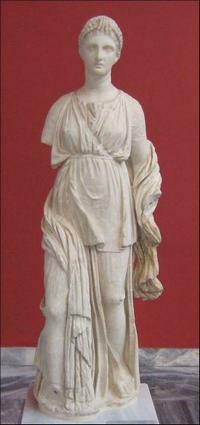
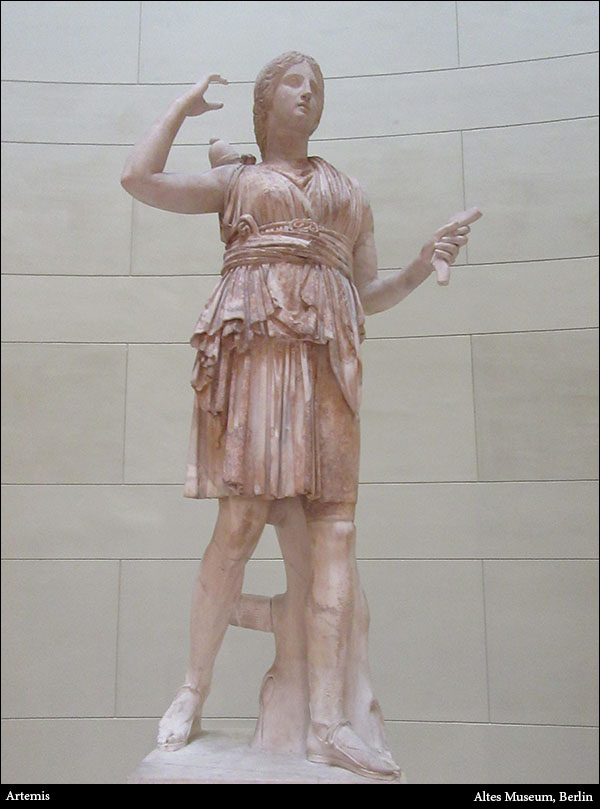
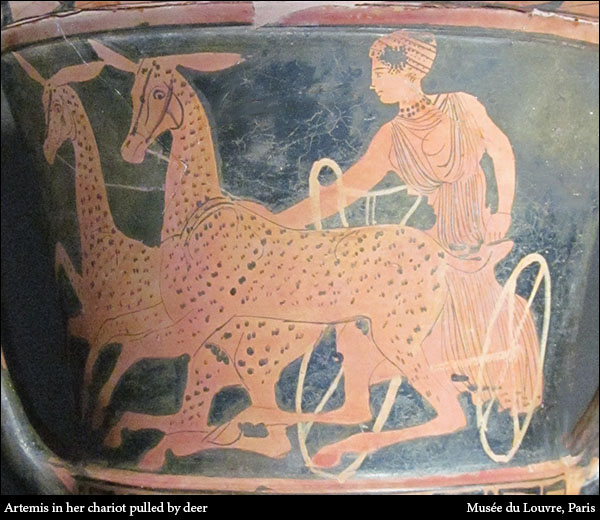
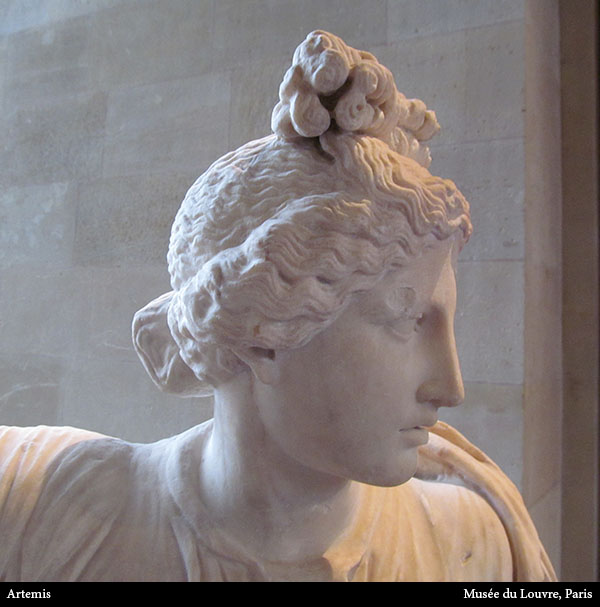
Artemis is the virgin goddess of the hunt ... she roams the wilderness caring for the beasts and birds ... all hunters must show respect for Artemis's animals or there will be a heavy price to pay ... often fatal. Artemis can be seen wandering through the forests in her silver sandals or soaring across the skies in her chariot ... her appearance is always a good omen ... unless you have betrayed her ... in that case, there is no escaping her wrath.
Artemis and her brother Apollon are the children of Zeus and Leto. When Leto became pregnant, she traveled far and wide to find a suitable birthplace for her children. The Immortals who had dominion over the various islands and provinces were reluctant to be the home of Leto's twins because they knew that Zeus's sister-wife Hera was angry with Zeus for his indiscretion with Leto ... the Immortals were rightfully afraid that Hera would vent her wrath on anyone who assisted Leto.
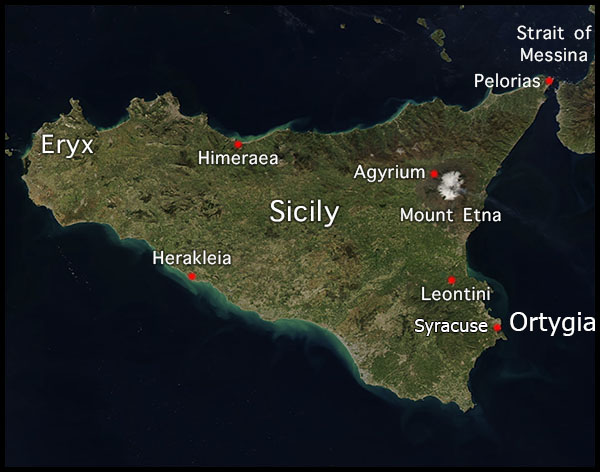
Apollon was finally born on the island of Delos and Artemis was born on the island of Ortygia, which is in the harbor of Syracuse, Sicily. Ortygia—as yet unnamed—was given to Artemis by the Immortals and named Quailland (Ὀρτυίη) in her honor. Ortygia was generally referred to as an "island" but was connected to the mainland by a narrow strip of land and thus a peninsula. In historical times, Ortygia was considered to be one of the four distinct subdivisions of the city of Syracuse.
The Nymphs of Ortygia created a fountain called Arethusa. The large and numerous fish inhabiting to fountain were considered sacred to Artemis ... eating the fish would incur serious punishment from the goddess.
Artemis's association with Ortygia was multifaceted. Apparently, there was a Nymph named Ortygia who was the nurse of Leto during Artemis's birth. There is a small island named Rhenaia approximately one half mile from the island of Delos, Apollon's birthplace. Rhenaia was formerly known as Ortygia. It was forbidden to bury people on Delos so Rhenaia (Ortygia) became the cemetery of Delos. A magnificent temple of Artemis, which was one of the Seven Wonders of the Ancient World, was located on the western coast of Anatolia in Ephesus. North of Ephesus, set back from the sea, was a city named Ortygia, which was also sacred to Artemis.
Apollon took up the bow and lyre but is often called Apollon of the Golden Sword ... Artemis became the huntress and the clamorous protector of all wild and innocent things. Artemis discovered how to affect the healing of young children and determined which foods are most suitable for children ... she is thus called Kourotrophos (Child-Rearer).
When Apollon leaves his shrine at Delphi and travels to Mount Olympos, the other gods and goddesses gather to hear the beautiful music he plays on the lyre. He sings with the Muses, the nine goddesses of the creative arts ... they sing of the unending gifts the Immortals enjoy and the sad plight of mortals who must endure the pains of illness and the failings of old age. Hebe (goddess of youth), the Kharites (Graces), the Horae (Hours), Harmonia, and Aphrodite join hands and dance ... Artemis also sings to her brother's irresistible melodies.
The story of Niobe is meant to be a lesson in humility as well as an injunction against blasphemy.
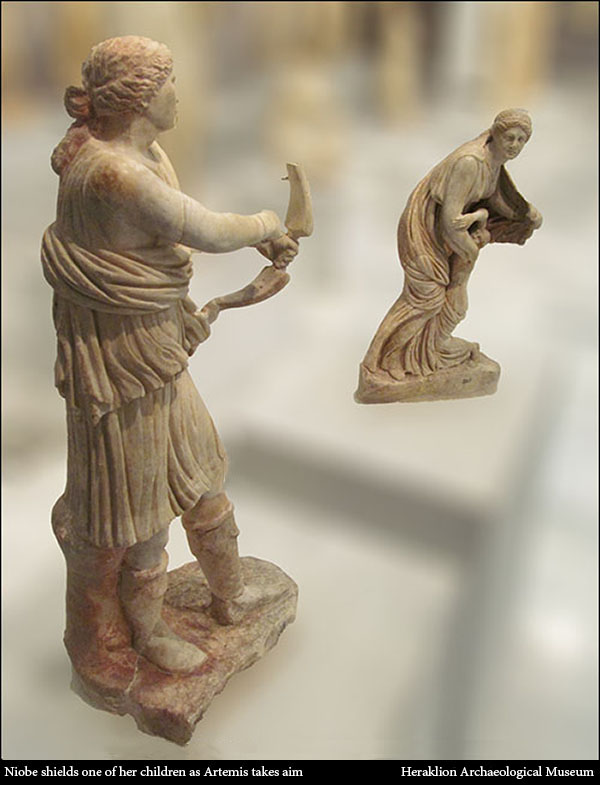
Niobe was the daughter of Tantalos and the sister Pelops, eponymous founder of the Peloponnesian Peninsula. She was the mother of seven sons and seven daughters, of which she was very proud ... perhaps, too proud. She would frequently boast that she was more blessed with children than the goddess Leto ... after all, Niobe had fourteen children and Leto had only two.
Leto became weary of Niobe's arrogant boasting and sent Apollon and Artemis to kill Niobe's children. Apollon and Artemis did as their mother commanded but it seems that only twelve of the children were slain. One daughter and one son survived because of their prayers to Leto ... their names were Meliboea and Amyklas ... Meliboea was struck ghostly white from the frightening experience and was afterwards called Khloris (Pale).
Niobe was supposedly turned to stone and placed on Mount Sipylos to eternally weep for her children. When the traveler-historian Pausanias was on Mount Sipylos, he observed, "When you are near, it is a beetling crag with not the slightest resemblance to a woman, mourning or otherwise; but if you go further away you will think you see a woman in tears, with head bowed down."
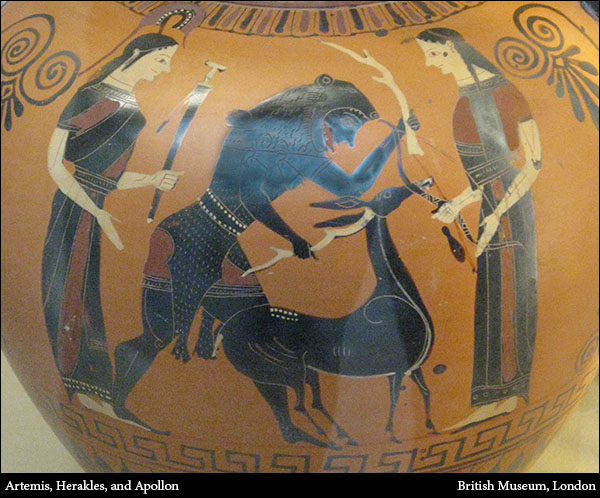
The semidivine hero Herakles was given Twelve Labors at the command of his cousin, Eurystheus. Herakles encountered Apollon and Artemis while he was completing his Third Labor—Capturing the Keryneian Hind. Herakles was required to capture a deer with golden horns and return the beast to Mykenai. The Keryneian Hind was sacred to Artemis and had been named after a Peloponnesian river. Herakles spent a year searching for the elusive deer before he was able to capture it.
While returning the hind to Eurystheus, Herakles was stopped by Apollon and Artemis. They demanded the return of the sacred creature, but Herakles successfully argued the justice of his quest and was allowed to complete his Labor with the blessings of Apollon and Artemis.
The hunter Orion encountered Artemis and Leto on the island of Krete ... he had been recently punished with blindness and then healed but he learned nothing from the ordeal ... his vanity and brutality remained his trademark. While hunting with Artemis and Leto, Orion threatened to kill every wild beast on the earth. Ge (Earth) was so annoyed with Orion that she sent a giant scorpion to sting and kill him. Artemis and Leto prayed to Zeus that Orion be put in the heavens as a major constellation to honor his manliness and there he remains today with the scorpion beside him.
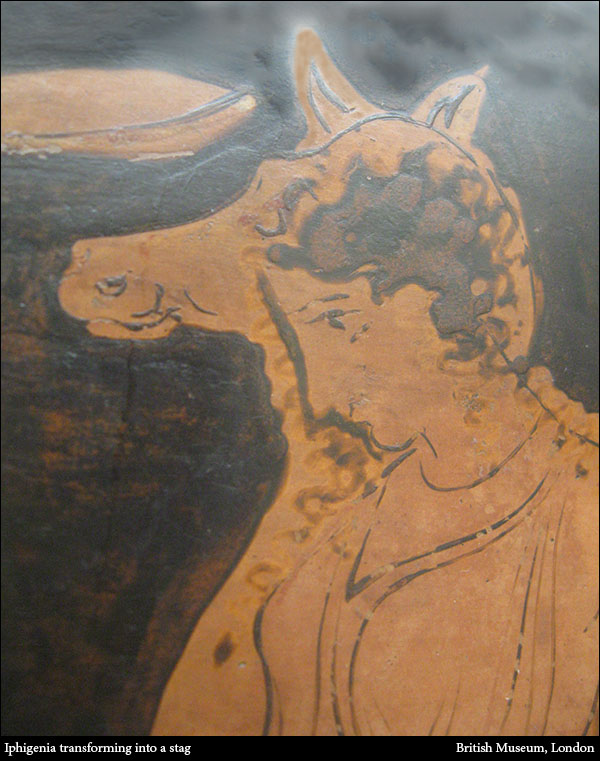
The preparations for the siege of Troy were well under way when the Greek fleet rendezvoused at the port town of Aulis. While at Aulis, Agamemnon offended Artemis with his boasting. Such disrespectful behavior could not go unpunished ... at the bidding of Artemis, Boreas (North Wind) would not let the ships leave the harbor. The seer Kalkhas said that unless Agamemnon sacrificed his daughter Iphigenia to Artemis the fleet would not be allowed to leave. Agamemnon had Iphigenia (or perhaps her name was Iphianassa), brought to Aulis on the pretext that she was to marry Achilles, the most virile man in Greece. When the time for the sacrifice came, Artemis took Iphigenia from the altar and substituted a stag in her stead. Artemis transported Iphigenia to Tauris where she became an immortal priestess to the goddess. Iphigenia was thus saved from the cruel sacrifice, but this incident set the stage for Agamemnon's tragic homecoming at the end of the Trojan War.
Agamemnon's wife Klytemnestra learned of the attempt to sacrifice Iphigenia to Artemis and, coupled with the lonely neglect of Agamemnon's ten-year absence, decided to kill him when he returned from Troy. Upon his triumphant return, Agamemnon paid no heed to the dire warnings from the ghost of Achilles or king Priam's daughter, Kassandra. He entered his palace oblivious to his fate and was brutally murdered by Klytemnestra.
Perhaps the most glorious tribute to Artemis was the Temple of Artemis at Ephesus. The temple was so magnificent it was included as one of the Seven Wonders of the World.
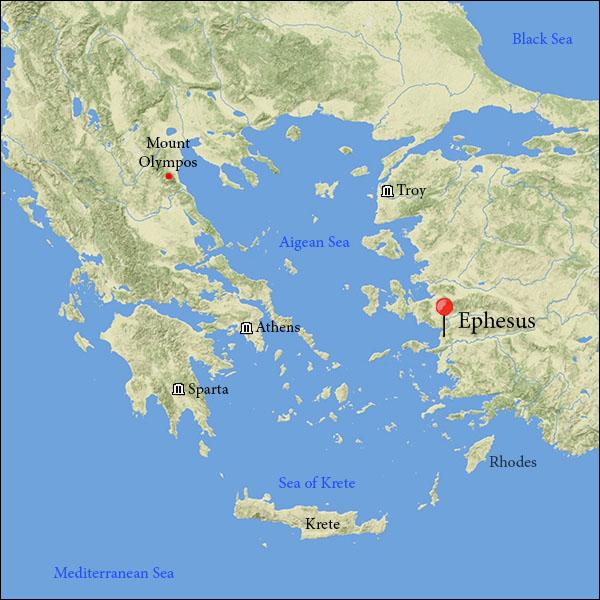

The site on which the Temple of Artemis was built had been a center of worship for an Anatolian Mother Goddess since prehistoric times. When King Kroesus of Lydia conquered Karia, of which Ephesus was the primary city, he built the first Temple of Artemis on the ruins of the temple of the Mother Goddess, which was on the estuary of the Cayster River (modern Kucuk Menderes). Construction began circa 560 BCE under the supervision of the engineer-architect Khersiphron.
The temple was utterly destroyed in 356 BCE when a man named Herostratus set fire to the wooden roof. The heat from the flames was so intense that the building, although mostly constructed of marble, was ruined. Herostratus is reputed to have arrogantly boasted that the men who built the temple would be forgotten but he would always be remembered as the man who destroyed it.
A new temple was built—gigantic by Greek standards—larger than the Parthenon at Athens or the Temple of Zeus at Olympia. The temple was built on the same site as the previous temples and although the proposed design was traditional, the scope and budget surpassed any previous construction project except for those in Egypt and Babylon. The new temple was a massive structure and measured 425 feet (130 meters) in length and 225 feet (78 meters) wide; the 60 foot (18 meter) columns were set on a 10 foot (3 meter) base and surmounted by a wooden roof that added another 20 feet (6 meters) to the overall height. The base of the temple had fourteen pairs of columns on each side and six pairs on each end.
A gold and ivory statue of Artemis was the centerpiece of the temple but there were numerous other statues decorating the interior and exterior. The building was surrounded by beautifully landscaped gardens and glades full of wild beasts suitable for the habitat of Artemis as the goddess of the hunt.
The temple supported a large staff of musicians as well as a choir and was well financed by Persian and Greek benefactors. The temple was a magnet for travelers and pilgrims not only because of its grandiose beauty but also because of its location in Asia Minor rather than on the Greek mainland. Persians, Greeks, and Europeans revered the goddess Artemis and found a commonality in her worship.
The city of Ephesus was devoted to the goddess and each spring there was a festival in her honor where contributions of jewels, gold, silver, silk, and other valuable gifts were presented to the priests and priestesses. The city of Ephesus and the temple were plundered in 262 CE by the Goths. The temple was rebuilt but never restored to its former grandeur. Finally, in 401 CE, the Patriarch of Constantinople supervised the utter destruction of the temple. The remaining temple artifacts were looted, and the massive stones were used to build churches and civic buildings.
After hundreds of years of peaceful splendor, the Temple of Artemis at Ephesus became relegated to the mist of legend and the once powerful symbol of Greek culture was doomed to be lost in time until the ruins were finally excavated in 1858 CE by the English engineer, John T. Wood.
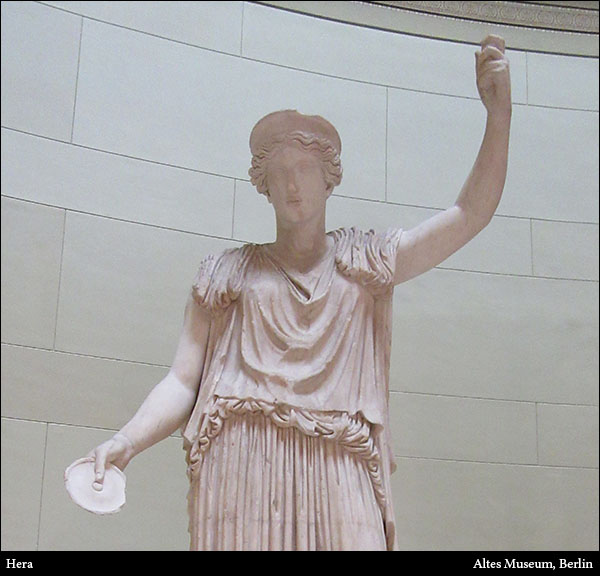
Artemis was humiliated when she confronted the goddess Hera during the final battle for the city of Troy. Artemis and her brother Apollon were clearly on the side of the Trojans, but Hera was determined to see the walls of Troy toppled and the Trojans killed or enslaved. When Artemis encountered Hera on the battlefield, the elder goddess warned her that her shameless and bold actions would not be tolerated. Hera knocked the bow and arrows from Artemis's shoulder before the young goddess could defend herself. (It should be mentioned that Artemis was a rather small goddess and always depicted in statuary as considerably smaller than any other god or goddess.) After being assaulted by Hera, Artemis fled the battlefield in tears and sought the protection of her father Zeus on Mount Olympos. Zeus had very little control over Hera and could only comfort his daughter ... after all, only her pride had been injured.
Aktaeon was a famous hunter who met a horrible fate because he incurred the wrath of Artemis. The details are not clear but Aktaeon was either too boastful of his hunting skills or he saw Artemis bathing and thus violated her privacy. Regardless of the way in which Aktaeon insulted Artemis, his fate was dreadful ... he was torn to pieces by his own hunting dogs. His death was a very clear warning to all hunters that Artemis was not inclined to forget or forgive insults to her skills or intrusions into her privacy.
Kallisto was the daughter of Lykaon and lived in Arkadia ... she was a lovely young woman ... her name means Most-Beautiful. Kallisto was a frequent companion of Artemis when the goddess roamed the mountains of Arkadia. Kallisto's beauty did not go unnoticed by Zeus ... he desired the young woman and eventually made her pregnant. Artemis did not know of the relationship between her father and Kallisto until she saw Kallisto bathing ... she was enraged to see that her companion was pregnant and transformed Kallisto into a bear. Kallisto's gave birth to a normal child and named him Arkas. Mother and son were eventually captured by some goatherds and returned to her father, Lykaon. Kallisto violated the law by going into the precinct of Zeus and was hunted down by Arkas and other Arkadians. Zeus saw her plight and placed her in the heavens as the constellation the Great Bear.
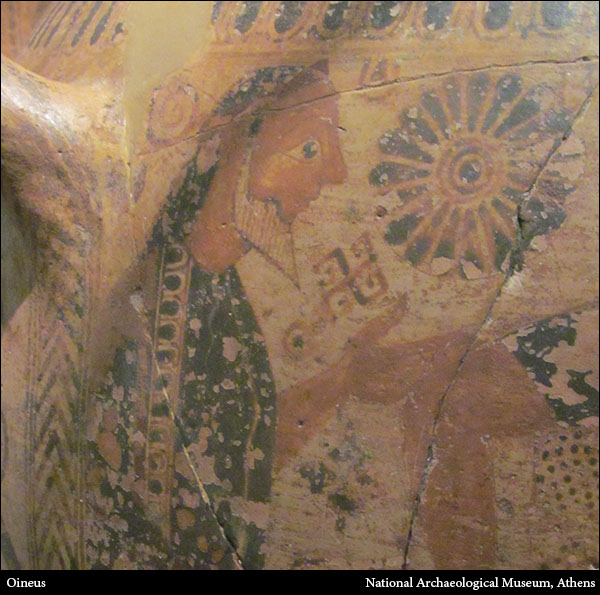
King Oineus of Kalydon offended Artemis and the resulting punishment became the backdrop for one of the most important gathering of heroes in the ancient world. After reaping an excellent crop of grain, Oineus offered sacrifices to all the Immortals except Artemis. As punishment for the oversight, Artemis sent a savage boar to ravage Kalydon ... it became known as the Kalydonian Boar. A company of heroes was assembled ... also a heroine was included ... her name was Atalanta. The hunt for the boar was led by Oineus's son Meleagros. Atalanta was the first to wound the boar and awarded the hide after Meleagros killed it.
A dispute arose when Meleagros's uncles—Iphiklos and Aphares—tried to take the hide from Atalanta. According to the poet Pindar, Meleagros killed both men for their temerity. Meleagros's mother Althaia felt compelled to avenge the murder of her brothers ... she initiated a series of events that resulted in Meleagros's death. If King Oineus had simply given Artemis the respect she deserved, the attacks by the savage boar, the murders of Iphiklos and Aphares, and Meleagros's tragic death could have all been avoided. The Kalydonian Hunt took place circa 1485 BCE, i.e. one generation before the Trojan War.
The ruling families of ancient Greece were often related. Meleagros was the cousin of Helen of Argos, who later became known as Helen of Troy. Queen Aphares, mother of Meleagros, was the sister of Leda, mother of Helen, Kastor, Polydeukes, Klytemnestra and Timandra.
Bellerophontes, a son of Poseidon, lord of the sea, had a very interesting life that was sometimes blessed and sometimes tragic. He had three children—Isandros, Laodameia, and Hippolokhos. Of the three, only Hippolokhos survived. Isandros was killed by Ares, god of war. Laodameia became the consort of Zeus and the mother of the hero Sarpedon. Like Kallisto, Laodameia was killed by Artemis but we are not told if she was killed because of her relationship with Zeus or for some other reason ... we are only told that Artemis killed Laodameia "in anger."
In order to support their siege of Troy, the Greeks would often raid neighboring towns and islands for slaves and supplies. On one such raid, Achilles attacked Thebe. Andromakhe, the wife of Trojan Prince Hektor was from Thebe. Andromakhe's father King Eetion and her six brothers marched out to defend their city ... they all died at the hands of Achilles ... he also took Andromakhe's mother hostage to be exchanged for ransom. The ransom was paid and the poor woman was returned to Thebe ... that's were Artemis killed her ... she died in a shower of arrows from Artemis's bow.
Princess Ariadne of Krete was killed by Artemis at the request of the god, Dionysos.
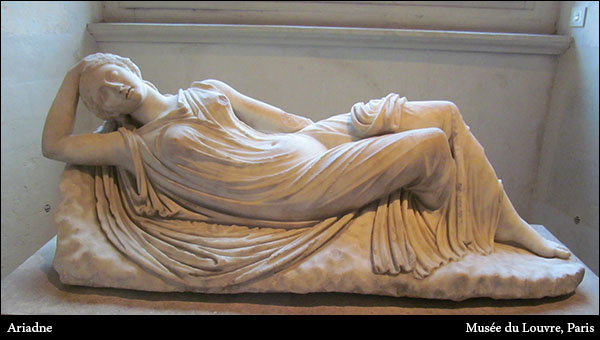
Ariadne endured love, betrayal and finally an undignified death. Ariadne's father, King Minos of Krete, ruled from the city of Knossos, which harbored the half-man, half-bull Minotaur. The beast was housed in the famous Labyrinth ... Ariadne defied her father and helped Prince Theseus of Athens navigate the maze and kill the Minotaur. Theseus took Ariadne onboard his ship with the promise to take her to Athens and make her his wife. They stopped at the island Dia and Theseus decided to abandon the young princess because "he found no pleasure in her." When the god Dionysos encountered her, Ariadne was at his mercy, but he had none ... at Dionysos's request, Artemis killed Ariadne.
The island of Syria is located off the coast of Sicily near Ortygia ... Ortygia was the birthplace of Artemis, therefore Ortygia, Sicily, and the surrounding islands are all sacred to Artemis. The land of Syria is fertile, and the inhabitants enjoy a life without disease or hardship. When it comes time for the Syrians to die, Apollon and Artemis kill them with arrows of mild death.
Eumaios, the swineherd of Odysseus, was kidnapped from his home on the island of Syria while he was still a child. Although Artemis did not prevent his kidnapping, she delivered divine retribution to the nurse who took the young boy from his home. Some Phoinikian sailors were on Syria and one of the scoundrels met and seduced Eumaios's nurse. The rogue sailor convinced the nurse to come with him so she could be reunited with her parents in Sidon. The nurse stole some goblets from Eumaios's parents and took the child to the ship with the intention of selling him in Sidon. Once the ship left Syria, Artemis pierced the nurse's heart with arrows ... the sailors unceremoniously dumped the dead nurse in the sea to be devoured by the seals and fish.
Antiokhos was a headstrong and antireligious man who tried to despoil the richly appointed Temple of Artemis in Elymais. The guardians of the temple and the neighboring people successfully defended the temple and Antiokhos was forced to withdraw. Soon afterwards, Antiokhos was driven mad by apparitions and terrors until he finally died of an unspecified disease. It was commonly believed that Artemis inflicted those punishments because of Antiokhos's sacrilege.
There is an interesting story in the Library of History by Diodorus of Sicily about an unnamed hunter who offended Artemis and paid for the insult with his life. A hunter living in Italy was in the habit of nailing the heads and feet of the animals he killed to trees as a dedication to the goddess. On one fateful occasion, the hunter killed a huge wild boar but instead of making the usual dedication to Artemis, he boasted that he would dedicate the head of the magnificent boar to himself. He hung the boar's head on a tree branch and fell asleep ... the thong holding the boar's head broke and fell on the hunter, killing him.
Hymns to Artemis
The Iliad
The Odyssey
Theogony
Aethiopis
Astronomy
Catalogues of Women and Eoiae
Catalogue of Women
Contest of Homer and Hesiod
Kypria
Hymn to Demeter II
Hymn to Delian Apollon
Hymn to Pythian Apollon
Hymn to Aphrodite V
The Histories by Herodotos
Description of Greece by Pausanias
Library of History by Diodorus of Sicily
The Argonautika by Apollonius of Rhodes