
| Ares the Olympian |
| Ares at War |
| Ares at Troy |
| Ares and Aphrodite |
| Ares and Herakles |
| Children of Ares |
| Places Named After Ares |
| Hymn to Ares |
| Bibliography |
| Previous Page |
| Homepage |
| Site Search |
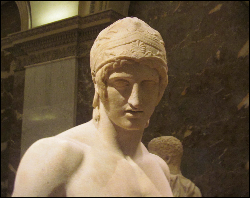
Ares is the god of war and his unquestionable authority comes from his immortal parents, Zeus and Hera. Mount Olympos was occupied by Immortals for several generations before Ares was born but Zeus finally established a permanent abode on Mount Olympos and allowed eleven other Immortals to make their homes on the sacred mountain. Ares became so important and influential that he was included as one of the twelve Olympians.
Ares was born in the second generation after the Titan gods. The Gold and Silver ages of men were over, and the age of Bronze dominated the inhabitants of the earth. The men of the Bronze Age were considered to be men of Ares ... they lived and died by their bronze weapons and left no heritage other than the memory of their bitter conflicts. The world they inhabited was as bright as the gleam of their weapons and as dark as the blood they spilled. Ares was the incarnation of that warlike ideal and represented not only the act of war but the spirit of war.
Ares has two sisters—Hebe (goddess of youth) and Eileithyia (goddess of childbirth). Ares had many semidivine children, but his most important and surprising relationship was with Aphrodite, goddess of love. At first it might seem illogical that Ares and Aphrodite would be attracted to one another, but their union can be thought of as the reconciliation of opposites ... the essence of love and the spirit of war coming together to produce the children: Harmonia (Harmony), Deimos (Fear) and Phobos (Panic).
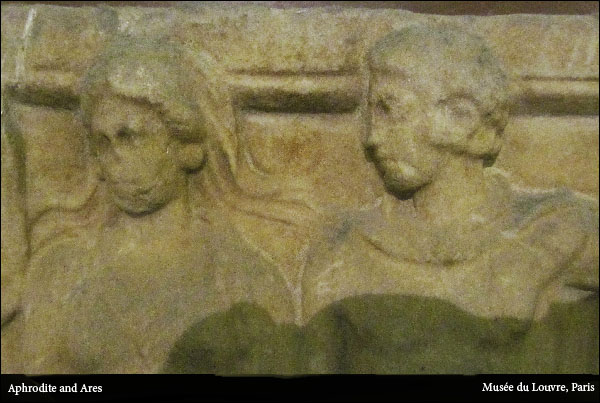
In the Odyssey by Homer, the singer, Demodokos, tells the tale of how Aphrodite and Ares secretly laid together in the bed of her husband, Lord Hephaistos, the smith of the gods. Helios (Sun) secretly observed the lovers and told Hephaistos of Aphrodite's betrayal.
The smith went to work and devised clever fastenings to ensnare and hold the lovers in an unbreakable trap. The careless lovers fell into the trap and Hephaistos stood before the other Olympians and demanded that his gifts of courtship be returned. Only after Poseidon (lord of the sea) offered to guarantee the adulterer's damages would Hephaistos loose the bonds.
After being freed, Aphrodite went to her sacred precinct on the island of Kypros where she was bathed by the Kharites (Graces) ... Ares went towards Thrake. Seeing the two lovers in the indignity of the snare, Apollon asked Hermes how he would feel in such a situation. Hermes answered that he would suffer thrice the number of bonds if only he could share the bed of Aphrodite the Golden.
Ares was the inspiration for and initiator of warfare ... he began by making war on those who were disobedient to the gods and introduced the wearing of armor by mortal men. The goddesses Eris (goddess of discord and strife) and Enyo (one of the Gray Sisters) often accompanied Ares into battle ... their relationship to him was so close that they were sometimes referred to as his sisters.
Hades (lord of the dead) was also a companion of Ares because any time Ares unleashed his fury there were always casualties to be inducted into the realm of the dead. When Ares appeared on earth, the skies would darken ... his might was considerable but he was not invincible ... the goddess Athene was his equal and even the semidivine Herakles could wound and cower the god of war. All great warriors would call upon Ares to aid them in the fighting ... even Herakles respected Ares and gave him appropriate honors when he was going into battle.
Ares was firmly on the side of the Trojans when the Achaians laid siege to the city of Troy. Ares rode into battle with his gold-bridled horses, Flame and Terror, pulling his war chariot. He fought alongside Apollon and Aphrodite and, although fierce, Ares was not unassailable.
Aphrodite also defended the Trojans and was wounded when she tried to protect her son Aineias from the Achaian commander, Diomedes. Aphrodite retreated to the edge of the battlefield and found Ares with his spear leaning on a cloud. He gave her his chariot to ride to the safety of Mount Olympos to tend her wounds.
The elder goddess Dione treated Aphrodite's wounds and reminded the sobbing goddess that the Immortals were not immune to hardship and suffering. Dione told Aphrodite about the time Ares had been captured and bound by the Giants, Ephialtes and Otos. The two daring brothers imprisoned Ares in a brass jar for thirteen months until Hermes (messenger of the Immortals) freed the humbled god of war.
The Dread-Goddess Athene delighted in the works of Ares but she would fight against him as well as with him. During the siege of Troy, Athene stood against Ares and was victorious on several occasions. Pallas Athene donned the Helm of Death and, after deflecting Ares's spear, hurled a bolder, knocking Ares senseless ... the din of the battle was eclipsed by Ares's bellowing ... his savage cry of pain made the sound of nine thousand men. Aphrodite came to Ares's assistance but, as she was helping Ares from the battlefield, Hera urged Athene to attack Aphrodite ... Athene struck Aphrodite in the breast and knocked her and Ares to the ground ... she stood over them and warned them that the same fate would befall any Immortal who allied themselves with the Trojans. Ares reluctantly retreated to Mount Olympos to be treated by the immortal physician Paieon. Seeing his wounded son, Zeus rebuked Ares by saying, "To me you are most hateful of all gods who hold Olympos."
Ares's son Askalaphos was one of the casualties of the Trojan War. Ares was furious when he heard the news. The goddess Hera added to his anger by saying that Zeus had no concern for the sorrow of the Immortals or the death of their children ... she also cautioned Ares that he must not disobey Zeus by entering the battle to avenge the death of Askalaphos. Ares slapped his thighs and ordered his sons, Deimos (Fear) and Phobos (Panic), to harness his horses so he could leave Mount Olympos and go to the battlefield of Troy ... Athene stopped Ares and took his helmet and shield ... she reminded him that all the Immortals would be punished if he defied Zeus ... she took his mighty spear and made him sit passively as the war at Troy proceeded in accordance with Zeus's plans.
Ares occasionally took the guise of mortal men to fight alongside the Trojan soldiers. When Trojan Prince Hektor took the armor of Achilles from the dead body of Patroklos, Ares entered Hektor's body and led a fierce charge into the Achaian battle-lines ... the Achaians prudently withdrew in the face of such ferociousness. He also took the guise of a storm-cloud and bellowed from the walls of Troy to remind the Achaians that the war god was standing against them.
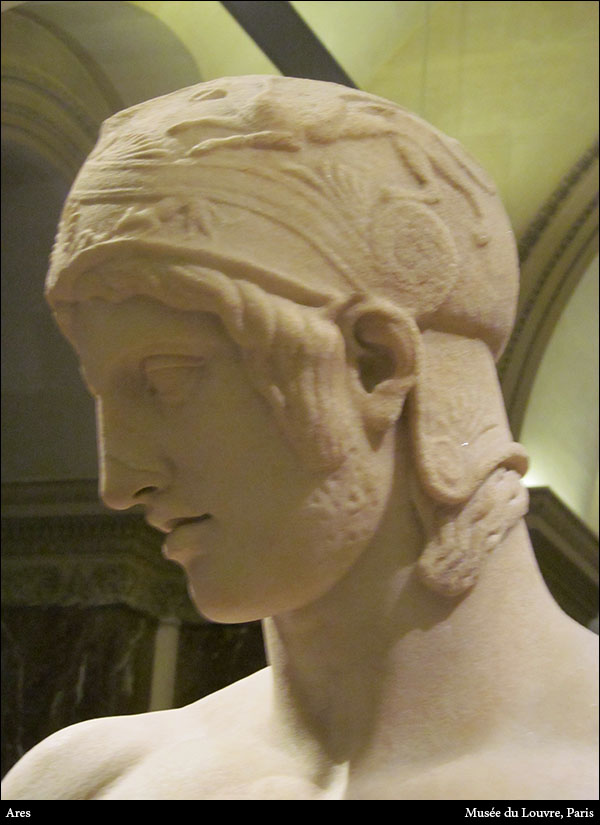
Like Ares, Herakles was a son of Zeus, but Ares was the son of the goddess Hera and thus fully divine and immortal. Herakles was the son of a mortal woman named Alkmene and only semidivine, but Herakles had the advantage of being Zeus's favorite child. Ares, on the other hand, was Zeus's least favorite.
Ares and Herakles had at least two violent encounters ... Herakles won both fights. The first confrontation was at the city of Pylos on the Peloponnesian Peninsula. Ares was defending Pylos when Herakles attacked the city ... Herakles struck Ares three times with his spear and knocked the god of war to the ground with each blow ... on the fourth attack, Herakles's spear pierced Ares's shield and cut into Ares's thigh. Although defeated, Ares managed to retain the spoils he had captured, otherwise he would have been disgraced among the other Immortals.
Ares and Herakles met again when Ares's son Kyknos was caught stealing animals that were to be sacrificed at Apollon's temple at Delphi. Apollon chose Herakles to be his champion and punish Kyknos for his acts of sacrilege. Herakles found Kyknos and Ares in a grove scared to Apollon ... the goddess Athene appeared to Herakles and told him he was destined to kill Kyknos but he should be careful because Ares would to attack him after Kyknos was dead.
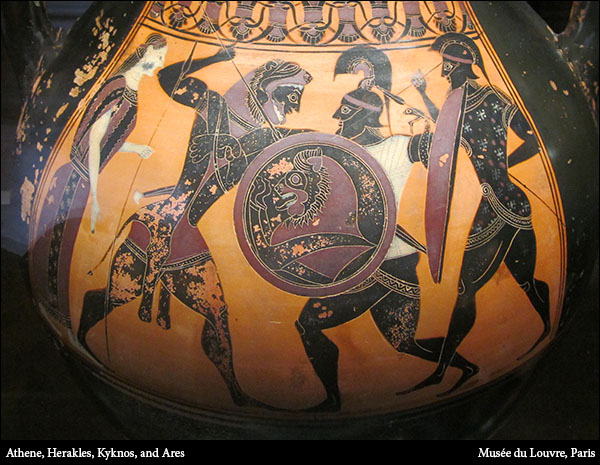
Herakles killed Kyknos with a single thrust of his spear. After the death of Kyknos, Ares could not contain his anger, he immediately charged at Herakles with his spear ... the goddess Athene intervened and turned the force of the spear-thrust aside and told Ares that he was not destined to kill Herakles and should withdraw from the fight. Ares was not inclined to obey Athene's command ... he drew his sword and attacked Herakles again. Herakles did not back away from the war god's fierce attack ... he stabbed upwards under Ares's shield with his spear and the point tore into Ares's exposed flesh ... Ares fell flat upon the ground.
Ares's sons, Deimos and Phobos swooped down in Ares's chariot and lifted their father from the ground ... they lashed the chariot horses and were off to the safety of Mount Olympos.
Besides his three immortal children—Harmonia, Deimos and Phobos—Ares sired children with mortal women ... the following is a partial list:
Penthesilea was an Amazon queen and a daughter of Ares. She went to Troy as an ally of the Trojans and was killed by Achilles. An Achaian soldier named Thersites reviled Achilles saying that, although he killed Penthesilea, he was actually in love with her. In his rage, Achilles killed Thersites. The other Achaians were outraged and there was turmoil in the Achaian encampment. Seeking forgiveness, Achilles sailed to the island of Lesbos and made sacrifices to Apollon, Artemis, and Leto. After the sacrifices were completed, Achilles was purified of his blood guilt by the Achaian commander, Odysseus.
Ares had two sons by Astyokhe, daughter of Aktor. His two sons—Askalaphos and Ialmenos—commanded the soldiers from Aspledon and Orkhomenos with thirty ships for the siege of the city of Troy.
True to his bloodthirsty heritage and to keep his mares battle-keen, Diomedes fed his mares human flesh. Herakles was given the task of taking the mares from Diomedes regardless of what Diomedes said or did. Diomedes died for his savage behavior and Herakles took the mares to complete his Eighth Labor. It's not clear whether Diomedes was killed defending his horrible horses or if Herakles fed him to the mares as a just desert.
Melanippe was the daughter of Ares who was taken hostage by Herakles when he was trying to complete his Ninth Labor (Retrieve the Belt of the Amazon, Hippolyte). Herakles held Melanippe captive until Hippolyte gave him the Belt (or Girdle) as ransom.
Alkippe was the daughter of Ares who was ravaged by Poseidon's son Halirrhothius. Ares was enraged and killed Halirrhothius. This must have happened at the dawn of mortal-time because Ares was put on trial as the first to shed blood.
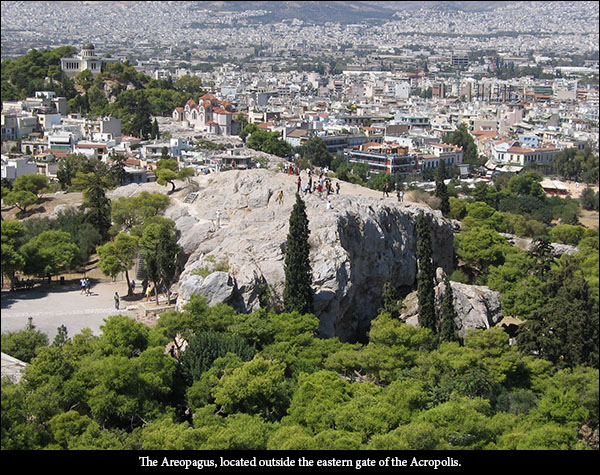
The Hill of Ares is on the Acropolis of Athens and is commonly called the Areios or Areopagus. Areios means Warlike or Martial. The Areios was where Ares was tried as the first to shed blood. Ares's daughter Alkippe was ravaged by Poseidon's son, Halirrhothius, and Ares took revenge for the savage act by killing Halirrhothius. A trial was held and Halirrhothius's murder was deemed justified. The Areios became the site for murder trials and if convicted, the offenders were thrown to their death from the Areios.
The Grove of Ares played a pivotal role in the Quest for the Golden Fleece by Ieson (Jason) and the Argonauts. The Golden Fleece was the hide from a flying ram that had been created by Helios (Sun) and Nephele (Cloud) to allow Helle and Phrixus to escape the machinations of their father and evil stepmother—King Athamas and Ino. Helle died in the escape but Phrixus managed to reach Kolkhis at the eastern edge of the Black Sea. The ram was sacrificed to Zeus and then placed in Ares's sacred grove.
King Aietes of Kolkhis did not want to surrender the Golden Fleece and assumed it could not be stolen because an ever-vigilant dragon lived in the Grove of Ares. Sometimes referred to as the Garden of Ares or the Sanctuary of Ares, the Grove of Ares was absolutely secure ... or so Aietes mistakenly believed.
Ieson and the Argonauts were able to steal the Golden Fleece with the help of King Aietes sorceress daughter, Princess Medeia. She cast a spell on the dragon with a hypnotic song and undiluted potions ... Ieson took the Golden Fleece from the Grove of Ares and fled Kolkhis.
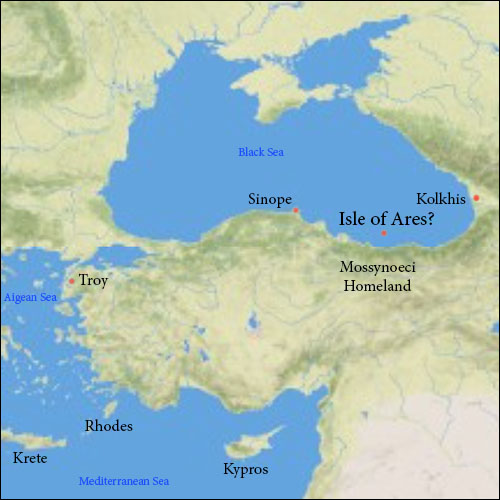
The Isle of Ares is an island in the Black Sea that became the backdrop for a harrowing adventure for Ieson and the Argonauts as they were sailing to the land of Kolkhis in search of the Golden Fleece. As the Argonauts approached the Isle of Ares, they came under attack by a flock of vicious birds that Ares used to protect the island from unwanted visitors. The birds would swoop down on the Argonauts and release dagger-like feathers ... an Argonaut named Oileus was severely wounded. The Argonauts put on their armor and clashed their swords against their shields to frighten the birds away. Once they made landfall, the Argonauts found four shipwreck survivors. The four men were the sons of Phrixus ... Phrixus was the man who had ridden the ram with the Golden Fleece to Kolkhis and sacrificed the animal in the Grove of Ares. The four brothers joined the Argonauts and they proceeded to Kolkhis to steal the Golden Fleece and complete their mission.
The exact location of the Isle of Ares is a mystery. When describing the Isle of Ares, Apollonius of Rhodes, author of Argonautika, noted that the island was near the homeland of the barbaric Mossynoeci. With that in mind, we might place the Isle of Ares in the general location shown on the following map.

Ares was the name the ancient Greeks gave to the planet we call Mars ... Mars was the Roman god of war. It's assumed that the "Red Planet" was named after the god of war because its color reminded the ancients of blood ... Ares is of course the god of blood and gore.
The Iliad
The Odyssey
Works and Days
Theogony
Catalogues of Women and Eoiae
Catalogue of Women
Shield of Herakles
Hymn to Pythian Apollo
Hymn to Aphrodite
Epigrams of Homer
Kypria
Aethiopis
Little Iliad
Telegony
Battle of Frogs and Mice
Contest of Homer and Hesiod
The Histories by Herodotos
Library of History by Diodorus of Sicily
The Argonautika by Apollonius of Rhodes
Description of Greece by Pausanias