
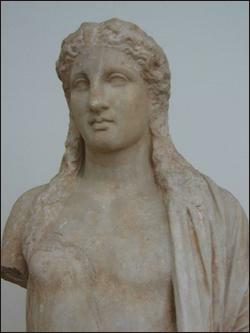
Apollon is known by many names—Phoibos Apollon, Phoibos, Loxias, the Archer, the Far-Shooter, Lord of the Silver Bow, Shooter from Afar, Son of Leto, God of Delphi, and Far-Darter. However, for understandable yet unforgivable reasons, there are some who insist on calling him Apollo. They seem to have forgotten that Apollon is Greek, and Apollo was Roman.
At the time of the Trojan War (circa 1250 BCE) Apollon was quite old. As an Immortal, he retained his youthful appearance but in human years he was very old when he fought at Troy. A thousand years after the Trojan War, the Romans included a sun god named Apollo in their pantheon ... he was the son of Latona and Iuppiter, and brother of Diana. Apollon was the son of Leto and Zeus, and brother of Artemis. Apollon should never be confused with the real god of the sun, Helios.
Many of the Greek Immortals and Roman deities had similar attributes but they were certainly not "identical" or "equivalent" ... let's leave Apollo to the Romans and discuss the Greek god Apollon.
Apollon and his sister Artemis are the immortal children of Zeus and Leto. Zeus is considered to be the father of the gods even though he was born several generations after the Immortal race was spawned by Khaos. Zeus and Leto were both children of Titans ... Leto's parents were Koios and Phoibe ... Zeus's parents were Kronos and Rhea.
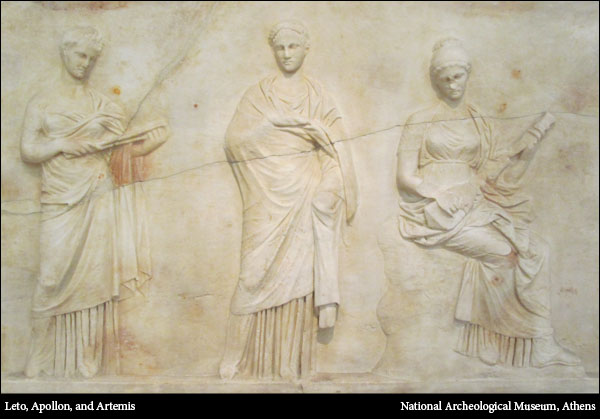
Leto was the consort of Zeus ... his sister-wife Hera was not pleased when she became aware that Leto was pregnant with twins. When it came time for her children to be born, Leto traveled far and wide to find a suitable birthplace. The Nymphs of the various islands and provinces were reluctant to allow their domains to be the home of Leto's twins because they knew Hera was angry with Zeus for his association with Leto ... the Nymphs were justifiably afraid that Hera would vent her wrath on any Immortal who assisted Leto.
The goddess Delos had a rocky island in the southern Aigean Sea that Leto thought would be the perfect birthplace for Apollon. Delos was aware of the dangers she faced by helping Leto, but she also knew that Leto's children would be honored by mortal and immortal alike. To protect herself, Delos made Leto swear a great oath on the waters of the river Styx that her new son would never abandon his birthplace and always keep his temple on the humble island. Leto swore the oath and Apollon was soon to be born on the island of Delos. An oath taken while pouring the waters of Styx was the most binding oath an Immortal could swear.
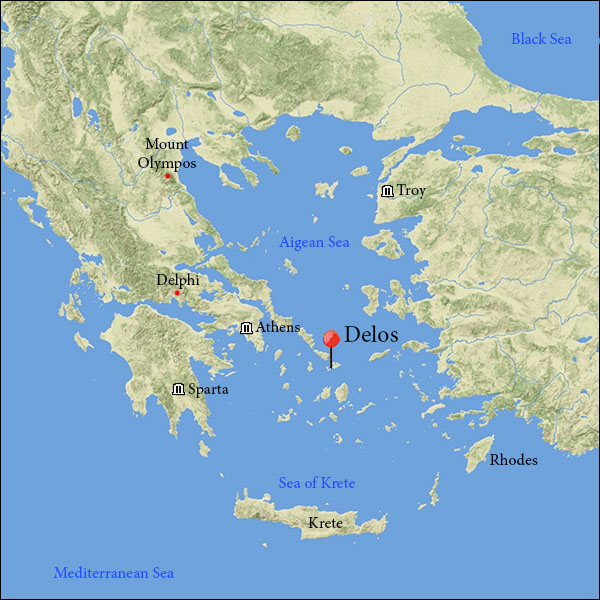

The goddesses Rhea, Dione, Themis, Aphrodite (goddess of love), and two Hyperborean maidens went to Delos to attend Apollon's birth. Hera knew she couldn't prevent the birth of Apollon, but she was determined to make it as difficult as possible. Hera distracted her daughter Eileithyia (goddess of childbirth) so that Apollon's birth would be delayed, and Leto would suffer for the presumed insult to the queen of the goddesses. Finally, the assembled goddesses dispatched Iris to bring Eileithyia to Delos ... Iris flew to Mount Olympos and waited until Hera was not looking to tell Eileithyia of the situation ... the two goddesses returned to Delos where Apollon's birth proceeded without further delay. Leto had been in labor for nine days and nights before Apollon was born.
Apollon was born on the seventh day of the month and that day is considered to be holy. He did not nurse at his mother's breast because he was given ambrosia and nectar, which are the food and drink of the Immortals. He burst from his crib and announced his intentions to play the lyre, carry the curved bow, and declare the unfailing will of Zeus to the mortals of the earth.
The island of Delos became rich and beautiful with the presence of Apollon and Leto ... the mountains bloomed with flowers and people came from all regions to make generous donations to the shrine of Apollon. Games and dances inspired the worshipers, but the handmaidens of Apollon were the most amazing attraction on the island ... they had the ability to sing in such a way that each person heard them in his or her native tongue.
Although she was not born on Delos, Apollon's sister Artemis is considered to be his twin ... she is skillful with her silver bow and aids the people of the earth by giving comfort to the weak and unfortunate. Artemis is often called the Virgin Goddess of the Hunt or simply Goddess of the Hunt.
Apollon was given another responsibility by Zeus ... he was to join with the daughters and sons of Tethys and Okeanos (Ocean) to protect mortal children. Apollon, the Okeanids and the Rivers were excellent choices for that important task.
Apollon sought to establish a shrine of prophecy and conceived a plan whereby he could build and populate a new city for that purpose. Apollon did not make a hasty decision as to where his temple would be built ... he traveled throughout Greece and Asia Minor seeking the perfect location. The place he finally chose was Delphi, located at the foot of Mount Parnassos in central-southern Greece just north of the Gulf of Korinth in the district of Phokis.
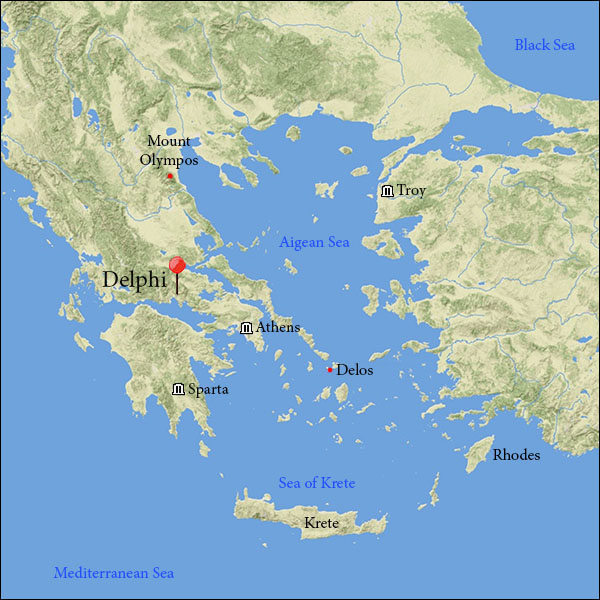
The site was inhabited by the streams of Telphousa and a great she-dragon ... neither wanted a city or a god as their neighbor. Telphousa tried to beguile Apollon but he eventually saw through her manipulation. The she-beast was known to be deadly to anyone who came near her ... Apollon shot her with an arrow and exalted over her as she lay dying in the holy light of Helios (Sun). From that time on, Delphi was called Pytho and Apollon became known as The Pythian because Helios made the creature rot away (πυθώ = pytho). Apollon then turned his attention to Telphousa ... she had tried to mesmerize him and he punished her by causing a rockslide to cover her waters ... in the grove where she once flowed Apollon is worshiped as The Telphousian Lord signifying his domination over her.
The site of the temple had been chosen and secured ... the foundations had been laid ... now Apollon needed ministers to supervise the sacrifices and administer the temple. As he pondered this problem, he became aware of a ship on the sea ... the men on the ship appeared to be goodly men from the island of Krete ... Apollon at once decided that they would serve him well. In the form of a dolphin, Apollon approached the ship and leapt onto the deck ... the men on the ship were perplexed but were unable to remove the disguised god from the vessel. Apollon took control of the ship and steered it to the proximity of Delphi and ran it aground on the shore. Apollon transformed from a dolphin into a flaming star and flew from the ship to his temple at Delphi ... the sky lit up and the people in the surrounding countryside were terrified.
Apollon returned to the beached ship in the guise of a young man ... the men on the ship knew that the young man who stood before them was a god and begged for mercy and understanding. Apollon told them his true identity and that he had brought them to that place so they could become his ministers and serve him at his temple. The men willingly accepted his commands and went to the temple ... Apollon promised them that they would want for nothing as long as they were not idle or disobedient ... he would put the will of Zeus in their hearts so they could advise the worshipers. In turn the worshipers would provide the necessities of life for those who served him on the rocky folds of Mount Parnassos.
Apollon's temple at Delphi quickly became famous for the prophecies recited by the Pythia, i.e. the priestess/medium. Apollon would speak through the Pythia and make the will of Zeus known to worthy patrons. The Pythia would traditionally give the prophesies of the god in hexameter poetry ... the verses recited by the Pythia would usually be enigmatic ... they were mysterious but not necessarily unfathomable.
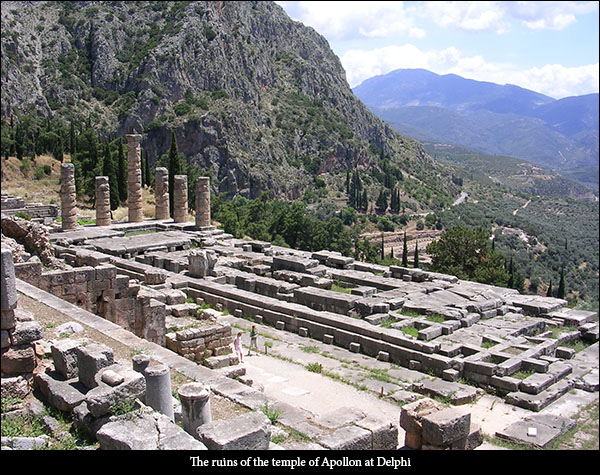
The way in which it was first realized that the oracular trances induced at Delphi were a direct communication with Apollon is as mysterious as the accuracy of the oracles themselves. The residents of Delphi told the traveler-historian Pausanias that shepherds were perhaps the first to inhale the vapors of the mountain and give prophecy as "the mouthpiece of Apollon," however the prevalent view was that a woman named Phemonoe was the first Pythia and the first to give the prophecies in hexameter verse. A native woman of Delphi named Boeo composed a hymn stating that a Hyperborean named Olen was the first to prophesy and the first to chant the hexameter oracles.
The exact date when the first temple was built at Delphi is not known but we can assume the site went through an evolutionary process that took thousands of years to become a monumental stone structure ... only the ruins of the temple of Apollon remain but we can easily imagine its former magnificence.
The first temple of Apollon at Delphi was made of laurel branches from Tempe. The temple is assumed to have been simplistic in size and shape but none the less awe inspiring because it was the dwelling place of the god. The second temple of Apollon was more supernatural in its construction ... it was made by bees from beeswax and feathers. At first this might seem like an extraordinary claim but it becomes more reasonable if we remember that there was a sect of priestesses of Artemis known as the Melissonomoi, i.e. the Bee-Keepers ... for Artemis to have her priestesses assist her brother by building a temple for him seems quite reasonable. Finally, the second temple was sent to the Hyperboreans by Apollon. The Hyperboreans, as the name implies, occupied a region in the far north, beyond the abode of Boreas, the North Wind. A special relationship existed between the Hyperboreans and Apollon. It's not mentioned in the early texts but the historian Diodorus of Sicily made note that Leto, Apollon's mother, was born on an island of the Hyperboreans. The island is unnamed but if Leto was indeed born there it would explain Apollon's frequent visits to the Hyperboreans as well as their devotion to him.
The Omphalos was one of the most important features of the temple of Apollon at Delphi. Simply speaking, the Omphalos was a stone ... but it was not just any stone. The Omphalos was the stone Kronos was tricked into swallowing by his sister-wife Rhea.
When Kronos ruled heaven and earth, he was given a prophecy that his son would usurp his powers ... Kronos began swallowing his children as soon as they were born so there would be no chance that one of them could threaten his authority. Rhea became weary of Kronos's obsessive behavior and when her sixth child was born, substituted a stone in place of the baby ... Kronos swallowed the stone down without noticing he had been tricked.
Rhea named her child Zeus and took him to the island of Krete where he would be safe from Kronos. When Zeus attained manhood, he assaulted his father, kicking him in the stomach with such force, the stone was vomited up along with the other children Kronos had swallowed. True to the prophecy, Zeus deposed Kronos and became ruler of all creation. Zeus took the stone Kronos vomited up and placed it at the foot of Mount Parnassos near the city of Delphi and proclaimed that the stone would be a portent and marvel for the mortals of the earth for all time. The stone was called the Omphalos (Navel) and Delphi became known as the Navel of the Earth.
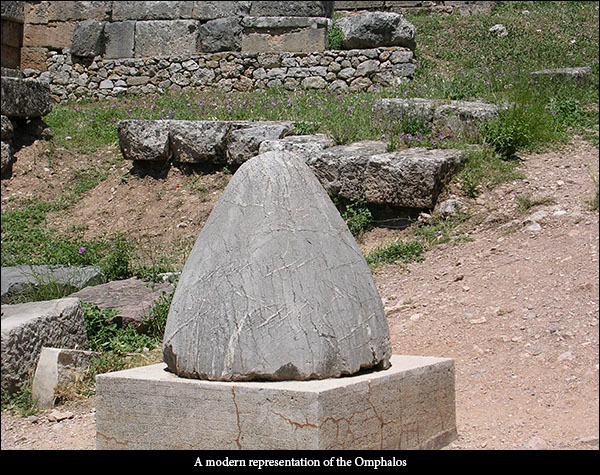
Although the original stone has been lost for almost two thousand years, it is thought to have been conical in shape and endowed with supernatural powers. There is a replica (pictured above) of the stone on display at the entrance to the ruins of the temple of Apollon at Delphi but we cannot be certain of the shape or size of the original stone. The traveler-historian Pausanias reported (circa 160 CE) that he had seen a stone of unremarkable size that was said to be the original stone.
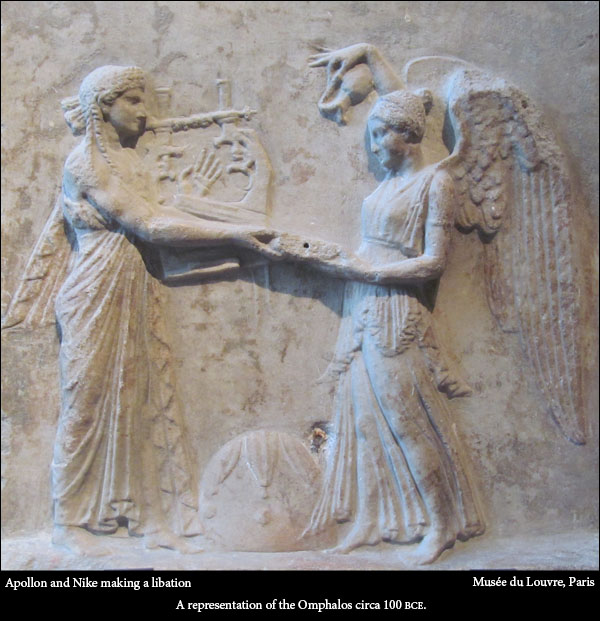
There are numerous examples in the ancient literature of the prophecies given by the Pythia at Delphi, but I will only present a few of the more famous ones here.
Circa 776 BCE, the city of Sparta went through a complete reformation of its laws and social structure. One man is credited with that transformation, Lykurgos.
No aspect of Spartan culture was overlooked by Lykurgos ... every man, woman, and child were given a clearly defined role in society and laws were enforced without regard to military rank or social standing ... kings and shop keepers were held to the same standards.
Lykurgos was a driven man and did his best to have his new laws implemented without delay but he was also a reasonable and religious man. Lykurgos truly wanted what was best for Sparta and in that spirit, went to Delphi to ask the Pythia for Apollon's determination on his proposed innovations. The message from Apollon was unambiguous:
With the blessings of Apollon, Sparta became a strictly regimented military state virtually overnight.
Gyges consulted he Oracle at Delphi to justify the murder of the king of Lydia.
Gyges became involved with the queen of Lydia and by using blackmail, she maneuvered him into killing her husband, King Kandaules. Not everyone in Lydia supported Gyges because he had not only killed their king, he had killed a descendant of Herakles. When the resulting civil war became a stalemate, it was agreed that the Oracle at Delphi would decide the matter. The Pythia announced that Gyges should remain on the throne of Lydia, however it was not publicly known that the Pythia also declared that Gyges's descendants would only rule for five generations.
Just as the Pythia had ordained, after five generations King Kroesus was the last king of Lydia in the bloodline of Gyges.
Kroesus was the king of Lydia from 560-546 BCE.
Kroesus wanted to know if oracles could be trusted but he did not want to appear disrespectful to the Immortals by openly doubting them. Kroesus sent messengers to several oracular sites with a specific question to be asked on a specific day and time. His question was essentially, "What am I doing right now?" Kroesus sent messengers to Abae, Dodona, and Delphi as well as other Greek and foreign oracular sites. His messengers were instructed to ask the question, write down the response and then return to Lydia.
The response from the Pythia at Delphi was the only correct answer:
At the exact time the question was asked of the oracles, Kroesus had been cooking a tortoise and lamb in a covered bronze pot ... the Pythia described the event with uncanny accuracy. After that, Kroesus trusted the Oracle at Delphi implicitly.
As Kroesus became more aggressive, he set his sights on portions of the Persian Empire to his east. He consulted the Oracle at Delphi and was told: "... that if he should march against the Persians, he should destroy a great empire."
Kroesus thought he understood the oracle and blundered into a war that he was destined to lose. Kroesus was taken prisoner by King Cyrus of Persia and sentenced to death. Kroesus was put on a pyre and the flames were lit ... as Kroesus lamented his cruel fate, King Cyrus decided to spare him. Cyrus ordered his men to douse the flames, but they could not. When Kroesus cried out for Apollon the save him, rain fell from a clear sky and put out the fire.
After talking to Kroesus, Cyrus realized that the defeated king was very intelligent and asked him to become his advisor ... he also offered Kroesus anything he desired. Instead of asking for his freedom or his kingdom, Kroesus wanted to send an envoy to Delphi to demand an answer as to why Apollon had given him such an ambiguous prophecy. An envoy was dispatched and, when confronted, the Pythia said:
"The fated destiny it is impossible even for a god to escape. And Kroesus paid the debt due for the sin of his fifth ancestor, who being one of the spearmen of the Herakleidai followed the treacherous device of a woman and, having slain his master took possession of his royal dignity, which belonged not to him of right. And although Loxias eagerly desired that the calamity of Sardis might come upon the sons of Kroesus and not upon Kroesus himself, it was not possible for him to draw the Moirai (Destinies) aside from their course; but so much as these granted he brought to pass, and gave it as a gift to Kroesus: for he put off the taking of Sardis by three years; and let Kroesus be assured that he was taken prisoner later by these years than the fated time: moreover secondly, he assisted him when he was about to be burnt. And as to the oracle that was given, Kroesus finds fault with good ground: for Loxias told him beforehand that if he should march upon the Persians he should destroy a great empire: and he upon hearing this, if he wished to take counsel well, ought to have sent and asked further whether the god meant his own empire or that of Cyrus, but as he did not comprehend that which was uttered and did not ask again, let him pronounce himself to be the cause of that which followed."
Kroesus accepted his fate and resigned himself to be the slave of Persian kings until his death.
When King Xerxes of the Persian Empire invaded Greece in 480 BCE, his primary target was Athens. The Athenians had burned the Persian city of Sardis in a previous dispute and now Xerxes was determined to burn Athens ... Xerxes was also determined to conquer every city in Greece even though most of them had done nothing to offend the Persian Empire.
The enormous size of Xerxes's advancing army and navy alarmed the Athenians, so they sent an envoy to Delphi to seek guidance from Apollon. The Athenian representatives had performed the usual rites and were sitting in the sanctuary when a Pythia named Aristonike addressed them:
"Why do you sit, O you wretched? Flee to the uttermost limits, Leaving your home and the heights of the wheel-round city behind!"
The Athenians were distressed to hear such dire words from Apollon's priestess. A Delphian named Timon advised the Athenian representatives to enter the sanctuary as supplicants and beg for a better oracle ... they were not disappointed when the Pythia said:
The wording of the oracle was confusing to some but Themistokles had no doubt as to the meaning ... the "bulwark of wood" clearly meant that "ships" would be their protection ... the reference to "Salamis, the divine" implied that the island would be their salvation ... the "sons of women" who would perish mentioned in the oracle were going to be Persian men. Fortunately, the Athenians, at the urging of Themistokles, had recently built two hundred war ships ... their "bulwark of wood" was ready.
The prophecy related by the Pythia was fulfilled when the Athenians engaged the Persian navy in the confining waters around Salamis. The Persians were tricked into thinking that the Greeks were going to flee and thus caught completely off-guard when the Greeks boldly attacked. The Persians had more ships but the familiar waters around Salamis gave the Greeks a decided advantage. The Persians were forced to retreat after suffering great losses of men and ships. Although Athens had been burned to the ground, the people of Athens survived and were able to return and rebuild their city.
Plutarch writes about Alexander's visit to Delphi and how he accosted the Pythia:
"And now, wishing to consult the god concerning the expedition against Asia, he went to Delphi; and since he chanced to come on one of the inauspicious days, when it is not lawful to deliver oracles, in the first place he sent a summons to the prophetess. And when she refused to perform her office and cited the law in her excuse, he went up himself and tried to drag her to the temple, whereupon, as if overcome by his ardor, she said: 'You are invincible, my son!' On hearing this, Alexander said he desired no further prophecy, but had from her the oracle that he wanted."
Plutarch's Lives, Alexander, 14.4
There was a notable case where a Pythia was persuaded to lie ... it was reported that circa 490 BCE, the Spartan King Kleomenes induced a Pythia to "adjust" her responses to suit his desires.
The two kings of Sparta had always maintained the delicate balance of cooperation and antagonism, but their differences were usually settled by the Spartan Ephors in accordance with their laws and for the good of Sparta rather than the benefit of any individual. While Kleomenes had been out of the city with his army, his co-king Demaratos began a slander campaign against him. Upon his return, Kleomenes initiated a series of intrigues for the deposition of King Demaratos. In order to settle the dispute, an embassy was sent to Delphi to consult the oracle.
Kleomenes persuaded a Delphian named Kobon to "influence" a Pythia named Perialla to say that Demaratos was not eligible to be a king of Sparta because of his questionable bloodline. Demaratos had to relinquish his power but eventually the truth of the matter was revealed ... Kobon was exiled from Delphi and Perialla was forced to resign her post as Pythia. Kleomenes then lapsed into a form of madness where he wounded and maimed himself with his own sword. Since Kleomenes was no stranger to disrespectful behavior towards the Gods, the root of his madness was variously blamed on his desecration of a precinct sacred to Artemis, his killing of supplicants seeking refuge in a sacred grove and, of course, corrupting the Pythia.
Hermes and Apollon were both sons of Zeus, but Apollon was quite old when Hermes was born. The lives of Apollon and the schemer-god Hermes became intertwined immediately after Hermes's birth.
On the day he was born Hermes was hungry for adventure ... he left his mother's cave and began to roam the countryside destined to cause some sort of mischief. He reached the mountains of Pieria and found the sacred grove of Apollon ... he stole fifty cattle from Apollon's herd. Hermes cleverly disguised his footprints so that it would appear that an adult had been walking beside the cattle ... he also made the cattle walk backwards so it would look as if a they were coming instead of going.
At dawn of the next day Apollon began searching for his stolen cattle. He soon deduced that his cattle had been stolen by Hermes. Apollon went swiftly to Mount Kyllene and confronted the infant Hermes ... he threatened to cast the young god into Tartaros (the Pit) if he did not return the stolen cattle. Hermes found it easy to lie and declared that he knew nothing of the cattle. Apollon was not fooled by the posturing infant ... he took Hermes from his crib and flew to Mount Olympos so they could stand before Zeus and have the truth be known.
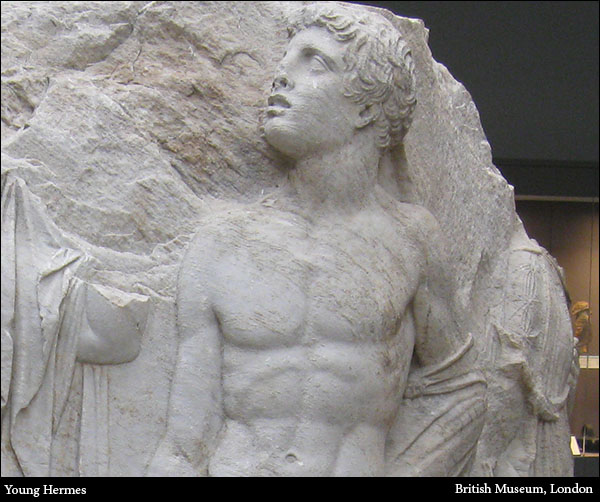
Zeus listened to Apollon's truthful account of the cattle theft but Hermes pretended innocence and said he was only born yesterday and too young to know the ways of deceit and falsehood. Zeus laughed at the child's roguishness and commanded Hermes to take Apollon to the cattle. Hermes obeyed without hesitation and soon he and Apollon were at the place where the cattle had been hidden. Apollon was amazed that a mere infant had been able to kill two of the cattle and stretch their hides to dry in the sun. Hermes began to play the lyre he had invented on the day he was born, and again Apollon was amazed. Apollon said he had danced and sang with the Muses, the nine goddesses of the creative arts, but had never heard such beautiful music or seen such a masterful musician.
Apollon was impressed with the precocious child and promised Hermes many gifts as well as a place of renown amongst the Immortals. Hermes truly appreciated the kindness of Apollon and gave him the lyre as a token of his affection. With the blessing of Zeus, Apollon pronounced that Hermes would become the lord over lions, boars, dogs and all animal herds on the face of the earth. Apollon also made Hermes the messenger of Hades (lord of the dead) but he would not give Hermes the gift of prophecy because that gift was his alone ... only he was allowed to know the will of Zeus. As a minor concession, Apollon told Hermes that there were three virgin goddesses who could be of service to him ... they lived under the folds of Mount Parnassos and would flitter about feeding on yellow honey ... after they had eaten the honey, they would only speak the truth ... if Hermes questioned them carefully he would learn many things. He would then have the power to impart these truths to men of his choosing for their benefit. Apollon also gave Hermes a beautiful golden staff with three branches to represent wealth and affluence. The staff would protect the young god against harm and enforce the laws of righteous words and actions.
When Hermes was a young man, he and Apollon were witness to the humiliation of Ares (god of war) at the hands of Hephaistos. Ares had been secretly meeting with Hephaistos's wife Aphrodite (goddess of love) and Hephaistos had devised a clever trap to catch them in the embrace of love. The trap was sprung, and Ares and Aphrodite could not escape ... Hephaistos called for the Immortals to come and see his disloyal wife and her lover in their humiliating situation. Apollon asked Hermes how he would feel if he were trapped in such an embarrassing position. The light-hearted Hermes replied that he would suffer thrice the bindings if only he could share the bed of Aphrodite the golden.
The lyre Hermes presented to Apollon became one of his most treasured possessions. When Apollon leaves his shrine in Pytho and travels to Mount Olympos, the other gods and goddesses gather to hear the beautiful music he plays on the lyre ... he sings with the Muses of the unending gifts the Immortals enjoy and the mortal plight of the people who must endure the pains of illness and the failings of old age. Hebe (goddess of youth), the Kharites (Graces), the Horae (Hours), Harmonia and Aphrodite join hands and dance ... the goddess Artemis, tall and enviable, sings to her brother's irresistible melodies.
Asklepios was the son of Apollon and a mortal woman named Koronis, daughter of King Phlegyas.
Asklepios was the greatest physician in the ancient world. His sons, Makhaon and Podaleirios, fought on the side of the Achaians during the Trojan War, but also used the medical training to aid wounded soldiers.
His reputation was so widespread that Asklepios was revered as the god of medicine and healing. Several shrines were established in honor of Asklepios including one at Athens and another at the city of Epidauros. Patients would sleep in the temple of Asklepios and either be cured during the night or have dreams that would indicate the correct treatment for their ailments. Some people were healed with calming incantations, some were given potions, and others were cured with surgery.
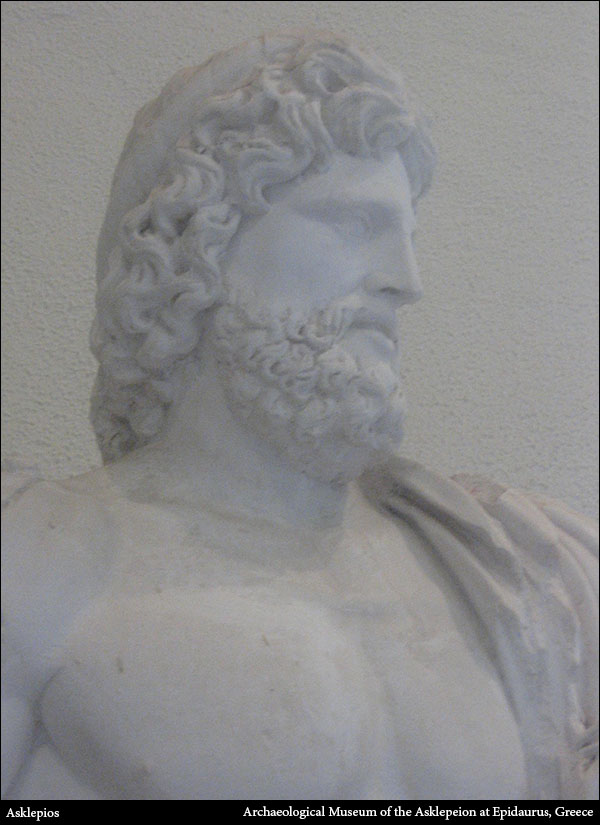
Apollon took Koronis as his lover and she became pregnant. She lived in Lakereia on the banks of Boibeis Lake in Thessaly. Since the birth of Asklepios was at least one generation before the Trojan War, it's understandable that there might be some confusion about the circumstances of his miraculous birth. Either of the following two accounts may be correct.
1) While she was pregnant, Koronis traveled with her father King Phlegyas to Epidauros on the Peloponnesian Peninsula ... for nine months she had managed to keep her pregnancy a secret from her father. When the child was born, she took it to a mountain known as Myrtium but called Nipple when this account was written (circa 160 CE). Koronis abandoned the baby on the mountain. True to the child's divine heritage, a watchdog went to the baby and protected him until a shepherd named Aresthanas came upon the scene ... as he approached, lightning flashed from the child ... Aresthanas assumed correctly that the baby was divine.
2) Koronis thought she could deceive Apollon and began having an illicit affair with a man named Iskhys. When she and Iskhys decided to get married, a crow flew to Apollon and informed him of Koronis's disgraceful intentions. Before Eileithyia (goddess of childbirth) could bring Koronis to term, Apollon's sister Artemis killed the pregnant woman with a shower of golden arrows while she slept. Koronis was not the only one to die in the hail of arrows ... many of Koronis's neighbors were also killed in the conflagration. When Koronis's relatives placed her on the funeral pyre and lit the flames, Apollon could not endure to have his offspring killed for the mother's irreverent deeds ... he swooped down on the pyre, parted the flames, and rescued Asklepios from his dead mother's body ... he then entrusted the infant to the Centaur Kheiron so he could learn the art of healing.
Asklepios became a man of great renown ... pilgrims came from all over Greece to find cures for their ailments and wounds. Asklepios became too enamored with his own abilities and finally committed an act of selfishness that angered Zeus beyond redemption. Instead of continuing to use his god-given abilities with gracious humility, Asklepios accepted gold for restoring a dead man to life. Zeus struck down Asklepios and the man he had resurrected with a flash of lightning and thus ended the life of the greatest physician of the ancient Greek world.
After Zeus killed Asklepios with a thunderbolt, Apollon wanted some sort of revenge, but he dared not attack Zeus directly ... instead, he killed the Cyclopes who forged Zeus's thunderbolts. Even though he loved Apollon very much, Zeus was infuriated ... his first impulse was to cast Apollon into the depths of Tartaros, but Leto intervened and negotiated a lesser punishment for her son. Zeus sentenced Apollon to serve for one year as a slave for the king of Pherai in Thessaly—King Admetos.
Admetos was a kind master and treated Apollon with respect ... to show his appreciation, Apollon arranged for Admetos to marry an exceptional woman named Alkestis.
Soon thereafter, Apollon discovered that Admetos was destined to die immediately after the marriage. He wooed the Eumenides (Furies) with wine until they agreed to allow Admetos to live ... the Eumenides were not easily persuaded ... they would only allow Admetos to live on the condition that someone else volunteer to die in his place. Alkestis loved her husband so much that she agreed to die for him.
As the drama in King Admetos's house was unfolding, Herakles arrived as a guest. Admetos treated him hospitably but Herakles could tell that something was drastically wrong. When Admetos told Herakles the sad state of affairs, the otherwise stoic hero became inspired by Alkestis's selflessness ... he left Admetos's house and rushed to intercept Thanatos (Death) as he was escorting Alkestis to the Underworld ... Herakles persuaded Thanatos to release Alkestis and allow her to return to the land of the living to be reunited with Admetos.
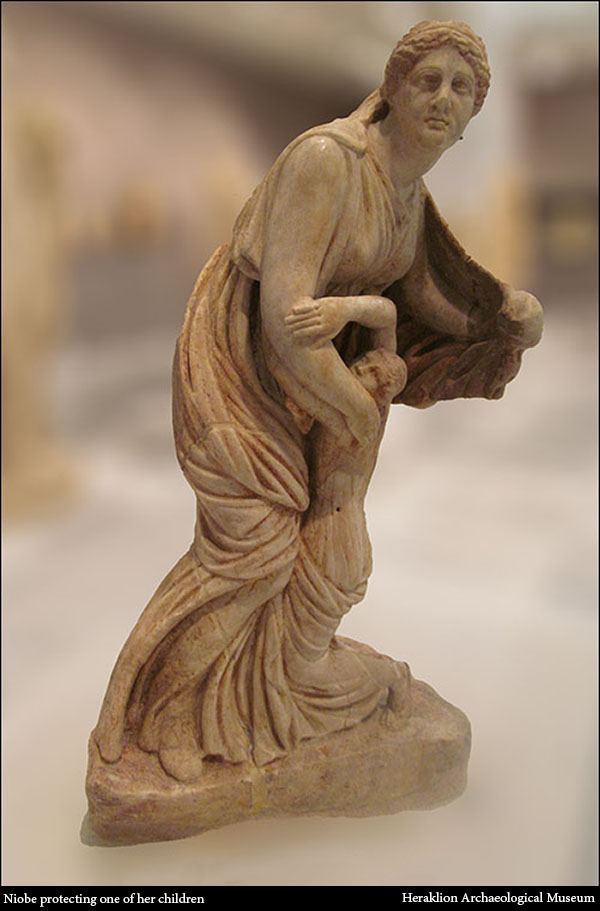
The story of Niobe is meant to be a lesson in humility as well as an injunction against blasphemy.
Niobe was the daughter of Tantalos and the sister Pelops, eponymous founder of the Peloponnesian Peninsula. She was the mother of seven sons and seven daughters, of which she was very proud ... perhaps, too proud. She would frequently boast that she was more blessed with children than the goddess Leto ... after all, Niobe had fourteen children and Leto had only two.
Leto became weary of Niobe's arrogant boasting and sent Apollon and Artemis to kill Niobe's children. Apollon and Artemis did as their mother commanded but it seems that only twelve of the children were slain. One daughter and one son survived because of their prayers to Leto ... their names were Meliboea and Amyklas ... Meliboea was struck ghostly white from the frightening experience and was afterwards called Khloris (Pale).
Niobe was supposedly turned to stone and placed on Mount Sipylos to eternally weep for her children. When the traveler-historian Pausanias was on Mount Sipylos, he observed, "When you are near, it is a beetling crag with not the slightest resemblance to a woman, mourning or otherwise; but if you go further away you will think you see a woman in tears, with head bowed down."
Perhaps two of the most infamous prophecies ever received from Apollon concerned the kings of Thebes—Laius and Oedipous.
The first prophecy was given to King Laius ... it was unambiguous ... Apollon informed Laius that he would be killed by his son. In a foolish attempt to cheat the fate, Laius and his wife Queen Iokasta (Jocasta) pierced the ankles of their newly born son and gave him to a servant with instructions to leave the hobbled baby in the wilderness to die. The servant could not carry out such a cowardly act and gave the child to a shepherd from a neighboring province. The child was finally presented to the king of the city of Korinth where he was named Oedipous and raised as part of the royal household ... the name Oedipous means "swollen foot."
When Oedipous became a man, he went to Delphi where the Oracle of Apollon informed him that he was destined to kill his father. Oedipous vainly thought he too could cheat the fate. Believing the king of Korinth to be his father, Oedipous left home and took the road to Thebes. He encountered a difficult old man on the road and an argument ensued ... Oedipous killed the old man and all but one of his bodyguards ... the old man was of course King Laius. Just as Apollon foretold, Laius had been killed by his son and Oedipous had killed his father.
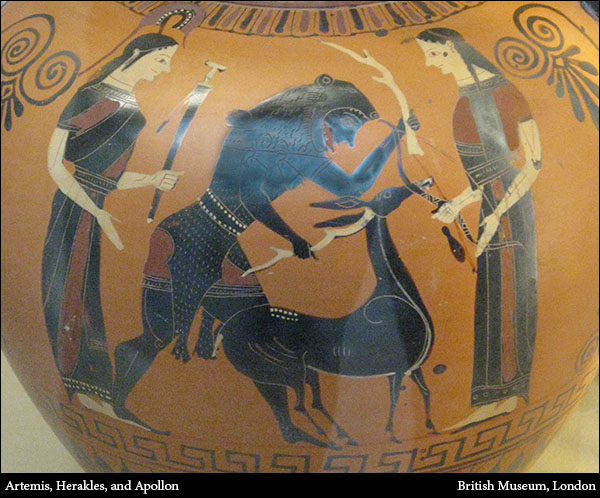
Herakles encountered Apollon and Artemis while he was completing his Third Labor—Capturing the Keryneian Hind. At the command of his cousin Eurystheus, Herakles was required to capture an elusive deer (hind) with golden horns and return the sacred beast to Mykenai. The Keryneian Hind was sacred to Artemis and named after a Peloponnesian river. Herakles spent a year searching for the elusive deer before he was able to capture it.
While returning the hind to Eurystheus, Herakles encountered Apollon and Artemis. They demanded the return of the sacred creature, but Herakles successfully argued the justice of his quest and was allowed to complete his Labor with the blessings of Apollon and Artemis.
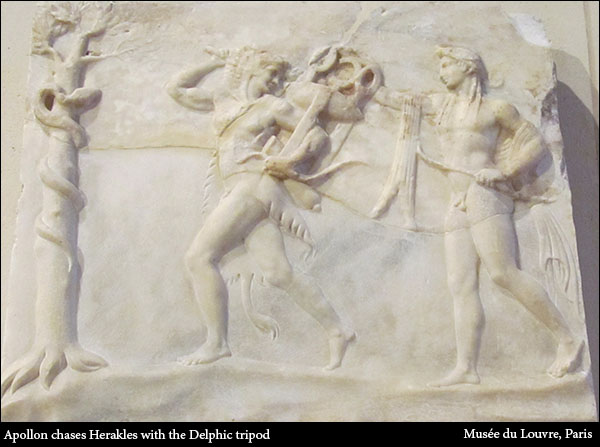
There was an incident where Herakles and Apollon "came to grips" over the possession of a tripod that had been dedicated at Apollon's temple at Delphi. Tripods were often presented to Apollon because of their artistic potential and the precious metals of which they were often made. In this case, it was not the beauty or value of the tripod that mattered ... against all tradition and common sense, Herakles took a tripod out of the temple without permission ... he didn't necessarily "steal" it ... he simply took it without permission.
Herakles went to Delphi with questions for Apollon but was turned away by the Pythia because he had been responsible for the death of a man named Iphitos. Herakles, Iphitos, and his brother Klytios had been fellow Argonauts ... Herakles left the Argonauts before the Quest for the Golden Fleece was complete but Iphitos and Klytios stayed until the Quest was successfully concluded. Several years later, while Herakles was laying siege to the city of Tiryns, Iphitos was killed defending the city.
When Herakles arrived at Delphi, a Pythia named Xenokleia refused to give a response to his questions ... she cited the murder of Iphitos as the reason for her refusal. Herakles went into a rage ... he snatched up a tripod and attempted to leave the temple with the prize. This is where the story either becomes dramatic or realistic.
The poets tell the story as the basis for a fight and struggle between Apollon and Herakles ... there is ample artwork to support this scenario, but the facts of the encounter might be otherwise.
As impulsive as Herakles could be, it's easy to believe that he took a tripod from Apollon's temple and then stormed out ... however, it's equally easy to believe that when he was confronted by Apollon and asked to return the tripod, the ultimate hero complied without a fight. After the "struggle," Herakles returned to the temple and Xenokleia told him all he wished to know.
To further illustrate the cooperation between Apollon and Herakles, the people of Kythium say that their city had no human founder, but that Herakles and Apollon, when they were reconciled after their "strife" for the possession of the tripod, united to found the city.
Apollon played a significant role in the Trojan War. He was clearly on the side of the Trojans and aided Trojan Prince Hektor in many ways. In the tenth year of the war, Apollon came to the defense of one of his priests and nearly destroyed the Achaian encampment. The soldiers in the army laying siege to Troy were called Achaians, Argives, and Danaans ... we normally refer to them simply as Greeks, even though, strictly speaking, the inhabitants of Troy were also Greek.
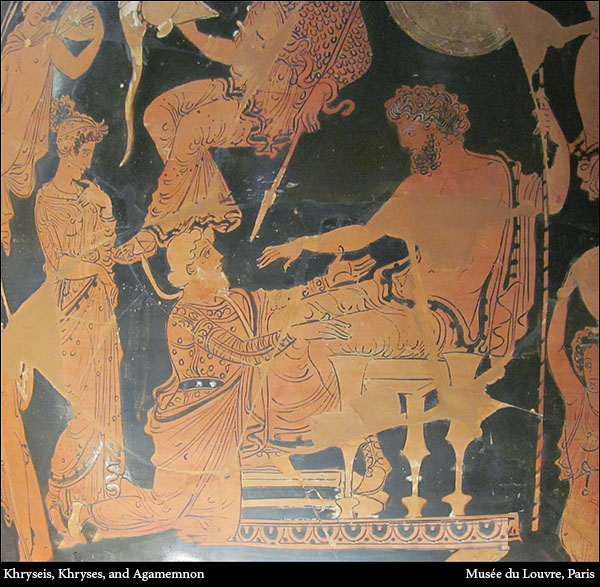
The Greeks would regularly go on raids to pillage the nearby cities and islands to maintain their supplies of food and slaves. During one such raid, they took a young woman named Khryseis as a slave ... she was awarded to the Greek commander-in-chief, Agamemnon. The Greeks did not realize that Khryseis was the daughter of Apollon's priest, Khryses. When Khryses went to Agamemnon to beg for the return of his daughter, he was treated with insulting disrespect. Agamemnon went so far as to threaten to beat Khryses for daring to ask for his daughter.
Khryses prayed to Apollon for justice and his prayers were answered. Apollon stood offshore and rained arrows on the Greek encampment. Achilles called an assembly of the Greek commanders and soldiers because he did not understand why their camp was under attack by one of the Immortals. A seer named Kalkhas knew the answer and told Agamemnon that if the young girl was not returned to her father, Apollon would certainly destroy them. Agamemnon believed Kalkhas and made immediate arrangements for the girl to be returned to her father accompanied by elaborate sacrifices to Apollon at his temple on the island of Lemnos. Agamemnon assigned Odysseus, one off his trusted commanders, the task of returning the girl and supervising the sacrifice. Apollon was pleased and gave Odysseus a favorable wind so he could sail swiftly back to Troy.
Apollon gave preferential protection to Aphrodite's son, Aineias. Although Aineias was considered a Trojan commander, he was referred to as a Dardanian, denoting his reverence for Dardanos, the first king of Troy. By the will of Zeus, Aineias was one of the few Trojan men to survive the war. When the Greek soldier Diomedes attacked Aineias and knocked him to the ground, Apollon stepped in and stood between the two men. With incredible bravado, Diomedes tried to charge past Apollon and kill Aineias. Apollon brushed Diomedes aside three times and finally warned him not to test his strength against a god. Diomedes was brash but not foolish ... he backed away.
The goddess Athene was on the side of the Greeks but that did not stop her from cooperating with Apollon to stop the continued bloodshed. The two Immortals devised a plan whereby Prince Hektor would be allowed to fight one of the Greeks in one-to-one combat. The winner of the fight would decide the fate of the war. Hektor was delighted with the idea and promised to strip the armor from whichever Greek soldier he defeated, Hektor swore he would dedicate the armor at the temple of Apollon inside the walls of Troy. Since Achilles was not willing to help the Greeks because of his dispute with Agamemnon, Telamonian Aias was chosen to fight Hektor. Apollon and Athene took the forms of vultures and perched in an oak tree to watch the fight. Aias was a powerful man and soon beat Hektor to the ground. Hektor was wounded severely before Apollon swooped down to save him. After removing Hektor from the battlefield, Apollon took up the shield of Zeus and drove the Greeks back to their encampment. Hektor was seriously wounded and at the brink of death when Apollon breathed life back into his body.
Hektor regained his strength and was eager to return to the fighting. Apollon shrouded himself in mist and marched in front of Hektor until they reached the wall and ditch the Greeks had built to protect their ships. Apollon easily brushed aside the Greek defenses, allowing the Trojans to breach the protective wall. The situation was becoming critical for the Greeks but Achilles would still not fight because of his argument with Agamemnon. Achilles's companion Patroklos donned Achilles's armor and charged into the Trojans. The Greeks thought Achilles was back in the fighting and regained their courage ... the Trojans also thought Achilles was back in the fighting and began to retreat.
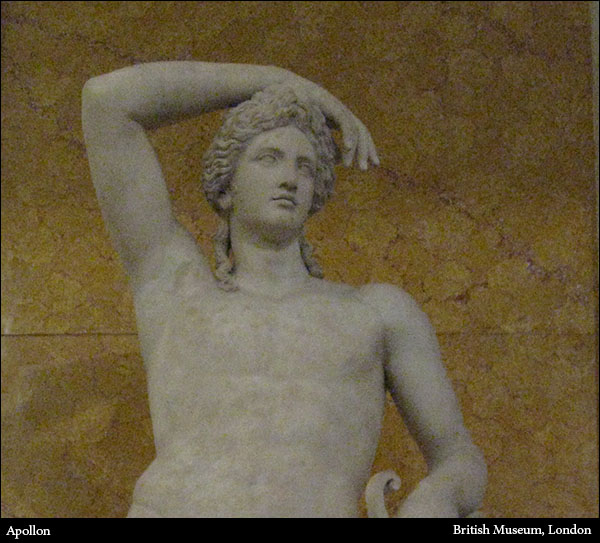
Apollon gave what protection he could to the retreating Trojans but the appearance of Patroklos in Achilles's armor was devastating to the Trojan moral. Apollon stood before Patroklos and warned him to withdraw ... he told Patroklos that it was not his destiny to breach the walls of Troy but Patroklos ignored the warning ... he was obsessed with his own prowess and did not realize that he was on a headlong charge towards death. Apollon went to Hektor in the guise of a man named Asios and encouraged him to fight Patroklos ... Apollon put valor in Hektor's breast and urged him forward. When Patroklos finally confronted Hektor, his fate became sealed. Apollon clouded himself in a mist and struck Patroklos in the back knocking the protective corselet from his armor. Hektor stepped in to deliver the killing blow and stripped away Achilles's armor from Patroklos's body.
Another casualty of the fighting was a son of Zeus named Sarpedon. Although Sarpedon was loved by Zeus, it was necessary for him to die. One of the primary reasons for the protracted war at Troy was to rid the earth of the race of demigods ... Sarpedon was a demigod. Zeus called Apollon to his side and told him to go to the battlefield to retrieve Sarpedon's body and return it to his home in Lykia ... Zeus wanted Sarpedon to have a funeral worthy of a hero. Apollon cleaned Sarpedon's body of the blood and gore and gave him to Hypnos (Sleep) and Thanatos (Death) to be returned to his native land.
Apollon had been the constant protector of Hektor throughout the Trojan War but when the time came for Hektor to die, Apollon could not subvert the will of Zeus. After Hektor killed Patroklos his death was inevitable. Patroklos had been Achilles's closest companion and after Patroklos's death Achilles swore an oath to kill Hektor. Achilles plunged into the Trojan defenses and slaughtered his way to where Hektor stood outside the city gates. Apollon urged Hektor to stand and fight knowing full well that Hektor was fated to die. When Achilles finally reached Hektor, Apollon turned away and left Hektor to the mercy of Athene ... of course, she had none. Achilles killed Hektor with unimaginable viciousness ... in spite of the betrayal and brutality, Prince Hektor died with honor.
When the fighting at Troy reached its peak, Zeus told the Immortals they could enter the fray on whichever side they wished. Up until then, the Immortals were restricted by Zeus and could only influence the war rather than participate in the fighting ... the difference was subtle and infractions were inevitable but it was necessary to keep the war going for ten years in order to kill as many heroes and demigods as possible. At one point, Apollon encountered his uncle Poseidon (lord of the sea) on the battlefield. Poseidon was roaring through the Trojan defenses living up to his title Earth-Shaker ... his presence was unmistakable. Apollon had once bragged that he would fight Poseidon if necessary but when the two gods stood face to face, Apollon decided it would be best not to fight with his uncle. Apollon's sister Artemis chided her brother for not wanting to fight Poseidon, but it was only in jest ... she would never encourage Apollon to do something that would certainly do him harm.
The Trojan War was almost over, but Apollon still had a major role to play before the war could end and the walls of Troy could be toppled. Achilles was one of the demigods slated to die at Troy but Zeus decided that he should have a glorious death that would make the name Achilles immortal and give honor to his mother, Thetis. The Greeks used the ruse of the Trojan Horse to gain access to the city and once the Greeks were inside the walls of Troy, they were unstoppable. Zeus would not allow a mortal man to kill Achilles, so Apollon was given the task. With the aid of Prince Alexandros (Paris), Apollon killed Achilles. The exact circumstances of Achilles's death were not recorded in the ancient texts but later, perhaps embellished, accounts of his death say he was killed at the Trojan temple of Apollon with an arrow in the heel ... Achilles supposedly bled to death from the wound. Other accounts imply that it was Prince Alexandros and not Apollon who shot the arrow that killed Achilles. I suggest that we simply accept the oldest accounts and assume that it was Apollon who killed Achilles. The slaying of Achilles was the last noble deed of the Trojan War because the slaughter and destruction that followed were the opposite of glorious and noble.
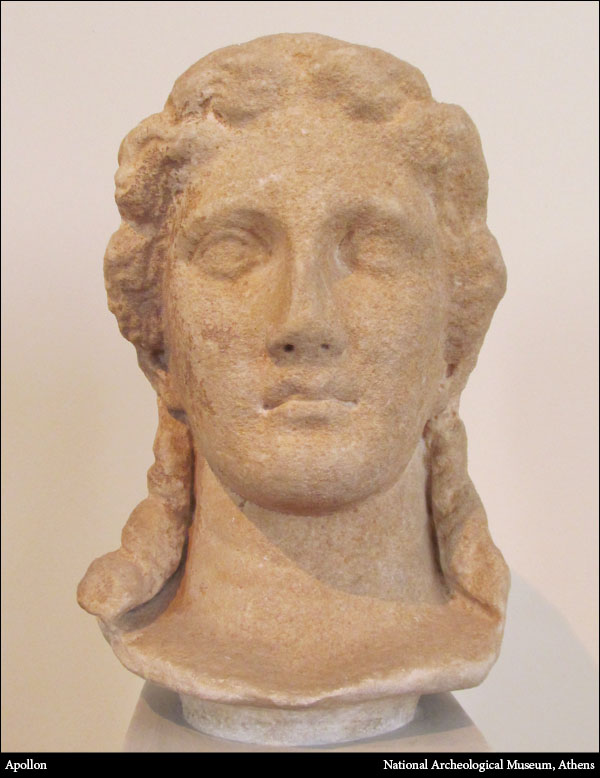
Apollon travels the earth and makes his presence known in many ways. He can be protective or incredibly vicious, but his intentions are always in accordance with the will of Zeus.
Silenos Marsyas was a satyr who lost a contest of musical skills with Apollon and was flayed alive for his arrogance.
Marsyas encountered Apollon and Dionysos (also a son of Zeus) at Nysa. A competition arose between Apollon and Marsyas to test their musical skills ... the Nysaeans were chosen to be the judges of the contest. Apollon went first and played his lyre but did not sing to accompany himself. Marsyas went next and played his flute with such skill, the Nysaean judges were amazed and delighted. At that point, if the contest had been over, Marsyas would have won the competition but they had agreed to take turns ... when Apollon played his lyre again, he sang a beautiful melody in harmony with his lyre.
When Marsyas saw the favorable reaction of the judges towards Apollon's performance, he was outraged ... he claimed that he had entered a test of skill that did not include the voice as an instrument ... he claimed that Apollon was taking unfair advantage by adding the vocal accompaniment ... he insisted that the judges should be required to choose only between the music of his flute and that of Apollon's lyre.
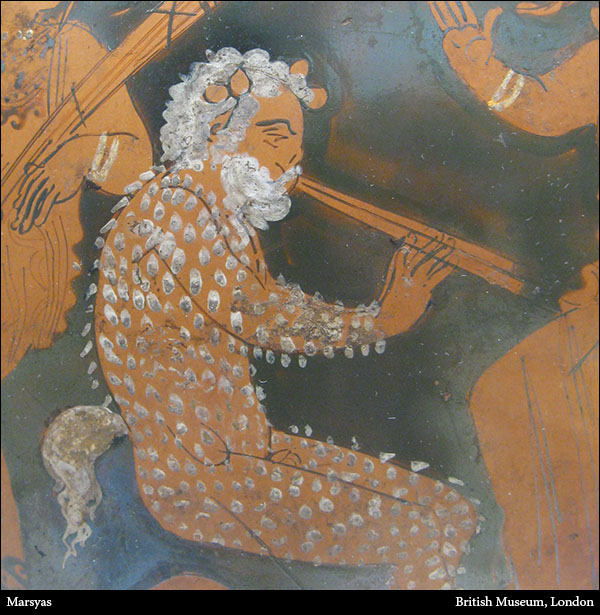
Apollon replied that using his voice was no different than Marsyas using his breath to play the flute ... he reasoned that they both used their hands and their breath in the contest and that if he could not use his breath to sing, Marsyas should not be allowed to use his breath to play the flute ... the judges agreed with Apollon and declared him the winner of the contest.
Although victorious, Apollon was embittered by Marsyas's quarreling and flayed him alive ... his skin was displayed in the marketplace of Kelaenae. Apollon regretted his brutality and broke the strings of his lyre, destroying their harmony ... he then placed his lyre and Marsyas's flute in the cave of Dionysos as a votive offering.
Mopsos was one of the Argonauts ... he was accepted into that elite band of adventures because he had been taught augury by Apollon—augury is the ability to foretell the future from the flight and cries of birds. When the Argonauts were stranded in the Libyan desert, Mopsos stepped on the tail of a serpent and was bitten on the leg ... he died almost instantly.
The serpent was no ordinary snake ... it was a nameless, supernatural beast that had been created when another son of Zeus named Perseus beheaded the Gorgon Medusa and fled on his winged sandals across the Libyan desert ... the blood from Medusa's severed head dripped on the desert sands and spawned the snake that killed Mopsos.
The Giants waged an unsuccessful war against the Olympians and were severely punished after their defeat. The poet Hesiod states that the Giants were banished to the Underworld, but Apollodorus of Athens clearly describes the brutal death of the Giants.
Most of the Immortals from Mount Olympos were involved in the war but Zeus's son Herakles killed most of the Giants. Apollon and Herakles fought together to kill the Giant Ephialtes ... they both used bows and arrows ... Apollon shot Ephialtes in the left eye, Herakles in the right.
After the Trojan War was over and the victorious Greeks were sailing homeward, Apollon struck one last deadly blow.
Helen of Argos was called Helen of Troy so she could be blamed for the Trojan War ... Helen was not the cause of the war, but she became the focus of a considerable amount of hostility ... including the animosity of Apollon. By making her 'Helen of Troy' she became an enemy of the Greeks instead of what she actually was ... the kidnaped queen of Sparta. When Helen and her Spartan husband Menelaos were sailing home after the war, Apollon struck down one of their best crewmen, setting the stage for the death of Menelaos's brother, Agamemnon. As Menelaos and Helen were sailing around the Cape of Athens (Holy Sunium) Apollon killed the helmsman Phrontis with a painless arrow.
As Phrontis's commander, Menelaos was required by tradition to halt his homeward journey and give his worthy companion the burial rites suitable for a warrior of his caliber. The delay separated Menelaos and Helen from the other victorious Greeks who were also sailing home. Without Phrontis at the helm, Menelaos's ships were blown off course and finally made a belated landfall in Egypt. The delay provided an opportunity for a murderous plot to be instigated against Menelaos's brother, Agamemnon. With Menelaos out of the way, Agamemnon's wife Klytemnestra and her lover Aigisthos, literally got away with murder and took over the kingdom of Mykenai.
A semidivine race was shaped and nurtured by the Immortals to insure the future of the Greek people. The leader of this race was descended from Poseidon (lord of the sea) and Giants ... his name was Nausithoos, lord of the Phaiakians.
Nausithoos had two male children, Alkinoos and Rhexenor. Alkinoos remained unmarried but Rhexenor married and had a daughter named Arete. For reasons known only to the Immortals, Apollon killed Rhexenor with a shower of painless arrows ... Alkinoos married his niece Arete and they became king and queen of the Phaiakians.
As is often the case, the Immortals work together to achieve great or subtle ends. In the case of the Phaiakians, Poseidon founded their race and Apollon refined it.
Apollon's confrontation with a man named Eurytos was mentioned briefly in the Odyssey by Homer. The resourceful traveler Odysseus commented that his archery skills were as good as any mortal man, but he would never compare himself to heroes like Herakles or Eurytos. Odysseus went on to say that Eurytos did not live to enjoy his property and fame because he challenged Apollon in archery ... Apollon killed him for his effrontery.
Apollon was asked to intervene when the two monstrous young men named Otos and Ephialtes threatened to attack the Immortals on Mount Olympos. The boys were either the sons of Poseidon and Iphimedeia or Aloeus and Eeriboia. Regardless of their parentage, Otos and Ephialtes were the tallest men ever to walk the earth. They were almost as handsome as the famous hunter Orion, but they were too loud and too proud for the Immortals to tolerate. They threatened to uproot mountains and pile them up against Mount Olympos so they could climb into the precincts of the Olympian Immortals. Zeus believed that if the boys were allowed to reach their full stature, they would be capable of fulfilling their threat. Zeus sent Apollon to kill the dangerous youths before they were too strong to be defeated.
Prince Meleagros was the son of King Oineus and Queen Althaia of Kalydon ... he lived and died prior to the Trojan War. When Meleagros was born, an oracle informed Queen Althaia that her new son would die as soon as the wood burning in the hearth was consumed. Wishing to save her son, Althaia extinguished the fire and preserved the unburned wood. When Meleagros became an adult, Althaia had reason to burn the wood and end her son's life ... Apollon would become the instrument of Meleagros's death.
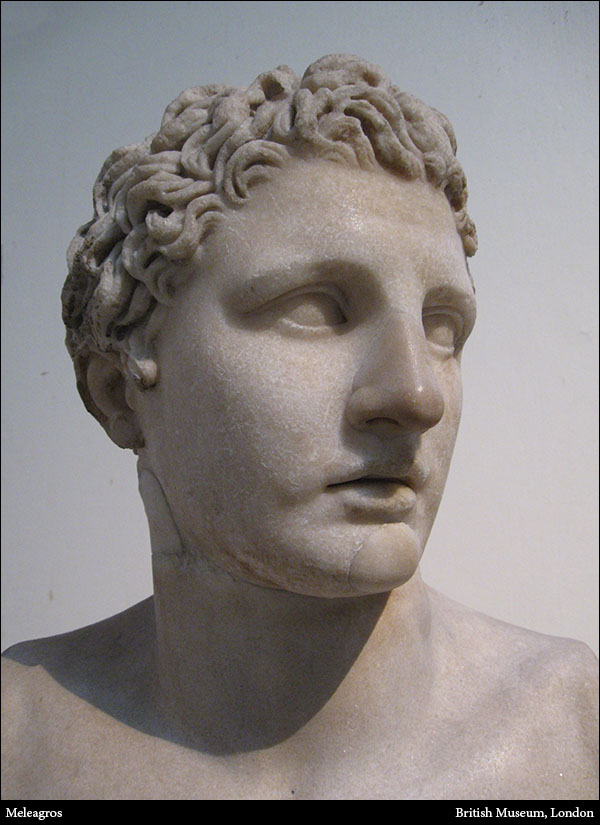
Kalydon was the site of what became known as the Kalydonian Hunt. King Oineus insulted the goddess Artemis by neglecting to offer her the first-fruits of Kalydon's harvest. Artemis demonstrated her displeasure by sending a savage boar to ravage the Kalydonian orchards.
The boar Artemis sent was in no way ordinary ... it was so fierce that no single person could master it. Meleagros assembled a hunting party of the most noble and bravest fighters in all of Greece. Included in the hunt was the beautiful virgin huntress, Atalanta ... she was the first to wound the boar, but the beast was finally killed by Meleagros.
Meleagros awarded the boar-skin to Atalanta as a tribute to her bravery but his mother's brothers tried to take the prize away from Atalanta. Meleagros killed his uncles—Iphiklos and Aphares—for the insult to his authority and his mother became inconsolable ... she called upon the lords of darkness to avenge the death of her brother(s) and burned the wood she had saved since the time of Meleagros's birth ... the oracle was fulfilled with Apollon as the instrument of fate ... he killed Meleagros.
The ruling families of ancient Greece were often related. Meleagros was the cousin of Helen of Argos, who later became known as Helen of Troy. Queen Aphares, mother of Meleagros, was the sister of Leda, mother of Helen, Kastor, Polydeukes, Klytemnestra and Timandra.
Syria was the island home of Eumaios, the swineherd of King Odysseus of Ithaka.
Syria was near the island of Ortygia which is in the harbor of the city of Syracuse on the island if Sicily. The inhabitants of Syria lived long and peaceful lives but when they reached old age, Apollon and Artemis killed them with painless arrows.
Apollon was given the surname Lykios meaning Wolf-God for a very practical reason. While traveling in Sikyon circa 160 CE, the traveler-historian Pausanias saw the ruined sanctuary of Apollon Lykios ... the sanctuary had been neglected because its purpose had been served and it was no longer necessary to worship Apollon as the Wolf-God.
Wolves had once preyed upon the flocks of the Sikyonians to such an extent that their efforts became profitless. Apollon revealed to them the location of a dry log that would work as a poison against the wolves. Following Apollon's instructions, the bark from the log was mixed with meat and left for the wolves to eat. The poison killed the wolves and Apollon was given the surname Lykios.
Even though the sanctuary of Apollon was in ruins when Pausanias saw it, the log was still in the sanctuary, but no one seemed to know what kind of tree it had been.
Kassandra was the daughter of the King Priam and Queen Hekabe of Troy. She was a devoted daughter, but she made the tragic mistake of being unappreciative of Apollon's romantic advances ... she rejected Apollon and thus suffered a life of rejection and slavery.
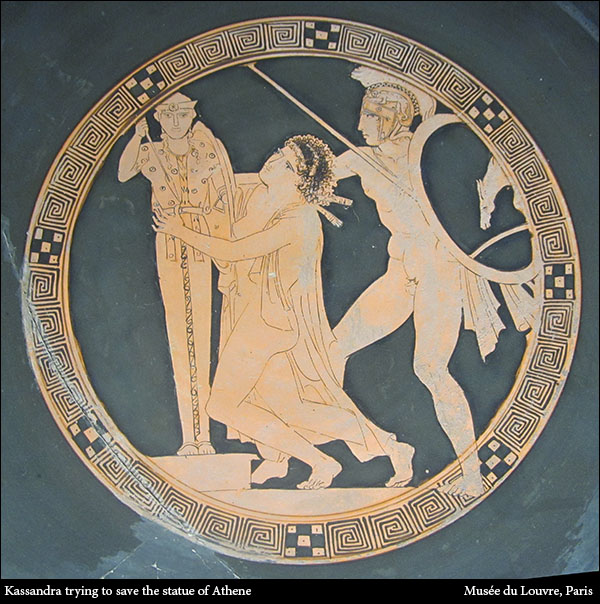
Apollon gave Kassandra the gift of prophecy, but he also cursed her so that no one would believe what she predicted. Kassandra's life at Troy was misery because she could foresee the Trojan defeat but couldn't save her city or family. After the war, Kassandra was taken as a slave by the Greek commander-in-chief, Agamemnon. When she arrived at Mykenai with Agamemnon, she correctly predicted his murder but of course he would not believe her.
The area named after Apollon's lover Kyrene in Libya was not colonized by the Greeks until 630 BCE ... Kyrene was settled by an expedition from the island of Thera ... an expedition instigated by Apollon through the Pythia at Delphi.
King Grinnus of Thera was commanded by the Pythia to found a colony in Libya but he felt that he was too old and did not do as he was instructed. As a result of Grinnus's disobedience, Thera was cursed with seven years of drought. When the Pythia was consulted about the draught, she again said that it was Apollon's command that the Therans establish a colony in Libya.
Even though King Grinnus had not obeyed the Pythia, it seems that everything was proceeding according to Apollon's design. During the second consultation with the Pythia, she referred to the Theran envoy as Battus ... we can confidently assume that Battus was the name the Pythia gave him and not his actual name ... Battus means "Stammerer" in Greek ... the Theran envoy had a speech impediment so it would seem that the Pythia named him correctly. Also, Battus meant "King" in the Libyan language ... when the Pythia referred to the young Theran by the name Battus, she obviously knew his past and future.
After some delays and several more consultations with the Pythia at Delphi, Kyrene was settled in Libya by Battus ... his descendants ruled Kyrene for eight generations.
At the prompting of Apollon, the city of Thebes was founded by Prince Kadmos of Tyre.
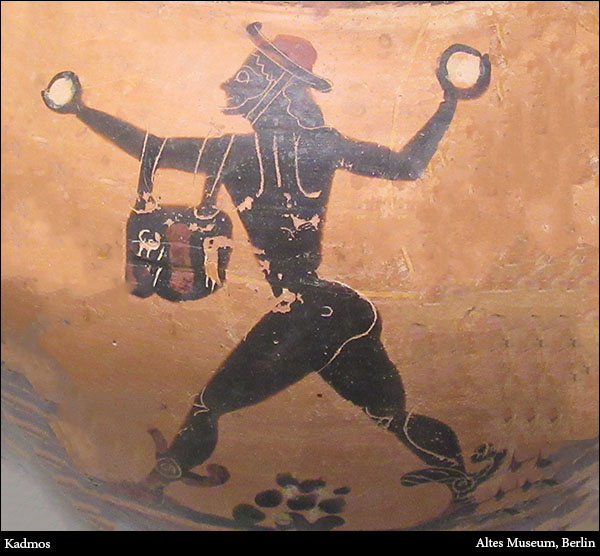
Zeus abducted Princess Europa from Tyre ... her brother Kadmos began an exhaustive search to bring his sister home. Failing to find Europa, Kadmos went to Delphi for help. The Pythia told him that he would never find Europa ... she said that when he left the sanctuary of Apollon, he would see a cow ... he should follow the cow until it laid down ... at that place, he was told to build a new city. Kadmos did as instructed and the city of Thebes was founded.
Daphne was a virgin Nymph who did not want to become Apollon's consort ... in fact, she didn't want a romantic relationship with anyone ... god or mortal man.
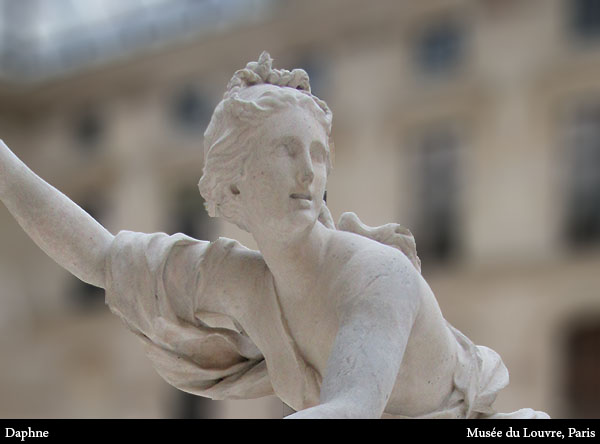
Daphne's revulsion of romantic relationships was clearly demonstrated when a young man named Leukippus tried to court her ... Daphne and her Nymph companions killed Leukippus. Daphne was rescued from Apollon's embrace by the river-god Peneios ... he transformed Daphne into a laurel tree.
Laomedon was the father of the last king of the city of Troy, Priam.
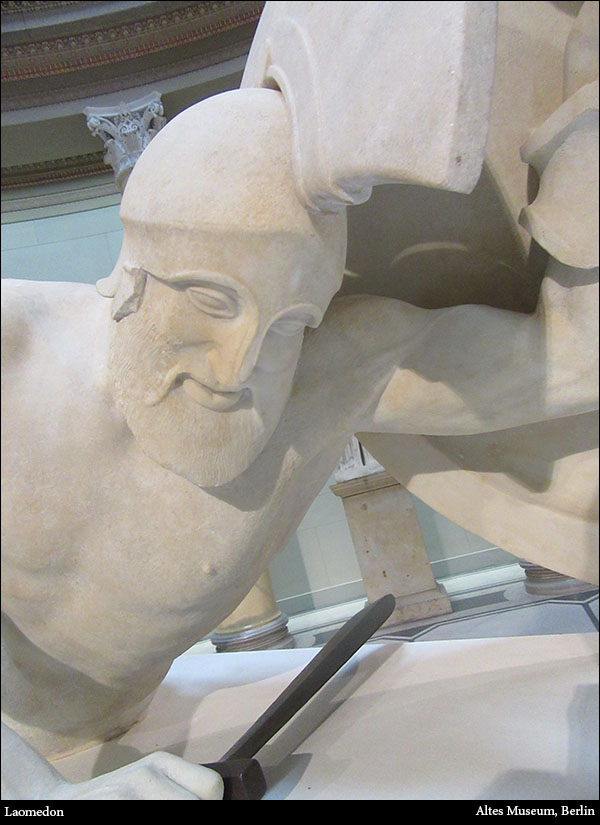
Zeus commanded Apollon and Poseidon (lord of the sea) to serve King Laomedon of Troy for one year. Poseidon built the walls of Troy and Apollon tended Laomedon's herds. Unappreciative of the divine help he had received, Laomedon refused to pay Apollon and Poseidon for their services ... he arrogantly threatened to sell them into slavery. Apollon was more inclined to forgive the insult, but Poseidon would not forgive or forget. When the final battle for Troy was fought, Poseidon helped topple the walls he had built.
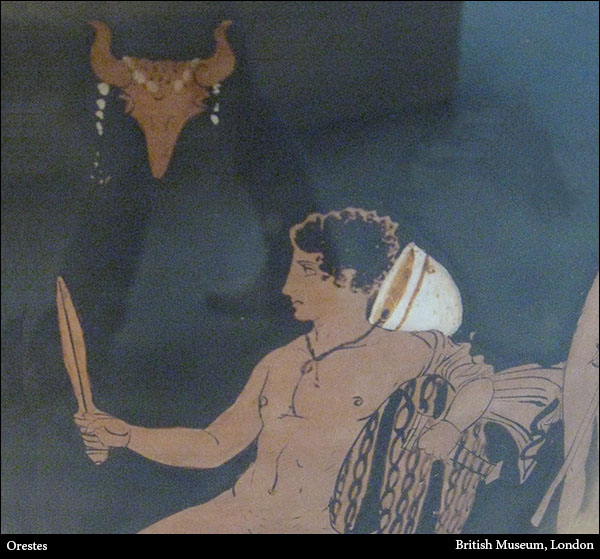
Orestes was the son of King Agamemnon and Queen Klytemnestra of Mykenai. Orestes was only a child when his father returned to Mykenai (circa 1240 BCE) as the victorious commander-in-chief of the invading Greeks at Troy. Agamemnon's homecoming was tragic ... he was murdered by his wife and her lover, Aegisthus. Orestes was forced to go into hiding for his own safety. When he became a young man, he consulted an oracle of Apollon ... he was told that the time was right for him to exact revenge for his father's death and that it was his duty to kill his mother and uncle.
Orestes killed Klytemnestra and Aegisthus and was saved from any retribution by Apollon and Athene.
King Midas of Phrygia in Asia Minor had to deal with several curses imposed by the Immortals ... one of his curses came from Apollon.
The first "curse" Midas endured was intended as a blessing, but Midas's greed turned it into a curse. The god Dionysos offered to grant Midas one wish. Lacking sensibility and indulging his greed, Midas wished that everything he touched be turned to gold. Midas regretted his wish when his household items, food and finally his daughter were transformed into gold. The curse was lifted, and his household returned to normality when Midas washed his hands in the Paktolos River.
Apollon's curse on King Midas was much more insidious. Midas intruded on a musical competition involving Apollon and Pan. Midas said Apollon did not deserve to be the winner even though the official judge had so decided. Apollon declared that Midas had the ears of an ass and then replaced Midas's ears with those of an ass. Midas managed to successfully hide his ears from everyone except his barber. The barber could not keep such a secret, so he dug a hole in the ground and whispered the secret into the hole ... the reeds growing from the hole began to speak the secret of Midas's ears whenever the wind blew.
Apollon's temple at Delphi housed the most famous oracle of Apollon but there were other cities where Apollon occasionally resided and spoke through priests and priestesses.
Abae was the site of the oracular shrine of Apollon in Phokis. The people of Abae claimed to have originally come from Argos and that their city was named after Abas, a son of Lynkeus and Hypermnestra, the daughter of Danaus.
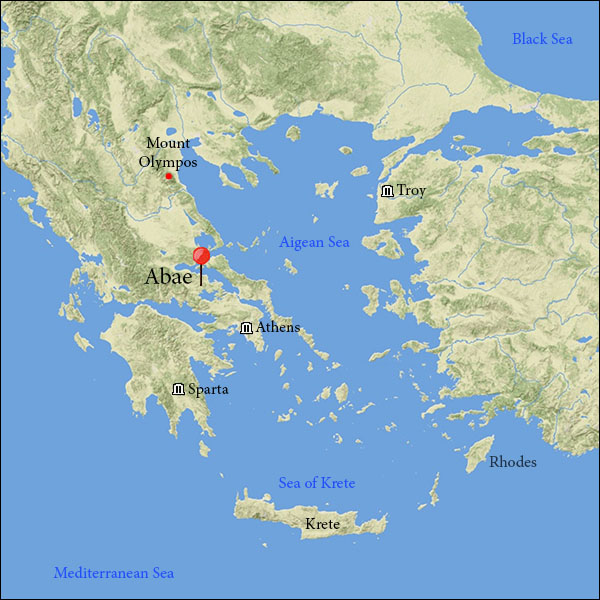
When King Xerxes of Persia invaded Greece in 480 BCE, he burned many of the Phokian cities including Abae. After the Persians were forced out of Greece, the inhabitants of Abae refused to rebuild the original temple of Apollon so they could remember their hatred of the Persians and the sacrilege the barbarians had committed. The temple of Apollon was burned a second time by the Thebans and very little of the original structure survived. A smaller temple of Apollon was built by the Roman Emperor Hadrian and decorated with old bronze statues of Apollon, Artemis and their mother, Leto.
Trophonius was a renowned builder but he was best known as the Oracle of Trophonius at Lebadeia, Boeotia. Trophonius's father was generally thought to be a man named Erginus but there was also the sincere belief that his father was Apollon.
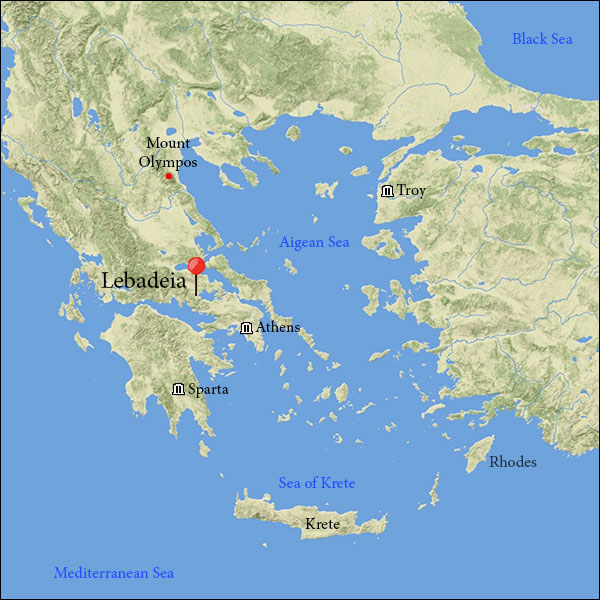
After the tragic death of his brother Agamedes, the earth opened and swallowed up Trophonius in the Grove of Lebadeia at the so-called Pit of Agamedes. The grove became known as the Grove of Trophonius ... the Oracle of Trophonius was located up the mountain from the grove.
The Boeotians learned of the Oracle of Trophonius from the Oracle at Delphi. Although the Boeotians knew Lebadeia very well, they had never heard of the Oracle of Trophonius. They went to Lebadeia and began searching for the oracle. The eldest of their group, a man named Saon, saw a swarm of bees fly into a hole in the ground. Saon followed the bees and discovered an underground chamber where the spirit of Trophonius spoke to him ... Trophonius taught Saon the rituals and observances to be kept at the oracle.
The establishment of the Oracle of Trophonius at Lebadeia can be confidently dated circa 1310 BCE.
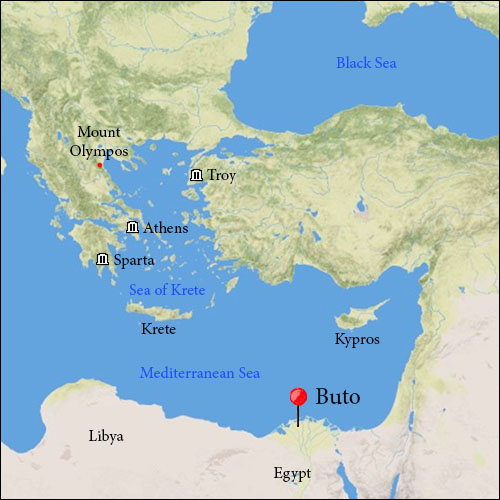
The Egyptians knew Apollon by the name Horus. There were oracles for Apollon, Artemis, and Leto at the Egyptian city of Buto ... Leto was most honored of the three. Apollon was the last god-king of Egypt ... after Apollon, mortal men were given kingship as his representative.
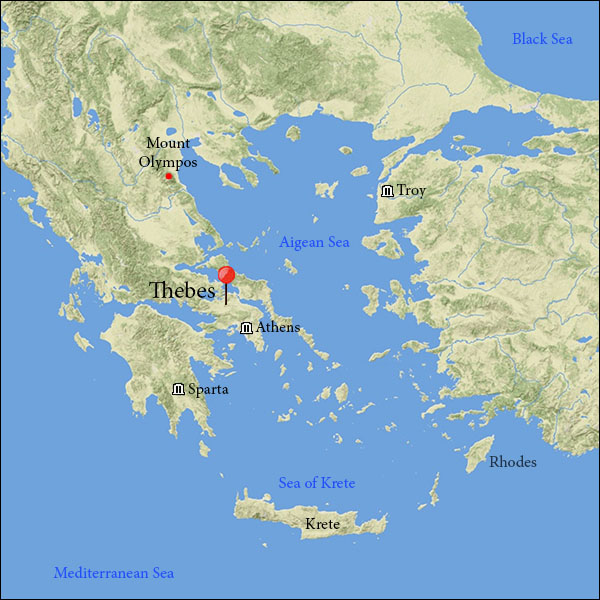
There was an oracle of Ismenian Apollon at Thebes that was briefly mentioned in the ancient texts. The historian Herodotos write: "there one may consult just as at Olympia with victims (animal sacrifices)."
A man named Mys from Europos was making the rounds, so to speak, of the oracle sites in eastern Greece. He consulted the Oracle of Apollon at Thebes, Abae, Lebadeia and finally the Oracle of Ptoan Apollon, located above Lake Kopais at the foot of the mountains, close to the town of Akraiphia.
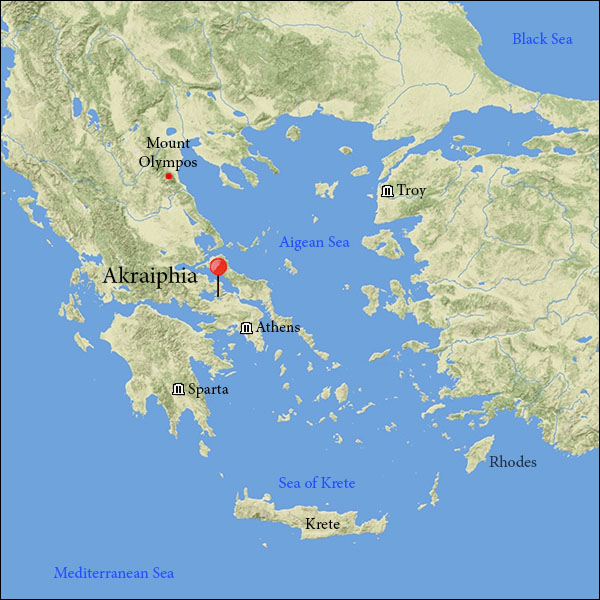
When Mys went to the Oracle of Ptoan Apollon, three men were chosen from the citizens of Thebes and sent by the public authority to write down the words of the oracle. The men were ready to perform their function when the oracle began to speak in a foreign (barbarian) tongue ... Mys took the tablet from the envoys and wrote down what the oracle said ... he did not inform the Thebans what the oracle said but did say that it had been in the Karian language. Mys, apparently satisfied with his encounters with the oracles, departed Thessaly.
There was an oracular site at Larissa where Apollon was referred to as Apollon Deiradiotes, because the place was called Deiras (Ridge). The temple and shrine were first built by a man named Pythaeus, when he came from Delphi.
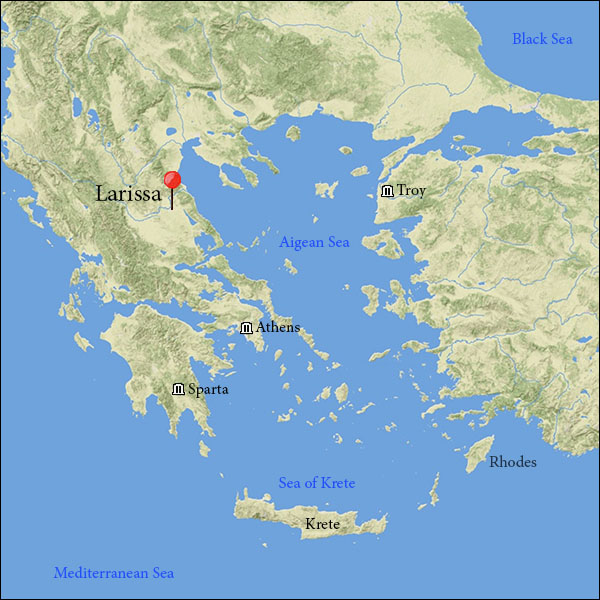
When the traveler-historian Pausanias visited Larissa (circa 160 CE), the oracles were still being delivered by a woman who was forbidden to have intimate relations with a man ... each month a lamb was sacrificed at night and the woman tasted the blood of the lamb to become inspired by Apollon and deliver prophecy.
Oropus was the site of the primary oracular shrine of Amphiaraus. The cult of Amphiaraus was first established at Oropus but eventually became popular throughout Greece. During his life, Amphiaraus had been a respected seer but it was his miraculous death that elevated him to divine stature. Amphiaraus's death can be tentatively dated as 1280 BCE, which would be approximately one generation before the Trojan War.
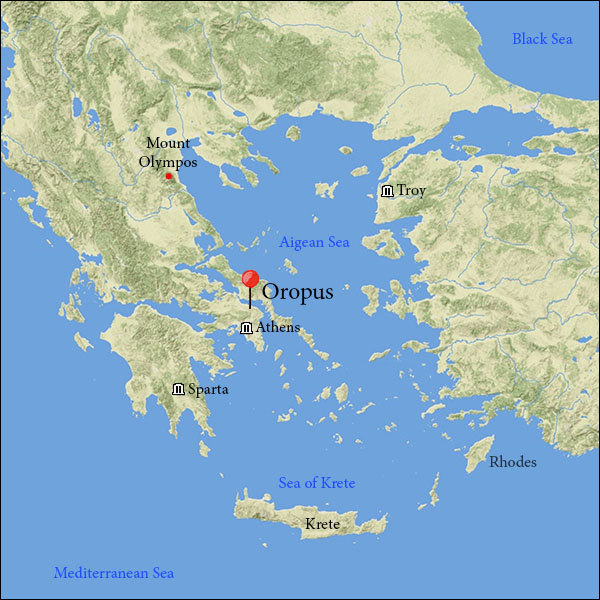
Amphiaraus was one of the seven commanders of the doomed army that attacked Thebes in the war between the sons of Oedipous ... the army was known as the Seven Against Thebes. As a seer, Amphiaraus had foreknowledge of his death and knew it was his destiny to die at Thebes. During the battle, Amphiaraus, with his chariot and horses, was swallowed-up by the earth at a place near Thebes called The Chariot.
After the establishment of the shrine, supplicants would sleep in the temple of Amphiaraus to receive healing dreams and visions of the future. Oropus is located near the eastern coast of Boeotia very close to the northern border of Attica. Amphiaraus's oracular shrine was used well into Roman times before it was destroyed.
There are times when the approval of the Immortals is very important to individuals and groups. Apollon usually reveals his will through the Oracle at Delphi but there are times when he shows his intentions through signs and personal encounters.
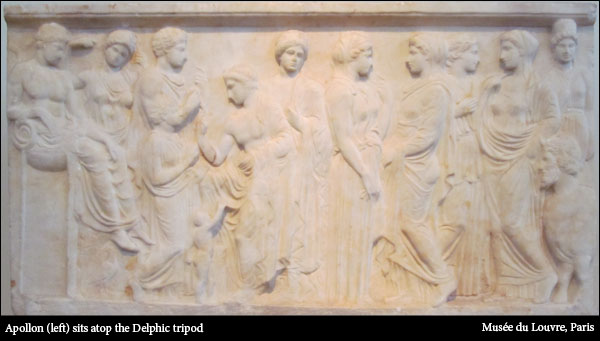
A generation before the Trojan War, Ieson (Jason) led a group of the greatest heroes in ancient Greece on the Quest for the Golden Fleece. The men who accompanied Ieson to the remote land of Kolchis to retrieve the Golden Fleece became known as the Argonauts.
Before leaving on the Quest for the Golden Fleece, Ieson consulted the Oracle at Delphi and was told that he would accomplish his mission. He was given three tripods that Apollon intended for Ieson to use to ensure his safety and success.
Although the goddesses Athene and Hera were the primary protectors of the Argonauts, Ieson never failed to give thanks and homage to Apollon. He built altars to Apollon Embasius (god of Embarkation) and Apollon Ekbasian and Ekbasius (god of Disembarkation) to show his respect. When the beleaguered Argonauts were on the island of Thynias, they saw Apollon arrive on the island from the sky. The Argonauts were so humbled by the vision of the god, they built an altar and renamed the island The Sacred Isle of Apollon of the Dawn.
Apollon honored and blessed the Argonauts in many ways but perhaps the most dramatic example was when the Argonauts were trying to sail from the island of Krete to the Greek mainland. A very dense fog surrounded their ship and blotted out the stars in the sky. Ieson prayed to Phoibos to save them. Apollon heard Ieson's sincere plea and created a beacon in the foggy murk to lead the Argonauts to a nearby island. The Argonauts built an altar to Apollon the Gleamer and named the island Anaphe, The Isle of Revealing.
Idmon was the son of Apollon whose skill as a seer could not save him from a cruel and early death.
Although he was sired by Apollon with an unnamed woman, Idmon was raised in Argos by a man named Abas. Idmon learned the art of prophecy from Apollon ... he was taught to "pay heed to birds and to observe the signs of the burning sacrifice."
When Ieson was recruiting heroes to accompany him on the dangerous Quest for the Golden Fleece, Idmon eagerly came forward. Before the quest began, he informed Ieson that the mission would be a success but he (Idmon) would die somewhere in Asia. That chilling prophecy did not stop him from joining the Argonauts because he wanted to gain fame and renown before his short life was over.
Idmon was a pious young man ... when the overbearing Argonaut Idas was boasting of his prowess, Idmon chastised him and warned him that the gods were quick to anger and used the example of Otos and Ephialtes, the sons of Aloeus, who insulted the Immortals and were killed by Apollon's swift arrows. Idmon implied that Idas could suffer a similar fate if he continued to belittle the gods.
Idmon's prophecy about his own death came true where the Akherusian Headland jutted into the Black Sea. Idmon did not see a white-tusked boar cooling itself in the reeds of the shore ... the boar was a monster that even the Nymphs of the area feared. Idmon came too close to the boar's hiding spot and it was on him before he could defend himself ... likewise, the other Argonauts were not fast enough to ward off the deadly attack. Mercifully, his wounds were so severe, Idmon died almost immediately.
Kalkhas was a seer who had been given his powers by lord Apollon. Kalkhas used his prophetic gifts to aid the Greeks throughout the Trojan War even though his benefactor was clearly on the side of the Trojans.
When the Greeks were massing for the attack on Troy, the fleet stopped at the port of Aulis ... they were subsequently stranded at Aulis because the Greek commander-in-chief Agamemnon inadvertently insulted the goddess Artemis. Kalkhas said that unless Agamemnon sacrificed his daughter Iphianassa to Artemis, the fleet would not be allowed to leave Aulis. Iphianassa was summoned from Mykenai on the pretext that she would marry Achilles but when the girl was about to be sacrificially killed, Artemis substituted a stag in her place and removed her to Tauris where she remained until Agamemnon's son Orestes and his companion Pylades rescued her.
While the Greeks were at Aulis, a truly remarkable thing happened during the course of an elaborate sacrifice. A snake appeared from under the altar ... the snake was a thing of horror with its back mottled with blood. It was clear to all those present that the snake had been sent by Zeus with a prophetic message. The snake slithered to the top of a nearby tree where a mother sparrow lorded over a nest of eight chicks. The snake ate each of the chicks despite their pitiful screaming. Finally, the snake grabbed the mother by the wing and ate her too. In order to prove to the men watching the spectacle that the vision was of divine origin, the snake turned to stone. Kalkhas correctly reasoned that each of the nine birds symbolized a year of fighting at Troy and that the Trojans would finally be defeated in the tenth year of the war.
After the Trojan War had been over for ten years (circa 1230 BCE), Odysseus had not returned to his island home of Ithaka. Odysseus's son Telemakhos was in dire need of guidance because he did not know whether his father was dead or alive. The goddess Athene tried to guide Telemakhos, but her intervention was usually, but not always, too subtle.
The home of Odysseus had been invaded by a group of suitors seeking to marry Odysseus's wife Penelope ... the excesses of the suitors had become a curse on Telemakhos and his mother. There were many people in Ithaka who were dismissive of Telemakhos because he was young but there were others who recognized the potential greatness of the young man ... after all, he was the son of the resourceful and dynamic Odysseus.
At a meeting of the men of Ithaka, Apollon sent a message to demonstrate his divine protection of Telemakhos. A falcon flew overhead and snatched a pigeon out of the air ... the falcon proceeded to rip the pigeon to pieces and shower the men below with feathers and blood.
The entire assembly witnessed the event and a companion of Telemakhos named Theoklymenos proclaimed that it was a favorable sign sent from Apollon to show the men of Ithaka what would happen to the insolent suitors who were abusing the hospitality of Odysseus's son and wife.
When Odysseus returned to Ithaka, the suitors suffered just as Apollon had predicted. Odysseus, Telemakhos and a few faithful servants literally slaughtered the suitors and their female consorts ... the pigeon that had been torn to shreds by the falcon clearly demonstrated Apollon's knowledge of future events as well as his concern for individuals such as Telemakhos.
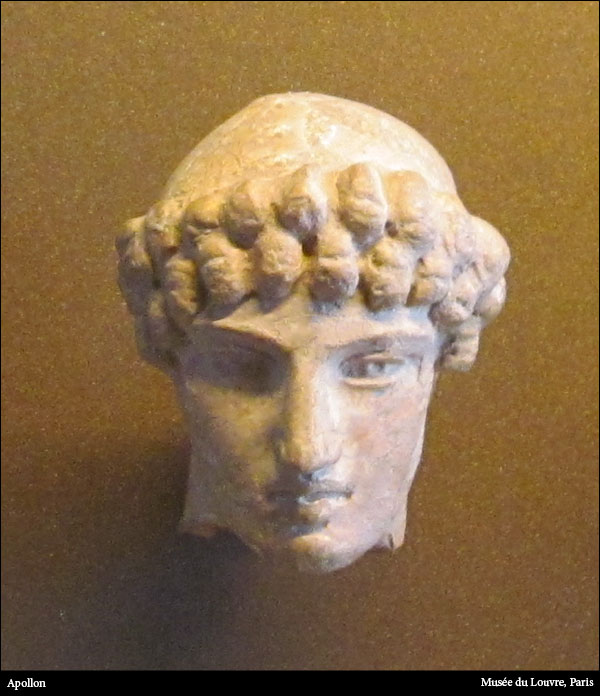
Aethusa was the daughter of Poseidon (lord of the sea) ... she and Apollon had one son named Eleuther. After four generations, a descendant of Aethusa named Poemander married Tanagra, the daughter of Aeolus (or Asopos) ... Poemander established himself as the ruler of a district in Boeotia that he named after Tanagra.
It was also believed that the poet Hesiod could trace his heritage back to Apollon and Aethusa.
Akakallis was the daughter of King Minos of Krete. When Minos discovered that Akakallis had become the consort of Apollon, he banished her from his palace and forced her to live in Libya. She and Apollon had a glorious son named Amphithemis ... he was also called Garamas. Amphithemis wedded a Tritonian Nymph and had two sons named Nasamon and Kaphauros.
When the Argonauts were returning from their Quest for the Golden Fleece, they were stranded in the Libyan desert ... trying to survive their harsh predicament, the Argonaut Kanthos stole some of Kaphauros's sheep. Kaphauros was a very strong man ... he threw a stone at Kanthos and killed him. The other Argonauts avenged the death of their companion by killing Kaphauros.
Even though Kaphauros was Apollon's grandson, Apollon did not begrudge Kaphauros's death at the hands of the Argonauts ... in fact, Apollon went out of his way to ensure a safe homecoming for Ieson and the Argonauts.
Aria is a Nymph and the mother of Miletos by Apollon.
Miletos was the eponymous founder of the city Miletos, in Karia, on the coast of the Aigean Sea in Asia Minor near the Maiandros River.
In the Great Eoiae, the six-headed beast Skylla was said to have been the offspring of Apollon and the Roaring-Goddess Hekate. Skylla was an important character in the Odyssey and the Argonautika where Hekate is listed as her mother but we are not told the name of her father. Skylla had quite a reputation as a murderous beast ... she attacked and killed sailors if they happened to come near her lair ... Skylla seems to be unlike any of Apollon's other children.
Herophile was a gifted seer who lived before the Trojan War, which means she lived prior to 1250 BCE. She foretold that Helen would be from Sparta and become the ruin of Asia and Europe, and that for Helen's sake, the Greeks would capture Troy.
When the traveler-historian Pausanias visited Delos, he observed that the Delians remembered a hymn that Herophile composed to Apollon. In her poem she called herself not only Herophile but also Artemis, and the wedded wife of Apollon, saying that sometimes she is his sister, and sometimes she is his daughter. The inhabitants of Alexandria (near Troy) said that Herophile became the attendant of the temple of Apollon Smintheus (Apollon of Smintheus, a town near Troy). On the occasion of a dream by Trojan Queen Hekabe, "Herophile uttered the prophecy that we know was actually fulfilled." Unfortunately, Pausanias did not elaborate on Hekabe's dream.
Hyakinthos was a young man who was loved by Apollon ... unfortunately, he was accidentally killed by Apollon. From his blood sprang the hyacinth (a bulbous plant of the Lily family).
Magnes, the eponymous founder of Magnesia in Thessaly, had a beautiful young son named Hymenaeus. While visiting with Magnes, Apollon lingered overlong so he could be with Hymenaeus. The infant Hermes stole Apollon's cattle while he was thus distracted.
The story of Khrysorthe and Apollon is touching and strange. Khrysorthe's grandfather was a man named Plemnaeus ... all children born to Plemnaeus and his wife died the first time the infant cried. The goddess Demeter took pity on Plemnaeus and in the guise of a strange woman, reared a son for Plemnaeus. As a goddess, Demeter could sooth the child so it would not cry and thus not die. The boy's name was Orthopolis.
Khrysorthe was the daughter of Orthopolis ... she became the consort of Apollon and they had a son named Koronos who in turn had two sons, Korax and a younger one named Lamedon.
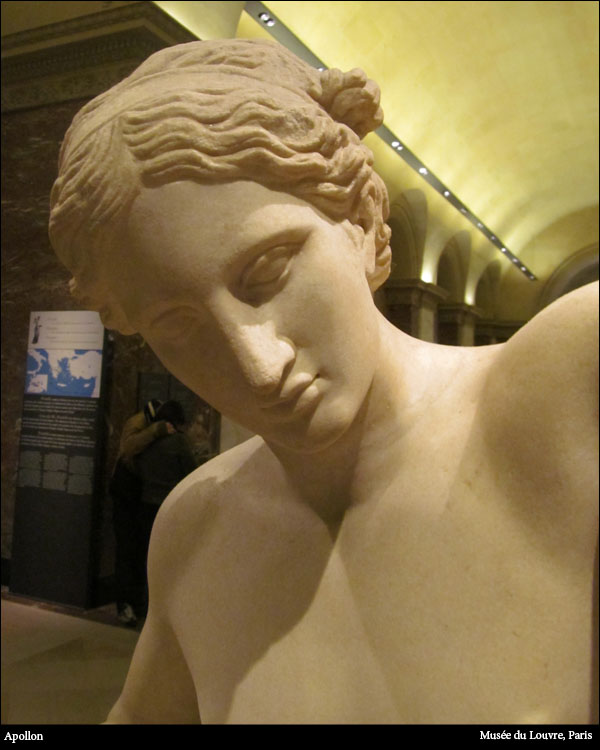
Of all the young women Apollon "carried off," one name stands out because her father would not let his daughter go without a fight.
Kleopatra was the daughter of Marpessa and Idas ... Marpessa was the daughter of the river-god Euenos so she was semidivine ... Kleopatra would have been one-eighth immortal. When Apollon abducted Kleopatra, the poor girl's mother cried with such a sorrowful sound, Kleopatra became known as Alkyone—a sea bird. Idas was relentless in his quest to bring his daughter home and finally succeeded.
Korykia was a Nymph who became the consort of Apollon. She and Apollon had a son named Lykoros. The city of Lykoreia was named after Lykoros and the Korykian Cave on Mount Parnassos was named after Korykia. The Korykian Cave was sacred to the Goat-God Pan and his Nymphs.
Kreusa became the consort of Apollon, and what might have become a tragic story turned out to be a blessing for the Greek nations.
Kreusa and Apollon had a son but Kreusa abandoned the semidivine child in a cave. Since there is no such thing as "coincidence" when the Immortals are involved, Hermes found the abandoned infant and took him to Delphi where the child was given a home ... he was named Ion.
Kreusa eventually married a mortal man named Xuthus but try as they might, they could not have children. Kreusa and Xuthus went to the temple of Apollon at Delphi to ask for the assistance of the god. The Pythia told them they would have a child if they followed her instructions ... the Pythia told them to adopt the first child they encountered when they left the sanctuary ... Kreusa and Xuthus encountered Ion.
Kreusa thought she recognized the young boy and assumed he was a child of Xuthus born out of wedlock. Jealousy consumed Kreusa and she began plotting to kill the child but before she could carry out her ill-conceived plan, the Pythia showed her the swaddling clothing in which the infant had been wrapped when he was brought to the temple by Hermes.
Kreusa recognized the swaddling clothing and accepted the fact that Ion was her abandoned child. She and Xuthus took the child to Athens where, according to the goddess Athene, a prophecy had been fulfilled in which Ion would become the founder of the Ionian race.
Kybele was a woman from Phrygia who had a very difficult and interesting upbringing. As an infant, her parents abandoned her on Mount Kybelos. Wild animals nurtured the helpless child until several shepherd women discovered her and gave her a home. The nameless baby was called Kybele after the mountain on which she had been found.
Kybele matured into a beautiful and talented woman, and finally came to the notice of the parents who had abandoned her as an infant ... the reunion was not a happy one. Her father killed Kybele's lover and the distraught woman ran into the countryside acting like a lunatic. The musician Marsyas followed Kybele in her wanderings until they came to Nysa where they encountered Dionysos and Apollon. Marsyas became entangled in a dispute with Apollon and was flayed alive for his argumentative behavior. It would seem that during the course of her wanderings, Kybele regained her sanity. Apollon became attracted to her because she was a skilled physician and an innovative musician. They traveled together and went as far as the northern habitat of the Hyperboreans.
Kyrene was a young maiden who lived in the district of Elis on the Peloponnesian Peninsula ... Apollon saw her and became infatuated. He took her as his lover, removed her to Libya and transformed her into a Nymph so she could have a long life and live as one of the Immortals. Kyrene and Apollon had a son that they named Aristaios.
After Aristaios was born, Apollon gave him to Nymphs to be reared ... although his name was Aristaios, the Nymphs called him by two other names—Nomius (Shepherd) and Agreus (Hunter). The Nymphs taught Aristaios how to curdle milk, make beehives, and cultivate olive trees. Aristaios was the first to instruct men in these matters.
Circa 630 BCE, at the command of the Pythia at Delphi, colonists from the island of Thera (now Santorini) built a city in Libya at a place called Apollon's Spring and named the city after Kyrene.
The story of the relationship between Psamathe and Apollon is a very sad tale. Psamathe was the daughter of King Krotopos of Argos. As the consort and lover Apollon, she eventually became pregnant. Psamathe was in such fear of her father that when she had Apollon's child, she abandoned the infant in the wilderness where it would die from exposure. The child did not live long enough to die from the elements ... it was set upon by the sheepdogs of King Krotopos and died a horrible death. The child's name was Linus ... not to be confused with the poet by the same name who lived much later.
Apollon was outraged by such a despicable act. He sent Nemesis, the goddess of divine retribution, to Argos to punish not just Psamathe and King Krotopos, but all Argives. Nemesis responded by snatching children away from their mothers until an Argive named Koroebos attacked (some say, killed) Nemesis. At that point, the wrath of the Immortals became a plague upon the people of Argos. To have the plague lifted and to atone for the crime of Psamathe and his own sacrilegious behavior against Nemesis, Koroebos went to Delphi and submitted himself to Apollon for punishment.
As part of his punishment, the Pythia told Koroebos that he could not return to his home in Argos. She gave him instructions as to how he would find his new home and be forgiven for his crime against Nemesis. He was told to take up a tripod from the sanctuary at Delphi and carry it until it fell from his hands ... at the spot where the tripod fell, Koroebos was instructed to build a temple of Apollon. Koroebos walked south and east from Delphi ... he went around the eastern edge of the Gulf of Korinth and finally came to Mount Gerania ... near the mountain, the tripod slipped from his hands and Koroebos faithfully fulfilled the Pythia's command by building a temple of Apollon ... Koroebos's new home became the village of Tripodiskous (Little Tripods).
The river-god Asopos had a daughter named Sinope. Apollon carried Sinope away to a peninsula on the southern-central edge of the Black Sea ... the place was named Sinope after her. She and Apollon had a son named Syrus who became the eponymous founder of the Syrians.
Syllis was a Nymph who became the consort of Apollon. She and Apollon had a son named Zeuxippus who became the king of Krete just prior to the Trojan War ... that would mean that Zeuxippus lived circa 1260 BCE.
Thelpusa was the Nymph daughter of the river-god Ladon ... the spring she inhabited was located in Arkadia in the central Peloponnese not far from the modern town of Tropaea.
The laurel crown is often associated with Apollon, but the traveler-historian Pausanias speculated that the reason laurel leaves are used as prizes for the Pythian Games is because of Apollon's love for Thelpusa.
There is some confusion about Thero but if we accept the reference to her in the Great Eoiae, she "lay in the embrace of Apollon and their son was horse-taming Khaeron."
The traveler-historian Pausanias stated that the Greeks did not know of Thero but goes on to say that the Spartans used the surname Theritas for Ares meaning "the Beastly One" ... the surname was supposedly taken from Thero, who was said to have been the nurse of Ares. Pausanias seemed to think that it was from the Kolkhians that the Spartans heard the name Theritas.
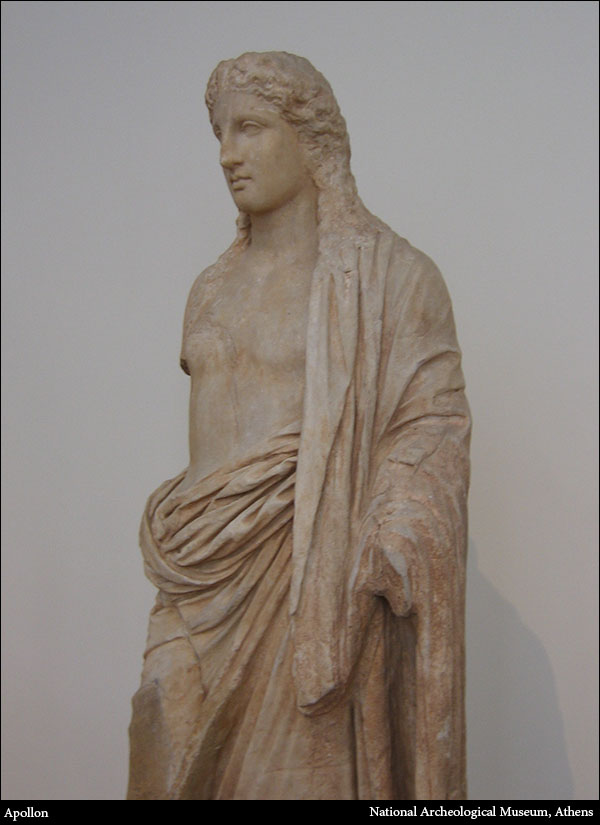
The Hyperboreans are a race of people who live in a land of perpetual sunshine and abundance beyond the abode of Boreas (North Wind). Apollon had a special relationship with the Hyperboreans dating back to the birth of his mother, Leto.
It was believed that Leto was born on an island in the realm of the Hyperboreans. The residents of that (unnamed) island became priests of Apollon and their lives were devoted to his worship. There was a sacred precinct of Apollon on the island with a spherical shaped temple.
The exact location of the home of the Hyperboreans is unknown but the poet Pindar refers to the "shady springs of the Danube" as being part of their domain and calls the Hyperboreans "the servants of Apollon." Pindar also says, "Neither by ship nor on foot could you find the marvelous road to the meeting-place of the Hyperboreans" ... the inference being that their home was beyond the reach of any mortal traveler.
Representatives of the Hyperboreans visited Apollon's island of Delos on several documented occasions.
The Hyperboreans sent two maidens to Delos in the very distant past to make offerings—their names were Arge and Opis—they arrived on Delos accompanied by some unnamed Greek Immortals. Arge and Opis stayed on Delos until they died and were buried behind the temple of Artemis. This brings up an interesting mystery because when Arge and Opis arrived on Delos, Apollon had not been born and thus the temples of Apollon and his sister Artemis were not in existence at that time. We are left with at least three possible explanations as to how Arge and Opis were buried behind the temple of Artemis: 1) the temple of Artemis was built in front of the graves of Arge and Opis, 2) the remains of Arge and Opis were moved from their original place of rest and re-buried behind Artemis's temple, or 3) Arge and Opis lived a very long time and did not die until after the temple of Artemis had been built. To honor Arge and Opis, the women of Delos were noted for singing a special hymn composed by a Lykian named Olen—Arge and Opis were named in the lyrics. As part of the ceremony, the women of Delos would spread the ashes of the sacrificial victims on the graves of Arge and Opis. There was also a Hyperborean named Olen who was cited as the first to prophesy and chant the hexameter oracles as the "mouthpiece" of Apollon.
When Apollon was ready to be born, another pair of Hyperborean maidens arrived on Delos with a tribute for Eileithyia, goddess of childbirth ... their names were Hyperokhe and Laodike. With the protection of five Hyperborean men, Hyperokhe and Laodike traveled south through Skythia and then westward to the Oracle of Zeus at Dodona before they made their way to Delos. The maidens brought offerings to Artemis "the Queen" wrapped in wheat straw. When Hyperokhe and Laodike did not return to the land of the Hyperboreans, no more envoys were sent directly to Delos. The Hyperboreans would give their offerings to their southerly neighbors and ask that they be relayed to Delos. In honor of Hyperokhe and Laodike, young Delian women would cut a lock of their hair before marriage, wind it on a spindle, and place it on the tomb of Hyperokhe and Laodike, which was located to the left of the entrance to the temple of Artemis. Young Delian men would also cut a lock of their hair, wrap it around a green tree shoot and place it on the tomb of Hyperokhe and Laodike.
The Apollon Epikourios was a temple in honor of Apollon built at Bassae on the Peloponnesian Peninsula during the second half of the fifth century BCE. The name Epikourios refers to Apollon as The Helper.
Apollon Lykeios is a name for Apollon referring to the temple of Apollon in the Lykeum, i.e. a gymnasium, noted for its covered walkways, located in an eastern suburb of the city of Athens.
The Apollon Patroos is a representation of Apollon as the protector of his father, Zeus. The statue of Apollon Patroos at Athens was attributed to the master sculptor, Euphranor.
The Delia was a festival for Apollon held every four years on the island of Delos.
The Delphinia was an ancient Greek festival in honor of Apollon.
The Ebdomagetes was the name of Apollon used in Sparta when sacrifices were dedicated to him on the seventh of each month ... ebdomas = the number seven.
Ekaergos is a name for Apollon literally meaning Far-Working ... sometimes translated as Far-Shooting or Far-Darting.
It was believed in some circles that the poet Homer was the son of Apollon and the Muse, Kalliope.
Iepaieon was a name for Apollon and also the name for hymns sung in his honor. The word was taken from the combination of the terms Ie Paion meaning roughly, Oh Healer.
The Karneia was a nine-day festival held at Sparta in honor of Apollon during the month Metageitnion which would be the modern equivalent of the last half of August and the first half of September.
Kynthios was a name for Apollon meaning, "born on Kynthus" because he was born on Mount Kynthus on the sacred island of Delos.
Loxias was a name for Apollon meaning either Ambiguous or Speaker depending on the root word from which you assume the name was derived ... loxos or logos respectively.
Lykeios was an epithet of Apollon as the Giver of Light.
Lykoktonos was an epithet of Apollon as the Wolf-Slayer.
Musagetes was a name for Apollon as the Leader of the Muses.
Phoibos was an epithet for Apollon meaning Pure or Bright. Phoibos can be placed before Apollon as an adjective or simply used alone to signify the god.
The Pyanepsia was an Athenian festival in honor of Apollon and was held on the seventh day of the month of Pyanepsion (approximately the third week of September to the third week of October of our calendar). Young boys would go door-to-door offering blessings in exchange for gifts of food.
Smintheus was an epithet for Apollon with two possible meanings:
1) Smintheus is a word of Kretan origin meaning Mouse God. The modern translator Robert Fagles states that "perhaps" it implies that Apollon is associated with the mouse because he is the god who bears the plague; or
2) Smintheus refers to a town on the Troad, which was the site of a temple of Apollon Smintheus. The Troad was the region in northwestern Asia Minor surrounding ancient Troy (near modern Troia, Turkey).
The Thargelia was a festival in honor of Apollon and Artemis celebrated at Athens and the Ionian colonies. The festival took place during the second week of the month of Thargelion, which would be approximately early May by our calendar. Some insist that the Thargelia was a birthday celebration for Apollon because he was born on the seventh day of Thargelion.
The Thargelia was an odd combination of the celebration of life and death ... there was a procession where the first-fruits of the harvest were presented to Apollon and Artemis but there was also a rite where two condemned people were executed. As time went by, the executions became more ritualistic and symbolic, and then finally replaced with a ritual where a man and a woman were chosen to represent Apollon and Artemis and referred to as scapegoats ... they were then driven from the city by the citizens.
The Theophania was a festival held Delphi at which the images of Apollon and other Immortals were put on public display.
Thronos was the name of the seat of the Oracle of Apollon at Delphi.
A name of Apollon used to denote his generative powers.
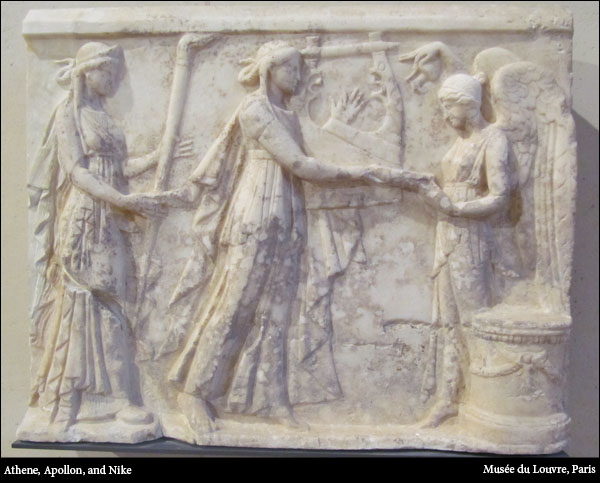
The Iliad
The Odyssey
Theogony
Works and Days
Catalogues of Women and Eoiae
Shield of Herakles
Great Eoiae
Melampodia
Epigoni
Telegony
Margites
Contest of Homer and Hesiod
Hymn to Apollon III
Hymn to Apollon XXI
Hymn to Hermes IV
Hymn to Aphrodite V
Hymn to Dionysos VII
Hymn to Artemis IX
Hymn to Artemis XXVII
Hymn to Asklepios XVI
Hymn to Histia XXIV
Hymn to the Muses and Apollon XXV
Odes of Pindar
The Argonautika by Apollonius of Rhodes
The Histories by Herodotos
Description of Greece by Pausanias
Library of History by Diodorus of Sicily
Campaigns of Alexander by Arrian